
BuddhistCatholicContemplativeEvangelicalGeneral ChristianHinduJewishLatter-day SaintMuslimNew VisionsProgressive Christian
Beliefs
- Buddhist
- Catholic
- Contemplative
- Evangelical
- General Christian
- Hindu
- Jewish
- Latter-day Saint
- More Voices
- Muslim
- New Visions
- Pagan
- Progressive Christian
Topics
- Religion News
- Food and Religion
- Sports and Religion
- Religious Art
- Religious Music and Entertainment
- Religious Events
- History and Religion
- Style and Religion
- Politics and Religion
- Women in Religion
- Recreation Outdoors and Religion
- Business Finance and Religion
- Careers Workplace and Religion
- Education and Religion
- Family Parenting and Religion
- Health Fitness and Religion
- Home and Religion
- Relationships and Religion
- Technology and Religion
- Travel and Religion
Columnists
- Buddhist Columnists
- Business Finance and Religion Columnists
- Careers Workplace and Religion Columnists
- Catholic Columnists
- Contemplative Columnists
- Education and Religion Columnists
- Evangelists Columnists
- Family Parenting and Religion Columnists
- General Christian Columnists
- Health Fitness and Religion Columnists
- Hindu Columnists
- History and Religion Columnists
- Home and Religion Columnists
- Jewish Columnists
- More Voices Columnists
- Latter Day Columnists
- Muslim Columnists
- New Visions Columnists
- Nonreligious Columnists
- Pagan Columnists
- Politics and Religion Columnists
- Progressive Columnists
- Recreation Outdoors and Religion Columnists
- Relationships and Religion Columnists
- Religion News Columnists
- Religious Art Columnists
- Religious Events Columnists
- Religious Music and Entertainment Columnists
- Sports and Religion Columnists
- Style and Religion Columnists
- Technology and Religion Columnists
- Travel and Religion Columnists
- Women in Religion Columnists
Resource Library
- 2026 Calendar
- Library of World Religions
- The 100 Most Holy Places on Earth
- Patheos Answers
- Podcasts
- Videos
- Faith Leaders Database
- Anglican Episcopalian
- Bahai
- Baptist
- Buddhism
- Christianity
- Confucianism
- Eastern Orthodoxy
- Hinduism
- Holiness and Pentecostal
- ISKCON
- Islam
- Judaism
- Lutheran
- Methodist
- The Church of Jesus Christ of Latter-day Saints
- New Age
- Paganism
- Presbytarian and Reformed
- Protestantism
- Religion Behind the Scenes
- Roman Catholic
- Scientology
- Shia Islam
- Sikhism
- Sufism
- Sunni Islam
- Taoism
- Zen
- See all religions
Research Tools
 Ad-Free & Subscriber Log-In Subscription Support
Ad-Free & Subscriber Log-In Subscription Support
Follow Patheos 

- Trending:
- Forgiveness
- |
- Marriage
- |
- Consciousness
- |
- Death Penalty
- |
- Election
- |
- Halloween
 Walk and Word
- Home
- Evangelical
- Interpreting Aesop
Interpreting Aesop
Last updated on: September 12, 2019 at 10:29 pm by Samuel C. Long
Interpreting Aesop 2019-09-12T22:29:16-05:00 Samuel C. Long
Patheos Explore the world's faith through different perspectives on religion and spirituality! Patheos has the views of the prevalent religions and spiritualities of the world.
About 2 years ago, after I had just been hired at GLCC, I accompanied one of our VPs to a Northern Indiana Men’s Fellowship. I was introduced as the OT professor and I gave a message. Afterward I was greeting some of the men and the inevitable question was asked of the “OT Guy”—“Do you take Genesis literally?” Ah the age old question of interpretation. It’s a terrible position to be put in. Especially because it’s hard to distill lots of years of education into a 5-10 minute conversation with a random stranger.
There’s a lot of freight and baggage bound up in the question and in your answer. If you say “yes” then you kind of logically end up in the young earth creationist camp. If you say “no” then you get lumped into the liberal camp who don’t believe in a certain view of inspiration. So, it is vital to interpret different genres of the Old Testament in a way that takes into account divine inspiration while respecting the original author and context. In order to get there let me begin with a short exercise. Read the following Aesop Fable:
THE LION, THE BEAR, AND THE FOX
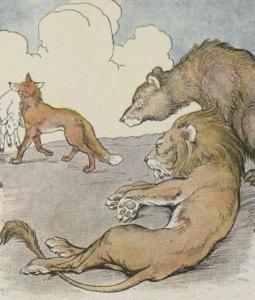
Milo Winter / Project Gutenberg
Just as a great Bear rushed to seize a stray kid, a Lion leaped from another direction upon the same prey. The two fought furiously for the prize until they had received so many wounds that both sank down unable to continue the battle.
Just then a Fox dashed up, and seizing the kid, made off with it as fast as he could go, while the Lion and the Bear looked on in helpless rage.
“How much better it would have been,” they said, “to have shared in a friendly spirit.”
Now a simple question—What is the meaning of this story? A variety of answers might be given.
Work smarter not harder
If you ain’t cheatin’ you ain’t tryin’
Aesop gives his own meaning: It sometimes happens that one man has all the toil, and another all the profit.
But I would go further and ask, “Do you have any other questions about this story?” I’m doubting any of you asked, “What kind of a bear was it? How old was the kid? What part of the world did this happen? Did the fox eat the kid or help him grow up and flourish?” Or perhaps the most obvious question, “Why are animals talking?”
Questioning the Bible
Why do we not ask such questions? Because we understand that it is a certain kind of genre requires certain techniques to interpret. We understand that a fable or a story is able to suspend reality for the sake of the story. There is a meaning that is at stake more than explanation.
So why do we ask such questions of Biblical accounts, especially Genesis 1-11? Because we misread genres. We expect biblical texts to act in a certain way when in reality they were never intended to. We struggle with the tension between regarding this as Holy Scripture and allowing it to speak from its own context.
Our churches are filled with this same tension but we use different terms. It’s the difference between the modern and the post-modern mindset. The modern mindset wants proofs and scientific principles. The post-modern mindset wants to create its own meaning outside of facts.
But the biblical writers weren’t modern or post-modern. They were story tellers, crafting meaning from their circumstances and histories. Facts were important, but they weren’t the purpose of their story telling. Their stories were conveying sentiments about God, about humanity, and right and wrong, good and evil, and about how they were supposed to live in this world. So if the facts of a story were altered in order to make a point, they were okay with that.
Fake News?
And that is a hard thing for many of us and those in our congregations to face isn’t it? In a #fakenews culture, when people alter facts we feel lied to and deceived. But the ancient world didn’t feel that way. This is a tough concept for many to accept, but the biblical writers cared more about truth than they did facts. If you hold to a certain view of inspiration that sees the Bible as dropped out of heaven and so has to be adhere to a certain standard, then what I’m saying is probably making you uncomfortable. After all, what about the doctrines of inerrancy and infallibility?
That might be a discussion for another day, but for today, let me leave you with this: if we allow ourselves to get over the uncomfortable feeling, we might find that it can be liberating to read the Bible in this way. We don’t have to force it to carry weight it was not designed to. We can let it speak truth into our lives and the lives of our congregations. We can let the greatest story ever told do what it was intended to do.
What if we let our interpretation of the Bible be driven by same techniques that we apply to other genres? Perhaps these interpretive lenses would open up the rich and original meaning that the authors intended.
Previous Post

July 19, 2019
Killing in the Name of...
Next Post

July 24, 2019 Reading Scripture Rightly
Browse Our Archives
Select a Category Biblitically Correct Christian Practices Church Discipleship Entertainment New Testament Old Testament Scripture Uncategorized Witness to World
Select a Month October 2019 September 2019 August 2019 July 2019 June 2019 May 2019 April 2019
Follow Us!
TAKE THE
Religious Wisdom Quiz
In which Psalm do we find "Your word is a lamp to my feet..."?
Select your answer to see how you score.
Psalm 23 Psalm 27 Psalm 119 Psalm 90
Related posts from Walk and Word


Star Wars and the Book of Ruth


TRENDING AT PATHEOS Evangelical

Indigenous Peoples’ Day and the Church
Indigenous' Peoples Day or Columbus Day? Depending on where you live...

When Spiritual Growth Looks Like Losing Ground
Four Passive Spiritual Disciplines: An Introduction When I was a college freshman,...

Faith and Finding Your Current Season
“To everything there is a season,” Ecclesiastes tells us, “and a time...

Did Jesus Fear God's Wrath in Gethsemane?
That Time Jesus Was Terrified Before we begin, let me say at...

A Generation Searching for God in All the...
Revival Begins With God’s People! Holidays Are Upon Us! Welcome to October!...

Faith and End of Life Planning
The Psalmist's prayer to “teach us to number our days, that we...
view all Evangelical blogs
Ad-Free & Subscriber Log-In Subscription Support
- About Us
- 2026 Calendar
- Videos
- Podcasts
- Library of World Religions
- Faith In Media Tracker
- Advertise With Us
- Write for Us
- Privacy Policy
- Terms of Service
- Do Not Sell My Data
- Contact Us
- Radiant Digital
- Manage Newsletter Subscriptions
- Unsubscribe From Notifications
- Sitemap
Copyright 2008-2026, Patheos. All rights reserved.
Subscription Support Ad-Free & Subscriber Log-In
Follow Patheos