
BuddhistCatholicContemplativeEvangelicalGeneral ChristianHinduJewishLatter-day SaintMuslimNew VisionsProgressive Christian
Beliefs
- Buddhist
- Catholic
- Contemplative
- Evangelical
- General Christian
- Hindu
- Jewish
- Latter-day Saint
- More Voices
- Muslim
- New Visions
- Pagan
- Progressive Christian
Topics
- Religion News
- Food and Religion
- Sports and Religion
- Religious Art
- Religious Music and Entertainment
- Religious Events
- History and Religion
- Style and Religion
- Politics and Religion
- Women in Religion
- Recreation Outdoors and Religion
- Business Finance and Religion
- Careers Workplace and Religion
- Education and Religion
- Family Parenting and Religion
- Health Fitness and Religion
- Home and Religion
- Relationships and Religion
- Technology and Religion
- Travel and Religion
Columnists
- Buddhist Columnists
- Business Finance and Religion Columnists
- Careers Workplace and Religion Columnists
- Catholic Columnists
- Contemplative Columnists
- Education and Religion Columnists
- Evangelists Columnists
- Family Parenting and Religion Columnists
- General Christian Columnists
- Health Fitness and Religion Columnists
- Hindu Columnists
- History and Religion Columnists
- Home and Religion Columnists
- Jewish Columnists
- More Voices Columnists
- Latter Day Columnists
- Muslim Columnists
- New Visions Columnists
- Nonreligious Columnists
- Pagan Columnists
- Politics and Religion Columnists
- Progressive Columnists
- Recreation Outdoors and Religion Columnists
- Relationships and Religion Columnists
- Religion News Columnists
- Religious Art Columnists
- Religious Events Columnists
- Religious Music and Entertainment Columnists
- Sports and Religion Columnists
- Style and Religion Columnists
- Technology and Religion Columnists
- Travel and Religion Columnists
- Women in Religion Columnists
Resource Library
- 2026 Calendar
- Library of World Religions
- The 100 Most Holy Places on Earth
- Patheos Answers
- Podcasts
- Videos
- Faith Leaders Database
- Anglican Episcopalian
- Bahai
- Baptist
- Buddhism
- Christianity
- Confucianism
- Eastern Orthodoxy
- Hinduism
- Holiness and Pentecostal
- ISKCON
- Islam
- Judaism
- Lutheran
- Methodist
- The Church of Jesus Christ of Latter-day Saints
- New Age
- Paganism
- Presbytarian and Reformed
- Protestantism
- Religion Behind the Scenes
- Roman Catholic
- Scientology
- Shia Islam
- Sikhism
- Sufism
- Sunni Islam
- Taoism
- Zen
- See all religions
Research Tools
 Ad-Free & Subscriber Log-In Subscription Support
Ad-Free & Subscriber Log-In Subscription Support
Follow Patheos 

- Trending:
- Forgiveness
- |
- Marriage
- |
- Consciousness
- |
- Death Penalty
- |
- Election
- |
- Halloween
 Walk and Word
- Home
- Evangelical
- Taming the Dragon Part 2 – the Ancient Serpent
Taming the Dragon Part 2 – the Ancient Serpent
Last updated on: September 12, 2019 at 10:40 pm by Samuel C. Long
Taming the Dragon Part 2 – the Ancient Serpent 2019-09-12T22:40:13-05:00 Samuel C. Long
Patheos Explore the world's faith through different perspectives on religion and spirituality! Patheos has the views of the prevalent religions and spiritualities of the world.

zulu Zero / Flickr
In my previous post, I talked about Leviathan in the Old Testament and located it as “some sort of serpenty sea monster, perhaps resembling a dragon, with multiple heads.” But I also alluded to the benefit of this information in helping to interpret Revelation. And so, to the New Testament we turn!
Ancient Snake in the Garden?
Interpreters have long equated the ancient serpent of Revelation 12 with the serpent of Genesis 3. And, since John explicitly calls his serpent “Satan,” then people assume that the serpent in Genesis 3 was some sort of manifestation of Satan. But what if that’s not the serpent that John was referring to? What if he had a different serpent in mind—one that his first century audience would have been very familiar with?
If you’ve read my first post you probably know where I’m going with this. But humor me for a second. If we compare the serpent in Genesis 3 with the one in Revelation 12 we find that there are very few similarities. In fact, the only clear parallel is that they are both called “serpent,” and John makes that association secondarily. This beast in Revelation is primarily a dragon that is bent on the destruction of God’s people. The serpent in Genesis 3 is a land-dwelling snake that has a rational conversation with Eve and is never called Satan. Not quite the same thing is it? When John calls this frightening, powerful dragon “that ancient serpent” it seems like a stretch to think he was trying to point readers back to the far less imposing snake in Genesis 3.
Ancient Serpent in the Sea
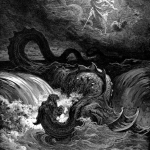
So what other serpent of old might have better parallels to the dragon in Revelation 12? You already know the answer—Leviathan.

InspiredImages / Pixabay
Compared to a dragon—check.
Seven heads—check.
Does battle with God—check.
We have already seen that Leviathan is a slithering dragon creature associated with chaos who opposed the shalom that God has created this earth to enjoy. In the ancient world, the dragon or sea monster represented the evil that threatened God’s creation. So when Old Testament writers reference of Leviathan, they did so with the purpose of displaying God’s power to conquer it. This scary monster that people in Job’s days feared and dreaded, was nothing compared to the power of God. As opposed to the other deities from surrounding nations, the God of Israel was not threatened or scared of this beast.
This message of power and control over all of creation was one that John’s original audience needed to hear! And this is the message he brought them. As frightful as this dragon in Revelation 12 appeared, it could not consume the woman, it could not conquer the angelic host, and eventually it will be thrown into the lake of fire.
Unravelling the images
The key to understanding this passage—and all of Revelation for that matter—is grappling with John’s figurative imagery. John is not talking about beasts, dragons, seals and trumpets. He is using these vivid pictures to talk about something else—Roman persecution of Christians in the first century. John draws upon any illustration at his disposal and applies that image to the idolatrous, evil Roman empire, along with the corrupt religious system that does its bidding.
In this chapter, John makes a complex move—he layers his images. We start with the dragon. Without being explicit, he basically calls Rome a dragon of chaos. During this period, the Roman Empire, spearheaded by their ruthless Caesars, were destroying God’s good creation in the form of the saints—God’s faithful Kingdom citizens. Rome was as frightening and destructive to Christians as Leviathan was to the ancient Near East. So, though early Christians may have feared the Roman Empire, John wants to encourage them to be faithful. Just as God made Leviathan his plaything, God was also in control of this beast.
But there’s another layer. While the dragon is Rome, it is also Satan. Or, perhaps, a Satan. The purpose of the Satan in the Old Testament was to verify whether people were truly righteous, pious, and faithful for the right reasons. (A fuller discussion of the function of Satan can be found in Season 1, Episodes 16-20 of the After Class Podcast). The late first century church had plenty of temptation to play both sides:
To split their allegiance between the Roman Empire and the Kingdom of God.
To attempt to appease God and Caesar
To avoid persecution by saying and doing the right things
But just as the Satan in Job wanted to verify that Job was authentically pious, perhaps he is trying to authenticate the faith of these Christians. His tactics have not changed all that much. The Satan sent destruction and death against Job. The Roman Empire brought the same things against Christians. So we might suggest that Satan, in the form of the Roman Empire, was testing Christians to see whether they would “curse God and die” or whether they would seek the blessedness of dying because of their faith.
Encouraging through artistry
So the dragon is, at the same time, Leviathan, Satan, and Rome. Like a tapestry, John is going to weave together different threads to form a cohesive whole. He is bringing all of these images together for one reason—encouragement.
Just as God domesticated Leviathan so he will bring this 7 headed beast to heel.
Just as God defeated the beast from the sea in Daniel so he will defeat this dragon.
The reader is encouraged to see a final victory over the dragon, and everything it represents—evil, chaos, and corruption. After all, in the new heaven and earth there will no longer be a sea (21:1). And so there will be no dragon of chaos to threaten God’s new creation and all the peace and wholeness that comes with it.
In confidence that the dragon would be tamed, the early Christians could be encouraged to remain faithful, even in the face of tremendous fear and persecution.

Clint Bustrillos / Unsplash
Previous Post
May 29, 2019
Taming the Dragon Part 1 - Leviathan
Next Post

June 3, 2019 Life is a Highway
Browse Our Archives
Select a Category Biblitically Correct Christian Practices Church Discipleship Entertainment New Testament Old Testament Scripture Uncategorized Witness to World
Select a Month October 2019 September 2019 August 2019 July 2019 June 2019 May 2019 April 2019
Follow Us!
TAKE THE
Religious Wisdom Quiz
True or False: Nehemiah rebuilt the walls of Jerusalem in 52 days.
Select your answer to see how you score.
FALSE TRUE
Related posts from Walk and Word


Star Wars and the Book of Ruth


TRENDING AT PATHEOS Evangelical

Indigenous Peoples’ Day and the Church
Indigenous' Peoples Day or Columbus Day? Depending on where you live...

When Spiritual Growth Looks Like Losing Ground
Four Passive Spiritual Disciplines: An Introduction When I was a college freshman,...

Faith and Finding Your Current Season
“To everything there is a season,” Ecclesiastes tells us, “and a time...

Did Jesus Fear God's Wrath in Gethsemane?
That Time Jesus Was Terrified Before we begin, let me say at...

A Generation Searching for God in All the...
Revival Begins With God’s People! Holidays Are Upon Us! Welcome to October!...

Faith and End of Life Planning
The Psalmist's prayer to “teach us to number our days, that we...
view all Evangelical blogs
Ad-Free & Subscriber Log-In Subscription Support
- About Us
- 2026 Calendar
- Videos
- Podcasts
- Library of World Religions
- Faith In Media Tracker
- Advertise With Us
- Write for Us
- Privacy Policy
- Terms of Service
- Do Not Sell My Data
- Contact Us
- Radiant Digital
- Manage Newsletter Subscriptions
- Unsubscribe From Notifications
- Sitemap
Copyright 2008-2026, Patheos. All rights reserved.
Subscription Support Ad-Free & Subscriber Log-In
Follow Patheos