
BuddhistCatholicContemplativeEvangelicalGeneral ChristianHinduJewishLatter-day SaintMuslimNew VisionsProgressive Christian
Beliefs
- Buddhist
- Catholic
- Contemplative
- Evangelical
- General Christian
- Hindu
- Jewish
- Latter-day Saint
- More Voices
- Muslim
- New Visions
- Pagan
- Progressive Christian
Topics
- Religion News
- Food and Religion
- Sports and Religion
- Religious Art
- Religious Music and Entertainment
- Religious Events
- History and Religion
- Style and Religion
- Politics and Religion
- Women in Religion
- Recreation Outdoors and Religion
- Business Finance and Religion
- Careers Workplace and Religion
- Education and Religion
- Family Parenting and Religion
- Health Fitness and Religion
- Home and Religion
- Relationships and Religion
- Technology and Religion
- Travel and Religion
Columnists
- Buddhist Columnists
- Business Finance and Religion Columnists
- Careers Workplace and Religion Columnists
- Catholic Columnists
- Contemplative Columnists
- Education and Religion Columnists
- Evangelists Columnists
- Family Parenting and Religion Columnists
- General Christian Columnists
- Health Fitness and Religion Columnists
- Hindu Columnists
- History and Religion Columnists
- Home and Religion Columnists
- Jewish Columnists
- More Voices Columnists
- Latter Day Columnists
- Muslim Columnists
- New Visions Columnists
- Nonreligious Columnists
- Pagan Columnists
- Politics and Religion Columnists
- Progressive Columnists
- Recreation Outdoors and Religion Columnists
- Relationships and Religion Columnists
- Religion News Columnists
- Religious Art Columnists
- Religious Events Columnists
- Religious Music and Entertainment Columnists
- Sports and Religion Columnists
- Style and Religion Columnists
- Technology and Religion Columnists
- Travel and Religion Columnists
- Women in Religion Columnists
Resource Library
- 2026 Calendar
- Library of World Religions
- The 100 Most Holy Places on Earth
- Patheos Answers
- Podcasts
- Videos
- Faith Leaders Database
- Anglican Episcopalian
- Bahai
- Baptist
- Buddhism
- Christianity
- Confucianism
- Eastern Orthodoxy
- Hinduism
- Holiness and Pentecostal
- ISKCON
- Islam
- Judaism
- Lutheran
- Methodist
- The Church of Jesus Christ of Latter-day Saints
- New Age
- Paganism
- Presbytarian and Reformed
- Protestantism
- Religion Behind the Scenes
- Roman Catholic
- Scientology
- Shia Islam
- Sikhism
- Sufism
- Sunni Islam
- Taoism
- Zen
- See all religions
Research Tools
 Ad-Free & Subscriber Log-In Subscription Support
Ad-Free & Subscriber Log-In Subscription Support
Follow Patheos 

- Trending:
- Forgiveness
- |
- Marriage
- |
- Consciousness
- |
- Death Penalty
- |
- Election
- |
- Halloween
 Walk and Word
- Home
- Evangelical
- Taming the Dragon Part 1 – Leviathan
Taming the Dragon Part 1 – Leviathan
Last updated on: September 12, 2019 at 10:41 pm by Samuel C. Long
Taming the Dragon Part 1 – Leviathan 2019-09-12T22:41:00-05:00 Samuel C. Long
Patheos Explore the world's faith through different perspectives on religion and spirituality! Patheos has the views of the prevalent religions and spiritualities of the world.
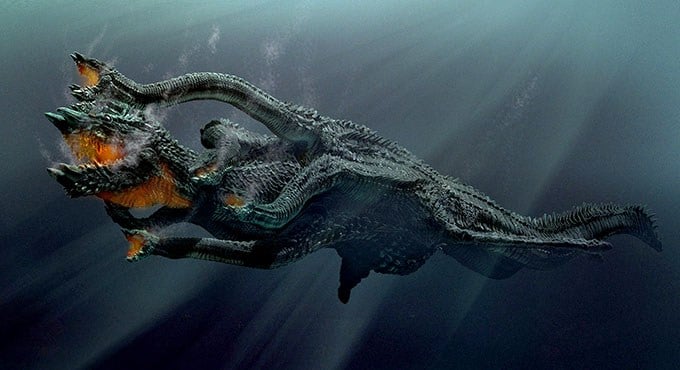
Leviathan as depicted by Brian Godawa
https://godawa.com/of-myth-and-the-bible-part-4-leviathan-sea-dragon-of-chaos/
If you were to take a poll of Christians and non-Christians alike, asking which of the biblical books is most confusing, the overwhelming response is going to be “Revelation.” The bizarre imagery and coded language combined with the misunderstanding of the genre of the book as “end times prophecy” causes too many people just throw their hands up in frustration. And yet, as a minister, if I asked what the congregation wanted to study, without fail, someone asked for “Revelations.” (Yes that’s intentionally misspelled).
While I disagree with those who suggest that we can never understand Revelation, I do admit that some serious background and understanding of the Old Testament, first century culture, and even ancient myths are required to properly understand John’s message for the early church. Many good commentaries cover these things, and I would not presume to be a Revelation expert, but I want to make a connection between a Revelation beast and one from the Old Testament—the dragon.
Leviathan
Ron has already done a bang up job of tracing the concept of dragons through the Bible. I don’t want to go over that all again, but I want to dig deeper into one dragon specifically because I think this particular dragon carries significant interpretive insights into Revelation. And this dragon is none other than Leviathan. The word “Leviathan” is a transliteration of a Hebrew word whose root means something like “twisting” or “wreath-like.” This particular form occurs in only five passages in the OT, and the context of each of these uses indicates some form of aquatic monster.
When most people think of Leviathan, they go to the book of Job. As God lambastes Job for his lack of knowledge, he references this ancient beast. Now, if you read lots of study bibles and even study notes, they suggest that this is some sort of crocodile. Of course, I’ve never seen a crocodile sneeze fire (Job 41:18), breathe smoke (Job 41:20), or scare gods (Job 41:25). No, this seems to be some sort of a dragon-like creature as it shares many of the same characteristics.
The Psalms also contain references to Leviathan. Psalm 74:12-17 describes God as ancient and refers to the creation of the world. In other creation myths, the gods have to overcome the watery chaos to create. This psalm suggests the same, but the God of the Israelites had no problem and the struggle was not real. With little effort God divided waters (just as in Genesis 1). But the psalmist does something intriguing—he uses Leviathan to personify the waters of chaos. Like a cowboy wrangling a steer, God subdues Leviathan by breaking and crushing his heads. With the restless waters (and the creatures within it) subdued, God can begin his creative acts.

Israelite Cosmology, by Jonathan Walton
https://davidwaltonfiction.wordpress.com/
2012/10/20/science-and-genesis-1/
Psalm 104 continues this theme of creation, attributing all things to God. But in verse 25 it focuses on the sea, and the many “creeping things” found within. Verse 26 even suggests that Leviathan—this scary sea monster—is just a harmless pet of God. It’s like a goldfish in God’s cosmic aquarium. It just wanders around in the lower waters. Again this depiction reinforces God’s dominance over all of creation.
Finally, Isaiah 27:1 provides a very interesting insight into the Israelites’ understanding of the Leviathan:
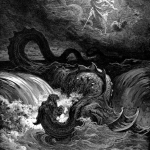
The Destruction of Leviathan
by Gustave Doré (1865) / Wikipedia
“On that day the Lord with his cruel and great and strong sword will punish Leviathan the fleeing serpent, Leviathan the twisting serpent, and he will kill the dragon that is in the sea.”
Assuming that there is parallelism here (God will punish Leviathan / He will kill the dragon), Leviathan is the mythological sea monster (dragon). It is being used symbolically here, referring to the empires of Assyria. Likely the imagery of “fleeing serpent” refers to the swift-flowing Tigris River and the “twisting serpent” is the Euphrates River. These 2 rivers come together to form the area of Assyria and Babylon.
From these passages we see that Leviathan is some sort of serpenty sea monster, perhaps resembling a dragon, with multiple heads. Sounds way cooler than a dinosaur or a crocodile. Reminds me a bit of the Hydra from Greek mythology. Though the people of the ancient world may have been scared of it, God viewed it as a pet or plaything.
Baal’s Leviathan
Weird right? So how did this thing make it into the Old Testament? Likely due to influence from the neighbors of the Israelites. The various groups in Canaan had their own religions and myths. And one of them, the Baal Cycle, contains very interesting language:
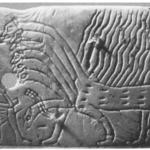
Baal Hadad Fights Lotan.
Courtesy of the Bible Lands
Museum, Jerusalem
“When you killed Litan, the Fleeing Serpent,
Annihilated the Twisty Serpent,
The Potentate with Seven Heads,
The heavens grew hot, they withered.”
KTU 1.5 1-3
Notice the similar language (especially to Isaiah 27:1)
Killing/punishing Leviathan (Litan in Ugaritic)
Fleeing serpent
Twisting serpent
Multiple (7) heads (care of Psalm 74)
There are other language parallels, but these are probably sufficient to prove the point – apparently the ancient world believed in some sort of Loch Ness-Smaug hybrid. They called this dragon-like creature Leviathan (Litan), and considered it to be dangerous, evil, and potentially destructive as it perpetuated chaos that had to be overcome by the gods. What does this have to do with Revelation you may ask? Tune in next time for the answer.
Previous Post

May 27, 2019
Suckcession Syndrome
Next Post

May 31, 2019 Taming the Dragon Part 2 - the Ancient Serpent
Browse Our Archives
Select a Category Biblitically Correct Christian Practices Church Discipleship Entertainment New Testament Old Testament Scripture Uncategorized Witness to World
Select a Month October 2019 September 2019 August 2019 July 2019 June 2019 May 2019 April 2019
Follow Us!
TAKE THE
Religious Wisdom Quiz
How many books does the Old Testament have?
Select your answer to see how you score.
41 51 50 39
Related posts from Walk and Word


Star Wars and the Book of Ruth


TRENDING AT PATHEOS Evangelical

Indigenous Peoples’ Day and the Church
Indigenous' Peoples Day or Columbus Day? Depending on where you live...

When Spiritual Growth Looks Like Losing Ground
Four Passive Spiritual Disciplines: An Introduction When I was a college freshman,...

Faith and Finding Your Current Season
“To everything there is a season,” Ecclesiastes tells us, “and a time...

Did Jesus Fear God's Wrath in Gethsemane?
That Time Jesus Was Terrified Before we begin, let me say at...

A Generation Searching for God in All the...
Revival Begins With God’s People! Holidays Are Upon Us! Welcome to October!...

Faith and End of Life Planning
The Psalmist's prayer to “teach us to number our days, that we...
view all Evangelical blogs
Ad-Free & Subscriber Log-In Subscription Support
- About Us
- 2026 Calendar
- Videos
- Podcasts
- Library of World Religions
- Faith In Media Tracker
- Advertise With Us
- Write for Us
- Privacy Policy
- Terms of Service
- Do Not Sell My Data
- Contact Us
- Radiant Digital
- Manage Newsletter Subscriptions
- Unsubscribe From Notifications
- Sitemap
Copyright 2008-2026, Patheos. All rights reserved.
Subscription Support Ad-Free & Subscriber Log-In
Follow Patheos