
BuddhistCatholicContemplativeEvangelicalGeneral ChristianHinduJewishLatter-day SaintMuslimNew VisionsProgressive Christian
Beliefs
- Buddhist
- Catholic
- Contemplative
- Evangelical
- General Christian
- Hindu
- Jewish
- Latter-day Saint
- More Voices
- Muslim
- New Visions
- Pagan
- Progressive Christian
Topics
- Religion News
- Food and Religion
- Sports and Religion
- Religious Art
- Religious Music and Entertainment
- Religious Events
- History and Religion
- Style and Religion
- Politics and Religion
- Women in Religion
- Recreation Outdoors and Religion
- Business Finance and Religion
- Careers Workplace and Religion
- Education and Religion
- Family Parenting and Religion
- Health Fitness and Religion
- Home and Religion
- Relationships and Religion
- Technology and Religion
- Travel and Religion
Columnists
- Buddhist Columnists
- Business Finance and Religion Columnists
- Careers Workplace and Religion Columnists
- Catholic Columnists
- Contemplative Columnists
- Education and Religion Columnists
- Evangelists Columnists
- Family Parenting and Religion Columnists
- General Christian Columnists
- Health Fitness and Religion Columnists
- Hindu Columnists
- History and Religion Columnists
- Home and Religion Columnists
- Jewish Columnists
- More Voices Columnists
- Latter Day Columnists
- Muslim Columnists
- New Visions Columnists
- Nonreligious Columnists
- Pagan Columnists
- Politics and Religion Columnists
- Progressive Columnists
- Recreation Outdoors and Religion Columnists
- Relationships and Religion Columnists
- Religion News Columnists
- Religious Art Columnists
- Religious Events Columnists
- Religious Music and Entertainment Columnists
- Sports and Religion Columnists
- Style and Religion Columnists
- Technology and Religion Columnists
- Travel and Religion Columnists
- Women in Religion Columnists
Resource Library
- 2026 Calendar
- Library of World Religions
- The 100 Most Holy Places on Earth
- Patheos Answers
- Podcasts
- Videos
- Faith Leaders Database
- Anglican Episcopalian
- Bahai
- Baptist
- Buddhism
- Christianity
- Confucianism
- Eastern Orthodoxy
- Hinduism
- Holiness and Pentecostal
- ISKCON
- Islam
- Judaism
- Lutheran
- Methodist
- The Church of Jesus Christ of Latter-day Saints
- New Age
- Paganism
- Presbytarian and Reformed
- Protestantism
- Religion Behind the Scenes
- Roman Catholic
- Scientology
- Shia Islam
- Sikhism
- Sufism
- Sunni Islam
- Taoism
- Zen
- See all religions
Research Tools
 Ad-Free & Subscriber Log-In Subscription Support
Ad-Free & Subscriber Log-In Subscription Support
Follow Patheos 

- Trending:
- Forgiveness
- |
- Marriage
- |
- Consciousness
- |
- Death Penalty
- |
- Election
- |
- Halloween

- Home
- Catholic
- On the Golden Jubilee of the Second Vatican Council
On the Golden Jubilee of the Second Vatican Council
Last updated on: October 11, 2012 at 10:10 am by Mark Gordon
On the Golden Jubilee of the Second Vatican Council 2012-10-11T10:10:18-05:00 Mark Gordon
Patheos Explore the world's faith through different perspectives on religion and spirituality! Patheos has the views of the prevalent religions and spiritualities of the world.

Today is the fiftieth anniversary of the opening of the Second Vatican Council. We can expect all the various factions in the Church to offer their perspectives on the Council and its legacy: what went wrong, what went right, what opportunities were seized, what opportunities were missed, what this or that document “really” said or meant, or didn’t say or mean.
Rather than jump into that endless and often self-serving debate, I think the best way to mark this anniversary is to review Blessed Pope John XXIII’s opening remarks. After all, it was he who called the Council, and it was his vision that animated the Council’s work, even following his untimely death in mid-1963. Reading this address, one is struck by the degree to which John XXIII was both a man of the Church and a product of the modern world. We who have lived most of our lives in the turbulent backwash of the Second Vatican Council can learn much about faith, constancy, humility, and openness from his words.
Address of Blessed Pope John XXIII on the opening of the Second Vatican Council, October 11, 1962.
Mother Church rejoices that, by the singular gift of Divine Providence, the longed-for day has finally dawned when — under the auspices of the virgin Mother of God, whose maternal dignity is commemorated on this feast — the Second Vatican Ecumenical Council is being solemnly opened here beside St. Peter’s tomb.
Ecumenical Councils of the Church
The Councils — both the twenty ecumenical ones and the numberless others, also important, of a provincial or regional character which have been held down through the years — all prove clearly the vigor of the Catholic Church and are recorded as shining lights in her annals.
In calling this vast assembly of bishops, the latest and humble successor to the Prince of the Apostles who is addressing you intended to assert once again the Magisterium (teaching authority), which is unfailing and perdures until the end of time, in order that this Magisterium, taking into account the errors, the requirements, and the opportunities of our time, might be presented in exceptional form to all men throughout the world.
It is but natural that in opening this Universal Council we should like to look to the past and to listen to its voices whose echo we like to hear in the memories and the merits of the more recent and ancient Pontiffs, our predecessors. These are solemn and venerable voices, throughout the East and the West, from the fourth century to the Middle Ages, and from there to modern times, which have handed down their witness to those Councils. They are voices which proclaim in perennial fervor the triumph of that divine and human institution, the Church of Christ, which from Jesus takes its name, its grace, and its meaning.
Side by side with these motives for spiritual joy, however, there has also been for more than nineteen centuries a cloud of sorrows and of trials. Not without reason did the ancient Simeon announce to Mary the mother of Jesus, that prophecy which has been and still is true: “Behold this child is set for the fall and the resurrection of many in Israel, and for a sign which shall be contradicted” (Lk. 2: 34 ) . And Jesus Himself, when He grew up, clearly outlined the manner in which the world would treat His person down through the succeeding centuries with the mysterious words: “He who hears you, hears me” (Ibid. 10:16), and with those others that the same Evangelist relates: “He who is not with me is against me and he who does not gather with me scatters” (Ibid. 11 :23).
The great problem confronting the world after almost two thousand years remains unchanged. Christ is ever resplendent as the center of history and of life. Men are either with Him and His Church, and then they enjoy light, goodness, order, and peace. Or else they are without Him, or against Him, and deliberately opposed to His Church, and then they give rise to confusion, to bitterness in human relations, and to the constant danger of fratricidal wars.
Ecumenical Councils, whenever they are assembled, are a solemn celebration of the union of Christ and His Church, and hence lead to the universal radiation of truth, to the proper guidance of individuals in domestic and social life, to the strengthening of spiritual energies for a perennial uplift toward real and everlasting goodness.
The testimony of this extraordinary Magisterium of the Church in the succeeding epochs of these twenty centuries of Christian history stands before us collected in numerous and imposing volumes, which are the sacred patrimony of our ecclesiastical archives, here in Rome and in the more noted libraries of the entire world.
The Origin and Reason for the Second Vatican Council
As regards the initiative for the great event which gathers us here, it will suffice to repeat as historical documentation our personal account of the first sudden bringing up in our heart and lips of the simple words, “Ecumenical Council.” We uttered those words in the presence of the Sacred College of Cardinals on that memorable January 25, 1959, the feast of the Conversion of St. Paul, in the basilica dedicated to him. It was completely unexpected, like a flash of heavenly light, shedding sweetness in eyes and hearts. And at the same time it gave rise to a great fervor throughout the world in expectation of the holding of the Council.
There have elapsed three years of laborious preparation, during which a wide and profound examination was made regarding modern conditions of faith and religious practice, and of Christian and especially Catholic vitality. These years have seemed to us a first sign, an initial gift of celestial grace.
Illuminated by the light of this Council, the Church — we confidently trust — will become greater in spiritual riches and gaining the strength of new energies therefrom, she will look to the future without fear. In fact, by bringing herself up to date where required, and by the wise organization of mutual co-operation, the Church will make men, families, and peoples really turn their minds to heavenly things.
And thus the holding of the Council becomes a motive for wholehearted thanksgiving to the Giver of every good gift, in order to celebrate with joyous canticles the glory of Christ our Lord, the glorious and immortal King of ages and of peoples.
The opportuneness of holding the Council is, moreover, venerable brothers, another subject which it is useful to propose for your consideration. Namely, in order to render our Joy more complete, we wish to narrate before this great assembly our assessment of the happy circumstances under which the Ecumenical Council commences.
In the daily exercise of our pastoral office, we sometimes have to listen, much to our regret, to voices of persons who, though burning with zeal, are not endowed with too much sense of discretion or measure. In these modern times they can see nothing but prevarication and ruin. They say that our era, in comparison with past eras, is getting worse, and they behave as though they had learned nothing from history, which is, none the less, the teacher of life. They behave as though at the time of former Councils everything was a full triumph for the Christian idea and life and for proper religious liberty.
We feel we must disagree with those prophets of gloom, who are always forecasting disaster, as though the end of the world were at hand.
In the present order of things, Divine Providence is leading us to a new order of human relations which, by men’s own efforts and even beyond their very expectations, are directed toward the fulfilment of God’s superior and inscrutable designs. And everything, even human differences, leads to the greater good of the Church.
It is easy to discern this reality if we consider attentively the world of today, which is so busy with politics and controversies in the economic order that it does not find time to attend to the care of spiritual reality, with which the Church’s Magisterium is concerned. such a way of acting is certainly not right, and must justly be disapproved. It cannot be denied, however, that these new conditions of modern life have at least the advantage of having eliminated those innumerable obstacles by which, at one time, the sons of this world impeded the free action of the Church. In fact, it suffices to leaf even cursorily through the pages of ecclesiastical history to note clearly how the Ecumenical Councils themselves, while constituting a series of true glories for the Catholic Church, were often held to the accompaniment of most serious difficulties and sufferings because of the undue interference of civil authorities. The princes of this world, indeed, sometimes in all sincerity, intended thus to protect the Church. But more frequently this occurred not without spiritual damage and danger, since their interest therein was guided by the views of a selfish and perilous policy.
In this regard, we confess to you that we feel most poignant sorrow over the fact that very many bishops, so dear to us are noticeable here today by their absence, because they are imprisoned for their faithfulness to Christ, or impeded by other restraints. The thought of them impels us to raise most fervent prayer to God. Nevertheless, we see today, not without great hopes and to our immense consolation, that the Church, finally freed from so many obstacles of a profane nature such as trammeled her in the past, can from this Vatican Basilica, as if from a second apostolic cenacle, and through your intermediary, raise her voice resonant with majesty and greatness.
The Principle Duty of the Council: The Defense and Advancement of the Truth
The greatest concern of the Ecumenical Council is this: that the sacred deposit of Christian doctrine should be guarded and taught more efficaciously. That doctrine embraces the whole of man, composed as he is of body and soul. And, since he is a pilgrim on this earth, it commands him to tend always toward heaven.
This demonstrates how our mortal life is to be ordered in such a way as to fulfill our duties as citizens of earth and of heaven, and thus to attain the aim of life as established by God. That is, all men, whether taken singly or as united in society, today have the duty of tending ceaselessly during their lifetime toward the attainment of heavenly things and to use. for this purpose only, the earthly goods, the employment of which must not prejudice their eternal happiness.
The Lord has said: “Seek first the kingdom of Cod and his justice” (Mt. 6:33). The word “first” expresses the direction in which our thoughts and energies must move. We must not, however, neglect the other words of this exhortation of our Lord, namely: “And all these things shall be given you besides” (Ibid. ). In reality, there always have been in the Church, and there are still today, those who, while seeking the practice of evangelical perfection with all their might, do not fail to make themselves useful to society. Indeed, it from their constant example of life and their charitable undertakings that all that is highest and noblest in human society takes its strength and growth.
In order, however, that this doctrine may influence the numerous fields of human activity, with reference to individuals, to families, and to social life, it is necessary first of all that the Church should never depart from the sacred patrimony of truth received from the Fathers. But at the same time she must ever look to the present, to the new conditions and new forms of life introduced into the modern world, which have opened new avenues to the Catholic apostolate.
For this reason, the Church has not watched inertly the marvelous progress of the discoveries of human genius, an has not been backward in evaluating them rightly. But, while following these developments, she does not neglect to admonish men so that, over and above sense — perceived things — they may raise their eyes to God, the Source of all wisdom and all beauty. And may they never forget the most serious command: “The Lord thy God shalt thou worship, and Him only shalt thou serve” (Mt. 4:10; Lk. 4:8), so that it may happen that the fleeting fascination of visible things should impede true progress.
The manner in which sacred doctrine is spread, this having been established, it becomes clear how much is expected from the Council in regard to doctrine. That is, the Twenty-first Ecumenical Council, which will draw upon the effective and important wealth of juridical, liturgical, apostolic, and administrative experiences, wishes to transmit the doctrine, pure and integral, without any attenuation or distortion, which throughout twenty centuries, notwithstanding difficulties and contrasts, has become the common patrimony of men. It is a patrimony not well received by all, but always a rich treasure available to men of good will.
Our duty is not only to guard this precious treasure, as if we were concerned only with antiquity, but to dedicate ourselves with an earnest will and without fear to that work which our era demands of us, pursuing thus the path which the Church has followed for twenty centuries.
The salient point of this Council is not, therefore, a discussion of one article or another of the fundamental doctrine of the Church which has repeatedly been taught by the Fathers and by ancient and modern theologians, and which is presumed to be well known and familiar to all.
For this a Council was not necessary. But from the renewed, serene, and tranquil adherence to all the teaching of the Church in its entirety and preciseness, as it still shines forth in the Acts of the Council of Trent and First Vatican Council, the Christian, Catholic, and apostolic spirit of the whole world expects a step forward toward a doctrinal penetration and a formation of consciousness in faithful and perfect conformity to the authentic doctrine, which, however, should be studied and expounded through the methods of research and through the literary forms of modern thought. The substance of the ancient doctrine of the deposit of faith is one thing, and the way in which it is presented is another. And it is the latter that must be taken into great consideration with patience if necessary, everything being measured in the forms and proportions of a Magisterium which is predominantly pastoral in character.
How to Repress Errors
At the outset of the Second Vatican Council, it is evident, as always, that the truth of the Lord will remain forever. We see, in fact, as one age succeeds another, that the opinions of men follow one another and exclude each other. And often errors vanish as quickly as they arise, like fog before the sun. The Church has always opposed these errors. Frequently she has condemned them with the greatest severity. Nowadays however, the Spouse of Christ prefers to make use of the medicine of mercy rather than that of severity. She consider that she meets the needs of the present day by demonstrating the validity of her teaching rather than by condemnations. Not, certainly, that there is a lack of fallacious teaching, opinions, and dangerous concepts to be guarded against an dissipated. But these are so obviously in contrast with the right norm of honesty, and have produced such lethal fruits that by now it would seem that men of themselves are inclined to condemn them, particularly those ways of life which despise God and His law or place excessive confidence in technical progress and a well-being based exclusively on the comforts of life. They are ever more deeply convinced of the paramount dignity of the human person and of his perfection as well as of the duties which that implies. Even more important, experience has taught men that violence inflicted on others, the might of arms, and political domination, are of no help at all in finding a happy solution to the grave problems which afflict them.
That being so, the Catholic Church, raising the torch of religious truth by means of this Ecumenical Council, desires to show herself to be the loving mother of all, benign, patient, full of mercy and goodness toward the brethren who are separated from her. To mankind, oppressed by so many difficulties, the Church says, as Peter said to the poor who begged alms from him: “I have neither gold nor silver, but what I have I give you; in the name of Jesus Christ of Nazareth, rise and walk” (Acts 3:6). In other words, the Church does not offer to the men of today riches that pass, nor does she promise them merely earthly happiness. But she distributes to them the goods of divine grace which, raising men to the dignity of sons of God, are the most efficacious safeguards and aids toward a more human life. She opens the fountain of her life-giving doctrine which allows men, enlightened by the light of Christ, to understand well what they really are, what their lofty dignity and their purpose are, and, finally, through her children, she spreads everywhere the fullness of Christian charity, than which nothing is more effective in eradicating the seeds of discord, nothing more efficacious in promoting concord, just peace, and the brotherly unity of all.
The Unity of the Christian and Human Family Must Be Promoted
The Church’s solicitude to promote and defend truth derives from the fact that, according to the plan of God, who wills all men to be saved and to come to the knowledge of the truth (l Tim. 2:4), men without the assistance of the whole of revealed doctrine cannot reach a complete and firm unity of minds, with which are associated true peace and eternal salvation.
Unfortunately, the entire Christian family has not yet fully attained this visible unity in truth.
The Catholic Church, therefore, considers it her duty to work actively so that there may be fulfilled the great mystery of that unity, which Jesus Christ invoked with fervent prayer from His heavenly Father on the eve of His sacrifice. She rejoices in peace, knowing well that she is intimately associated with that prayer, and then exults greatly at seeing that invocation extend its efficacy with salutary fruit, even among those who are outside her fold.
Indeed, if one considers well this same unity which Christ implored for His Church, it seems to shine, as it were, with a triple ray of beneficent supernal light: namely, the unity of Catholics among themselves, which must always be kept exemplary and most firm; the unity of prayers and ardent desires with which those Christians separated from this Apostolic See aspire to be united with us; and the unity in esteem and respect for the Catholic Church which animates those who follow non-Christian religions.
In this regard, it is a source of considerable sorrow to see that the greater part of the human race — although all men who are born were redeemed by the blood of Christ — does not yet participate in those sources of divine grace which exist in the Catholic Church. Hence the Church, whose light illumines all, whose strength of supernatural unity redounds to the advantage of all humanity, is rightly described in these beautiful words of St. Cyprian:
“The Church, surrounded by divine light, spreads her rays over the entire earth. This light, however, is one and unique and shines everywhere without causing any separation in the unity of the body. She extends her branches over the whole world. By her fruitfulness she sends ever farther afield he rivulets. Nevertheless, the head is always one, the origin one for she is the one mother, abundantly fruitful. We are born of her, are nourished by her milk, we live of her spirit’ (De Catholicae Eccles. Unitate, 5).
Venerable brothers, such is the aim of the Second Vatican Ecumenical Council, which, while bringing together the Church’s best energies and striving to have men welcome more favorably the good tidings of salvation, prepares, as it were and consolidates the path toward that unity of mankind which is required as a necessary foundation, in order that the earthly city may be brought to the resemblance of that heavenly city where truth reigns, charity is the law, and whose extent is eternity (Cf. St. Augustine, Epistle 138, 3).
Now, “our voice is directed to you” (2 Cor. 6:11 ) venerable brothers in the episcopate. Behold, we are gathered together in this Vatican Basilica, upon which hinges the history of the Church where heaven and earth are closely joined, here near the tomb of Peter and near so many of the tombs of our holy predecessors, whose ashes in this solemn hour seem to thrill in mystic exultation.
The Council now beginning rises in the Church like daybreak, a forerunner of most splendid light. It is now only dawn. And already at this first announcement of the rising day, how much sweetness fills our heart. Everything here breathes sanctity and arouses great joy. Let us contemplate the stars, which with their brightness augment the majesty of this temple. These stars, according to the testimony of the Apostle John (Apoc. 1:20), are you, and with you we see shining around the tomb of the Prince of the Apostles, the golden candelabra. That is, the Church is confided to you (Ibid.).
We see here with you important personalities, present in an attitude of great respect and cordial expectation, having come together in Rome from the five continents to represent the nations of the world.
We might say that heaven and earth are united in the holding of the Council — the saints of heaven to protect our work, the faithful of the earth continuing in prayer to the Lord, and you, seconding the inspiration of the Holy Spirit in order that the work of all may correspond to the modern expectations and needs of the various peoples of the world.
This requires of you serenity of mind, brotherly concord moderation in proposals, dignity in discussion, and wisdom of deliberation.
God grant that your labors and your work, toward which the eyes of all peoples and the hopes of the entire world are turned, may abundantly fulfill the aspirations of all.
Almighty God! In Thee we place all our confidence, not trusting in our own strength. Look down benignly upon these pastors of Thy Church. May the light of Thy supernal grace aid us in taking decisions and in making laws. Graciously hear the prayers which we pour forth to Thee in unanimity of faith, of voice, and of mind.
O Mary, Help of Christians, Help of Bishops, of whose love we have recently had particular proof in thy temple of Loreto, where we venerated the mystery of the Incarnation dispose all things for a happy and propitious outcome and, with thy spouse, St. Joseph, the holy Apostles Peter and Paul St. John the Baptist and St. John the Evangelist, intercede for us to God.
To Jesus Christ, our most amiable Redeemer, immortal King of peoples and of times, be love, power, and glory forever and ever.
Previous Post

October 9, 2012
War Without End, Amen
Next Post
October 16, 2012 Debate Prayer and Petitions
Browse Our Archives
Select a Category 2019 A Consistent Ethic of Life Aaron Weldon Abortion absurdity Abuse Scandal Academics Adoption Advent Africa agreement/disagreement with Church teaching Alexander Schmemann Alexham Alterity America Amnesty International Anarchism angels Anglicanism Animals Annual Statistics Anthony Anxietas Apocalyptic Apophatic Appalachia Aquinas Art Atheism Atonement Augustine Authority Baptism Beauty Bible biblical criticism biblical scholarship Bioethics Bishops Black Catholics Black Theology Blackadder Blogs Books Breastfeeding Brett Salkeld Buddhism Bush administration Byzantine Catholic Calvinism Canada Canon Law Capital Punishment Capitalism Caryll Houselander Catholic Blog Awards Catholic Blogging Catholic League Catholic Social Teaching Catholic Worker Movement Catholicity CFL Charity Children Chris West Christ and Culture Christian Democracy Christian Unity Christmas Christology Church Church Doctrine Church History Climate Change Cohabitation Colbert Collegiality Communion Communism Comparative Theology Competition Conferences conscience conscience rights Consequentialism Consistent Life Ethics Consumerism Contraception Contrition Conversion Converts Coptic COVID-19 Creation Critical Thinking Cross Cuba Culture Culture of Death Culture of Life Darfur David Cruz-Uribe David Wheeler-Reed Death Death Penalty Democracy Demons Desert Fathers Devil Dialogue dignity Disability Disarmament discernment Discipleship discrimination Dissent Distributism Division Doctrine Domestic Church Dorothy Day Double Effect Doubt Down syndrome Driving Early Church Easter Eastern Churches Ecclesiology Economics Economy Ecumenism Education El Salvador Election Election 2020 Ellul Embryonic Stem Cell Research Empire Energy Enlighenment Environmentalism Ephraim Radner Episcopal Church epistemology Equality Eschatology Ethics Eucharist Europe Euthanasia Evangelization Evil Evolution Excommunication F.X. Durrwell Facism Facts Fair Trade Faith Family Fashion Feddie Feminism Feminist theology Fertility Fetal Rights Fiction Film Finances First Things flags Folk Religion Food Foreign Affairs Forgiveness Frank Sheed Free Speech Freedom gay & lesbian persons Genocide George W. Bush George Weigel Gerald L. Campbell Girard/Mimetic Theory Global Warming Globalization Gnosticism Good Friday Grace Gratitude Greed Grey Cup 2009 Guadalupe Guest Post Guest Posts Gun Control Gustave Martelet Habitat for Humanity Hans Urs von Balthasar Harry Potter Hate Speech Health Health Care Healthcare Heather King Hebrew Bible Henri de Lubac Henry Karlson Herbert McCabe Heresy HHS Mandate Controversy History Holidays Holiness Holy Spirit Homiletics Homily Homosexuality Hope Hospitality How Far Can We Go? How Far Can We Go? Human Person Human Rights Humanae Vitae Humility Humor Hunger Hunting Identity Idolatry Ignacio Ellacuría Imagination Immigration In Memoriam Income Inequality Inculturation Indigenous People Individualism Inklings Intellect Interdependence Internet Interpretation Interviews Introduction Iraq War Islam Israel Jain James Alison James Martin Jazz Jesus Christ Jews Joe Biden Joe Hargrave Johann Baptist Metz John Allen John Henry Newman John Paul II John the Baptist John XXIII Jonathan Josef Pieper Joseph (the husband of Mary) Joseph Bernardin Joseph Ratzinger Josh Brumfield Journals Joy Judgment Just War Justice Kari Lundgren Karl Rahner Katerina Ivanovna Kenya Keynes Kingdom of God Kyle R. Cupp Labor Language Latin America Law Leanne Ogasawara Legion of Christ Leisure Lent Liberalism Liberation Theology Libertarianism Libya Lies Life life & dignity & responsibility of the human person Literature Little Way Liturgical music Liturgical Year Liturgy Living Simply Living Wage Local Church Lombard Lord of the Rings Louis Dupre Love M.Z. Magic Magisterium Mark DeFrancisis Mark Gordon Marriage Martin Luther Martin Luther King Jr. Martyrdom Marxism Mary Masculinity Matt Talbot Matthew Fish Matthew Levering McCain Media Memorial Day Mennonites Mental Illness mercy Michael Iafrate Middle East militarism Miroslav Volf Mitt Romney Modesty Moral Theology Morality Mormonism Morning's Minion Mother Teresa Music Muslims Natalie Nate Wildermuth Nationalism Native Americans Nature Nazis Neuhaus New Evangelization New York City News NFP nihilism Nonviolence Not Abortion Nova's Ordo Nuclear weapons Nuns Obama Occult Old Age Opus Dei Ordination ordination of women original sin Orthodoxy Oscar Romero Other Voices Pacifism Palestine Palin Papacy Papal Peace Messages Papal Social Encyclicals Particular Affections Partisanship Patriotism Paul Paul Ryan Paul VI Peace Pentimento persecution Personalism Phantastes Philosophy PKD Planned Parenthood Pluralism Poetry Policraticus Politcal Apathy Politics Poll Pope Benedict XVI Pope Francis Pope John Paul II Pope Leo XIV Population Postcolonialsim Poverty Power Prayer Preaching Predictions Predictions for 2012 President Barack Obama priestly formation & discernment Pro-Life Progress Prophetic Witness Proportionalism Public Diplomacy Public Policy Question Quotes Rachel Maddow Racism Radical Catholic Mom Radical Catholicism Raymund Schwager Real Catholic TV Real Presence Reconciliation Reginald Garrigou-Lagrange Religion religious freedom Responsibility Ressourcement Resurrection Rick Garnett Ridiculous Crap You Never Thought You'd See Robert Barron Roe v. Wade Roman Curia Rome Russia Sacraments Saints Salvation History Sam Harris Sam Rocha Same-sex Marriage Saskatchewan Roughriders Satire School of the Americas Science Scripture Seamless Garment Second Vatican Council Seeing Sex sexual violence Sexuality Sia Sin social justice Social Security Socialism Society of Jesus Sofia Loves Wisdom Solidarity Sophia soteriology Soutenus Spirituality Sports St. Dismas St. Joseph Stanley Hauerwas Statistics Stimulus Suffering Sunday Reflections Supernatural Supreme Court Symbolism Syria Taxing Technology Terrorism The State The Tea Party The Trump Administration Theological Anthropology Theology Theotokos Thomas Merton Throwaway Culture Tim Muldoon Tim Riley Tim Tebow Time Titian Tolkien Torture Toys Trade Traditionalism Transgender Transportation Transubstantiation Trinity Truth TV U.S. Affairs Uncategorized Unions unity among people who disagree US Catholicism USCCB Usury Utilitarianism Utopia Valentine's Day Vatican Vatican II Veterans Vicarious Suffering Video Violence Virgin Mary Vocations Voluntary Associations Voluntary Poverty Voting Vox Nova vox nova blog war War and Peace War Strategy Wealth Weirdness Welfare state Women Women Priests Work Woundedness Youth
Select a Month June 2026 May 2025 February 2025 January 2025 July 2024 May 2024 April 2024 March 2024 February 2024 January 2024 December 2023 July 2023 March 2023 January 2023 December 2022 November 2022 October 2022 September 2022 August 2022 July 2022 June 2022 November 2021 September 2021 July 2021 June 2021 May 2021 April 2021 February 2021 January 2021 December 2020 November 2020 October 2020 September 2020 August 2020 July 2020 June 2020 May 2020 April 2020 March 2020 February 2020 January 2020 December 2019 November 2019 September 2019 August 2019 July 2019 June 2019 April 2019 March 2019 February 2019 January 2019 December 2018 November 2018 October 2018 September 2018 August 2018 July 2018 June 2018 May 2018 April 2018 March 2018 February 2018 January 2018 December 2017 November 2017 October 2017 September 2017 August 2017 July 2017 June 2017 May 2017 April 2017 March 2017 February 2017 January 2017 December 2016 November 2016 October 2016 September 2016 August 2016 July 2016 June 2016 May 2016 April 2016 March 2016 February 2016 January 2016 December 2015 November 2015 October 2015 September 2015 August 2015 July 2015 June 2015 May 2015 April 2015 March 2015 February 2015 January 2015 December 2014 November 2014 October 2014 September 2014 August 2014 July 2014 June 2014 May 2014 April 2014 March 2014 February 2014 January 2014 December 2013 November 2013 October 2013 September 2013 August 2013 July 2013 June 2013 May 2013 April 2013 March 2013 February 2013 January 2013 December 2012 November 2012 October 2012 September 2012 August 2012 July 2012 June 2012 May 2012 April 2012 March 2012 February 2012 January 2012 December 2011 November 2011 October 2011 September 2011 August 2011 July 2011 June 2011 May 2011 April 2011 March 2011 February 2011 January 2011 December 2010 November 2010 October 2010 September 2010 August 2010 July 2010 June 2010 May 2010 April 2010 March 2010 February 2010 January 2010 December 2009 November 2009 October 2009 September 2009 August 2009 July 2009 June 2009 May 2009 April 2009 March 2009 February 2009 January 2009 December 2008 November 2008 October 2008 September 2008 August 2008 July 2008 June 2008 May 2008 April 2008 March 2008 February 2008 January 2008 December 2007 November 2007 October 2007 September 2007 August 2007 July 2007 June 2007 May 2007
Follow Us!
TAKE THE
Religious Wisdom Quiz
Who led the Israelites into the Promised Land?
Select your answer to see how you score.
Moses Aaron Caleb Joshua
Related posts from Vox Nova
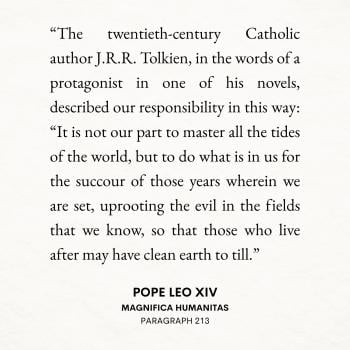
Letting Go of Libido Dominandi: Tolkien and Niebuhr...
Wrestling with my Critical Mind at Christmas
Reading Gaudium et Spes Part IV
TRENDING AT PATHEOS Catholic

Creation, Preservation, and Teleology in Catholic Theology
As I write this, it is very early Monday morning. Like millions...

The Parable Of The Sower And The Word...
One of Christ’s most famous parables is that of the sower who...

Rejecting Doom: Christian Hope And Human Action
Christianity is a religion of hope. We are to have hope and...

Why I Choose the Eucharist Over the Sermon
Choose the Eucharist, Not the Sermon What are we supposed to get...

5 Design Elements Found in Spiritually Rooted Homes
Putting Spirituality Into Home Decor Our homes are more than our living...

Credo: A Story of God Told with the...
About 10 years ago, I began to imagine a personal "Credo" that...
view all Catholic blogs
Ad-Free & Subscriber Log-In Subscription Support
- About Us
- 2026 Calendar
- Videos
- Podcasts
- Library of World Religions
- Faith In Media Tracker
- Advertise With Us
- Write for Us
- Privacy Policy
- Terms of Service
- Do Not Sell My Data
- Contact Us
- Radiant Digital
- Manage Newsletter Subscriptions
- Unsubscribe From Notifications
- Sitemap
Copyright 2008-2026, Patheos. All rights reserved.
Subscription Support Ad-Free & Subscriber Log-In
Follow Patheos