
BuddhistCatholicContemplativeEvangelicalGeneral ChristianHinduJewishLatter-day SaintMuslimNew VisionsProgressive Christian
Beliefs
- Buddhist
- Catholic
- Contemplative
- Evangelical
- General Christian
- Hindu
- Jewish
- Latter-day Saint
- More Voices
- Muslim
- New Visions
- Pagan
- Progressive Christian
Topics
- Religion News
- Food and Religion
- Sports and Religion
- Religious Art
- Religious Music and Entertainment
- Religious Events
- History and Religion
- Style and Religion
- Politics and Religion
- Women in Religion
- Recreation Outdoors and Religion
- Business Finance and Religion
- Careers Workplace and Religion
- Education and Religion
- Family Parenting and Religion
- Health Fitness and Religion
- Home and Religion
- Relationships and Religion
- Technology and Religion
- Travel and Religion
Columnists
- Buddhist Columnists
- Business Finance and Religion Columnists
- Careers Workplace and Religion Columnists
- Catholic Columnists
- Contemplative Columnists
- Education and Religion Columnists
- Evangelists Columnists
- Family Parenting and Religion Columnists
- General Christian Columnists
- Health Fitness and Religion Columnists
- Hindu Columnists
- History and Religion Columnists
- Home and Religion Columnists
- Jewish Columnists
- More Voices Columnists
- Latter Day Columnists
- Muslim Columnists
- New Visions Columnists
- Nonreligious Columnists
- Pagan Columnists
- Politics and Religion Columnists
- Progressive Columnists
- Recreation Outdoors and Religion Columnists
- Relationships and Religion Columnists
- Religion News Columnists
- Religious Art Columnists
- Religious Events Columnists
- Religious Music and Entertainment Columnists
- Sports and Religion Columnists
- Style and Religion Columnists
- Technology and Religion Columnists
- Travel and Religion Columnists
- Women in Religion Columnists
Resource Library
- 2026 Calendar
- Library of World Religions
- The 100 Most Holy Places on Earth
- Patheos Answers
- Podcasts
- Videos
- Faith Leaders Database
- Anglican Episcopalian
- Bahai
- Baptist
- Buddhism
- Christianity
- Confucianism
- Eastern Orthodoxy
- Hinduism
- Holiness and Pentecostal
- ISKCON
- Islam
- Judaism
- Lutheran
- Methodist
- The Church of Jesus Christ of Latter-day Saints
- New Age
- Paganism
- Presbytarian and Reformed
- Protestantism
- Religion Behind the Scenes
- Roman Catholic
- Scientology
- Shia Islam
- Sikhism
- Sufism
- Sunni Islam
- Taoism
- Zen
- See all religions
Research Tools
 Ad-Free & Subscriber Log-In Subscription Support
Ad-Free & Subscriber Log-In Subscription Support
Follow Patheos 

- Trending:
- Forgiveness
- |
- Marriage
- |
- Consciousness
- |
- Death Penalty
- |
- Election
- |
- Halloween

- Home
- Catholic
- Gnosticism. Some of Its Beliefs, Practices and Continued Influences in the World. Part III
Gnosticism. Some of Its Beliefs, Practices and Continued Influences in the World. Part III
Last updated on: January 3, 2008 at 3:23 pm by Henry Karlson
Gnosticism. Some of Its Beliefs, Practices and Continued Influences in the World. Part III 2008-01-03T15:23:36-05:00 Henry Karlson
Patheos Explore the world's faith through different perspectives on religion and spirituality! Patheos has the views of the prevalent religions and spiritualities of the world.
Reincarnation was a commonly held belief among the Gnostics. They believed that the spirit was a prisoner of the body. Unless it was able to escape the bonds of the material world, the spirit would find itself trapped again after death. Reincarnation prevented us from becoming what we should be. Because our bodies are grown in the womb, women were seen as being more connected to the material world and its evil ruler than men. To such Gnostics, femininity represented the materialistic principle and masculinity the spiritualistic. We all contain elements of both in ourselves. For us to be saved, they believed that we must reject all that is feminine within. Thus the Gospel of Thomas, in very telling passage which demonstrates its Gnostic origins, it is said that Mary can be saved if and when she abandons all that is feminine in herself and become masculine:
Simon Peter said to them, “Let Mary leave us, for women are not worthy of life.”
Jesus said, “I myself shall lead her in order to make her male, so that she too may become a living spirit resembling you males. For every woman who will make herself male will enter the kingdom of heaven.” — Gospel of Thomas 104 in The Nag Hammadi Library. 3rd ed. Ed. James M. Robinson (San Francisco: HarperCollins, 1990).
While this sentimentality might seem to make it impossible for women to hold positions of authority within Gnostic circles, the reverse is true. “One of Tertullian’s prime targets, the heretic Marcion, had, in fact, scandalized his orthodox contemporaries by appointing women on an equal basis with men as priests and bishops. The gnostic teacher Marcellina traveled to Rome to represent the Carpocratian group, which claimed to have received secret teachings from Mary, Salome, and Martha,” Elaine Pagels, The Gnostic Gospels (New York: Vintage Books, 1981), 72. What matters is the spirit. The spirit is the same in men and women. One’s exterior gender does not have to dictate who one is; while the feminine principle tends to dominate those who happened to be women, it is clear that they could deny their femininity, their ties to their material selves, and as such become like men.
While looking at the influences of Gnosticism throughout history, it must be recognized that not all of its influences have always been malign. Not everything they said was completely wrong. As with most heresies, Gnosticism often emphasized aspects of truth while ignoring or rejecting the rest. Some elements of Gnostic thought were capable of being adapted to Christian thought. But the adaptation had to be done very carefully; any error which remained after the adaptation had a way of making itself known and leading people back into heresy. Thus, there are clear lines of development between the asceticism of early Gnosticism with monasticism in Egypt. Christians recognized that some ascetic groups, such as the Encratites, were closer to the truth than others. St Hippolytus suggested that it was a grave hubris which prevented from them full admission into the Church. He believed that their theological views on God were closer to the truth than many other Gnostics. “Others, however, styling themselves Encratites acknowledge some things concerning God and Christ in like manner with the Church. In respect, however, of their mode of life, they pass their days inflated with pride. The suppose that by meats they magnify themselves, while abstaining from animal food, (and) being water-drinkers, and forbidding to marry, and devoting themselves during the remainder of life to habits of asceticism. But persons of this description are estimated Cynics rather than Christians, inasmuch as they do not attend to the words spoken against them through the Apostle Paul,” St Hippolytus, The Refutation of All Heresies, ANF5 (Peabody, MA: Hendrickson, 1994), VIII-XIII.
Clearly there was a difference between the Gnostics and later orthodox monks and nuns. Christian monasticism practiced similar activities as their Gnostic counterparts, but their goal was different: they desired to purify their flesh so that it could become a suitable temple for God. Yet, as with all monastic groups, the experiences of one could be discussed and understood by the other. Early monks had the examples of their Gnostic predecessors before them, and looked to their methods and achievements as a way to grasp their own spiritual progress. It was no accident that caused the majority of Gnostic texts to be preserved in Coptic, written down by those living in the deserts of Egypt. Indeed, it is clear that these monks were looking for the true gnosis. Alexandrian theology and spirituality as found in writers such as St Clement and Origen served as the basis for their quest. Sadly, many of these monks ended up saying things which were very close to the Gnostic rejection of the body. “Abba Daniel also said, ‘The body prospers in the measure in which the soul is weakened, and the soul prospers in the measure in which the body is weakened,” The Sayings of the Desert Fathers. Trans. Benedicta Ward (Kalamazoo, MI: Cistercian Publications, 1984), 52.
While what Abba Daniel said could barely be justified, it is easy to use what he and others like him said as a justification for a new kind of rejection of the body. And this is what we see happening in some monastic communities. They knew that they could not outright condemn the body, because Christianity proclaimed it had a place with us in the eschaton. Instead, they claimed that the body will be transformed and become a “spiritual body.” The resurrection of the flesh, which had confused learned pagans, was simply tossed aside in one theological stroke. For support of their view, they revised and reinterpreted many of Origen’s theological speculations, turning his guesswork into irrefutable fact. Evagrian monasticism could be seen as the combination of Origen’s wildest fancies with principles founded in ascetic forms of Gnosticism. Because of his connections with the Cappadocians, Evagrius became a highly recognized monastic authority whose ideas were having a major influence in Christendom. Justinian’s confrontation with the so-called Origenists (disciples of Evagrian thought) was a rehashing of the ancient battle Christianity had with Gnosticism. Of course, one can argue against the underhanded way Justinian engaged this new spiritual battle (interpolating texts to an ecumenical council is never a good thing to do), but one cannot deny that it helped correct eastern monasticism and prevent it from becoming outright Gnostic as it could have done without any intervention.
This tie between Gnosticism and monasticism did not end in the patristic era. Time and again, zealous devotion to asceticism has a tendency to reawaken the sleeping giant of world renunciation. Each time this happened, the Church and her authorities had to remind the religious the goodness of creation. While the way we exist in the world needs to be transformed, the world is not to be despised. Great pride exists in those who think they can overcome the world and leave it entirely behind. They are a part of the world, and they are meant to be a part of it. God created the world. He wants us to enjoy it. While its alluring beauty can tempt us, it is just as wrong to reject the world as it is to idolize it. Thus, St Francis of Assisi was capable of viewing the world as a wonderful work of God, and his praises of God always showed his appreciation for all God’s creation. His desire for poverty was not because he despised the world, but because he loved it. He wanted to be free to enjoy it; he understood that no human being could truly possess it, since everything belonged to God. But some Franciscan Spiritualists, demanding strict observance of his rule, did not understand the point of Francis’ poverty, and turned Francis’ means for preserving the integrity of the earth upside-down. Francis’ freedom from the demands of the world became the foundation of a legalistic labor which ended up rejecting the good things of the world. Such a fruit, whenever it is found, is justly rejected by the Church.
While these aspects of Gnostic thought are clearly temptations for those engaged in the religious life, it would be wrong to think “ascetic” forms of Gnosticism only influenced those practicing the religious life. Perhaps the clearest example of the continued influence of Gnostic thought in the Middle Ages can be found in the teachings of those who were labeled as the Cathars. Not all Cathars believed in the same exact doctrines, but they shared a world view which united them together: the earth was the domain of the devil, and all who held worldly authority (including those in the Church) were followers of evil. “Some of them taught that God had been the original Creator of the elements of the world, while others attributed their creation to the devil; but they agreed that the devil had divided the elements and was their lord,” Jaroslav Pelikan, The Growth of Medieval Theology (600 – 1300)(Chicago: The University of Chicago Press, 1978), 239. This led them completely to the Gnostic rejection of the material world. Only those who could become absolutely pure in thought and deed could overcome the world and be liberated. There were two classes of Cathars: the elite spiritual leaders (perfecti), and the common believers (credentes). The perfecti were the ones who lived the true Christian life and were the only ones who were actually saved, while the believers prepared themselves so that one day they could be chosen to become one of the perfecti, if not in this life, then in a life to come. The perfecti chose those who were to be among their own; once chosen, one was given a special anointing which led to their salvation. Since only the perfecti could chose who would become one of their own and only the perfecti could anoint someone to become one of their own, the Cathars claimed it was proof that they were the true Church and held apostolic succession. But once one became one of the perfecti, life was governed by strict rules. They were to be ascetics. The credentes were required to never kill, never to take oaths, and they were encouraged to follow, as much as they could, the higher ways of the perfecti celibates. Of course, as with all explicit Gnosticism, Cathar Christology tended to be docetical and their spiritual life unsacramental. All that could be done to overcome the world and its influences had to be done.
After the reformation, we can see extreme ascetic rigorism constantly affecting various aspects of Christian thought, such as with the Puritans or Jansenists, although it has yet to be as thoroughgoing or as widespread as was found in the Cathars. Perhaps the most interesting explicit manifestation of this way of life was found in the American Shaker communities. According to their teachings, men and women are both made in the image of God; Christ represented the masculine image of God, and Ann Lee, their prophet and founder, was the second coming of Christ who represented God’s feminine side. Since her coming into the world, believers were required to join in their communitarian society (which was required to exist as a manifestation of the kingdom of heaven in the world in opposition to normal ways of the world). Since in heaven there is “neither marriage nor giving into marriage,” virginal purity was to be kept, and the institution of marriage was rejected. Indeed, they interpreted all sexuality as sin, and Adam’s fall came from his sexual activity. While their lifestyle was very simple and clean, they made money by the production of arts and crafts, and recruited new members into their society by adopting orphans and raising them to become new members of their community.
Despite the luxurious, self-gratifying lifestyle many people live out today, we are living at a time where this kind of Gnosticism can easily return to the world and become more mainstream than at any other point of history. While Hegel’s eschatology is off, and must not be taken as absolute, he was right in saying that world views often arise in opposition to one another, with new theories being made to completely overturn its successor. We live in a time when such revolutions take place quicker and faster. It is not difficult to see that there is a general discontent, by people of all religious and political positions, with the way things are in the world today. The libertine ways of democratic freedom and laissez-faire capitalism have not created the happy society. In a world devoid of meaning, there is slowly, but surely, a developing undercurrent of self-hatred, the kind which can be seen in how we treat our bodies. How many men and women, especially women, look to their body with horror, and overwork it in exercises and fasts to try to create some illusionary, unnatural end? How many others abuse their bodies through excessive tattoos or body piercings? How many men or women appreciate the differences of the genders? How many others believe that a common human nature means gender differentiation is illusionary and based upon external accidents which can be overcome? Even among the Christians, how many of them truly appreciate the sanctity of the body and its place in eternal life? The sexual revolution, with all of its promises of self-gratification, is also being seen through by more and more people. And yet, as the same time, the institution of marriage is constantly being questioned and derided. Unless Christians step up their commitment to the world and to its sanctity, we are ripe for a social revolution which will follow the same ideas which were used to create the Gnostic rigorism of the past. But this is not the only kind of Gnostic threat which is with us today.
Previous Post

January 3, 2008
2008 Predictions
Next Post
January 3, 2008 New Urbanism and Natural Law
Browse Our Archives
Select a Category 2019 A Consistent Ethic of Life Aaron Weldon Abortion absurdity Abuse Scandal Academics Adoption Advent Africa agreement/disagreement with Church teaching Alexander Schmemann Alexham Alterity America Amnesty International Anarchism angels Anglicanism Animals Annual Statistics Anthony Anxietas Apocalyptic Apophatic Appalachia Aquinas Art Atheism Atonement Augustine Authority Baptism Beauty Bible biblical criticism biblical scholarship Bioethics Bishops Black Catholics Black Theology Blackadder Blogs Books Breastfeeding Brett Salkeld Buddhism Bush administration Byzantine Catholic Calvinism Canada Canon Law Capital Punishment Capitalism Caryll Houselander Catholic Blog Awards Catholic Blogging Catholic League Catholic Social Teaching Catholic Worker Movement Catholicity CFL Charity Children Chris West Christ and Culture Christian Democracy Christian Unity Christmas Christology Church Church Doctrine Church History Climate Change Cohabitation Colbert Collegiality Communion Communism Comparative Theology Competition Conferences conscience conscience rights Consequentialism Consistent Life Ethics Consumerism Contraception Contrition Conversion Converts Coptic COVID-19 Creation Critical Thinking Cross Cuba Culture Culture of Death Culture of Life Darfur David Cruz-Uribe David Wheeler-Reed Death Death Penalty Democracy Demons Desert Fathers Devil Dialogue dignity Disability Disarmament discernment Discipleship discrimination Dissent Distributism Division Doctrine Domestic Church Dorothy Day Double Effect Doubt Down syndrome Driving Early Church Easter Eastern Churches Ecclesiology Economics Economy Ecumenism Education El Salvador Election Election 2020 Ellul Embryonic Stem Cell Research Empire Energy Enlighenment Environmentalism Ephraim Radner Episcopal Church epistemology Equality Eschatology Ethics Eucharist Europe Euthanasia Evangelization Evil Evolution Excommunication F.X. Durrwell Facism Facts Fair Trade Faith Family Fashion Feddie Feminism Feminist theology Fertility Fetal Rights Fiction Film Finances First Things flags Folk Religion Food Foreign Affairs Forgiveness Frank Sheed Free Speech Freedom gay & lesbian persons Genocide George W. Bush George Weigel Gerald L. Campbell Girard/Mimetic Theory Global Warming Globalization Gnosticism Good Friday Grace Gratitude Greed Grey Cup 2009 Guadalupe Guest Post Guest Posts Gun Control Gustave Martelet Habitat for Humanity Hans Urs von Balthasar Harry Potter Hate Speech Health Health Care Healthcare Heather King Hebrew Bible Henri de Lubac Henry Karlson Herbert McCabe Heresy HHS Mandate Controversy History Holidays Holiness Holy Spirit Homiletics Homily Homosexuality Hope Hospitality How Far Can We Go? How Far Can We Go? Human Person Human Rights Humanae Vitae Humility Humor Hunger Hunting Identity Idolatry Ignacio Ellacuría Imagination Immigration In Memoriam Income Inequality Inculturation Indigenous People Individualism Inklings Intellect Interdependence Internet Interpretation Interviews Introduction Iraq War Islam Israel Jain James Alison James Martin Jazz Jesus Christ Jews Joe Biden Joe Hargrave Johann Baptist Metz John Allen John Henry Newman John Paul II John the Baptist John XXIII Jonathan Josef Pieper Joseph (the husband of Mary) Joseph Bernardin Joseph Ratzinger Josh Brumfield Journals Joy Judgment Just War Justice Kari Lundgren Karl Rahner Katerina Ivanovna Kenya Keynes Kingdom of God Kyle R. Cupp Labor Language Latin America Law Leanne Ogasawara Legion of Christ Leisure Lent Liberalism Liberation Theology Libertarianism Libya Lies Life life & dignity & responsibility of the human person Literature Little Way Liturgical music Liturgical Year Liturgy Living Simply Living Wage Local Church Lombard Lord of the Rings Louis Dupre Love M.Z. Magic Magisterium Mark DeFrancisis Mark Gordon Marriage Martin Luther Martin Luther King Jr. Martyrdom Marxism Mary Masculinity Matt Talbot Matthew Fish Matthew Levering McCain Media Memorial Day Mennonites Mental Illness mercy Michael Iafrate Middle East militarism Miroslav Volf Mitt Romney Modesty Moral Theology Morality Mormonism Morning's Minion Mother Teresa Music Muslims Natalie Nate Wildermuth Nationalism Native Americans Nature Nazis Neuhaus New Evangelization New York City News NFP nihilism Nonviolence Not Abortion Nova's Ordo Nuclear weapons Nuns Obama Occult Old Age Opus Dei Ordination ordination of women original sin Orthodoxy Oscar Romero Other Voices Pacifism Palestine Palin Papacy Papal Peace Messages Papal Social Encyclicals Particular Affections Partisanship Patriotism Paul Paul Ryan Paul VI Peace Pentimento persecution Personalism Phantastes Philosophy PKD Planned Parenthood Pluralism Poetry Policraticus Politcal Apathy Politics Poll Pope Benedict XVI Pope Francis Pope John Paul II Pope Leo XIV Population Postcolonialsim Poverty Power Prayer Preaching Predictions Predictions for 2012 President Barack Obama priestly formation & discernment Pro-Life Progress Prophetic Witness Proportionalism Public Diplomacy Public Policy Question Quotes Rachel Maddow Racism Radical Catholic Mom Radical Catholicism Raymund Schwager Real Catholic TV Real Presence Reconciliation Reginald Garrigou-Lagrange Religion religious freedom Responsibility Ressourcement Resurrection Rick Garnett Ridiculous Crap You Never Thought You'd See Robert Barron Roe v. Wade Roman Curia Rome Russia Sacraments Saints Salvation History Sam Harris Sam Rocha Same-sex Marriage Saskatchewan Roughriders Satire School of the Americas Science Scripture Seamless Garment Second Vatican Council Seeing Sex sexual violence Sexuality Sia Sin social justice Social Security Socialism Society of Jesus Sofia Loves Wisdom Solidarity Sophia soteriology Soutenus Spirituality Sports St. Dismas St. Joseph Stanley Hauerwas Statistics Stimulus Suffering Sunday Reflections Supernatural Supreme Court Symbolism Syria Taxing Technology Terrorism The State The Tea Party The Trump Administration Theological Anthropology Theology Theotokos Thomas Merton Throwaway Culture Tim Muldoon Tim Riley Tim Tebow Time Titian Tolkien Torture Toys Trade Traditionalism Transgender Transportation Transubstantiation Trinity Truth TV U.S. Affairs Uncategorized Unions unity among people who disagree US Catholicism USCCB Usury Utilitarianism Utopia Valentine's Day Vatican Vatican II Veterans Vicarious Suffering Video Violence Virgin Mary Vocations Voluntary Associations Voluntary Poverty Voting Vox Nova vox nova blog war War and Peace War Strategy Wealth Weirdness Welfare state Women Women Priests Work Woundedness Youth
Select a Month June 2026 May 2025 February 2025 January 2025 July 2024 May 2024 April 2024 March 2024 February 2024 January 2024 December 2023 July 2023 March 2023 January 2023 December 2022 November 2022 October 2022 September 2022 August 2022 July 2022 June 2022 November 2021 September 2021 July 2021 June 2021 May 2021 April 2021 February 2021 January 2021 December 2020 November 2020 October 2020 September 2020 August 2020 July 2020 June 2020 May 2020 April 2020 March 2020 February 2020 January 2020 December 2019 November 2019 September 2019 August 2019 July 2019 June 2019 April 2019 March 2019 February 2019 January 2019 December 2018 November 2018 October 2018 September 2018 August 2018 July 2018 June 2018 May 2018 April 2018 March 2018 February 2018 January 2018 December 2017 November 2017 October 2017 September 2017 August 2017 July 2017 June 2017 May 2017 April 2017 March 2017 February 2017 January 2017 December 2016 November 2016 October 2016 September 2016 August 2016 July 2016 June 2016 May 2016 April 2016 March 2016 February 2016 January 2016 December 2015 November 2015 October 2015 September 2015 August 2015 July 2015 June 2015 May 2015 April 2015 March 2015 February 2015 January 2015 December 2014 November 2014 October 2014 September 2014 August 2014 July 2014 June 2014 May 2014 April 2014 March 2014 February 2014 January 2014 December 2013 November 2013 October 2013 September 2013 August 2013 July 2013 June 2013 May 2013 April 2013 March 2013 February 2013 January 2013 December 2012 November 2012 October 2012 September 2012 August 2012 July 2012 June 2012 May 2012 April 2012 March 2012 February 2012 January 2012 December 2011 November 2011 October 2011 September 2011 August 2011 July 2011 June 2011 May 2011 April 2011 March 2011 February 2011 January 2011 December 2010 November 2010 October 2010 September 2010 August 2010 July 2010 June 2010 May 2010 April 2010 March 2010 February 2010 January 2010 December 2009 November 2009 October 2009 September 2009 August 2009 July 2009 June 2009 May 2009 April 2009 March 2009 February 2009 January 2009 December 2008 November 2008 October 2008 September 2008 August 2008 July 2008 June 2008 May 2008 April 2008 March 2008 February 2008 January 2008 December 2007 November 2007 October 2007 September 2007 August 2007 July 2007 June 2007 May 2007
Follow Us!
TAKE THE
Religious Wisdom Quiz
What does "Selah," found often in Psalms, likely mean?
Select your answer to see how you score.
Give thanks Pause or reflect Sing loudly Forever
Related posts from Vox Nova
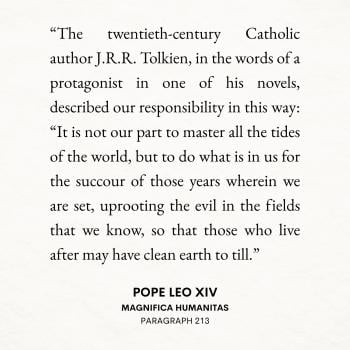
Letting Go of Libido Dominandi: Tolkien and Niebuhr...



No One Is Expendable: Gaudete et Exsultate, the...
TRENDING AT PATHEOS Catholic

Rejecting Doom: Christian Hope And Human Action
Christianity is a religion of hope. We are to have hope and...

It’s What Comes From Within Which Matters
One of the most difficult things for us to understand is why...

Why I Choose the Eucharist Over the Sermon
Choose the Eucharist, Not the Sermon What are we supposed to get...

5 Design Elements Found in Spiritually Rooted Homes
Putting Spirituality Into Home Decor Our homes are more than our living...

Credo: A Story of God Told with the...
About 10 years ago, I began to imagine a personal "Credo" that...

The Anatomy of Divine Revelation in Catholic Thought
The claim that God has made Himself known to human beings is...
view all Catholic blogs
Ad-Free & Subscriber Log-In Subscription Support
- About Us
- 2026 Calendar
- Videos
- Podcasts
- Library of World Religions
- Faith In Media Tracker
- Advertise With Us
- Write for Us
- Privacy Policy
- Terms of Service
- Do Not Sell My Data
- Contact Us
- Radiant Digital
- Manage Newsletter Subscriptions
- Unsubscribe From Notifications
- Sitemap
Copyright 2008-2026, Patheos. All rights reserved.
Subscription Support Ad-Free & Subscriber Log-In
Follow Patheos