
BuddhistCatholicContemplativeEvangelicalGeneral ChristianHinduJewishLatter-day SaintMuslimNew VisionsProgressive Christian
Beliefs
- Buddhist
- Catholic
- Contemplative
- Evangelical
- General Christian
- Hindu
- Jewish
- Latter-day Saint
- More Voices
- Muslim
- New Visions
- Pagan
- Progressive Christian
Topics
- Religion News
- Food and Religion
- Sports and Religion
- Religious Art
- Religious Music and Entertainment
- Religious Events
- History and Religion
- Style and Religion
- Politics and Religion
- Women in Religion
- Recreation Outdoors and Religion
- Business Finance and Religion
- Careers Workplace and Religion
- Education and Religion
- Family Parenting and Religion
- Health Fitness and Religion
- Home and Religion
- Relationships and Religion
- Technology and Religion
- Travel and Religion
Columnists
- Buddhist Columnists
- Business Finance and Religion Columnists
- Careers Workplace and Religion Columnists
- Catholic Columnists
- Contemplative Columnists
- Education and Religion Columnists
- Evangelists Columnists
- Family Parenting and Religion Columnists
- General Christian Columnists
- Health Fitness and Religion Columnists
- Hindu Columnists
- History and Religion Columnists
- Home and Religion Columnists
- Jewish Columnists
- More Voices Columnists
- Latter Day Columnists
- Muslim Columnists
- New Visions Columnists
- Nonreligious Columnists
- Pagan Columnists
- Politics and Religion Columnists
- Progressive Columnists
- Recreation Outdoors and Religion Columnists
- Relationships and Religion Columnists
- Religion News Columnists
- Religious Art Columnists
- Religious Events Columnists
- Religious Music and Entertainment Columnists
- Sports and Religion Columnists
- Style and Religion Columnists
- Technology and Religion Columnists
- Travel and Religion Columnists
- Women in Religion Columnists
Resource Library
- 2026 Calendar
- Library of World Religions
- The 100 Most Holy Places on Earth
- Patheos Answers
- Podcasts
- Videos
- Faith Leaders Database
- Anglican Episcopalian
- Bahai
- Baptist
- Buddhism
- Christianity
- Confucianism
- Eastern Orthodoxy
- Hinduism
- Holiness and Pentecostal
- ISKCON
- Islam
- Judaism
- Lutheran
- Methodist
- The Church of Jesus Christ of Latter-day Saints
- New Age
- Paganism
- Presbytarian and Reformed
- Protestantism
- Religion Behind the Scenes
- Roman Catholic
- Scientology
- Shia Islam
- Sikhism
- Sufism
- Sunni Islam
- Taoism
- Zen
- See all religions
Research Tools
 Ad-Free & Subscriber Log-In Subscription Support
Ad-Free & Subscriber Log-In Subscription Support
Follow Patheos 

- Trending:
- Forgiveness
- |
- Marriage
- |
- Consciousness
- |
- Death Penalty
- |
- Election
- |
- Halloween

- Home
- Pagan
- Saints, Sinners, Statues and Syncretism in Santeria and Voodoo
Saints, Sinners, Statues and Syncretism in Santeria and Voodoo
Last updated on: October 15, 2013 at 10:51 am by Lilith Dorsey
Saints, Sinners, Statues and Syncretism in Santeria and Voodoo 2013-10-15T10:51:46-05:00 Lilith Dorsey
Patheos Explore the world's faith through different perspectives on religion and spirituality! Patheos has the views of the prevalent religions and spiritualities of the world.
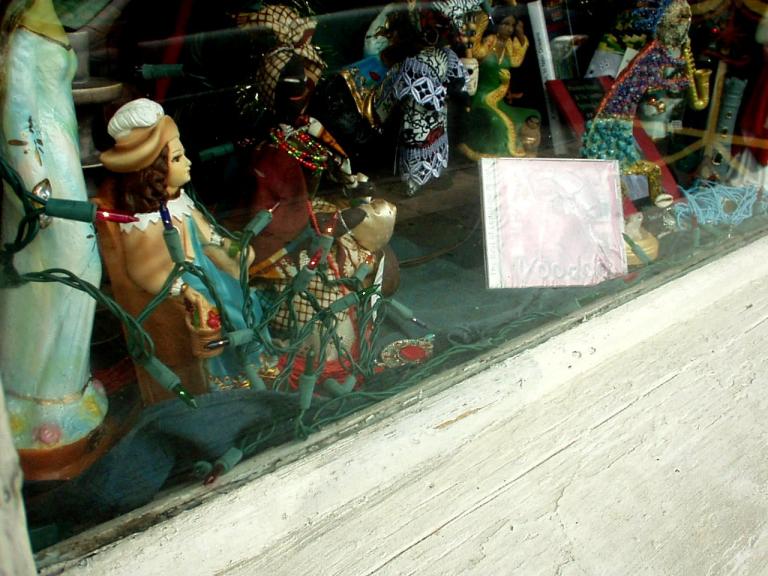
Voodoo Spiritual Temple Window showcasing both Catholic and African based images for the Orisha and Loa. Photo by Lilith Dorsey.
One of the most puzzling things for people both inside and outside the traditions of Voodoo and Santeria, also known as Lucumi, is the inclusion of other religions’ iconography. It is not uncommon to see statues for Caridad del Cobre on an Oshun shrine, or St. Patrick during a ritual for Damballa.
If you inquire about this to practitioners, you will most likely get a variety of answers ranging from colonial oppression, to secrecy, to beliefs that these individuals were part of the religion itself. I will address these one by one, and also hopefully explain my thoughts on the matter which are probably controversial as well. If you feel that way please take the time to leave a comment below, and share your thoughts with all of us here.
Colonial Oppression- Removing the ties that bind
The thing that one can never forget about Lucumi or Santeria, Vodou, or New Orleans Voodoo is that these were and are religions shaped and influenced by their own difficult history. These are the religions of hundreds of years of colonial oppression. These are the religions of captured and transplanted slaves, people who were uprooted from their homes, their families, and their land and forcibly relocated to places like Brazil, Haiti, Cuba, Puerto Rico, and other areas in both North and South America. These are religions, that despite all odds, survived and thrived. Highly restrictive laws like the “black codes” and the “Code Noir” severely limited what both free people of color and slaves were allowed to do. The “Code Noir” of the French colonies specifically required slaves to be baptized in the Roman Catholic tradition. This obviously presented a lot of problems for slaves clinging to their traditional faith.
Forget the Problem: It’s Part of the Solution
There is another school of thought about syncretism, or the amalgamation of different religions, in Voodoo and Lucumi (Santeria.) This stems from, I believe, the cosmology of the religions and their belief in the divine power of all things, highlighted under their concept of Ashe. Ashe or Axe is the universal life force of Afro-Caribbean religions. Everything and everyone has Ashe. The goddess Oshun, for example, has her own unique Ashe, it is present in the river, in her sacred honey, in her favorite herbs, like cinnamon or nutmeg, and most especially in the spirit of her children (devotees.) It is a short leap to see how individuals forced to use St. Lazarus, for example, to represent the god Babaluaiye, would honor and incorporate the healing miracles of this saint. One interesting element also comes into play when we realize most Catholic saint statues are made hollow. This allows devotees, both then and now, to utilize more traditional offerings for the Loa or Orisha stuffed up inside the statues. So are people worshipping the statue, the contents or both. I think for many people the answer is both. If people can become healed from their infectious diseases by praying to a statue of St. Lazarus with Babaluaiye’s ritual beans and rice inside then they should continue that practice. I have included some of the more common Saint to Orisha/Lwa correspondences below, as always each spiritual house is different and one should always follow the guidance and instruction of their godparents and elders in the tradition.
Vodou/Voodoo Associations between Saints and Lwa
St. Patrick- Damballa Wedo
St. Elias- Baron Samedi
St. Peter- Papa Legba
St. Claire- Ayizan
St. Ann- Erzulie
St. Bridget- Maman Brigitte
Lucumi/Santeria Associations between Saints and Orisha
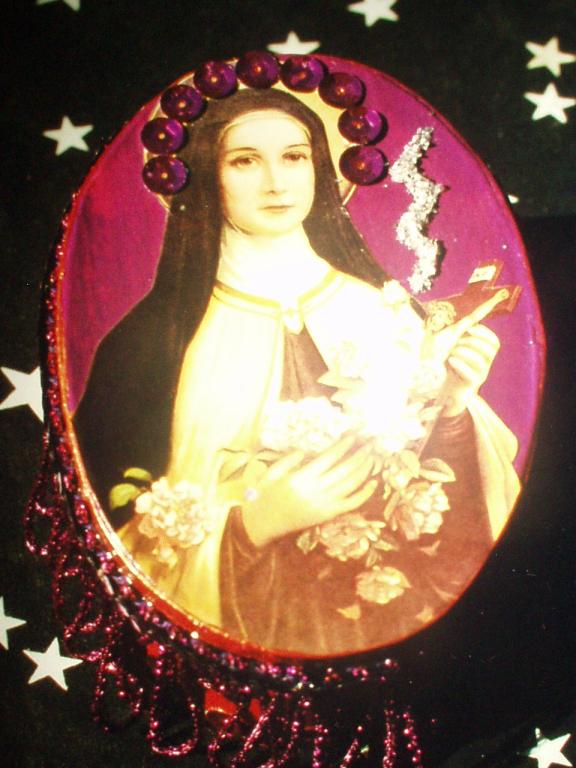
Oya Offering Box, featuring picture of St. Theresa. Photo by Lilith Dorsey.
St. Anthony- Eleggua
St. Barbara- Chango
St. Martha- Oya
St. Theresa- Oya
St. Michael- Ogun
St. Peter- Ogun
St. Lazarus- Babaluaiye
St. Christopher- Agayu
Diosa del Mar- Yemaya
Our Lady of Regla- Yemaya
Caridad del Cobre- Oshun
St. Norbert- Ochosi

Next Post
October 17, 2013 Taking Real Pictures of Ghosts: 10 Tips for Better Paranormal Photography
Browse Our Archives
Select a Category Ancestors astrology Candomble Crystals Divination Entertainment Goddess Herbs Hoodoo Ifa Pagan Ritual Recipes Santeria Spells Uncategorized Vodou Voodoo Witchcraft
Select a Month May 2025 January 2025 September 2024 August 2024 April 2024 March 2024 January 2024 December 2023 November 2023 September 2023 June 2023 March 2023 December 2022 November 2022 October 2022 September 2022 August 2022 July 2022 June 2022 May 2022 April 2022 March 2022 January 2022 November 2021 October 2021 August 2021 July 2021 June 2021 May 2021 April 2021 March 2021 February 2021 January 2021 December 2020 November 2020 October 2020 September 2020 August 2020 July 2020 June 2020 April 2020 March 2020 February 2020 January 2020 December 2019 November 2019 October 2019 September 2019 August 2019 July 2019 June 2019 May 2019 April 2019 March 2019 February 2019 January 2019 December 2018 November 2018 October 2018 September 2018 August 2018 July 2018 June 2018 May 2018 April 2018 March 2018 February 2018 January 2018 December 2017 November 2017 October 2017 September 2017 August 2017 July 2017 June 2017 May 2017 April 2017 March 2017 February 2017 January 2017 December 2016 November 2016 October 2016 September 2016 August 2016 July 2016 June 2016 May 2016 April 2016 March 2016 February 2016 January 2016 December 2015 November 2015 October 2015 September 2015 August 2015 July 2015 June 2015 May 2015 April 2015 March 2015 February 2015 January 2015 December 2014 November 2014 October 2014 September 2014 August 2014 July 2014 June 2014 May 2014 April 2014 March 2014 February 2014 January 2014 December 2013 November 2013 October 2013 September 2013
Follow Us!
TAKE THE
Religious Wisdom Quiz
How did Jesus respond when accused of eating with sinners?
Select your answer to see how you score.
"I have no friends" "I came to call sinners to repentance" "I am hungry" "Don't call me teacher"
Related posts from Voodoo Universe

1st New Orleans National Vodou Day

The Lost Interviews Of Miss Cleo

Words, Responsibility and the 2022 Reading Of The...
TRENDING AT PATHEOS Pagan

I was recently chatting with someone on Instagram. She asked me what...

While there are many people who share their results, the end of...

On July 23, I saw Christopher Nolan's The Odyssey which is Homer’s...

As I write this two big events have just finished up. One...

Restoring the Watershed of Divine Love
Perhaps cooperation is not something we manufacture through legislation, ideology, or moral...

Many UUs don’t pray because of bad experiences in a previous religion,...
view all Pagan blogs
Ad-Free & Subscriber Log-In Subscription Support
- About Us
- 2026 Calendar
- Videos
- Podcasts
- Library of World Religions
- Faith In Media Tracker
- Advertise With Us
- Write for Us
- Privacy Policy
- Terms of Service
- Do Not Sell My Data
- Contact Us
- Radiant Digital
- Manage Newsletter Subscriptions
- Unsubscribe From Notifications
- Sitemap
Copyright 2008-2026, Patheos. All rights reserved.
Subscription Support Ad-Free & Subscriber Log-In
Follow Patheos