
BuddhistCatholicContemplativeEvangelicalGeneral ChristianHinduJewishLatter-day SaintMuslimNew VisionsProgressive Christian
Beliefs
- Buddhist
- Catholic
- Contemplative
- Evangelical
- General Christian
- Hindu
- Jewish
- Latter-day Saint
- More Voices
- Muslim
- New Visions
- Pagan
- Progressive Christian
Topics
- Religion News
- Food and Religion
- Sports and Religion
- Religious Art
- Religious Music and Entertainment
- Religious Events
- History and Religion
- Style and Religion
- Politics and Religion
- Women in Religion
- Recreation Outdoors and Religion
- Business Finance and Religion
- Careers Workplace and Religion
- Education and Religion
- Family Parenting and Religion
- Health Fitness and Religion
- Home and Religion
- Relationships and Religion
- Technology and Religion
- Travel and Religion
Columnists
- Buddhist Columnists
- Business Finance and Religion Columnists
- Careers Workplace and Religion Columnists
- Catholic Columnists
- Contemplative Columnists
- Education and Religion Columnists
- Evangelists Columnists
- Family Parenting and Religion Columnists
- General Christian Columnists
- Health Fitness and Religion Columnists
- Hindu Columnists
- History and Religion Columnists
- Home and Religion Columnists
- Jewish Columnists
- More Voices Columnists
- Latter Day Columnists
- Muslim Columnists
- New Visions Columnists
- Nonreligious Columnists
- Pagan Columnists
- Politics and Religion Columnists
- Progressive Columnists
- Recreation Outdoors and Religion Columnists
- Relationships and Religion Columnists
- Religion News Columnists
- Religious Art Columnists
- Religious Events Columnists
- Religious Music and Entertainment Columnists
- Sports and Religion Columnists
- Style and Religion Columnists
- Technology and Religion Columnists
- Travel and Religion Columnists
- Women in Religion Columnists
Resource Library
- 2026 Calendar
- Library of World Religions
- The 100 Most Holy Places on Earth
- Patheos Answers
- Podcasts
- Videos
- Faith Leaders Database
- Anglican Episcopalian
- Bahai
- Baptist
- Buddhism
- Christianity
- Confucianism
- Eastern Orthodoxy
- Hinduism
- Holiness and Pentecostal
- ISKCON
- Islam
- Judaism
- Lutheran
- Methodist
- The Church of Jesus Christ of Latter-day Saints
- New Age
- Paganism
- Presbytarian and Reformed
- Protestantism
- Religion Behind the Scenes
- Roman Catholic
- Scientology
- Shia Islam
- Sikhism
- Sufism
- Sunni Islam
- Taoism
- Zen
- See all religions
Research Tools
 Ad-Free & Subscriber Log-In Subscription Support
Ad-Free & Subscriber Log-In Subscription Support
Follow Patheos 

- Trending:
- Forgiveness
- |
- Marriage
- |
- Consciousness
- |
- Death Penalty
- |
- Election
- |
- Halloween

- Home
- Contemplative
- This New Year — Rethinking Gratitude
This New Year — Rethinking Gratitude
Last updated on: December 26, 2018 at 12:33 pm by Guest Contributor
This New Year — Rethinking Gratitude 2018-12-26T12:33:07-04:00 Guest Contributor
Patheos Explore the world's faith through different perspectives on religion and spirituality! Patheos has the views of the prevalent religions and spiritualities of the world.
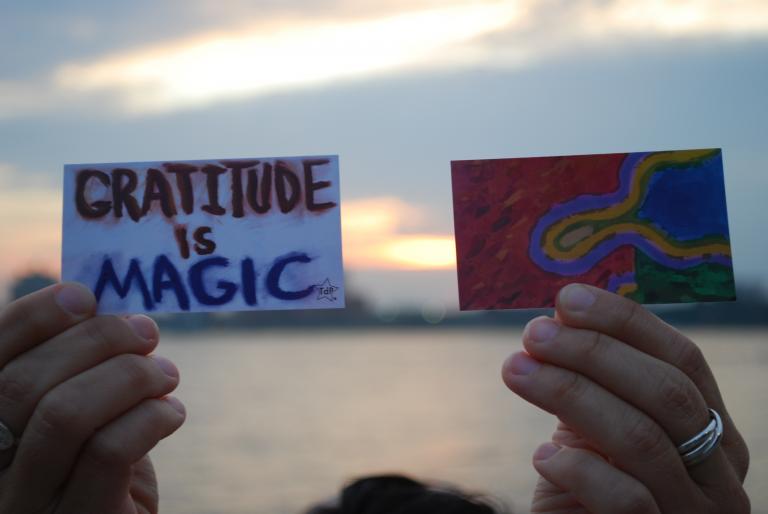
Joanne Morton, CC BY-NC
By Jeremy David Engels, Pennsylvania State University
It’s a new year, which means that it’s also time to imagine new beginnings and better futures. It’s time, in short, for New Year’s resolutions.
Gratitude, in particular, has become a popular resolution. For many of us, living gratefully seems to promise more happiness in our lives.
But what if we’ve got gratitude all wrong?
I began writing my book “The Art of Gratitude” because I too believed that gratitude might offer an antidote to the anger, fear and resentment that characterize contemporary life. But as I read one self-help book about gratitude after another, it had the opposite effect on me. The more I read, the less grateful I felt.
I came to ask, does the problem lie in how gratitude tends to be defined?
The debt of gratitude
Gratitude is often defined as a feeling of obligation and indebtedness toward those who give us a gift or help us out in some way. Consider how often many of us use the phrase, “I owe you a debt of gratitude,” or “One good turn deserves another.”
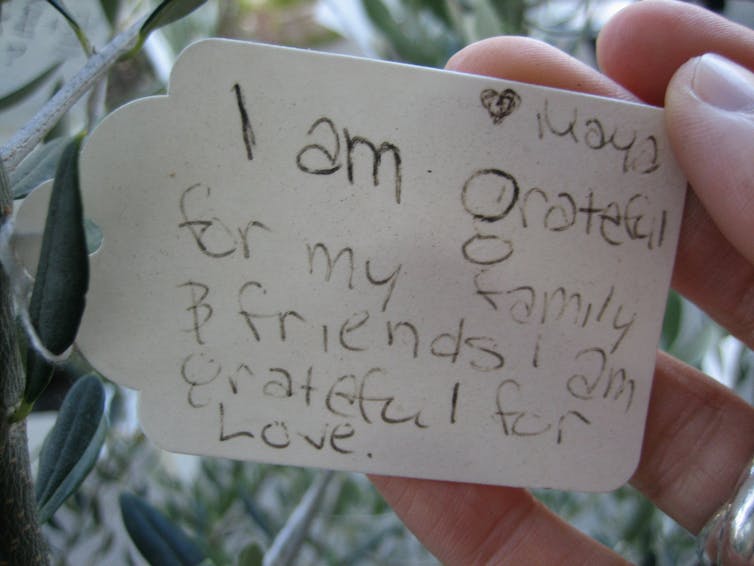
What is the framework of gratitude?
Eugene Kim, CC BY
The debt of gratitude idea dates back to the foundations of Western culture, to Aristotle, Cicero and the New Testament.
According to a leading contemporary expert on gratitude, UC Davis psychology professor Robert Emmons, “To be grateful means to allow oneself to be placed in the position of recipient – to feel indebted and aware of one’s dependence on others.” Or, as Emmons argues elsewhere, gratitude is “an acknowledgement of debt,” and ingratitude “the refusal to admit one’s debt to others.”
In this framework, people are debtors and the givers of debt. According to philosopher Shelly Kagan, “If someone does you a favor, you owe them something; you owe them a debt of gratitude.” People judge the value of others based on what they can offer. Emmons writes:
“Gratitude requires that a giver give not only a gift but also a gift dear to himself – a ‘pearl of great price,’ as it were. … The degree to which we feel gratitude always hinges on this internal, secret assessment of cost: It is intrinsic to the emotion, and perfectly logical, that we don’t feel all that grateful for gifts that we receive that cost little or nothing to the giver.”
In other words, gifts and kindnesses involve a calculation of “cost,” which extends to repayment: Gifts are calculated gestures that must be repaid with an expression of thanks and, if possible, reciprocal gifts.
Thinking in such terms might encourage people to see their relationships in economic terms – as transactions to be judged by market criteria of gain and loss.
To that end, the Christian radio show host Nancy Leigh DeMoss advises keeping a gratitude journal just like a bank statement or a checkbook registry, as a place to manage gratitude debts.
“I want to encourage you to think of gratitude as being a debt you owe, the same way you’re called upon to pay your monthly bills.”
The art of gratitude
Gratitude is about more than individual happiness. My happiness is bound with yours and with everyone else’s.
Gratitude authors, who urge us to focus on the debts we owe to others, are reminding us of this fact. I, however, argue in “The Art of Gratitude” that the rhetoric of the debt of gratitude sets us down a dangerous road. The trouble is that the value of our relationships cannot be calculated with numbers on the page, and trying to do so might make us miss out on what is most important.
Take, for example, a recent gift I received – of a nice aluminum water bottle. A friend said that she saw it and thought of me. Of course, I thanked her. But rather than immediately calculate the cost of the gift and determine how I would repay her, I asked: “Why did you choose a water bottle?”
She told me where she grew up in the United States, she did not have access to clean water. I travel a lot, and she wanted me to take clean water with me wherever I went. Moreover, she hoped that it would help to cut down on plastic bottle waste, because, she said, we all share this planet.
I might have missed all of this had I only pondered on how best to repay it. Instead, this gift prompted a conversation that reminded me of our fundamental interconnectedness. My actions, she was saying, impacted her life, just as her actions impacted my own.

Gratitude is an opportunity, not a debt.
InesBazdar via www.shutterstock.com
This interconnected world
It is crucial to recognize that our daily practices of gratitude have broader social and political implications.
Say I feel gratitude for access to clean air in Central Pennsylvania. I feel this gratitude because I grew up with asthma, and I know how hard it can be to breathe polluted air. I need not feel indebted to anyone for this clean air. Clean air is not a gift. I am grateful because clean air is necessary for life.
Same is true for clean water. There is currently, however, a potentially grave challenge to clean water in Centre County, Pennsylvania, where I live.
Looking through grateful eyes, attuned to the support necessary to live and thrive, I can recognize a threat to clean water as a personal threat. Though it is personal, it cannot be remedied alone. I must reach out to others who will also be affected, so that we can act together to manage it.
The takeaway of my book is that indebtedness is not the only way to relate. Examples like these prove that all of us are deeply dependent upon the material support of the earth, and that also speaks to our interconnectedness.
My resolution this year is therefore to practice the art of gratitude by imagining my life, and the world in which I live, as an opportunity, not a debt. I resolve to focus on what is necessary, and to work together with others to make it possible for all to live and to live well, because we live together. I hope that you will join me.
Jeremy David Engels, Sherwin Early Career Professor in the Rock Ethics Institute, and Associate Professor of Communication Arts and Sciences, Pennsylvania State University
This article is republished from The Conversation under a Creative Commons license. Read the original article.

Next Post

December 27, 2018 Could Consciousness All Come Down to the Way Things Vibrate?
Browse Our Archives
Select a Category Uncategorized
Select a Month July 2021 May 2020 January 2019 December 2018
TAKE THE
Religious Wisdom Quiz
What is the Christian view about material possessions?
Select your answer to see how you score.
Seek them after righteousness They are temporary Riches guarantee happiness They are the most important thing
Related posts from Voices in the Stillness

Sitting Bull's Prophetic Dreams

Practices From the Inside Out: Taking Steps Toward...


TRENDING AT PATHEOS Contemplative

Handy Contemplative Practices for Political Spaces
A Spiritually Grounded Presence In order to bring a spiritually grounded presence...

Halloween: The Holiday of Loving Your Neighbor
All Hallows Eve Is Halloween the least Christian holiday in America, or...

Can Love Be Saved? Some Thoughts on the...
Happy Valentine's Day! I recently published a post on Patreon called Can...

"This Loving, Uniting Embrace": the Holy Ordinary
Today's guest post is by Mark Longhurst, author of The Holy Ordinary:...

How Are We Called to Live?: More About...
How Are We Called to Live? Many of us struggle with discerning...

A Spiritual Practice of Reading: Join Us Online
A Spiritual Practice of Reading A healthy spiritual practice of reading is...
view all Contemplative blogs
Ad-Free & Subscriber Log-In Subscription Support
- About Us
- 2026 Calendar
- Videos
- Podcasts
- Library of World Religions
- Faith In Media Tracker
- Advertise With Us
- Write for Us
- Privacy Policy
- Terms of Service
- Do Not Sell My Data
- Contact Us
- Radiant Digital
- Manage Newsletter Subscriptions
- Unsubscribe From Notifications
- Sitemap
Copyright 2008-2026, Patheos. All rights reserved.
Subscription Support Ad-Free & Subscriber Log-In
Follow Patheos