
BuddhistCatholicContemplativeEvangelicalGeneral ChristianHinduJewishLatter-day SaintMuslimNew VisionsProgressive Christian
Beliefs
- Buddhist
- Catholic
- Contemplative
- Evangelical
- General Christian
- Hindu
- Jewish
- Latter-day Saint
- More Voices
- Muslim
- New Visions
- Pagan
- Progressive Christian
Topics
- Religion News
- Food and Religion
- Sports and Religion
- Religious Art
- Religious Music and Entertainment
- Religious Events
- History and Religion
- Style and Religion
- Politics and Religion
- Women in Religion
- Recreation Outdoors and Religion
- Business Finance and Religion
- Careers Workplace and Religion
- Education and Religion
- Family Parenting and Religion
- Health Fitness and Religion
- Home and Religion
- Relationships and Religion
- Technology and Religion
- Travel and Religion
Columnists
- Buddhist Columnists
- Business Finance and Religion Columnists
- Careers Workplace and Religion Columnists
- Catholic Columnists
- Contemplative Columnists
- Education and Religion Columnists
- Evangelists Columnists
- Family Parenting and Religion Columnists
- General Christian Columnists
- Health Fitness and Religion Columnists
- Hindu Columnists
- History and Religion Columnists
- Home and Religion Columnists
- Jewish Columnists
- More Voices Columnists
- Latter Day Columnists
- Muslim Columnists
- New Visions Columnists
- Nonreligious Columnists
- Pagan Columnists
- Politics and Religion Columnists
- Progressive Columnists
- Recreation Outdoors and Religion Columnists
- Relationships and Religion Columnists
- Religion News Columnists
- Religious Art Columnists
- Religious Events Columnists
- Religious Music and Entertainment Columnists
- Sports and Religion Columnists
- Style and Religion Columnists
- Technology and Religion Columnists
- Travel and Religion Columnists
- Women in Religion Columnists
Resource Library
- 2026 Calendar
- Library of World Religions
- The 100 Most Holy Places on Earth
- Patheos Answers
- Podcasts
- Videos
- Faith Leaders Database
- Anglican Episcopalian
- Bahai
- Baptist
- Buddhism
- Christianity
- Confucianism
- Eastern Orthodoxy
- Hinduism
- Holiness and Pentecostal
- ISKCON
- Islam
- Judaism
- Lutheran
- Methodist
- The Church of Jesus Christ of Latter-day Saints
- New Age
- Paganism
- Presbytarian and Reformed
- Protestantism
- Religion Behind the Scenes
- Roman Catholic
- Scientology
- Shia Islam
- Sikhism
- Sufism
- Sunni Islam
- Taoism
- Zen
- See all religions
Research Tools
 Ad-Free & Subscriber Log-In Subscription Support
Ad-Free & Subscriber Log-In Subscription Support
Follow Patheos 

- Trending:
- Forgiveness
- |
- Marriage
- |
- Consciousness
- |
- Death Penalty
- |
- Election
- |
- Halloween

- Home
- Contemplative
- Meister Eckhart — 14th-Century Mystic Appeals to Today’s ‘Spiritual but Not Religious’ Americans
Meister Eckhart — 14th-Century Mystic Appeals to Today’s ‘Spiritual but Not Religious’ Americans
Last updated on: December 19, 2018 at 1:33 pm by Guest Contributor
Meister Eckhart — 14th-Century Mystic Appeals to Today’s ‘Spiritual but Not Religious’ Americans 2018-12-19T13:33:21-04:00 Guest Contributor
Patheos Explore the world's faith through different perspectives on religion and spirituality! Patheos has the views of the prevalent religions and spiritualities of the world.
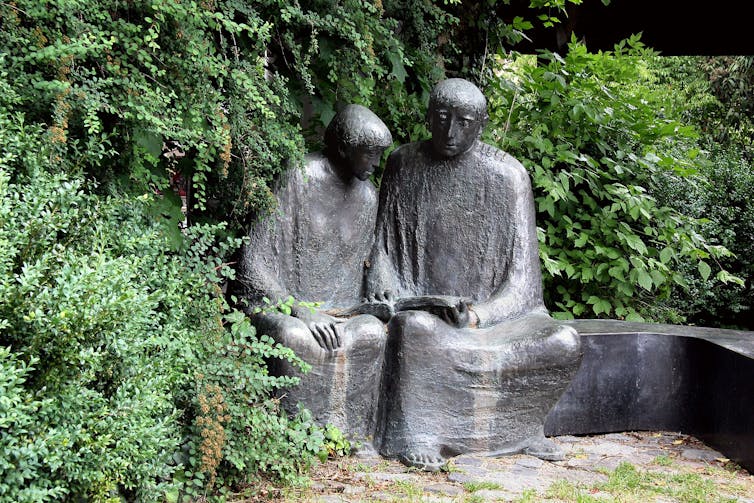
A sculpture of Meister Eckhart in Germany.
Lothar Spurzem , CC BY-SA

By Joel Harrington, Vanderbilt University
The percentage of Americans who do not identify with any religious tradition continues to rise annually. Not all of them, however, are atheists or agnostics. Many of these people believe in a higher power, if not organized religion, and their numbers too are steadily increasing.
The history of organized religion is full of schisms, heresies and other breakaways. What is different at this time is a seemingly indiscriminate mixing of diverse religious traditions to form a personalized spirituality, often referred to as “cafeteria spirituality.” This involves picking and choosing the religious ideas one likes best.
At the heart of this trend is the general conviction that all world religions share a fundamental, common basis, a belief known as “perennialism.” And this is where the unlikely figure of Meister Eckhart, a 14th-century Dominican friar famous for his popular sermons on the direct experience of God, is finding popular appeal.
Who was Meister Eckhart?
I have studied Meister Eckhart and his ideas of mysticism. The creative power that people address as “God,” he explained, is already present within each individual and is best understood as the very force that infuses all living things.
He believed this divinity to be genderless and completely “other” from humans, accessible not through images or words but through a direct encounter within each person.
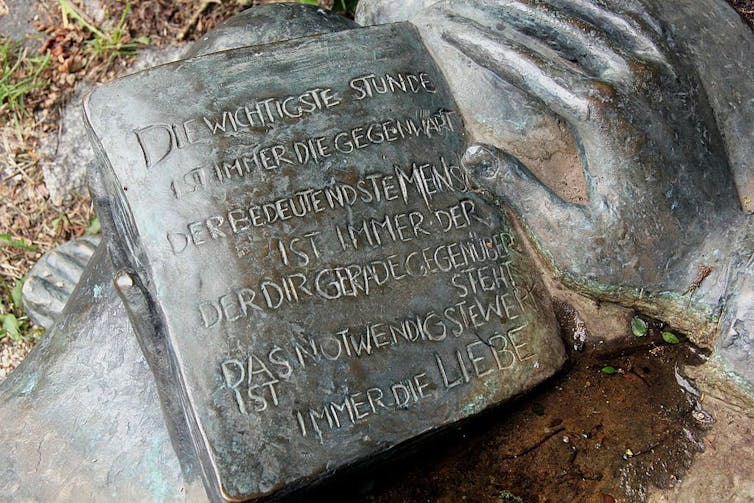
A sculpture of Meister Eckhart in Germany.
Lothar Spurzem, CC BY-SA

The method of direct access to the divine, according to Eckhart, depended on an individual letting go of all desires and images of God and becoming aware of the “divine spark” present within.
Seven centuries ago, Eckhart embraced meditation and what is now called mindfulness. Although he never questioned any of the doctrines of the Catholic Church, Eckhart’s preaching eventually resulted in an official investigation and papal condemnation.
Significantly, it was not Eckhart’s overall approach to experiencing God that his superiors criticized, but rather his decision to teach his wisdom. His inquisitors believed the “unlearned and simple people” were likely to misunderstand him. Eckhart, on the other hand, insisted that the proper role of a preacher was to preach.
He died before his trial was complete, but his writings were subsequently censured by a papal decree.
The modern rediscovery of Eckhart
Meister Eckhart thereafter remained relatively little known until his rediscovery by German romantics in the 19th century.
Since then, he has attracted many religious and non-religious admirers. Among the latter were the 20th-century philosophers Martin Heidegger and Jean-Paul Sartre, who were inspired by Eckhart’s beliefs about the self as the sole basis for action. More recently, Pope John Paul II and the current Dalai Lama have expressed admiration for Eckhart’s portrayal of the intimate relationship between God and the individual soul.
During the second half of the 20th century, the overlap of his teachings to many Asian practices played an important role in making him popular with Western spiritual seekers. Thomas Merton, a monk from the Trappist monastic order, for example, who began an exploration of Zen Buddhism later in his life, discovered much of the same wisdom in his own Catholic tradition embodied in Eckhart. He called Eckhart “my life raft,” for opening up the wisdom about developing one’s inner life.
Richard Rohr, a friar from the Franciscan order and a contemporary spirituality writer, views Eckhart’s teachings as part of a long and ancient Christian contemplative tradition. Many in the past, not just monks and nuns have sought the internal experience of the divine through contemplation.
Among them, as Rohr notes were the apostle Paul, the fifth-century theologian Augustine, and the 12th-century Benedictine abbess and composer Hildegard of Bingen.
In the tradition of Eckhart, Rohr has popularized the teaching that Jesus’ death and resurrection represents an individual’s movement from a “false self” to a “true self.” In other words, after stripping away all of the constructed ego, Eckhart guides individuals in finding the divine spark, which is their true identity.
Eckhart and contemporary perennials

Novelist Aldous Huxley frequently cited Eckhart, in his book, ‘The Perennialist Philosophy.’
RV1864/Flickr.com, CC BY-NC-ND
This subjective approach to experiencing the divine was also embraced by Aldous Huxley, best known for his 1932 dystopia, “Brave New World,” and for his later embrace of LSD as a path to self-awareness. Meister Eckhart is frequently cited in Huxley’s best-selling 1945 spiritual compendium, “The Perennialist Philosophy.”
More recently, the mega-best-selling New Age celebrity Eckhart Tolle, born Ulrich Tolle in 1948 in Germany and now based in Vancouver, has taken the perennial movement to a much larger audience. Tolle’s books, drawing from an eclectic mix of Western and Eastern philosophical and religious traditions, have sold millions. His teachings encapsulate the insights of his adopted namesake Meister Eckhart.
While many Christian evangelicals are wary of Eckhart Tolle’s non-religious and unchurched approach, the teachings of the medieval mystic Eckhart have nonetheless found support among many contemporary Catholics and Protestants, both in North America and Europe.
Fully understanding a new spiritual icon
The cautionary note, however, is in too simplistic an understanding of Eckhart’s message.
Eckhart, for instance, did not preach an individualistic, isolated kind of personal enlightenment, nor did he reject as much of his own faith tradition as many modern spiritual but not religious are wont to do.
The truly enlightened person, Eckhart argued, naturally lives an active life of neighborly love, not isolation – an important social dimension sometimes lost today.
Meister Eckhart has some important lessons for those of us trapped amid today’s materialism and selfishness, but understanding any spiritual guide – especially one as obscure as Eckhart – requires a deeper understanding of the context.
Joel Harrington, Centennial Professor of History, Vanderbilt University
This article is republished from The Conversation under a Creative Commons license. Read the original article.
Previous Post

July 19, 2021
Sitting Bull's Prophetic Dreams
Next Post

December 26, 2018 This New Year — Rethinking Gratitude
Browse Our Archives
Select a Category Uncategorized
Select a Month July 2021 May 2020 January 2019 December 2018
TAKE THE
Religious Wisdom Quiz
Which Christian group practices foot washing as an ordinance?
Select your answer to see how you score.
Anabaptists Catholics Methodists Baptists
Related posts from Voices in the Stillness

Sitting Bull's Prophetic Dreams

Practices From the Inside Out: Taking Steps Toward...


TRENDING AT PATHEOS Contemplative

Handy Contemplative Practices for Political Spaces
A Spiritually Grounded Presence In order to bring a spiritually grounded presence...

Halloween: The Holiday of Loving Your Neighbor
All Hallows Eve Is Halloween the least Christian holiday in America, or...

Can Love Be Saved? Some Thoughts on the...
Happy Valentine's Day! I recently published a post on Patreon called Can...

"This Loving, Uniting Embrace": the Holy Ordinary
Today's guest post is by Mark Longhurst, author of The Holy Ordinary:...

How Are We Called to Live?: More About...
How Are We Called to Live? Many of us struggle with discerning...

A Spiritual Practice of Reading: Join Us Online
A Spiritual Practice of Reading A healthy spiritual practice of reading is...
view all Contemplative blogs
Ad-Free & Subscriber Log-In Subscription Support
- About Us
- 2026 Calendar
- Videos
- Podcasts
- Library of World Religions
- Faith In Media Tracker
- Advertise With Us
- Write for Us
- Privacy Policy
- Terms of Service
- Do Not Sell My Data
- Contact Us
- Radiant Digital
- Manage Newsletter Subscriptions
- Unsubscribe From Notifications
- Sitemap
Copyright 2008-2026, Patheos. All rights reserved.
Subscription Support Ad-Free & Subscriber Log-In
Follow Patheos