
BuddhistCatholicContemplativeEvangelicalGeneral ChristianHinduJewishLatter-day SaintMuslimNew VisionsProgressive Christian
Beliefs
- Buddhist
- Catholic
- Contemplative
- Evangelical
- General Christian
- Hindu
- Jewish
- Latter-day Saint
- More Voices
- Muslim
- New Visions
- Pagan
- Progressive Christian
Topics
- Religion News
- Food and Religion
- Sports and Religion
- Religious Art
- Religious Music and Entertainment
- Religious Events
- History and Religion
- Style and Religion
- Politics and Religion
- Women in Religion
- Recreation Outdoors and Religion
- Business Finance and Religion
- Careers Workplace and Religion
- Education and Religion
- Family Parenting and Religion
- Health Fitness and Religion
- Home and Religion
- Relationships and Religion
- Technology and Religion
- Travel and Religion
Columnists
- Buddhist Columnists
- Business Finance and Religion Columnists
- Careers Workplace and Religion Columnists
- Catholic Columnists
- Contemplative Columnists
- Education and Religion Columnists
- Evangelists Columnists
- Family Parenting and Religion Columnists
- General Christian Columnists
- Health Fitness and Religion Columnists
- Hindu Columnists
- History and Religion Columnists
- Home and Religion Columnists
- Jewish Columnists
- More Voices Columnists
- Latter Day Columnists
- Muslim Columnists
- New Visions Columnists
- Nonreligious Columnists
- Pagan Columnists
- Politics and Religion Columnists
- Progressive Columnists
- Recreation Outdoors and Religion Columnists
- Relationships and Religion Columnists
- Religion News Columnists
- Religious Art Columnists
- Religious Events Columnists
- Religious Music and Entertainment Columnists
- Sports and Religion Columnists
- Style and Religion Columnists
- Technology and Religion Columnists
- Travel and Religion Columnists
- Women in Religion Columnists
Resource Library
- 2026 Calendar
- Library of World Religions
- The 100 Most Holy Places on Earth
- Patheos Answers
- Podcasts
- Videos
- Faith Leaders Database
- Anglican Episcopalian
- Bahai
- Baptist
- Buddhism
- Christianity
- Confucianism
- Eastern Orthodoxy
- Hinduism
- Holiness and Pentecostal
- ISKCON
- Islam
- Judaism
- Lutheran
- Methodist
- The Church of Jesus Christ of Latter-day Saints
- New Age
- Paganism
- Presbytarian and Reformed
- Protestantism
- Religion Behind the Scenes
- Roman Catholic
- Scientology
- Shia Islam
- Sikhism
- Sufism
- Sunni Islam
- Taoism
- Zen
- See all religions
Research Tools
 Ad-Free & Subscriber Log-In Subscription Support
Ad-Free & Subscriber Log-In Subscription Support
Follow Patheos 

- Trending:
- Forgiveness
- |
- Marriage
- |
- Consciousness
- |
- Death Penalty
- |
- Election
- |
- Halloween
 Greening the Spirit
- Home
- Pagan
- Midsummer – Phoenix Rising
Midsummer – Phoenix Rising
Last updated on: June 21, 2016 at 6:39 am by Vivianne Crowley
Midsummer – Phoenix Rising 2016-06-21T06:39:40+01:00 Vivianne Crowley
Patheos Explore the world's faith through different perspectives on religion and spirituality! Patheos has the views of the prevalent religions and spiritualities of the world.
Contemporary Paganism is often described as an orthopraxis rather than an orthodoxy. It is about common practice rather than common belief. In this we are not dissimilar to many of our Pagan ancestors.
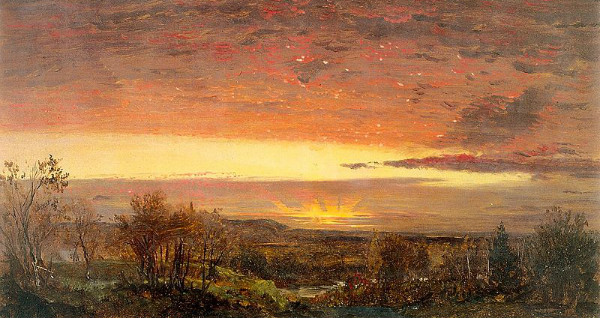
“Sunrise” by Fredric Edwin Church. From WikiMedia.
Pagans performed rites but professed no creed or doctrine. … they were not committed to revealed beliefs in the strong Christian sense of the term. They were not exhorted to faith: … no group of pagans ever called themselves “the faithful”: the term remains one of the few ways of distinguishing Jewish and Christian epitaphs from those which are pagan.
-Robin Lane Fox, Pagans and Christians, 1986, 31.
As Pagans, we work with shared symbols and myths. Each of us interprets our myths and symbols in a way that is deeply personal and individual, but we share a common non-verbal ‘language’. There are symbols drawn from the rhizome of the Western Mystery and Magical Traditions that are meaningful to us whether we label ourselves Pagan, Heathen, Christian, Jewish, Muslim, Hindu, Buddhist, or any other tradition.
These are archetypal images that have resonance across cultures. They are images that inspire the imagination, move the heart, and stimulate the creative psyche. Often apparently simple symbols – the quartered circle, the ankh, the spiral, the circle – convey in a single visual image a wealth of complex ideas that are an endless source of new meaning and insight.
We only understand that kind of thinking which is a mere equation … But besides that there is a thinking in primordial images, in symbols which are older than historical humankind, which are inborn in us from the earliest times, and, eternally living, outlasting all generations, still make up the groundwork of the human psyche. It is only possible to live the fullest life when we are in harmony with these symbols; wisdom is a return to them. It is a question neither of belief nor of knowledge, but of the agreement of our thinking with the primordial images of the unconscious . . . .
-Carl G. Jung, The Stages of Life, 1930/1, para. 794.
The Sun At Its Zenith
In our Midsummer rites, with the sun at its height, we work with symbols that echo the sun and its position as the dominant force in the heavens. We use symbols such as solar king and solar queen, which for us as individuals relate to that point in our lives when we are at our zenith – our most successful, powerful, and achieving. But while Midsummer rites celebrate the zenith, they hint at the decline to come. Sometimes this is conveyed by a combat between the sun king and his rival, the king of darkness. Light overcomes the Darkness – but only for a time. In this battle the Light is fatally wounded and in time that wound will lead to the Light’s demise.
If we meditate on these symbols, what do we find? We can discover the message that, however strong and powerful we are, in time we will decline and face the inevitability of death. We can learn that no power can go forever unchecked, that the will to power can only last so long, that material position and wealth are transitory. In time all things pass; all things change.
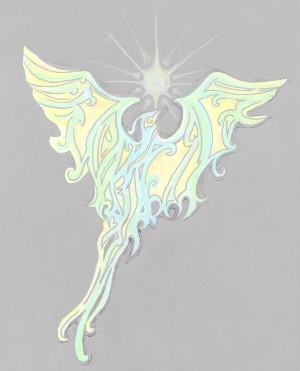
The Myth of the Phoenix
Symbols work because they stimulate the psyche. They are mysterious and have many layers of meaning. We struggle to understand them. The human mind communicated our deepest longings and spiritual aspirations in visual form long before we developed complex languages.
The phoenix is an archetypal image associated with the sun. It appears in many different cultures. Its myths vary, but all agree that it is a bird that is rare, wondrous, magical, and signifies great change. From ancient Greece the myth is that the phoenix is a legendary bird with beautiful fiery-colored plumage. It lives in Arabia near a cool well. Every morning as the sun rises and dawn breaks, the phoenix bathes in the cool clear water of the well and sings such a sweet and delightful song that the Sun God stops in his chariot to listen.
The phoenix is ever-renewing, existing for eons. Every 500 years, it constructs a nest of cinnamon twigs that ignites and consumes the phoenix to ashes. From the ashes, a new phoenix arises. The new incarnation wraps the ashes of its former body in an egg of myrrh and flies to the Egyptian City of the Sun, Heliopolis or On, where it leaves the egg as an offering on the altar of the Sun God Ra.
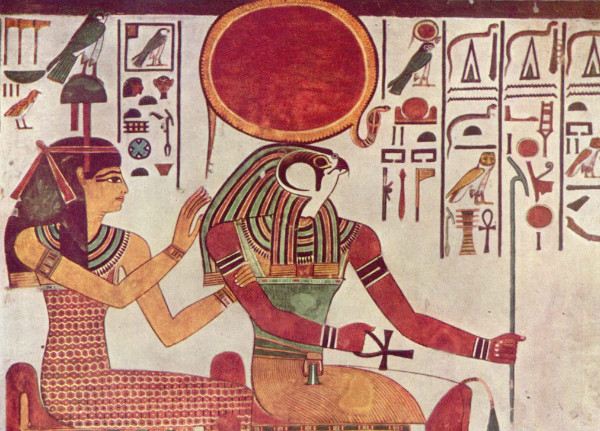
Imentet and Ra from the tomb of Nefertari” From WikiMedia and Directmedia.
What Meaning Can We Find in This Myth?
The solar king at Midsummer can be seen to represent the ego in its dominant place in the personality. In the first half of life we need to establish a strong sense of who we are, so that we can function in the world and carry out the adult challenges of earning our living and making relationships. In the second half of life we need to let go and move on. We will not be able to hold onto material achievements forever. Instead of focusing on doing more of the same, we can grow and develop in new ways.
 We cannot totally abandon the material for the spiritual, but we can allow ourselves to engage more of our energies on the inner world and on strengthening and developing an ever closer relationship with the transcendent realm – those values and experiences that are eternal and abide. We can move towards living more of our lives in accordance with the values that are closest to the core of human experience – our struggle to unite with consciousness that is beyond ourselves, the consciousness that is Divine.
In the second half of life our physical strength wanes, but our spiritual strength can increase. As one half of the hour glass drains, the other fills. To do this, we may need to exchange material ambitions for spiritual goals that can stretch our innermost selves and help us to continue to give to others and to realize the fullness of our human potential. This sacrifice is hinted at in the mythos of Midsummer – the solar king is wounded and his energy and strength must turn inwards to heal himself before he can heal the world.
The phoenix is a symbol of creative power. It recreates itself from fire; from the fire of its own energy it is reborn anew. At Midsummer the message is one of empowerment, and of our ability to transform ourselves. It is a message for spiritual maturity – no teacher, guru, priestess or priest, can perform this transformation for us. It is a transformation that is not gained without being willing to let go of the old self; to release the past to make way for the future. The phoenix offers itself up to itself and is reborn; from the ashes of the fire flies forth the new phoenix, the Morning Star of Ra.
Phoenix Rising Workshops
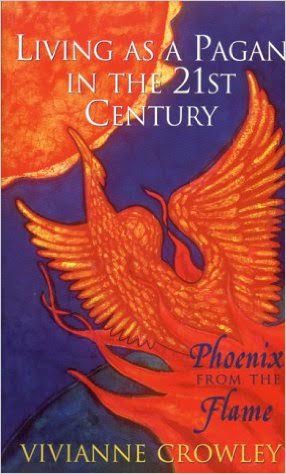
Vivianne Crowley is the author of Phoenix from the Flame: Living as a Pagan in the 21st Century. She and Chris Crowley run Phoenix Rising workshops on connecting to and working with phoenix energy. The next workshop dates are Saturday 2 July 2016 in Helsinki, Finland, contact: [email protected]; and Sunday 2 April 2017 in Rome, Italy, contact: [email protected]
References
Crowley, Vivianne. 2000. Carl Jung: Journey of transformation – an illustrated biography. Wheaton, Illinois: Quest.
—. 1994. Phoenix from the flame: Living as a Pagan in the 21st century. London: Thorsons/HarperCollins.
Jung, Carl G. 1930/1. The Stages of Life. Vol. 8, in The Collected Works of C.G. Jung, Vol. 8, The Structure and Dynamics of the Psyche., by Carl G. Jung. 1969 ed. First published 1960. London: Routledge & Kegan Paul.
Lane Fox, Robin. 1986. Pagans and Christians: In the Mediterranean World from the Second Century AD to the Conversion of Constantine. London: Penguin.
Phoenix Painting, Property of Vivianne Crowley
Previous Post

April 29, 2016
What Does Nature Do For Us?
Next Post

July 21, 2016 Eutierria – Oneness With Nature
Browse Our Archives
Select a Category Uncategorized
Select a Month January 2017 December 2016 October 2016 September 2016 July 2016 June 2016 April 2016 February 2016 January 2016 November 2015 October 2015 September 2015 August 2015 July 2015 June 2015 May 2015 April 2015 March 2015 February 2015 January 2015 December 2014 November 2014 October 2014 September 2014 August 2014 July 2014 June 2014 May 2014 April 2014 March 2014 February 2014 January 2014 December 2013 November 2013 October 2013 September 2013 August 2013 July 2013 June 2013 May 2013 April 2013 March 2013
Follow Us!
TAKE THE
Religious Wisdom Quiz
How many visions does the book of Revelation contain?
Select your answer to see how you score.
12 7 5 10
Related posts from Greening the Spirit

Samhain: Connecting to Ancestors of Blood, Spirit, Place

Equinox Greetings from Spring in the South to...
Eutierria – Oneness With Nature
TRENDING AT PATHEOS Pagan

I was recently chatting with someone on Instagram. She asked me what...

While there are many people who share their results, the end of...

On July 23, I saw Christopher Nolan's The Odyssey which is Homer’s...

As I write this two big events have just finished up. One...

Restoring the Watershed of Divine Love
Perhaps cooperation is not something we manufacture through legislation, ideology, or moral...

Many UUs don’t pray because of bad experiences in a previous religion,...
view all Pagan blogs
Ad-Free & Subscriber Log-In Subscription Support
- About Us
- 2026 Calendar
- Videos
- Podcasts
- Library of World Religions
- Faith In Media Tracker
- Advertise With Us
- Write for Us
- Privacy Policy
- Terms of Service
- Do Not Sell My Data
- Contact Us
- Radiant Digital
- Manage Newsletter Subscriptions
- Unsubscribe From Notifications
- Sitemap
Copyright 2008-2026, Patheos. All rights reserved.
Subscription Support Ad-Free & Subscriber Log-In
Follow Patheos