
BuddhistCatholicContemplativeEvangelicalGeneral ChristianHinduJewishLatter-day SaintMuslimNew VisionsProgressive Christian
Beliefs
- Buddhist
- Catholic
- Contemplative
- Evangelical
- General Christian
- Hindu
- Jewish
- Latter-day Saint
- More Voices
- Muslim
- New Visions
- Pagan
- Progressive Christian
Topics
- Religion News
- Food and Religion
- Sports and Religion
- Religious Art
- Religious Music and Entertainment
- Religious Events
- History and Religion
- Style and Religion
- Politics and Religion
- Women in Religion
- Recreation Outdoors and Religion
- Business Finance and Religion
- Careers Workplace and Religion
- Education and Religion
- Family Parenting and Religion
- Health Fitness and Religion
- Home and Religion
- Relationships and Religion
- Technology and Religion
- Travel and Religion
Columnists
- Buddhist Columnists
- Business Finance and Religion Columnists
- Careers Workplace and Religion Columnists
- Catholic Columnists
- Contemplative Columnists
- Education and Religion Columnists
- Evangelists Columnists
- Family Parenting and Religion Columnists
- General Christian Columnists
- Health Fitness and Religion Columnists
- Hindu Columnists
- History and Religion Columnists
- Home and Religion Columnists
- Jewish Columnists
- More Voices Columnists
- Latter Day Columnists
- Muslim Columnists
- New Visions Columnists
- Nonreligious Columnists
- Pagan Columnists
- Politics and Religion Columnists
- Progressive Columnists
- Recreation Outdoors and Religion Columnists
- Relationships and Religion Columnists
- Religion News Columnists
- Religious Art Columnists
- Religious Events Columnists
- Religious Music and Entertainment Columnists
- Sports and Religion Columnists
- Style and Religion Columnists
- Technology and Religion Columnists
- Travel and Religion Columnists
- Women in Religion Columnists
Resource Library
- 2026 Calendar
- Library of World Religions
- The 100 Most Holy Places on Earth
- Patheos Answers
- Podcasts
- Videos
- Faith Leaders Database
- Anglican Episcopalian
- Bahai
- Baptist
- Buddhism
- Christianity
- Confucianism
- Eastern Orthodoxy
- Hinduism
- Holiness and Pentecostal
- ISKCON
- Islam
- Judaism
- Lutheran
- Methodist
- The Church of Jesus Christ of Latter-day Saints
- New Age
- Paganism
- Presbytarian and Reformed
- Protestantism
- Religion Behind the Scenes
- Roman Catholic
- Scientology
- Shia Islam
- Sikhism
- Sufism
- Sunni Islam
- Taoism
- Zen
- See all religions
Research Tools
 Ad-Free & Subscriber Log-In Subscription Support
Ad-Free & Subscriber Log-In Subscription Support
Follow Patheos 

- Trending:
- Forgiveness
- |
- Marriage
- |
- Consciousness
- |
- Death Penalty
- |
- Election
- |
- Halloween
 Visions of Vocation
- Home
- Careers, Workplace and Religion
- Our Moral Responsibility to Pay Attention
Our Moral Responsibility to Pay Attention
Last updated on: February 10, 2016 at 9:41 am by Dr. Steven Garber
Our Moral Responsibility to Pay Attention 2016-02-10T09:41:05-05:00 Dr. Steven Garber
Patheos Explore the world's faith through different perspectives on religion and spirituality! Patheos has the views of the prevalent religions and spiritualities of the world.
Pay attention.
I have been teaching for a long time, and I confess that while I am always hoping that my words find a home in a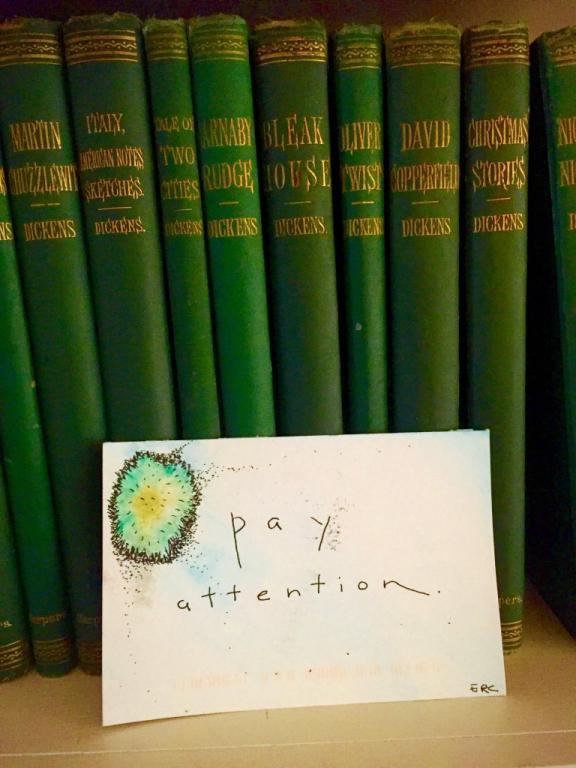 student’s heart, I never know. As the rabbi Jesus said at the beginning of his teaching, “If you have ears to hear, then hear.” That is as deep a wisdom as teachers, and their students, get.
Always and everywhere, there is a responsibility for knowledge, a response built into the very act of teaching. The truest truth about learning is that we are able to respond, responsible. So we choose to either take the teaching in, or not. And the response cannot only be for a moment, but for it to have its intended consequence, it has to be worked out over time— the words have to become flesh.
Last Saturday I received a letter in the mail, an honest communication from one person to another! In our emailing world, that is a rare gift, but it was specially so because it was from a former student, remembering something she had learned, and wanting me to know. With a thoughtful and tender note she told about words that she was still pondering, working them through her heart, and on the other side of the card the words, “Pay attention,” were artfully and simply crafted.
I can do no other than give my students what has been given to me. We all stand within traditions, consciously or not, choosing to think and live out of ways that others have before us. To anyone who wants to know, I describe myself as someone who sees and hears the world from the Hebrew and Christian vision of life and the world. That is the ground of my being, the wellspring of my life. Over the centuries there are teachers who have taught me, taking me further up and further into seeing and hearing the world, and I have been their glad student.

For example, years ago I began reading Simone Weil, the French philosopher. Intrigued by her life, instructed by her insight. I have written about her in many times and places. Born Jewish in the early years of the 20th-century in Paris, she took ideas seriously, eventually becoming the top student at the Sorbonne. But disillusioned by the inadequacy of communism to honestly address the depth of her commitments, she spent years looking for something more. And finally, finally, she found the God who has tears. (That pilgrimage is a substantive part of the first pages of theVisions of Vocation.)
Along the way she began to write, and one essay I have drawn on again and again is one written for students who want to take their studies seriously, “On the Right Use of School Studies with a View to the Love of God.” In it she argues that the task of study is to learn to pay attention, to see the way things honestly are in the worlds of history, of literature, of biology, of physics, of economics and politics, and on and on. When we learn to learn like that, Weil says that we learn to learn sacramentally, seeing where heaven and earth touch, where the seen reality of our everyday lives is twined together with the unseen reality of the transcendent universe. She roots this way of learning in the story we call the Good Samaritan, arguing that the expert in the law whose question to Jesus begins the parable, had never learned to pay attention— he had gotten “all A’s but was flunking life.” The Samaritan surprises us all, showing that he could see a neighbor in need, and respond. Knowing and doing were one… because he had learned to pay attention.
Wherever I go week by week, teaching as I do day by day, my longing is for my students to learn to learn the deepest lessons, the ones that transform and form their hearts. This week I began teaching in Washington DC on Monday, then went to Dallas, TX where my lecture at SMU was “On Learning to Learn,” and my hope was to finish on Friday on Capitol Hill at the American Studies Program for my once-a-semester lecture, before the snow storm came, but each time with a call to the vocation of study at the very center of teaching, hoping for my hearers to learn to pay attention to the truest truths of the universe.
To pay attention is the heart of all learning, and all life. To see truthfully is to see honestly, and therefore to see ourselves implicated, for love’s sake, in what we know. That is what my student is still working out, still thinking through, as she should, having ears to hear as she does.
For more from Steve Garber, check out his Commons Blog from The Washington Institute for Faith, Vocation and Culture.
Previous Post

February 3, 2016
Where "The Revenant" Missed the Mark
Next Post
February 17, 2016 A Conversation with a Stranger and Common Grace
Browse Our Archives
Select a Category Book Excerpts Book Reviews Community Conferences Dear Steve Economics Meaning Movie Review Uncategorized Vocation
Select a Month March 2016 February 2016 January 2016 December 2015 November 2015 October 2015 September 2015 August 2015 July 2015 June 2015 May 2015 April 2015 March 2015 February 2015 January 2015 December 2014 November 2014 October 2014 September 2014 August 2014 July 2014 June 2014 May 2014 April 2014 March 2014 February 2014 January 2014
Follow Us!
TAKE THE
Religious Wisdom Quiz
In Philippians, Paul mentions two women who need to be of the same mind. Who are they?
Select your answer to see how you score.
Lydia and Chloe Phoebe and Priscilla Euodia and Syntyche Mary and Martha
Related posts from Visions of Vocation



Three Words We Should Care More About

"Joy" and the Power of a Dream
TRENDING AT PATHEOS Careers, Workplace and Religion

St. Francis by Bill Droel Pope Leo XIV declares 2026 as “Year...

Catholics are schooled in the faith by memorizing dogmatic points and lots...

The Good News of Our Human Limitations -...
After another day of trying to meet deadlines and working on projects,...

Quiet Holy Attentiveness (podcast) with Sarah Clarkson
We know that quiet is an essential aspect of the spiritual life,...

Every Vocation Everywhere All At Once
What is a vocation? How does it endure through the years? Can...

I promise this is not going to become a Taylor Swift Studies...
view all Careers, Workplace and Religion blogs
Ad-Free & Subscriber Log-In Subscription Support
- About Us
- 2026 Calendar
- Videos
- Podcasts
- Library of World Religions
- Faith In Media Tracker
- Advertise With Us
- Write for Us
- Privacy Policy
- Terms of Service
- Do Not Sell My Data
- Contact Us
- Radiant Digital
- Manage Newsletter Subscriptions
- Unsubscribe From Notifications
- Sitemap
Copyright 2008-2026, Patheos. All rights reserved.
Subscription Support Ad-Free & Subscriber Log-In
Follow Patheos