
BuddhistCatholicContemplativeEvangelicalGeneral ChristianHinduJewishLatter-day SaintMuslimNew VisionsProgressive Christian
Beliefs
- Buddhist
- Catholic
- Contemplative
- Evangelical
- General Christian
- Hindu
- Jewish
- Latter-day Saint
- More Voices
- Muslim
- New Visions
- Pagan
- Progressive Christian
Topics
- Religion News
- Food and Religion
- Sports and Religion
- Religious Art
- Religious Music and Entertainment
- Religious Events
- History and Religion
- Style and Religion
- Politics and Religion
- Women in Religion
- Recreation Outdoors and Religion
- Business Finance and Religion
- Careers Workplace and Religion
- Education and Religion
- Family Parenting and Religion
- Health Fitness and Religion
- Home and Religion
- Relationships and Religion
- Technology and Religion
- Travel and Religion
Columnists
- Buddhist Columnists
- Business Finance and Religion Columnists
- Careers Workplace and Religion Columnists
- Catholic Columnists
- Contemplative Columnists
- Education and Religion Columnists
- Evangelists Columnists
- Family Parenting and Religion Columnists
- General Christian Columnists
- Health Fitness and Religion Columnists
- Hindu Columnists
- History and Religion Columnists
- Home and Religion Columnists
- Jewish Columnists
- More Voices Columnists
- Latter Day Columnists
- Muslim Columnists
- New Visions Columnists
- Nonreligious Columnists
- Pagan Columnists
- Politics and Religion Columnists
- Progressive Columnists
- Recreation Outdoors and Religion Columnists
- Relationships and Religion Columnists
- Religion News Columnists
- Religious Art Columnists
- Religious Events Columnists
- Religious Music and Entertainment Columnists
- Sports and Religion Columnists
- Style and Religion Columnists
- Technology and Religion Columnists
- Travel and Religion Columnists
- Women in Religion Columnists
Resource Library
- 2026 Calendar
- Library of World Religions
- The 100 Most Holy Places on Earth
- Patheos Answers
- Podcasts
- Videos
- Faith Leaders Database
- Anglican Episcopalian
- Bahai
- Baptist
- Buddhism
- Christianity
- Confucianism
- Eastern Orthodoxy
- Hinduism
- Holiness and Pentecostal
- ISKCON
- Islam
- Judaism
- Lutheran
- Methodist
- The Church of Jesus Christ of Latter-day Saints
- New Age
- Paganism
- Presbytarian and Reformed
- Protestantism
- Religion Behind the Scenes
- Roman Catholic
- Scientology
- Shia Islam
- Sikhism
- Sufism
- Sunni Islam
- Taoism
- Zen
- See all religions
Research Tools
 Ad-Free & Subscriber Log-In Subscription Support
Ad-Free & Subscriber Log-In Subscription Support
Follow Patheos 

- Trending:
- Forgiveness
- |
- Marriage
- |
- Consciousness
- |
- Death Penalty
- |
- Election
- |
- Halloween
 Visions of Vocation
- Home
- Careers, Workplace and Religion
- The world according to John LeCarre
The world according to John LeCarre
Last updated on: July 8, 2015 at 11:45 am by Dr. Steven Garber
The world according to John LeCarre 2015-07-08T11:45:03-05:00 Dr. Steven Garber
Patheos Explore the world's faith through different perspectives on religion and spirituality! Patheos has the views of the prevalent religions and spiritualities of the world.

This excerpt from Steve Garber’s book Visions of Vocation is the final one in our series reprinted here with the kind permission of InterVarsity Press. Get the book from IVP at this link!
One of the best chroniclers of contemporary geo-politics is the British novelist John Le Carré. From The Spy Who Came in from the Cold to Tinker, Tailor, Soldier, Spy, to Smiley’s People, to The Honourable Schoolboy, to The Constant Gardner, to The Most Wanted Man, to The Mission Song, he draws on his own years of spying for England in the MI5 and MI6 to tell his tales of the intelligence service through the Cold War and its end; in the years since then he has taken up global corporate machinations as the subject of his work.
Every story is remarkably engaging and sobering. A very gifted writer, Le Carré is brilliant, novel by novel taking up the most complex dynamics of the political economies of the modern world. If one story is Russia, post-USSR, with politicians full of malice doing business with kindred spirits in the West, another is Africa in all its hope and despair, with warring tribes set against global economic interests that profit when Africa suffers. Le Carré is a master story-teller, seeing the evil of the human heart played out in public and political arenas—and he expects his readers to come to the same conclusion that he has.
In a word, he is a cynic—about individuals and institutions, about persons and polities, about anyone and anything that has to do with power and money. And why not? There many good reasons to be cynical. Governments do betray their citizens, sometimes with tragic consequences. Nations do sacrifice long-term good for short-term gain, sometimes with intentional injustice written into the equation. People who really know what goes on in government and corporate bureaucracies have a very hard time not believing that everyone and everything is corrupt. They have seen too much. In Hitchcock’s inimitable image, they are men and women who know too much.
Le Carré captures this insightfully and eloquently. There have been many nights over many years when I have set his novels down, sure that the world is a better place because Le Carré has written another story. His sensibility about the nuances of the human heart rings true to my own heart and to people that I know. His instincts about motives, true and false, seem plausible, given what I have experienced. But there is also a sense of shame too, as I read him.
It is almost as if I have been a voyeur, looking in on life in a way that is illegitimate, a way that is intentionally perverse. Yes, I know that Bismarck, the Prussian politician, was painfully right about political life, about the human heart getting close to political realities, when he said that “if we want to respect sausage or law then we must not watch either being made.” But as I read Bismarck, there is a hard-won realism that is different than Le Carré’s cynicism.
Take The Constant Gardner, one of his novels, which also has become a film. It is about the world where global economic interests butt up against global health interests which butt up against global political interests. A complex and complicated world it is, and sausage-making is the reality that runs through the story. The British government has a part in the story, but a health crisis in Kenya does too, as does a British pharmaceutical company—and no one is clean, in fact, no one has integrity. The sausage has been made, and it stinks; it has made some people very wealthy, others have died from it. Only the naive refuse the logic of cynicism.
To keep going in the world, we cannot afford to be romantics. Even if we acknowledge that Pollyanna is fictional, we know the temptation and allure to imitate her. We do want all to be well, for all to be happy. “Life is good,” the T-shirts promise, and we buy them by the truckload. Well, sometimes in some places, but not very often in the massive ghettoes of Nairobi, which is where Le Carré takes us in The Constant Gardner. And when money and power are to be had, there are few who say no. Almost no one.
But there are exceptions. And it is here that Le Carré’s cynicism is more a protection of his heart than a truthful account of the heart. Whether conscious or not, intentional or not, the temptation to cynicism is always a way of keeping one’s heart from being wounded, again. Given my work and my city, I have watched scores of hundreds of twenty-somethings come to Washington, bright-eyed and bushytailed, ready for life, wanting to affect the way the world turns out. For most it does not take very long smelling the sausage being made. Before long, cynicism begins to grow as they see and hear more than they ever imagined.
But I have also watched many who are now older, seasoned as they are, who can remember a day when they too believed that justice was worth working for but who now know that it isn’t, because it only exists in university bull-sessions. After all, they are not twenty-one-year-olds anymore! They know how the world really works. And of course they are very willing to tell twenty-one-year-olds that they’d better get on with the real business of politics, which is using it for one’s own end. As one senior aide in the Senate told one of my students who had asked about the meaning of justice for a particular national debate in which his senator was a key participant, “Justice is crap! Grow up!” And for a half-hour he harangued her for even imagining that justice, inscribed though it might be on the buildings of Capitol Hill, had anything to do with Realpolitik, with the real business of politics. (Answering the question What is real? turns out to be more than an academic question, because how we define it has far-reaching consequences.)
There is much to be cynical about—and it is a good answer if there has not been an incarnation. But if that has happened, if the Word did become flesh, and if there are men and women who in and through their own vocations imitate the vocation of God, then sometimes and in some places the world becomes something more like the way it ought to be.
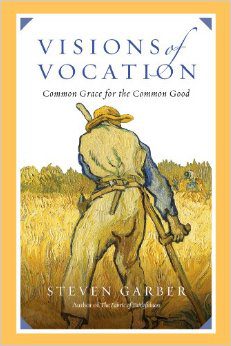 Taken from Visions of Vocation by Steven Garber. Copyright (c) 2014 by Steven Garber. Used by permission of InterVarsity Press, P.O. Box 1400, Downers Grove, IL 60515-1426. www.ivpress.com
Previous Post

June 24, 2015
A friend who tried to save the world
Next Post
August 5, 2015 Seeing Ourselves As Implicated
Browse Our Archives
Select a Category Book Excerpts Book Reviews Community Conferences Dear Steve Economics Meaning Movie Review Uncategorized Vocation
Select a Month March 2016 February 2016 January 2016 December 2015 November 2015 October 2015 September 2015 August 2015 July 2015 June 2015 May 2015 April 2015 March 2015 February 2015 January 2015 December 2014 November 2014 October 2014 September 2014 August 2014 July 2014 June 2014 May 2014 April 2014 March 2014 February 2014 January 2014
Follow Us!
TAKE THE
Religious Wisdom Quiz
What structure did people build to try to reach heaven?
Select your answer to see how you score.
Tower of Babel Altar of Baal Ark Temple of Solomon
Related posts from Visions of Vocation



Three Words We Should Care More About

"Joy" and the Power of a Dream
TRENDING AT PATHEOS Careers, Workplace and Religion

St. Francis by Bill Droel Pope Leo XIV declares 2026 as “Year...

Catholics are schooled in the faith by memorizing dogmatic points and lots...

The Good News of Our Human Limitations -...
After another day of trying to meet deadlines and working on projects,...

Quiet Holy Attentiveness (podcast) with Sarah Clarkson
We know that quiet is an essential aspect of the spiritual life,...

Every Vocation Everywhere All At Once
What is a vocation? How does it endure through the years? Can...

I promise this is not going to become a Taylor Swift Studies...
view all Careers, Workplace and Religion blogs
Ad-Free & Subscriber Log-In Subscription Support
- About Us
- 2026 Calendar
- Videos
- Podcasts
- Library of World Religions
- Faith In Media Tracker
- Advertise With Us
- Write for Us
- Privacy Policy
- Terms of Service
- Do Not Sell My Data
- Contact Us
- Radiant Digital
- Manage Newsletter Subscriptions
- Unsubscribe From Notifications
- Sitemap
Copyright 2008-2026, Patheos. All rights reserved.
Subscription Support Ad-Free & Subscriber Log-In
Follow Patheos