
BuddhistCatholicContemplativeEvangelicalGeneral ChristianHinduJewishLatter-day SaintMuslimNew VisionsProgressive Christian
Beliefs
- Buddhist
- Catholic
- Contemplative
- Evangelical
- General Christian
- Hindu
- Jewish
- Latter-day Saint
- More Voices
- Muslim
- New Visions
- Pagan
- Progressive Christian
Topics
- Religion News
- Food and Religion
- Sports and Religion
- Religious Art
- Religious Music and Entertainment
- Religious Events
- History and Religion
- Style and Religion
- Politics and Religion
- Women in Religion
- Recreation Outdoors and Religion
- Business Finance and Religion
- Careers Workplace and Religion
- Education and Religion
- Family Parenting and Religion
- Health Fitness and Religion
- Home and Religion
- Relationships and Religion
- Technology and Religion
- Travel and Religion
Columnists
- Buddhist Columnists
- Business Finance and Religion Columnists
- Careers Workplace and Religion Columnists
- Catholic Columnists
- Contemplative Columnists
- Education and Religion Columnists
- Evangelists Columnists
- Family Parenting and Religion Columnists
- General Christian Columnists
- Health Fitness and Religion Columnists
- Hindu Columnists
- History and Religion Columnists
- Home and Religion Columnists
- Jewish Columnists
- More Voices Columnists
- Latter Day Columnists
- Muslim Columnists
- New Visions Columnists
- Nonreligious Columnists
- Pagan Columnists
- Politics and Religion Columnists
- Progressive Columnists
- Recreation Outdoors and Religion Columnists
- Relationships and Religion Columnists
- Religion News Columnists
- Religious Art Columnists
- Religious Events Columnists
- Religious Music and Entertainment Columnists
- Sports and Religion Columnists
- Style and Religion Columnists
- Technology and Religion Columnists
- Travel and Religion Columnists
- Women in Religion Columnists
Resource Library
- 2026 Calendar
- Library of World Religions
- The 100 Most Holy Places on Earth
- Patheos Answers
- Podcasts
- Videos
- Faith Leaders Database
- Anglican Episcopalian
- Bahai
- Baptist
- Buddhism
- Christianity
- Confucianism
- Eastern Orthodoxy
- Hinduism
- Holiness and Pentecostal
- ISKCON
- Islam
- Judaism
- Lutheran
- Methodist
- The Church of Jesus Christ of Latter-day Saints
- New Age
- Paganism
- Presbytarian and Reformed
- Protestantism
- Religion Behind the Scenes
- Roman Catholic
- Scientology
- Shia Islam
- Sikhism
- Sufism
- Sunni Islam
- Taoism
- Zen
- See all religions
Research Tools
 Ad-Free & Subscriber Log-In Subscription Support
Ad-Free & Subscriber Log-In Subscription Support
Follow Patheos 

- Trending:
- Forgiveness
- |
- Marriage
- |
- Consciousness
- |
- Death Penalty
- |
- Election
- |
- Halloween
 UU Collective
- Home
- New Visions
- Circles of Concern: How to Talk Politics
Circles of Concern: How to Talk Politics
Last updated on: February 1, 2017 at 2:32 pm by Lynn Ungar
Circles of Concern: How to Talk Politics 2017-02-01T14:32:53-07:00 Lynn Ungar
Patheos Explore the world's faith through different perspectives on religion and spirituality! Patheos has the views of the prevalent religions and spiritualities of the world.
The bad news is…well, there’s a hell of a lot of it. But the good news is that many people are choosing to engage in politics and protest in a way they never have before. Which is awesome, and the main thing that gives me hope these days. But the thing is, like anything else you’ve never done before, it’s easy to engage awkwardly and feel ineffective or get chastised by someone who you identified as being on your side, and then feel discouraged. Which makes it harder, rather than easier, to take the next bold step.
We need to be in conversation. We need to be in difficult conversations about oppression and liberation, and we need to be in difficult conversations with people we love who hold convictions that we find abhorrent. We need protests and immediate action, but we also need the long-term, profound change that only happens through people talking with one another through their differences.
So how do we do that? I think that we could start by understanding that we need different conversations with different people. To help clarify this, I have actually made a picture. If you don’t know me, you don’t know how remarkable this is. This is how committed I am to this conversation. I actually made a picture. I didn’t say it was a good picture.
But here’s the point of the picture: We all come into conversations from a different perspective. Some of us have been activists for years and some of us are just coming in. Some of us are extremely threatened personally by present political realities, some of us are worried about our loved ones and some of us are concerned for society in general. And, of course, some of us aren’t concerned at all. My circles of concern aren’t meant to be an absolute declaration of who belongs where, but rather to suggest what I’m talking about in general. It’s up to you to figure out what circle of concern you belong to.
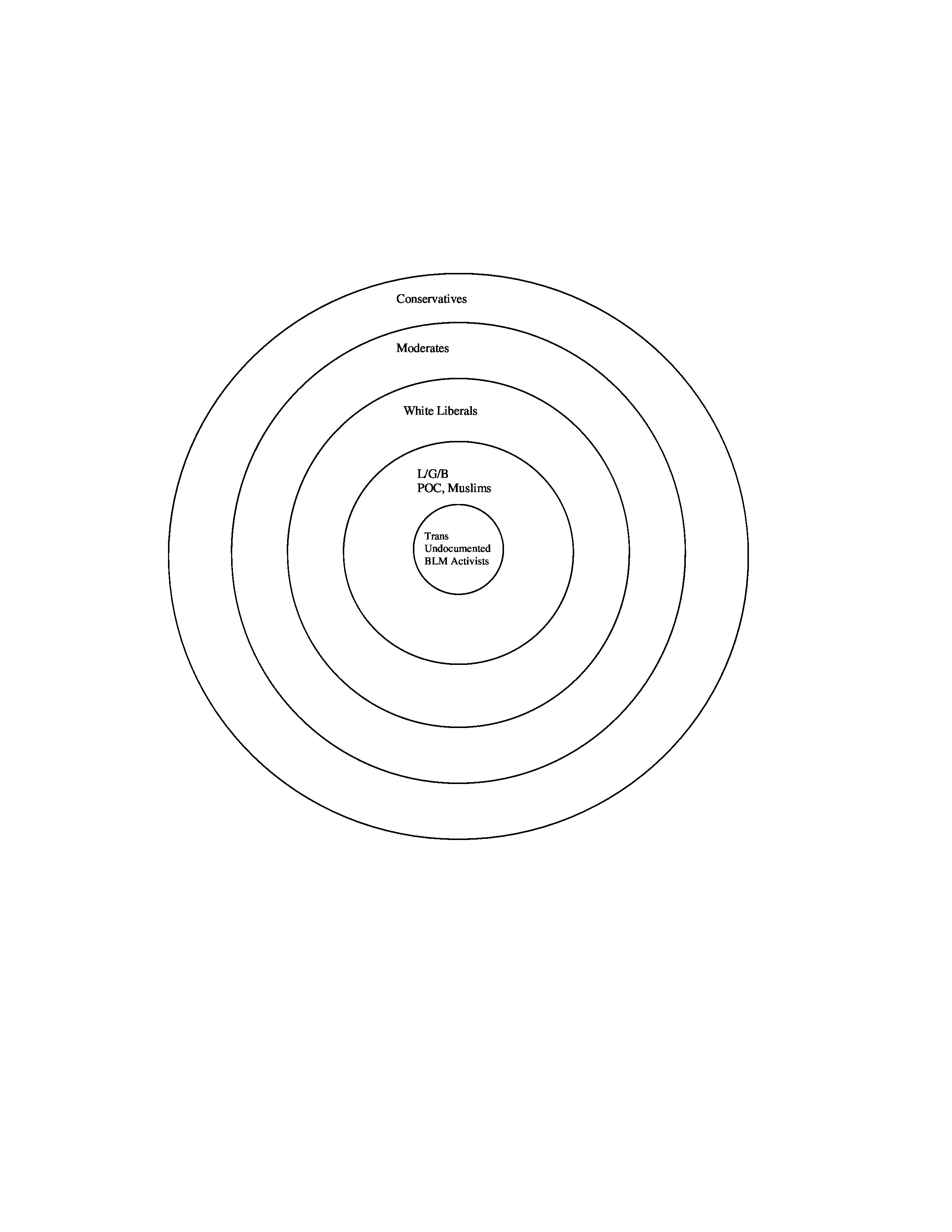
As I have it (labeled in print so small as to be completely indistinguishable) there is an innermost circle including undocumented immigrants, trans people and Black Lives Matter activists—which is to say any people whose experience of oppression is intense, ongoing and potentially life-threatening, and people who have already committed to activism as a lifestyle which involves risking life and limb.
The next circle out includes people of color, documented immigrants, Muslims, lesbians, gays, bisexuals…anyone who belongs to a group that not only stands to lose from this administration but also has reason to fear escalated levels of hate crimes. Recently, Jews seem to fall into this category as well. These are people who likely have had to deal with prejudice on a personal basis and may well have experience fighting for their civil rights.
The next circle out would be straight, cis-gender, white liberals and progressives. The circle outside that contains moderates/undecideds/apolitical folk. Conservatives go in the outmost ring. Again, for any of these circles you could argue about who belongs where, and make distinctions based on income, class status growing up, etc., etc. That’s kind of not the point. Make your own judgment about what circles you and the people you know occupy (and be ready to re-evaluate). Also, all of these circles presume different perspectives but with basic good faith. There is no circle for trolls and bigots. Some conversations just aren’t worth having, unless it’s a situation in which it matters that other people see that the bigot/troll perspective is not the only one.
OK, now that all that is set up, here are the guidelines. They are pretty straightforward. I use “in” to refer to moving toward the center of the concentric circles, and “out” for moving toward the larger circles.
1) Listen in. Listen to and learn from the people who are in circles further toward the center than you. Listen as far in as you can. Read books, read blogs, talk to friends. But listen. Listening does not mean that you have to agree. You don’t. But listen first, and if you need to muster arguments, do that later. And don’t bring those arguments back to the people in the center circle. Odds are very good they don’t want to hear it. Listen, learn, and if something makes you uncomfortable, just sit with that. It’s OK to be uncomfortable and just observe that. Deciding who is right and who is wrong is less important than you might think in this situation.
2) Complain and seek support across. It’s fine to vent, and to ask people to reassure you. Do that with people who are inside your own personal circle. The people in circles further in from you are likely to be overwhelmed with their own problems, or resentful that you are just now coming to realize something that they’ve been dealing with for a long time. The people in circles further out are likely to not get what you’re talking about, and tell you why you shouldn’t be upset. With people from your own circle you have the best chance of being met and understood and comforted.
3) Request one circle out. There are a lot of people of good will who don’t know what to do. Really, none of us does in any absolute way. Sure, you can resent people who came to this more recently than you, or seem clueless, but that doesn’t change anyone’s behavior. Go to one circle out from you to bring people in. Be as concrete as possible. Would you come with me to this protest? Would you call your senator at this number? Would you donate to this organization? Would you bring pizza to this sit-in? The clearer and more specific you can be about what you want, the more likely you are to get it. And the more likely the person who you ask will feel good about your request and their ability to participate. Which makes them more likely to participate the next time, even with more difficult tasks.
4) Tell stories two circles out. People two circles out from you aren’t necessarily ready for a request. You might be coming from very different perspectives. The best way to connect is to use your own story to explain your fears and hopes. Listen to the story of the person you are talking with. Again, you don’t have to agree in order to listen. Prioritize telling and hearing stories over convincing the person. Ironically, hearing one another’s stories is about the only way to change someone’s point of view.
None of us can do everything. All of us can do something. But let’s do what we can in the ways that are likely to be the most effective, and the most joyful. If you can approach creating change with a spirit of both curiosity and creativity you will have brought your very best tools to this work that can change your own life, as well as the country as a whole.
Previous Post

January 31, 2017
Blessing the Organizers
Next Post

February 2, 2017 Building Walls, Banning the Human
Browse Our Archives
Select a Category #9/11 Abortion Class community conflict Digital Life Diversity Divorce Environmental issues Evangelism Faith Development Foregiveness Garden glbt Gratitude Grief Healing health care Holidays Hospitality Interfaith LGBT Issues Military Service Mortality Orlando Parenting Peace Politics Power Prayer Racism Relationships Religion Scripture Senior citizens Sermons simplicity Social Justice Spirituality Sports Sustainability Uncategorized Unitarian Universalist Values Women's Issues World Community Worship
Select a Month August 2017 July 2017 June 2017 May 2017 April 2017 March 2017 February 2017 January 2017 December 2016 November 2016 October 2016 September 2016 August 2016 July 2016 June 2016 May 2016 April 2016 March 2016 February 2016 January 2016 December 2015 November 2015 October 2015 September 2015 August 2015 July 2015 June 2015 May 2015 April 2015 March 2015 February 2015 January 2015 December 2014 November 2014 October 2014 September 2014 August 2014 July 2014 June 2014 May 2014 April 2014 March 2014 February 2014 January 2014 December 2013 November 2013 October 2013 September 2013 August 2013 July 2013 June 2013 May 2013 April 2013 March 2013 February 2013 January 2013 December 2012 November 2012 October 2012 September 2012 August 2012 July 2012 June 2012 May 2012
Follow Us!
TAKE THE
Religious Wisdom Quiz
Which city did the believers first call themselves "Christians"?
Select your answer to see how you score.
Rome Jerusalem Antioch Corinth
Related posts from UU Collective

#Charlottesville and Getting Real

On the Suppression of Knowledge

#Epicurus and Atomic Moderation

Steal Your Fire, Drink Your Tea
TRENDING AT PATHEOS New Visions

Did Prayer Cure His Cancer? Or Was It...
At 4 AM one morning, Joshua W. Brown’s wife awoke to a...

8 Ways a Near-Death Experience Rewires the Soul
Does Consciousness Survive Physical Death? After 50 Years of Research, Dr. Raymond...

Holy Longing: What Our Restlessness Is Telling Us
“One can find so many pains when the rain is falling.” -John...

What this is NOT about. This blog is definitely not about...

Who said the Israelites were God’s chosen? That’s right, they did. Who...

The Spirit World Is the Real World: God...
A Monk’s Wisdom on Body and Spirit I sit with Brother Martin...
view all New Visions blogs
Ad-Free & Subscriber Log-In Subscription Support
- About Us
- 2026 Calendar
- Videos
- Podcasts
- Library of World Religions
- Faith In Media Tracker
- Advertise With Us
- Write for Us
- Privacy Policy
- Terms of Service
- Do Not Sell My Data
- Contact Us
- Radiant Digital
- Manage Newsletter Subscriptions
- Unsubscribe From Notifications
- Sitemap
Copyright 2008-2026, Patheos. All rights reserved.
Subscription Support Ad-Free & Subscriber Log-In
Follow Patheos