
BuddhistCatholicContemplativeEvangelicalGeneral ChristianHinduJewishLatter-day SaintMuslimNew VisionsProgressive Christian
Beliefs
- Buddhist
- Catholic
- Contemplative
- Evangelical
- General Christian
- Hindu
- Jewish
- Latter-day Saint
- More Voices
- Muslim
- New Visions
- Pagan
- Progressive Christian
Topics
- Religion News
- Food and Religion
- Sports and Religion
- Religious Art
- Religious Music and Entertainment
- Religious Events
- History and Religion
- Style and Religion
- Politics and Religion
- Women in Religion
- Recreation Outdoors and Religion
- Business Finance and Religion
- Careers Workplace and Religion
- Education and Religion
- Family Parenting and Religion
- Health Fitness and Religion
- Home and Religion
- Relationships and Religion
- Technology and Religion
- Travel and Religion
Columnists
- Buddhist Columnists
- Business Finance and Religion Columnists
- Careers Workplace and Religion Columnists
- Catholic Columnists
- Contemplative Columnists
- Education and Religion Columnists
- Evangelists Columnists
- Family Parenting and Religion Columnists
- General Christian Columnists
- Health Fitness and Religion Columnists
- Hindu Columnists
- History and Religion Columnists
- Home and Religion Columnists
- Jewish Columnists
- More Voices Columnists
- Latter Day Columnists
- Muslim Columnists
- New Visions Columnists
- Nonreligious Columnists
- Pagan Columnists
- Politics and Religion Columnists
- Progressive Columnists
- Recreation Outdoors and Religion Columnists
- Relationships and Religion Columnists
- Religion News Columnists
- Religious Art Columnists
- Religious Events Columnists
- Religious Music and Entertainment Columnists
- Sports and Religion Columnists
- Style and Religion Columnists
- Technology and Religion Columnists
- Travel and Religion Columnists
- Women in Religion Columnists
Resource Library
- 2026 Calendar
- Library of World Religions
- The 100 Most Holy Places on Earth
- Patheos Answers
- Podcasts
- Videos
- Faith Leaders Database
- Anglican Episcopalian
- Bahai
- Baptist
- Buddhism
- Christianity
- Confucianism
- Eastern Orthodoxy
- Hinduism
- Holiness and Pentecostal
- ISKCON
- Islam
- Judaism
- Lutheran
- Methodist
- The Church of Jesus Christ of Latter-day Saints
- New Age
- Paganism
- Presbytarian and Reformed
- Protestantism
- Religion Behind the Scenes
- Roman Catholic
- Scientology
- Shia Islam
- Sikhism
- Sufism
- Sunni Islam
- Taoism
- Zen
- See all religions
Research Tools
 Ad-Free & Subscriber Log-In Subscription Support
Ad-Free & Subscriber Log-In Subscription Support
Follow Patheos 

- Trending:
- Forgiveness
- |
- Marriage
- |
- Consciousness
- |
- Death Penalty
- |
- Election
- |
- Halloween
 UU Collective
- Home
- New Visions
- Five Reasons to Congregate in a Congregation
Five Reasons to Congregate in a Congregation
Last updated on: September 10, 2015 at 8:49 am by David Breeden
Five Reasons to Congregate in a Congregation 2015-09-10T08:49:20-06:00 David Breeden
Patheos Explore the world's faith through different perspectives on religion and spirituality! Patheos has the views of the prevalent religions and spiritualities of the world.
Why bother joining a congregation rather than, oh, say, a bowling league?
1. To meet people.
OK, yes it’s true that you will meet new people by joining a bowling league as well, but by joining a particular sort of congregation, you will find a particular sort of people. In Unitarian Universalist congregations, and particularly in Humanist congregations, you will meet people who put integrity above comfort—because, let’s face it, belonging to a more traditional congregation is more comfortable. When someone says, “I’m a Methodist,” an entire set of beliefs and commitments can go unsaid. Methodists are an understandable brand. UUs, Humanists, agnostics, atheists . . . we get asked follow-up questions.
The people who bother to get up on a Sunday morning tend to be edgy people who want to meet other edgy people, edgy people thinking waaaaay outside the box. If we are your tribe, welcome. If we’re not . . . thanks for visiting and I hope you find what you need elsewhere.
2. To learn stuff.
We are often the object of fun for saying we want intellectual stimulation, but some of us actually do. Perhaps the laughter comes from a misunderstanding of what we mean by intellectual stimulation. We agree with activist and educator Bell Hooks who said, “To build community requires vigilant awareness of the work we must continually do to undermine all the socialization that leads us to behave in ways that perpetuate domination.”
Becoming vigilantly aware. Now that’s intellectual stimulation. We aren’t looking for intellectual answers. In fact, we’re not going to be taking anyone else’s answers anyway.
We aren’t interested in having more facts piled higher and deeper or hearing rehashes of conventional thought. We want vigilant awareness.
How often does your bowling league discuss the causes and solutions of social oppressions?
3. To share life’s milestones.
We gather in community because we are looking for a real community, a community with the goal of being as real as it gets.
In real life there is illness; suffering; disabilities; aging; oppressions of various sorts. We gather to share both the joys and the sorrows of life.
Sociologists David W. McMillan and David M. Chavis, who focused their careers on the concept of community, said,
“Sense of community is a feeling that members have of belonging, a feeling that members matter to one another and to the group, and a shared faith that members’ needs will be met through their commitment to be together.”
The trust that comes of committing to being together through life’s thicks and thins. Unitarian writer Kurt Vonnegut said, “the most daring thing is to create stable communities in which the terrible disease of loneliness can be cured.”
That is a laudable goal. Congregations achieve it.
Bowling leagues? Perhaps you’ll get a beer for your birthday.
4. To model the struggle.
We struggle with our own sense of self; we struggle with meaning and purpose; we struggle to achieve justice. In community we see others struggling, and we learn something about ourselves and our capacities.
Sociologist Emile Durkheim claimed that, “Man cannot become attached to higher aims and submit to a rule if he sees nothing above him to which he belongs. To free him from all social pressure is to abandon him to himself and demoralize him.”
Congregational community requires that we listen to each other; that we respect the thoughts of others. What of hope? What about aspiration? What can we actually do about global climate change?
Congregational community requires that each of us sees other people as people, as valid as ourselves. That we see others as ends, not means. Congregational community asks that you be you. From this matrix, possibilities are born.
Communities have entrance fees, if you will. In the case of congregations, that cost is a commitment to listen to others. Congregational communities are not the place for pontificating; or mansplaining; or whitesplaining; or this-is-the-way-it-is—splaining.
If we can’t build the sort of community we say we wish to see in the wider culture and the world, why bother? Community is a struggle. It starts with us.
A serious community does not replicate the familiar and habitual community outside. Inasmuch as we reproduce the wider culture, we are failing in the practice of community.
Outside community is built on distinctions and exclusions—those who are in; those who are out; the successful and unsuccessful; the desirable and the undesirable; those like us and those not like us.
When congregational community is working, no one is excluded; no one is treated as a means to an end.
In bowling leagues, you get a tee shirt.
5. To change the world.
Why not join a bowling league instead of a congregation? Well, if you enjoy bowling, by all means you should join a bowling league. BUT if you are an edgy thinker who wishes to better yourself and the world around you, you should join in more intentional communities as well—a community searching for that higher ideal, a community searching for what is good and true. Only in community may we hope to change our world for the better.
In community we learn to forego the attempt to convince others of our own narratives. We stop expecting others to mirror our opinions. True community is where we have a meeting of the minds, not a melding of the minds. True community is a safe place to share dangerous ideas.
Have fun bowling; or playing chess; or a great on-line game. But perhaps I’ll see you Sunday.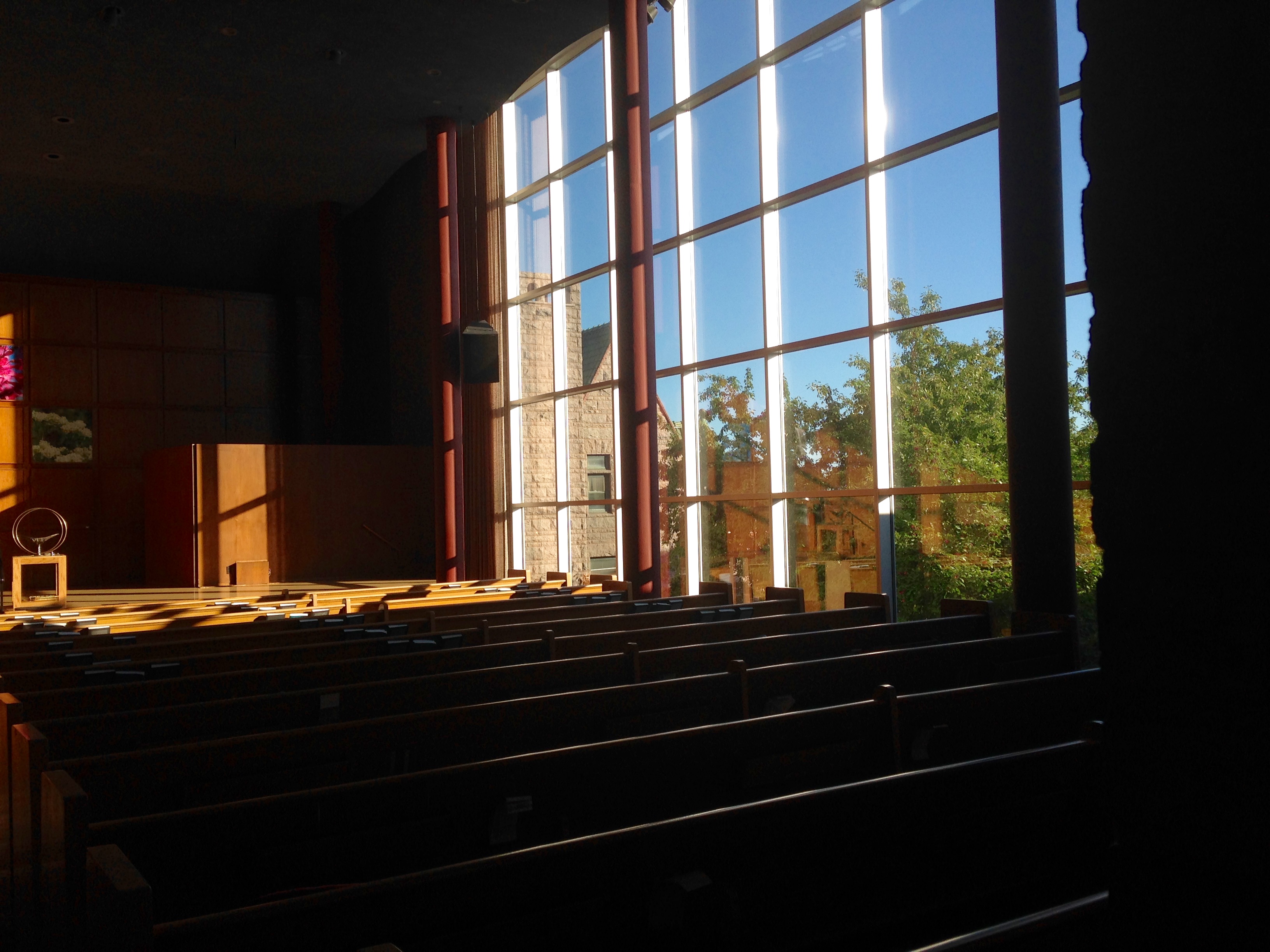
Previous Post

September 8, 2015
A little respite for our souls...
Next Post
September 15, 2015 In this time of intense polarization
Browse Our Archives
Select a Category #9/11 Abortion Class community conflict Digital Life Diversity Divorce Environmental issues Evangelism Faith Development Foregiveness Garden glbt Gratitude Grief Healing health care Holidays Hospitality Interfaith LGBT Issues Military Service Mortality Orlando Parenting Peace Politics Power Prayer Racism Relationships Religion Scripture Senior citizens Sermons simplicity Social Justice Spirituality Sports Sustainability Uncategorized Unitarian Universalist Values Women's Issues World Community Worship
Select a Month August 2017 July 2017 June 2017 May 2017 April 2017 March 2017 February 2017 January 2017 December 2016 November 2016 October 2016 September 2016 August 2016 July 2016 June 2016 May 2016 April 2016 March 2016 February 2016 January 2016 December 2015 November 2015 October 2015 September 2015 August 2015 July 2015 June 2015 May 2015 April 2015 March 2015 February 2015 January 2015 December 2014 November 2014 October 2014 September 2014 August 2014 July 2014 June 2014 May 2014 April 2014 March 2014 February 2014 January 2014 December 2013 November 2013 October 2013 September 2013 August 2013 July 2013 June 2013 May 2013 April 2013 March 2013 February 2013 January 2013 December 2012 November 2012 October 2012 September 2012 August 2012 July 2012 June 2012 May 2012
Follow Us!
TAKE THE
Religious Wisdom Quiz
How many chapters are in the book of Luke?
Select your answer to see how you score.
20 28 24 22
Related posts from UU Collective

#Charlottesville and Getting Real

On the Suppression of Knowledge

#Epicurus and Atomic Moderation

Steal Your Fire, Drink Your Tea
TRENDING AT PATHEOS New Visions

Did Prayer Cure His Cancer? Or Was It...
At 4 AM one morning, Joshua W. Brown’s wife awoke to a...

8 Ways a Near-Death Experience Rewires the Soul
Does Consciousness Survive Physical Death? After 50 Years of Research, Dr. Raymond...

Holy Longing: What Our Restlessness Is Telling Us
“One can find so many pains when the rain is falling.” -John...

What this is NOT about. This blog is definitely not about...

Who said the Israelites were God’s chosen? That’s right, they did. Who...

The Spirit World Is the Real World: God...
A Monk’s Wisdom on Body and Spirit I sit with Brother Martin...
view all New Visions blogs
Ad-Free & Subscriber Log-In Subscription Support
- About Us
- 2026 Calendar
- Videos
- Podcasts
- Library of World Religions
- Faith In Media Tracker
- Advertise With Us
- Write for Us
- Privacy Policy
- Terms of Service
- Do Not Sell My Data
- Contact Us
- Radiant Digital
- Manage Newsletter Subscriptions
- Unsubscribe From Notifications
- Sitemap
Copyright 2008-2026, Patheos. All rights reserved.
Subscription Support Ad-Free & Subscriber Log-In
Follow Patheos