
BuddhistCatholicContemplativeEvangelicalGeneral ChristianHinduJewishLatter-day SaintMuslimNew VisionsProgressive Christian
Beliefs
- Buddhist
- Catholic
- Contemplative
- Evangelical
- General Christian
- Hindu
- Jewish
- Latter-day Saint
- More Voices
- Muslim
- New Visions
- Pagan
- Progressive Christian
Topics
- Religion News
- Food and Religion
- Sports and Religion
- Religious Art
- Religious Music and Entertainment
- Religious Events
- History and Religion
- Style and Religion
- Politics and Religion
- Women in Religion
- Recreation Outdoors and Religion
- Business Finance and Religion
- Careers Workplace and Religion
- Education and Religion
- Family Parenting and Religion
- Health Fitness and Religion
- Home and Religion
- Relationships and Religion
- Technology and Religion
- Travel and Religion
Columnists
- Buddhist Columnists
- Business Finance and Religion Columnists
- Careers Workplace and Religion Columnists
- Catholic Columnists
- Contemplative Columnists
- Education and Religion Columnists
- Evangelists Columnists
- Family Parenting and Religion Columnists
- General Christian Columnists
- Health Fitness and Religion Columnists
- Hindu Columnists
- History and Religion Columnists
- Home and Religion Columnists
- Jewish Columnists
- More Voices Columnists
- Latter Day Columnists
- Muslim Columnists
- New Visions Columnists
- Nonreligious Columnists
- Pagan Columnists
- Politics and Religion Columnists
- Progressive Columnists
- Recreation Outdoors and Religion Columnists
- Relationships and Religion Columnists
- Religion News Columnists
- Religious Art Columnists
- Religious Events Columnists
- Religious Music and Entertainment Columnists
- Sports and Religion Columnists
- Style and Religion Columnists
- Technology and Religion Columnists
- Travel and Religion Columnists
- Women in Religion Columnists
Resource Library
- 2026 Calendar
- Library of World Religions
- The 100 Most Holy Places on Earth
- Patheos Answers
- Podcasts
- Videos
- Faith Leaders Database
- Anglican Episcopalian
- Bahai
- Baptist
- Buddhism
- Christianity
- Confucianism
- Eastern Orthodoxy
- Hinduism
- Holiness and Pentecostal
- ISKCON
- Islam
- Judaism
- Lutheran
- Methodist
- The Church of Jesus Christ of Latter-day Saints
- New Age
- Paganism
- Presbytarian and Reformed
- Protestantism
- Religion Behind the Scenes
- Roman Catholic
- Scientology
- Shia Islam
- Sikhism
- Sufism
- Sunni Islam
- Taoism
- Zen
- See all religions
Research Tools
 Ad-Free & Subscriber Log-In Subscription Support
Ad-Free & Subscriber Log-In Subscription Support
Follow Patheos 

- Trending:
- Forgiveness
- |
- Marriage
- |
- Consciousness
- |
- Death Penalty
- |
- Election
- |
- Halloween
 UU Collective
- Home
- New Visions
- On the Right to Take Up Space
On the Right to Take Up Space
Last updated on: August 6, 2015 at 6:09 am by David Breeden
On the Right to Take Up Space 2015-08-06T06:09:26-06:00 David Breeden
Patheos Explore the world's faith through different perspectives on religion and spirituality! Patheos has the views of the prevalent religions and spiritualities of the world.
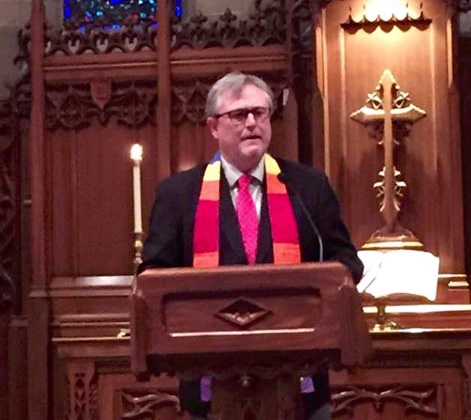
(homily for a prayer vigil for those murdered at Emanuel African Methodist Episcopal Church, Charleston, South Carolina)
I.
Power is about controlling space. Fundamentally, power is about controlling space.
Governments do it with borders.
Governments do it with armies and navies and air forces.
Governments do it with police.
Power is about controlling space.
In cities, take a look at the space: The bigger the space—the bigger the apartment or condo—the more expensive it is.
Power is about controlling space:
You can’t park here.
You can’t walk here.
You can’t sleep here.
You can’t spit here.
You can’t wash your face here.
There’s no toilet around here for you.
Power is about controlling space.
But here’s the thing: each and every human being takes up space.
The most radical thing a human being or a group of human beings can say is, “I take up space and I’m here.”
Feminist critic Soraya L. Chemaly wrote an article titled “Our Society Urges Girls To Take Up Less Space And Boys To Take Up More, And It Needs To Stop.”
And yes, the title pretty well sums up the article. Chemaly claims that girls are trained starting at a young age to—quote—“be as small as possible (so) we will love you more.” End quote.
The most radical thing a human being can do is say, “I’m here and I WILL take up my space.”
I’m female and I’m going to take up my space.
I’m gay and I’m going to take up my space.
I’m poor and I’m going to take up my space.
I’m black and I’m going to take up my space.
I’m an immigrant and I’m going to take up my space.
Freedom is all about whether or not you get to take up the space you need to inhabit.
I’m white. When I walk into a restaurant, they take one look at me and they surmise that I’ve got a credit card (that works) and so I’m welcome to take up their space.
That’s white privilege.
People don’t even tell me—nobody except my wife and my doctor—that I ought to go on a diet . . . because I’m taking up too much space.
That’s privilege: I’m here and nobody asks me why I’m taking up space. I have freedom.
I’m NOT bragging. I’m condemning. I’m calling out.
Because here’s the truth: I don’t have any more right to take up space than anybody else.
II.
James Carroll, a former Roman Catholic priest, recently published a book titled Christ Actually.
The title comes from a letter that the Christian theologian Dietrich Bonhoeffer wrote from has jail cell as he awaited execution by the Nazis. Bonhoeffer wrote,
What is Christianity, or who is Christ actually for us today? The age when we could tell people that with words—whether with theological or pious words—is past . . .
Carroll sets out to answer Bonhoeffer’s question, “Who is Christ actually for us today?” by asking another question: “Who was Christ when he was alive.”
Carroll’s answer: He was Jesus, a poor Jewish Palestinian peasant executed by the Romans.
Then Carroll looks at the circumstances of the time the first Gospel, the Gospel of Mark, was written, which was sometime around the year 70 of the Common Era.
What was happening?
Well—the Roman siege of the city of Jerusalem was happening, an event that eventually led to the destruction of the Second Temple and the displacement of most Jews from Jerusalem and Palestine.
Why is that context important? For one thing, it re-contextualizes what we see in the Gospel of Mark. Jesus is a Jew executed by the Romans. Jesus is a Jew told by the Romans, “Your life does not matter. You have no right to take up space.”
During that long Roman siege of Jerusalem, the Romans crucified five hundred Jews per day. They set up crosses around the walls of Jerusalem and crucified Jews in order to send a message to the defenders of Jerusalem: Your Jewish lives do not matter. You have no right to take up space.
And the Romans didn’t clean up the mess at night. They left the crosses and the broken bodies on the crosses to rot. And, when Jerusalem fell, there were more than 10,000 crosses surrounding the city.
10,000 YOUR LIVES DO NOT MATTER signs.
What happens when we re-contextualize the crucifixion of Jesus into that context? Just another broken Jewish body . . . another person told “Your life does not matter. You have no right to take up space . . .”
To the Romans, Jesus—and all Jews—were taking up too much space in the wrong place. So the Romans took away the right of Jesus and Jews like him to take up space: took away their right to be fully human where and how they were.
. . . You see where I’m going with this. Let’s re-contextualize this yet again: where would that poor brown preaching peasant be today, in the United States?
Look at the carnage around us for the answer. Look at the crosses . . . in Ferguson and Charleston and Baltimore and Dallas and on and on . . . The crosses that say, “Your Black life doesn’t matter.
You have no right to take up space.”
Hear me: It’s not the cops.
It’s not even the crazy White Supremacists.
It wasn’t the Roman soldiers.
It’s governments that exist to control space.
It’s the dominant culture that refuses to see that Black Lives Matter
and that a young black man walking home from the store,
or a black woman driving to a job interview,
or a group studying the bible in a church basement . . .
have the right to take up space.
I don’t care if it’s your specific religion; or if it’s God; or if it’s Humanism . . . or morality or ethics . . . whatever motivates you, we all are obligated . . . obligated . . . to change the culture; to change the way space gets controlled; to work until Black Lives Matter and everyone, EVERYONE has the right to take up the space
it takes to be free in our world.
Power is about . . . controlling space. Love is about . . . giving space . . . just because . . .
Next Post

August 12, 2015 The Deciduous Universe
Browse Our Archives
Select a Category #9/11 Abortion Class community conflict Digital Life Diversity Divorce Environmental issues Evangelism Faith Development Foregiveness Garden glbt Gratitude Grief Healing health care Holidays Hospitality Interfaith LGBT Issues Military Service Mortality Orlando Parenting Peace Politics Power Prayer Racism Relationships Religion Scripture Senior citizens Sermons simplicity Social Justice Spirituality Sports Sustainability Uncategorized Unitarian Universalist Values Women's Issues World Community Worship
Select a Month August 2017 July 2017 June 2017 May 2017 April 2017 March 2017 February 2017 January 2017 December 2016 November 2016 October 2016 September 2016 August 2016 July 2016 June 2016 May 2016 April 2016 March 2016 February 2016 January 2016 December 2015 November 2015 October 2015 September 2015 August 2015 July 2015 June 2015 May 2015 April 2015 March 2015 February 2015 January 2015 December 2014 November 2014 October 2014 September 2014 August 2014 July 2014 June 2014 May 2014 April 2014 March 2014 February 2014 January 2014 December 2013 November 2013 October 2013 September 2013 August 2013 July 2013 June 2013 May 2013 April 2013 March 2013 February 2013 January 2013 December 2012 November 2012 October 2012 September 2012 August 2012 July 2012 June 2012 May 2012
Follow Us!
TAKE THE
Religious Wisdom Quiz
Who said: "Let us draw near to God with a sincere heart and with the full assurance that faith brings"?
Select your answer to see how you score.
Paul Peter John James
Related posts from UU Collective

#Charlottesville and Getting Real

On the Suppression of Knowledge

#Epicurus and Atomic Moderation

Steal Your Fire, Drink Your Tea
TRENDING AT PATHEOS New Visions

Did Prayer Cure His Cancer? Or Was It...
At 4 AM one morning, Joshua W. Brown’s wife awoke to a...

8 Ways a Near-Death Experience Rewires the Soul
Does Consciousness Survive Physical Death? After 50 Years of Research, Dr. Raymond...

Holy Longing: What Our Restlessness Is Telling Us
“One can find so many pains when the rain is falling.” -John...

What this is NOT about. This blog is definitely not about...

Who said the Israelites were God’s chosen? That’s right, they did. Who...

The Spirit World Is the Real World: God...
A Monk’s Wisdom on Body and Spirit I sit with Brother Martin...
view all New Visions blogs
Ad-Free & Subscriber Log-In Subscription Support
- About Us
- 2026 Calendar
- Videos
- Podcasts
- Library of World Religions
- Faith In Media Tracker
- Advertise With Us
- Write for Us
- Privacy Policy
- Terms of Service
- Do Not Sell My Data
- Contact Us
- Radiant Digital
- Manage Newsletter Subscriptions
- Unsubscribe From Notifications
- Sitemap
Copyright 2008-2026, Patheos. All rights reserved.
Subscription Support Ad-Free & Subscriber Log-In
Follow Patheos