
BuddhistCatholicContemplativeEvangelicalGeneral ChristianHinduJewishLatter-day SaintMuslimNew VisionsProgressive Christian
Beliefs
- Buddhist
- Catholic
- Contemplative
- Evangelical
- General Christian
- Hindu
- Jewish
- Latter-day Saint
- More Voices
- Muslim
- New Visions
- Pagan
- Progressive Christian
Topics
- Religion News
- Food and Religion
- Sports and Religion
- Religious Art
- Religious Music and Entertainment
- Religious Events
- History and Religion
- Style and Religion
- Politics and Religion
- Women in Religion
- Recreation Outdoors and Religion
- Business Finance and Religion
- Careers Workplace and Religion
- Education and Religion
- Family Parenting and Religion
- Health Fitness and Religion
- Home and Religion
- Relationships and Religion
- Technology and Religion
- Travel and Religion
Columnists
- Buddhist Columnists
- Business Finance and Religion Columnists
- Careers Workplace and Religion Columnists
- Catholic Columnists
- Contemplative Columnists
- Education and Religion Columnists
- Evangelists Columnists
- Family Parenting and Religion Columnists
- General Christian Columnists
- Health Fitness and Religion Columnists
- Hindu Columnists
- History and Religion Columnists
- Home and Religion Columnists
- Jewish Columnists
- More Voices Columnists
- Latter Day Columnists
- Muslim Columnists
- New Visions Columnists
- Nonreligious Columnists
- Pagan Columnists
- Politics and Religion Columnists
- Progressive Columnists
- Recreation Outdoors and Religion Columnists
- Relationships and Religion Columnists
- Religion News Columnists
- Religious Art Columnists
- Religious Events Columnists
- Religious Music and Entertainment Columnists
- Sports and Religion Columnists
- Style and Religion Columnists
- Technology and Religion Columnists
- Travel and Religion Columnists
- Women in Religion Columnists
Resource Library
- 2026 Calendar
- Library of World Religions
- The 100 Most Holy Places on Earth
- Patheos Answers
- Podcasts
- Videos
- Faith Leaders Database
- Anglican Episcopalian
- Bahai
- Baptist
- Buddhism
- Christianity
- Confucianism
- Eastern Orthodoxy
- Hinduism
- Holiness and Pentecostal
- ISKCON
- Islam
- Judaism
- Lutheran
- Methodist
- The Church of Jesus Christ of Latter-day Saints
- New Age
- Paganism
- Presbytarian and Reformed
- Protestantism
- Religion Behind the Scenes
- Roman Catholic
- Scientology
- Shia Islam
- Sikhism
- Sufism
- Sunni Islam
- Taoism
- Zen
- See all religions
Research Tools
 Ad-Free & Subscriber Log-In Subscription Support
Ad-Free & Subscriber Log-In Subscription Support
Follow Patheos 

- Trending:
- Forgiveness
- |
- Marriage
- |
- Consciousness
- |
- Death Penalty
- |
- Election
- |
- Halloween
 UU Collective
- Home
- New Visions
- Got…a new and bigger question?
Got…a new and bigger question?
Last updated on: June 22, 2014 at 11:19 pm by Rev. Heather Rion Starr
Got…a new and bigger question? 2014-06-22T23:19:12-06:00 Rev. Heather Rion Starr
Patheos Explore the world's faith through different perspectives on religion and spirituality! Patheos has the views of the prevalent religions and spiritualities of the world.
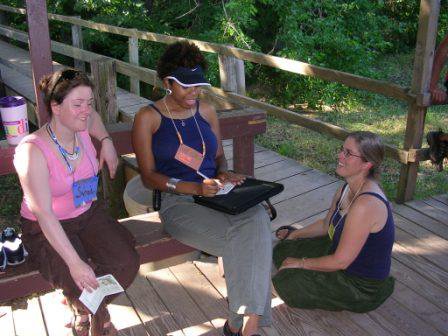
Young adults, myself on the right there, at a UU young adult spirituality conference (Opus) in 2005
Here’s the challenge: how to sum up a book which is about how faith communities can “bring young adults back” without carrying forward the assumption or premise on which the book begins — that that is a primary concern to our faith communities, how to “bring young people back?” That that should be what we are concerning ourselves with, how to bring young people back into “our” traditions?
I’ve really enjoyed and appreciated the insights of this book, Got Religion?, by Naomi Schaefer Riley. I’ve found myself telling people about Riley’s well-described conversations with young adults and sharing many of her rich insights, vivid accounts, and fascinating factoids (such as that Jesus never went beyond a forty-mile square area in his lifetime–how that single fact can convey so much about the differences between his time and most of our’s).
Yet I felt, at a number of points, that I wanted a larger, bigger-picture, broader conversation than one about how do we get young people to come…back. Is that what matters the most? As a parish minister in my late 30’s, of course, yes, I delight in seeing people in their twenties and thirties coming to church. But I long for something much more meaningful than just seeing younger faces in the group or crowd. I think lots of young people pass through or dip into spiritual communities throughout their twenties and thirties. What I want is for it to matter. What I want is for our spiritual lives to actually be rich and meaningful parts of our lives, not just about where we go once-in-a-while or whether or not we “join.”
Maybe it seems like a minor point, but it’s one I keep coming back to, over and over again throughout my experiences of ministry and congregational life: We all seem to get so focused on our particular setting or context or denomination and how to keep it alive, make it thrive. Too easily it seems we lose sight of the larger purpose that got us wanting to be a part of a community in the first place–to be there for one another, to be challenged and held and transformed ourselves and to be a part of that transformative experience for others. When we get mired in trying to keep the thing afloat, whether its form, we lose both our focus and our appeal.
That said, I can’t help but be a little frustrated that Riley does not include or even mention Unitarian Universalists in her study. I genuinely believe we create something unique in our congregations and gatherings–intergenerational community that is not concerned with everyone sharing the same understanding of God or needing to connect around shared God-language. I got excited about Riley’s chapter on a Charlotte-area collaborative of “forty or so” churches, but if its goal is truly to “reintroduce a generation to Christ and his bride, the church” (124), well, you’ve lost a whole lot of young people right there. That’s just too narrow of a goal for most of the thirty-somethings I know, and it sounds way too much like a Christianity 101 class.
There has to be some kind of middle path between trying to “get young people” to either join and support religious institutions the way they have been for decades or more, or throw our hands up and watch as “they” go off and form their own new kinds of communities and ways of connecting. I think part of the answer is, as always, looking at the initial questions we are asking, and at least rephrasing the question if not asking all new ones. Instead of “how do we get young people back?,” how about asking the young adults in our lives where they are finding community connection, how they/we are making new friends and figuring out ways to build community locally in our lives? Instead of “how can we get young people into leadership roles?,” how about asking young adults in our lives and communities what they/we would like to see happen in our larger city, state, country, or world, and how we can support them in doing that? Please share your questions to-be-asked in the “Comments” field. I’d love to read, ponder, and ask(!) them.
Previous Post

June 19, 2014
Making Sense of Life (or: Three Decorating Ideas for the Mind)
Next Post
June 26, 2014 Roadmaps for the Soul (or: Hunting, Gathering, Singing)
Browse Our Archives
Select a Category #9/11 Abortion Class community conflict Digital Life Diversity Divorce Environmental issues Evangelism Faith Development Foregiveness Garden glbt Gratitude Grief Healing health care Holidays Hospitality Interfaith LGBT Issues Military Service Mortality Orlando Parenting Peace Politics Power Prayer Racism Relationships Religion Scripture Senior citizens Sermons simplicity Social Justice Spirituality Sports Sustainability Uncategorized Unitarian Universalist Values Women's Issues World Community Worship
Select a Month August 2017 July 2017 June 2017 May 2017 April 2017 March 2017 February 2017 January 2017 December 2016 November 2016 October 2016 September 2016 August 2016 July 2016 June 2016 May 2016 April 2016 March 2016 February 2016 January 2016 December 2015 November 2015 October 2015 September 2015 August 2015 July 2015 June 2015 May 2015 April 2015 March 2015 February 2015 January 2015 December 2014 November 2014 October 2014 September 2014 August 2014 July 2014 June 2014 May 2014 April 2014 March 2014 February 2014 January 2014 December 2013 November 2013 October 2013 September 2013 August 2013 July 2013 June 2013 May 2013 April 2013 March 2013 February 2013 January 2013 December 2012 November 2012 October 2012 September 2012 August 2012 July 2012 June 2012 May 2012
Follow Us!
TAKE THE
Religious Wisdom Quiz
Why did Jesus wash His disciples' feet?
Select your answer to see how you score.
They asked Him to To show humble service Tradition only To clean them for eating
Related posts from UU Collective

#Charlottesville and Getting Real

On the Suppression of Knowledge

#Epicurus and Atomic Moderation

Steal Your Fire, Drink Your Tea
TRENDING AT PATHEOS New Visions

Did Prayer Cure His Cancer? Or Was It...
At 4 AM one morning, Joshua W. Brown’s wife awoke to a...

8 Ways a Near-Death Experience Rewires the Soul
Does Consciousness Survive Physical Death? After 50 Years of Research, Dr. Raymond...

Holy Longing: What Our Restlessness Is Telling Us
“One can find so many pains when the rain is falling.” -John...

What this is NOT about. This blog is definitely not about...

Who said the Israelites were God’s chosen? That’s right, they did. Who...

The Spirit World Is the Real World: God...
A Monk’s Wisdom on Body and Spirit I sit with Brother Martin...
view all New Visions blogs
Ad-Free & Subscriber Log-In Subscription Support
- About Us
- 2026 Calendar
- Videos
- Podcasts
- Library of World Religions
- Faith In Media Tracker
- Advertise With Us
- Write for Us
- Privacy Policy
- Terms of Service
- Do Not Sell My Data
- Contact Us
- Radiant Digital
- Manage Newsletter Subscriptions
- Unsubscribe From Notifications
- Sitemap
Copyright 2008-2026, Patheos. All rights reserved.
Subscription Support Ad-Free & Subscriber Log-In
Follow Patheos