
BuddhistCatholicContemplativeEvangelicalGeneral ChristianHinduJewishLatter-day SaintMuslimNew VisionsProgressive Christian
Beliefs
- Buddhist
- Catholic
- Contemplative
- Evangelical
- General Christian
- Hindu
- Jewish
- Latter-day Saint
- More Voices
- Muslim
- New Visions
- Pagan
- Progressive Christian
Topics
- Religion News
- Food and Religion
- Sports and Religion
- Religious Art
- Religious Music and Entertainment
- Religious Events
- History and Religion
- Style and Religion
- Politics and Religion
- Women in Religion
- Recreation Outdoors and Religion
- Business Finance and Religion
- Careers Workplace and Religion
- Education and Religion
- Family Parenting and Religion
- Health Fitness and Religion
- Home and Religion
- Relationships and Religion
- Technology and Religion
- Travel and Religion
Columnists
- Buddhist Columnists
- Business Finance and Religion Columnists
- Careers Workplace and Religion Columnists
- Catholic Columnists
- Contemplative Columnists
- Education and Religion Columnists
- Evangelists Columnists
- Family Parenting and Religion Columnists
- General Christian Columnists
- Health Fitness and Religion Columnists
- Hindu Columnists
- History and Religion Columnists
- Home and Religion Columnists
- Jewish Columnists
- More Voices Columnists
- Latter Day Columnists
- Muslim Columnists
- New Visions Columnists
- Nonreligious Columnists
- Pagan Columnists
- Politics and Religion Columnists
- Progressive Columnists
- Recreation Outdoors and Religion Columnists
- Relationships and Religion Columnists
- Religion News Columnists
- Religious Art Columnists
- Religious Events Columnists
- Religious Music and Entertainment Columnists
- Sports and Religion Columnists
- Style and Religion Columnists
- Technology and Religion Columnists
- Travel and Religion Columnists
- Women in Religion Columnists
Resource Library
- 2026 Calendar
- Library of World Religions
- The 100 Most Holy Places on Earth
- Patheos Answers
- Podcasts
- Videos
- Faith Leaders Database
- Anglican Episcopalian
- Bahai
- Baptist
- Buddhism
- Christianity
- Confucianism
- Eastern Orthodoxy
- Hinduism
- Holiness and Pentecostal
- ISKCON
- Islam
- Judaism
- Lutheran
- Methodist
- The Church of Jesus Christ of Latter-day Saints
- New Age
- Paganism
- Presbytarian and Reformed
- Protestantism
- Religion Behind the Scenes
- Roman Catholic
- Scientology
- Shia Islam
- Sikhism
- Sufism
- Sunni Islam
- Taoism
- Zen
- See all religions
Research Tools
 Ad-Free & Subscriber Log-In Subscription Support
Ad-Free & Subscriber Log-In Subscription Support
Follow Patheos 

- Trending:
- Forgiveness
- |
- Marriage
- |
- Consciousness
- |
- Death Penalty
- |
- Election
- |
- Halloween
 UU Collective
- Home
- New Visions
- Tinfoil Hats and the Examined Life
Tinfoil Hats and the Examined Life
Last updated on: May 22, 2014 at 5:31 am by David Breeden
Tinfoil Hats and the Examined Life 2014-05-22T05:31:23-06:00 David Breeden
Patheos Explore the world's faith through different perspectives on religion and spirituality! Patheos has the views of the prevalent religions and spiritualities of the world.
Let’s say I tell you I’m wearing a tinfoil hat today . . . What does that say to you? Crazy? Paranoid? Safe from the mental meddling of governments and/or extraterrestrials?
It’s shorthand, isn’t it? A tinfoil hat says crazy or paranoid or safe, not because of anything inherent in the tinfoil hat, but because we equate wearing a tinfoil hat with a set of behaviors that could be well described as crazy or paranoid or staying safe—“tinfoil hat” is a symbol for a set of beliefs—that, for example, space aliens or perhaps one government or another is sending messages into my brain by electric means.
The first known appearance of a tinfoil hat is in a science fiction story published in 1927 by the evolutionary biologist Julian Huxley. In that story, tinfoil hats prevent interference from mental telepathy.
Now, if you look for how tinfoil hats work on Yahoo Answers, you will discover this advice:
Tin foil does not work. I tried aluminum foil for my first thought screen helmet in 1998 and it was a failure. Thought screens made from velostat work. I’ve been making them since 1999 and sending them to abductees all over the world for free for 13 years.
https://answers.yahoo.com/question/index?qid=20121017081732AAn0A1T
Now, in case you’re like me and didn’t know, velostat is a packing material used to block electronic effects. So it goes.
I want to notice two things about this brief look at tinfoil hats. First, “tinfoil hat” has come to mean something way beyond merely a hat made of a particular material. And, second, how quickly we rocket from a discussion of tinfoil hats to a discussion of more efficient hats to evade thought surveillance.
Both of these things have to do with the human imagination. How the human imagination works. We make symbols. Then, often, we fall into the trap of treating a symbol as if it were a reality. We easily mistake symbols, and symbolic statements, for literal truths.
The simplest example is perhaps flags. We create a flag to symbolize a nation or some other grouping of people. Then we create rules and customs around how flags must be treated.
I’ve heard people debate whether a particular piece of cloth is a flag or only bunting—because you can burn bunting, but burning a flag might get you into trouble.
We create a symbol, then we treat the symbol as a reality. The flag becomes the nation. And so on.
Educator Hugh Mearns had something to say about this propensity back in 1899 when he wrote a poem in response to a brouhaha in the town of Antigonish, Nova Scotia concerning a ghost sighting. One of the poem’s verses goes like this:
Last night I saw upon the stair,
A little man who wasn’t there,
He wasn’t there again today
Oh, how I wish he’d go away…
It appears that we can make symbols of things that aren’t there at all. And then the symbol becomes a thing we can imagine.
We enter into pretend realms very early in childhood—you be Batman; I’ll be Joker. I’m an elephant. I’m a unicorn. When we play these games, we agree to certain rules. We agree to be bound by the logic of the game. Just as do the folks who wear tinfoil hats or who set out to make a better tinfoil hat. Or who imagine little men on stairs that aren’t there.
We can go to a murder mystery dinner party set in the 1920s and act as if we have murdered someone. Or act as if we are a Belgian detective. We can go to a Renaissance festival where corporate lawyers become barmaids and carpenters become knights.
We choose a game, we agree to obey the rules of the game, and then we act . . . as if.
This is how fiction works. There are all sorts of fictions, each written according to the rules of the game that the author asks us to play. Perhaps the novel is naturalistic—in that case, everything that happens will happen according to the observable and describable rules of the universe.
We can have “magical realism,” in which the world operates more or less as it does in our own world, but occasionally odd things happen—such as people flying away.
We can also have fantasy—that is, a world in which the rules we know do not apply. But even there, notice, there ARE rules of the game. Devotees of Star Trek or of the World of Warcraft will be quick to point out when an action goes outside the rules of that particular fantasy world.
We agree to the rules of a particular form of government. Or of economics. Of of religion. In these cases, usually, we have very little in the way of choice about playing the game—we are born in places where a set of games with rules are already in place—this is called culture and tradition.
Those who choose to ignore the rules are ostracized or punished. The rules of the games called culture and tradition often insist that you WILL see the little man on the stair—or at least say you do—, even if you cannot see the little man.
However, the difference between knowing you are playing a game with rules and thinking you are seeing reality are very different things, aren’t they?
Some games we choose, and some we don’t. No one is born wearing a tinfoil hat. Or saluting a particular flag. Or worshiping a particular god. Mostly, such games with their particular rules are forced upon us by geography or social status or educational attainment or mental health.
Am I really equating tin foil hats and patriotism, you might be asking. Yes, I am. Because I think the examined life requires that sort of examination. Until we see the games we are enmeshed in with some clarity, we have seen neither truth nor reality. We have not examined life.
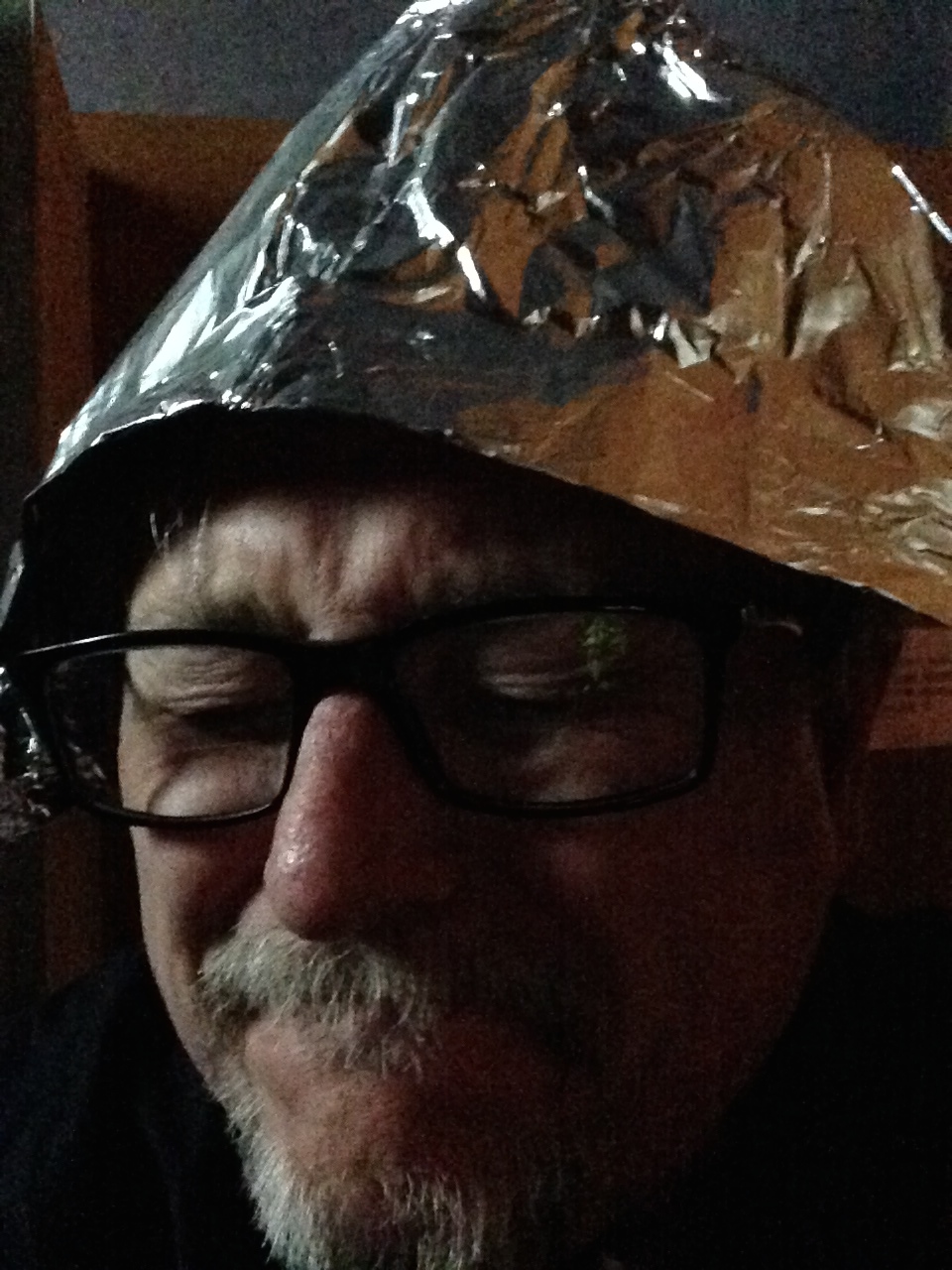 So, what’s your game? Do tinfoil hats come in handy?
Previous Post

May 19, 2014
Day One
Next Post
May 24, 2014 Day Two
Browse Our Archives
Select a Category #9/11 Abortion Class community conflict Digital Life Diversity Divorce Environmental issues Evangelism Faith Development Foregiveness Garden glbt Gratitude Grief Healing health care Holidays Hospitality Interfaith LGBT Issues Military Service Mortality Orlando Parenting Peace Politics Power Prayer Racism Relationships Religion Scripture Senior citizens Sermons simplicity Social Justice Spirituality Sports Sustainability Uncategorized Unitarian Universalist Values Women's Issues World Community Worship
Select a Month August 2017 July 2017 June 2017 May 2017 April 2017 March 2017 February 2017 January 2017 December 2016 November 2016 October 2016 September 2016 August 2016 July 2016 June 2016 May 2016 April 2016 March 2016 February 2016 January 2016 December 2015 November 2015 October 2015 September 2015 August 2015 July 2015 June 2015 May 2015 April 2015 March 2015 February 2015 January 2015 December 2014 November 2014 October 2014 September 2014 August 2014 July 2014 June 2014 May 2014 April 2014 March 2014 February 2014 January 2014 December 2013 November 2013 October 2013 September 2013 August 2013 July 2013 June 2013 May 2013 April 2013 March 2013 February 2013 January 2013 December 2012 November 2012 October 2012 September 2012 August 2012 July 2012 June 2012 May 2012
Follow Us!
TAKE THE
Religious Wisdom Quiz
Who was Mary's cousin?
Select your answer to see how you score.
Leah Sarah Elizabeth Rachel
Related posts from UU Collective

#Charlottesville and Getting Real

On the Suppression of Knowledge

#Epicurus and Atomic Moderation

Steal Your Fire, Drink Your Tea
TRENDING AT PATHEOS New Visions

Did Prayer Cure His Cancer? Or Was It...
At 4 AM one morning, Joshua W. Brown’s wife awoke to a...

8 Ways a Near-Death Experience Rewires the Soul
Does Consciousness Survive Physical Death? After 50 Years of Research, Dr. Raymond...

Holy Longing: What Our Restlessness Is Telling Us
“One can find so many pains when the rain is falling.” -John...

What this is NOT about. This blog is definitely not about...

Who said the Israelites were God’s chosen? That’s right, they did. Who...

The Spirit World Is the Real World: God...
A Monk’s Wisdom on Body and Spirit I sit with Brother Martin...
view all New Visions blogs
Ad-Free & Subscriber Log-In Subscription Support
- About Us
- 2026 Calendar
- Videos
- Podcasts
- Library of World Religions
- Faith In Media Tracker
- Advertise With Us
- Write for Us
- Privacy Policy
- Terms of Service
- Do Not Sell My Data
- Contact Us
- Radiant Digital
- Manage Newsletter Subscriptions
- Unsubscribe From Notifications
- Sitemap
Copyright 2008-2026, Patheos. All rights reserved.
Subscription Support Ad-Free & Subscriber Log-In
Follow Patheos