
BuddhistCatholicContemplativeEvangelicalGeneral ChristianHinduJewishLatter-day SaintMuslimNew VisionsProgressive Christian
Beliefs
- Buddhist
- Catholic
- Contemplative
- Evangelical
- General Christian
- Hindu
- Jewish
- Latter-day Saint
- More Voices
- Muslim
- New Visions
- Pagan
- Progressive Christian
Topics
- Religion News
- Food and Religion
- Sports and Religion
- Religious Art
- Religious Music and Entertainment
- Religious Events
- History and Religion
- Style and Religion
- Politics and Religion
- Women in Religion
- Recreation Outdoors and Religion
- Business Finance and Religion
- Careers Workplace and Religion
- Education and Religion
- Family Parenting and Religion
- Health Fitness and Religion
- Home and Religion
- Relationships and Religion
- Technology and Religion
- Travel and Religion
Columnists
- Buddhist Columnists
- Business Finance and Religion Columnists
- Careers Workplace and Religion Columnists
- Catholic Columnists
- Contemplative Columnists
- Education and Religion Columnists
- Evangelists Columnists
- Family Parenting and Religion Columnists
- General Christian Columnists
- Health Fitness and Religion Columnists
- Hindu Columnists
- History and Religion Columnists
- Home and Religion Columnists
- Jewish Columnists
- More Voices Columnists
- Latter Day Columnists
- Muslim Columnists
- New Visions Columnists
- Nonreligious Columnists
- Pagan Columnists
- Politics and Religion Columnists
- Progressive Columnists
- Recreation Outdoors and Religion Columnists
- Relationships and Religion Columnists
- Religion News Columnists
- Religious Art Columnists
- Religious Events Columnists
- Religious Music and Entertainment Columnists
- Sports and Religion Columnists
- Style and Religion Columnists
- Technology and Religion Columnists
- Travel and Religion Columnists
- Women in Religion Columnists
Resource Library
- 2026 Calendar
- Library of World Religions
- The 100 Most Holy Places on Earth
- Patheos Answers
- Podcasts
- Videos
- Faith Leaders Database
- Anglican Episcopalian
- Bahai
- Baptist
- Buddhism
- Christianity
- Confucianism
- Eastern Orthodoxy
- Hinduism
- Holiness and Pentecostal
- ISKCON
- Islam
- Judaism
- Lutheran
- Methodist
- The Church of Jesus Christ of Latter-day Saints
- New Age
- Paganism
- Presbytarian and Reformed
- Protestantism
- Religion Behind the Scenes
- Roman Catholic
- Scientology
- Shia Islam
- Sikhism
- Sufism
- Sunni Islam
- Taoism
- Zen
- See all religions
Research Tools
 Ad-Free & Subscriber Log-In Subscription Support
Ad-Free & Subscriber Log-In Subscription Support
Follow Patheos 

- Trending:
- Forgiveness
- |
- Marriage
- |
- Consciousness
- |
- Death Penalty
- |
- Election
- |
- Halloween
 UU Collective
- Home
- New Visions
- Reflections on death from the garden
Reflections on death from the garden
Last updated on: October 15, 2013 at 9:55 am by Meg Riley
Reflections on death from the garden 2013-10-15T09:55:11-06:00 Meg Riley
Patheos Explore the world's faith through different perspectives on religion and spirituality! Patheos has the views of the prevalent religions and spiritualities of the world.
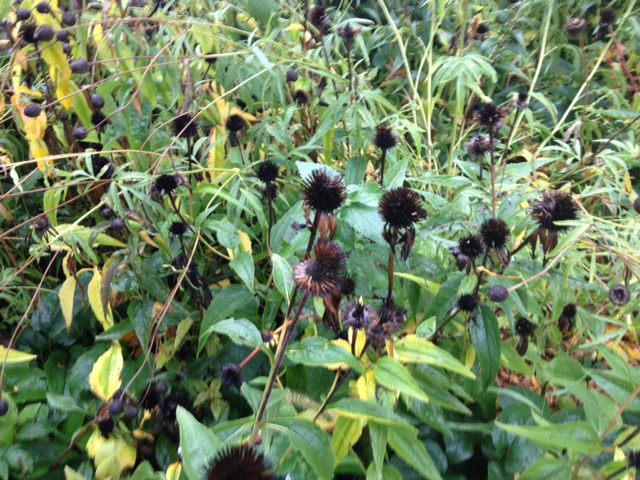
The echinacea, once vibrant pink, is now black.
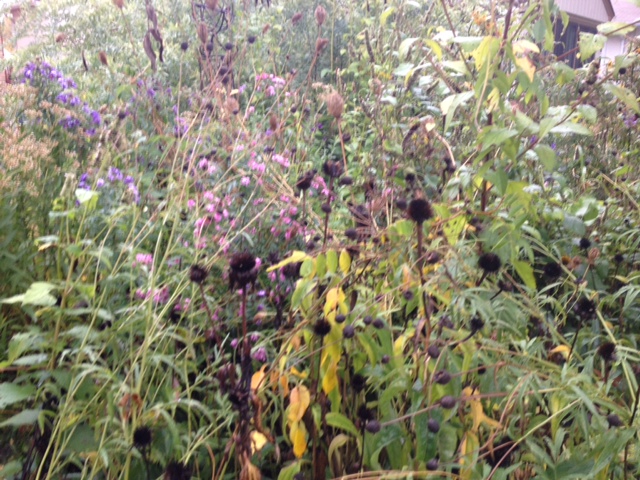
A friend told me that the word for aster in Hungarian means, literally, end of summer.
This time of year, as we approach Halloween, The Day of the Dead, and All Saints’ Day, I am often thinking of death. Granted, I am always a little bit morbid—my astrologer sister would say it’s because I’m a Scorpio. (I regret that I was too old to go Goth in my teen years, because I suspect I might have enjoyed that.) But right now, death is often lurking just under my mind’s surface.
My garden is one of the sources of my thoughts, and it is a place where there is plenty of room for such thoughts. This lovely, non-judgmental community of green friends, lets me think about whatever I fancy. And the garden is full of death. Every day I am pulling up or lopping off plants that have given their all—the perennials having given it for this year and likely to return, the annuals having lived their whole life in this one year. Farewell, I say to the enormous squash plant, as I pull it up and hold it by its roots. Farewell, I remember when you were just a seed!
The longer I garden, the more comfort I take in the ritual of going through the entire life cycle each year. I adore picking out seeds in the fall to plant in the spring. My grow light table in the basement has gotten bigger and bigger because having those tiny green babies means so much in March and early April, when the winter here in Minnesota has just gotten so long that I may go berserk if some tiny waft of a spring breeze doesn’t blow through, some tiny green weed doesn’t poke up under the snow. Tucking those seedlings into the May earth has all of the drama of sending my kid off to kindergarten, tucking tiny invisible notes into their invisible lunch boxes as I plant them. And then cheering for them in summer’s fullness as they grow up and begin to live out their life’s purpose—as zinnias’ shiny red petals glow in the sunlight, as basil or cilantro graces my table. And then, Minnesota fall means that all growing, all producing of food or flower, will cease for another long winter.
The more years I participate in this cycle, the more I love the dramatic resurrection stories so many of my plants tell me. Some are, simply, perennials, and I know as I cut them to the ground that they’ll bounce back in the spring, shiny green and new again. Others are busy throwing their seeds around the yard, winking at me and saying I’ll be impressed by their progeny. Other annuals are simply done, with no tales of regret to whisper in my ear as I say good-bye to them. All are amazing role models in giving it all away, in surrender, in generosity.
Some people believe that we’re perennials, that after our deaths, our souls reside eternally in one place or another. Some say we’ll be back, though perhaps in a different form. Whatever is and will be, I live my life as if I’m an annual—acting as if, if some part of me is to survive, it will be in the growth of the seeds I have sown in my lifetime.
With the help of wind, and birds, the exact location of the seeds which grow is unpredictable. Similarly, I don’t know which of the seeds I’ve sown will continue to bear their own seeds and keep growing after I’m gone. Given what I’ve seen in my life so far, my only prediction is that what of me keeps growing after I’m dead will be nothing I would ever predict.
My own mother, dead eleven years, increasingly comes back in memories that make me giggle. She wasn’t excessively funny when she was alive, but the memories of her humor are the ones that keep whispering in my ear now. Silly things she said forty years ago at dinner make me laugh out loud. This time of year she has more to say, I notice, as do other beloved ghosts. The pagans say that this is the time of year when the veil is thinnest between life and death, and in the garden, I feel that thinning all around me.
I don’t believe in a heaven in the sky, where St. Peter welcomes some and turns others away. But this time of year, in my garden, as the crows shout, squirrels scurry around, and geese fly over and honk their farewells, in the sweet grief of letting go and saying goodbye, I touch a tiny bit of heaven on earth.
Previous Post

October 12, 2013
Who does your heart break for?
Next Post
October 17, 2013 Here an Ist, There an Ist, Everywhere an Ist-Ist
Browse Our Archives
Select a Category #9/11 Abortion Class community conflict Digital Life Diversity Divorce Environmental issues Evangelism Faith Development Foregiveness Garden glbt Gratitude Grief Healing health care Holidays Hospitality Interfaith LGBT Issues Military Service Mortality Orlando Parenting Peace Politics Power Prayer Racism Relationships Religion Scripture Senior citizens Sermons simplicity Social Justice Spirituality Sports Sustainability Uncategorized Unitarian Universalist Values Women's Issues World Community Worship
Select a Month August 2017 July 2017 June 2017 May 2017 April 2017 March 2017 February 2017 January 2017 December 2016 November 2016 October 2016 September 2016 August 2016 July 2016 June 2016 May 2016 April 2016 March 2016 February 2016 January 2016 December 2015 November 2015 October 2015 September 2015 August 2015 July 2015 June 2015 May 2015 April 2015 March 2015 February 2015 January 2015 December 2014 November 2014 October 2014 September 2014 August 2014 July 2014 June 2014 May 2014 April 2014 March 2014 February 2014 January 2014 December 2013 November 2013 October 2013 September 2013 August 2013 July 2013 June 2013 May 2013 April 2013 March 2013 February 2013 January 2013 December 2012 November 2012 October 2012 September 2012 August 2012 July 2012 June 2012 May 2012
Follow Us!
TAKE THE
Religious Wisdom Quiz
What was the primary inheritance method in biblical times?
Select your answer to see how you score.
Firstborn son Youngest child Equal division Oldest daughter
Related posts from UU Collective

On the Suppression of Knowledge

Steal Your Fire, Drink Your Tea

The Danger is in Not Being You

TRENDING AT PATHEOS New Visions

Did Prayer Cure His Cancer? Or Was It...
At 4 AM one morning, Joshua W. Brown’s wife awoke to a...

8 Ways a Near-Death Experience Rewires the Soul
Does Consciousness Survive Physical Death? After 50 Years of Research, Dr. Raymond...

Holy Longing: What Our Restlessness Is Telling Us
“One can find so many pains when the rain is falling.” -John...

What this is NOT about. This blog is definitely not about...

Who said the Israelites were God’s chosen? That’s right, they did. Who...

The Spirit World Is the Real World: God...
A Monk’s Wisdom on Body and Spirit I sit with Brother Martin...
view all New Visions blogs
Ad-Free & Subscriber Log-In Subscription Support
- About Us
- 2026 Calendar
- Videos
- Podcasts
- Library of World Religions
- Faith In Media Tracker
- Advertise With Us
- Write for Us
- Privacy Policy
- Terms of Service
- Do Not Sell My Data
- Contact Us
- Radiant Digital
- Manage Newsletter Subscriptions
- Unsubscribe From Notifications
- Sitemap
Copyright 2008-2026, Patheos. All rights reserved.
Subscription Support Ad-Free & Subscriber Log-In
Follow Patheos