
BuddhistCatholicContemplativeEvangelicalGeneral ChristianHinduJewishLatter-day SaintMuslimNew VisionsProgressive Christian
Beliefs
- Buddhist
- Catholic
- Contemplative
- Evangelical
- General Christian
- Hindu
- Jewish
- Latter-day Saint
- More Voices
- Muslim
- New Visions
- Pagan
- Progressive Christian
Topics
- Religion News
- Food and Religion
- Sports and Religion
- Religious Art
- Religious Music and Entertainment
- Religious Events
- History and Religion
- Style and Religion
- Politics and Religion
- Women in Religion
- Recreation Outdoors and Religion
- Business Finance and Religion
- Careers Workplace and Religion
- Education and Religion
- Family Parenting and Religion
- Health Fitness and Religion
- Home and Religion
- Relationships and Religion
- Technology and Religion
- Travel and Religion
Columnists
- Buddhist Columnists
- Business Finance and Religion Columnists
- Careers Workplace and Religion Columnists
- Catholic Columnists
- Contemplative Columnists
- Education and Religion Columnists
- Evangelists Columnists
- Family Parenting and Religion Columnists
- General Christian Columnists
- Health Fitness and Religion Columnists
- Hindu Columnists
- History and Religion Columnists
- Home and Religion Columnists
- Jewish Columnists
- More Voices Columnists
- Latter Day Columnists
- Muslim Columnists
- New Visions Columnists
- Nonreligious Columnists
- Pagan Columnists
- Politics and Religion Columnists
- Progressive Columnists
- Recreation Outdoors and Religion Columnists
- Relationships and Religion Columnists
- Religion News Columnists
- Religious Art Columnists
- Religious Events Columnists
- Religious Music and Entertainment Columnists
- Sports and Religion Columnists
- Style and Religion Columnists
- Technology and Religion Columnists
- Travel and Religion Columnists
- Women in Religion Columnists
Resource Library
- 2026 Calendar
- Library of World Religions
- The 100 Most Holy Places on Earth
- Patheos Answers
- Podcasts
- Videos
- Faith Leaders Database
- Anglican Episcopalian
- Bahai
- Baptist
- Buddhism
- Christianity
- Confucianism
- Eastern Orthodoxy
- Hinduism
- Holiness and Pentecostal
- ISKCON
- Islam
- Judaism
- Lutheran
- Methodist
- The Church of Jesus Christ of Latter-day Saints
- New Age
- Paganism
- Presbytarian and Reformed
- Protestantism
- Religion Behind the Scenes
- Roman Catholic
- Scientology
- Shia Islam
- Sikhism
- Sufism
- Sunni Islam
- Taoism
- Zen
- See all religions
Research Tools
 Ad-Free & Subscriber Log-In Subscription Support
Ad-Free & Subscriber Log-In Subscription Support
Follow Patheos 

- Trending:
- Forgiveness
- |
- Marriage
- |
- Consciousness
- |
- Death Penalty
- |
- Election
- |
- Halloween
 UU Collective
- Home
- New Visions
- Worship as Emotive Experience
Worship as Emotive Experience
Last updated on: August 30, 2012 at 5:36 pm by Rev. David Pyle
Worship as Emotive Experience 2012-08-30T17:36:31-06:00 Rev. David Pyle
Patheos Explore the world's faith through different perspectives on religion and spirituality! Patheos has the views of the prevalent religions and spiritualities of the world.
This past Sunday, I became emotional in the pulpit… again. Ok, truth to be told,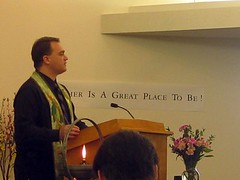 I’m always emotional in the pulpit. It’s part of why I never schedule anything for Sunday afternoon, because preaching a good UU sermon will wipe me out, physically, spiritually, and emotionally. I usually maintain enough reserves to make it through the coffee hour, but afterwards I have to go home and sleep for a few hours before I will be able to be worth much at all… and then it’s usually best for me to sit in front of the television and watch a movie.
It’s also why I tell anyone who has anything to talk to me about after the service that they should email me about it. I will listen during coffee hour, I will nod my head and I will even respond somewhat intelligently… and the chances of my having anything I would call “good recall and follow through” are slim. I’m simply operating in what I call my “coffee hour fugue”, a kind of emotional afterglow from the experience of worship, of preaching.
One thing I have noticed is that it was less emotional, less exhausting, and less “coffee hour fugue” inducing when I was mostly travel preaching as when I am regularly presenting worship in a congregation I know, and that knows me. The five years I spent travel preaching, the emotional content I was aware of was mostly just my own. While that was draining, I usually maintained enough energy to make it through the coffee hour and the multiple-hour drive home.
Yet in serving churches in Evanston IL, Midland MI, and now Ventura CA… that is not true. In each case, I believe I am becoming “in-tune” enough with the congregation that I am feeling more of what they feel. When, from the pulpit, I see a congregant with tears in their eyes, I know them well enough to have a fuller appreciation for what all those tears might mean. When I see a congregant laugh, I know them well enough to know some of the parts of their lives that might make laughing difficult. When a congregant comes up to me passionate and energized after the sermon, I now know them well enough to sense where that passion may be coming from (‘cause it is never actually my “wonderful sermon”).
I have said before that I believe we human beings are far more emotional creatures than we are rational creatures. Our ancestors on the evolutionary chain felt emotions far, far longer than we have had anything remotely resembling conceptualized rational thought. Our emotions have had many times many the centuries of development and opportunities to embed themselves into our nature, character and psyche than our capability for rational, symbolic thought has had. I believe that the primary purpose of reason is not to suppress or replace emotions, but rather to allow us to make some order and meaning out of our emotional lives. This understanding of reason accepts that our emotional lives remain the primary influence over who and what we are, and that reason just operates upon that primary influence.
Yet human emotion is often perceived by that reason, and by the outward society that reason reflects, as dangerous. As such, our society has created ways in which emotions can be “safely released”… Think of a football game, where emotions such as aggression, excitement, and anger can be safely released in a controlled manner about a topic that does not truly threaten our survival. Horror movies do the same for fear. Roller coasters do the same for both fear and excitement. Daytime talk shows such as Jerry Springer provide a safe experience of and release of some of our more shadow-filled emotions… jealousy, greed, superiority, etc.
At its least, congregational worship fills a similar role. I know, a shocking thing for a minister to say, to compare what we do on Sunday morning to Jerry Springer. There are some key differences… the first, and most obvious is the emotions that are brought forward in the congregational worship experience. Now, different traditions and different denominations of religious faith work with different emotions on a regular basis. I know that I experienced worship during my childhood in a different faith tradition as a regular emotional flow between superiority and shame. Superiority over all of the “sinners” who would be sent to hell when the judgment day came… and shame over my inability to save them all, and for the ways in which I too was one of those sinners. I know that when I have attended the Pentecostal churches of my mother’s tradition, there was some of that… but there was also the ecstatic emotions of joy, excitement, and connection.
The second key difference between our experience of many other societally sanctioned expressions of human emotion and congregational worship is that, at least in my understanding of the Unitarian Universalist tradition, those emotional experiences are to be shared communally. Experiencing and expressing these emotions is not a solo act. Worship should be a time where we allow the barriers that society creates around our emotional experiences to come down, just a bit… so that we can see one another as emotional creatures. And in seeing that, learn to accept our own emotional selves as normal, and beautiful.
I remember a time after a particular service where I became emotional in the pulpit, and the congregation became emotional with me. After the service, a fairly new member who was a social worker came up to me, quite disturbed. She was concerned that such an expression of emotion in a public way was unhealthy, and that it might even be unethical. Remember, this was after a sermon, so I was in my “coffee hour” fugue… but I think I responded along the lines of that congregations had been experiencing emotions together for thousands of years, and we just needed to be careful of and supportive of one another as we learned to be our emotional selves with one another. Later, that interaction helped me to develop a lens of being more aware of the emotional space of the congregation during the sermon, and to realize that some of the most important pastoral care work a congregation does happens in the Sunday Morning worship service.
Yet, I dream of something more for our time of Worship together than just an expression, even a collective expression, of our emotional selves. I dream of something more than creating a space in the lives of our congregants where it is okay to cry if you are called to cry, or laugh if you are called to laugh. I dream of something more than creating a space in the lives of congregants where it is okay to laugh with someone else, or cry with them. I dream of a space in the lives of congregants and in the life of a congregation where we can come together and not only express our emotional selves, but use the gift of our rational faculty to explore what those emotions mean for our understanding of and connection with life, the universe, and everything.
I want worship that is not only inspirational, but gets at why and how we feel inspired. I want worship that is not only deepening, but gets at why and how we feel deepened. I want worship that is not only challenging, but gets at why and how we feel challenged. I want worship that not only brings us to tears, but gets at why and how we are brought to tears. Not alone… not in a way that diagnoses what is wrong with us or makes us feel inadequate… but in a way that is simply about our learning to trust and care for our emotional souls… together.
I can dream…
Yours in faith,
Rev. David
Previous Post

August 29, 2012
The Cost of Speaking
Next Post
September 2, 2012 Friends: The Spice of Life
Browse Our Archives
Select a Category #9/11 Abortion Class community conflict Digital Life Diversity Divorce Environmental issues Evangelism Faith Development Foregiveness Garden glbt Gratitude Grief Healing health care Holidays Hospitality Interfaith LGBT Issues Military Service Mortality Orlando Parenting Peace Politics Power Prayer Racism Relationships Religion Scripture Senior citizens Sermons simplicity Social Justice Spirituality Sports Sustainability Uncategorized Unitarian Universalist Values Women's Issues World Community Worship
Select a Month August 2017 July 2017 June 2017 May 2017 April 2017 March 2017 February 2017 January 2017 December 2016 November 2016 October 2016 September 2016 August 2016 July 2016 June 2016 May 2016 April 2016 March 2016 February 2016 January 2016 December 2015 November 2015 October 2015 September 2015 August 2015 July 2015 June 2015 May 2015 April 2015 March 2015 February 2015 January 2015 December 2014 November 2014 October 2014 September 2014 August 2014 July 2014 June 2014 May 2014 April 2014 March 2014 February 2014 January 2014 December 2013 November 2013 October 2013 September 2013 August 2013 July 2013 June 2013 May 2013 April 2013 March 2013 February 2013 January 2013 December 2012 November 2012 October 2012 September 2012 August 2012 July 2012 June 2012 May 2012
Follow Us!
TAKE THE
Religious Wisdom Quiz
What was the first miracle performed by Elisha?
Select your answer to see how you score.
Parting the Jordan River Healing Naaman’s leprosy Raising a boy from the dead Multiplying oil
Related posts from UU Collective


Theology is Words, Words Matter

Ganesha, Nietzsche, Truth, Consequences
TRENDING AT PATHEOS New Visions

Did Prayer Cure His Cancer? Or Was It...
At 4 AM one morning, Joshua W. Brown’s wife awoke to a...

8 Ways a Near-Death Experience Rewires the Soul
Does Consciousness Survive Physical Death? After 50 Years of Research, Dr. Raymond...

Holy Longing: What Our Restlessness Is Telling Us
“One can find so many pains when the rain is falling.” -John...

What this is NOT about. This blog is definitely not about...

Who said the Israelites were God’s chosen? That’s right, they did. Who...

The Spirit World Is the Real World: God...
A Monk’s Wisdom on Body and Spirit I sit with Brother Martin...
view all New Visions blogs
Ad-Free & Subscriber Log-In Subscription Support
- About Us
- 2026 Calendar
- Videos
- Podcasts
- Library of World Religions
- Faith In Media Tracker
- Advertise With Us
- Write for Us
- Privacy Policy
- Terms of Service
- Do Not Sell My Data
- Contact Us
- Radiant Digital
- Manage Newsletter Subscriptions
- Unsubscribe From Notifications
- Sitemap
Copyright 2008-2026, Patheos. All rights reserved.
Subscription Support Ad-Free & Subscriber Log-In
Follow Patheos