
BuddhistCatholicContemplativeEvangelicalGeneral ChristianHinduJewishLatter-day SaintMuslimNew VisionsProgressive Christian
Beliefs
- Buddhist
- Catholic
- Contemplative
- Evangelical
- General Christian
- Hindu
- Jewish
- Latter-day Saint
- More Voices
- Muslim
- New Visions
- Pagan
- Progressive Christian
Topics
- Religion News
- Food and Religion
- Sports and Religion
- Religious Art
- Religious Music and Entertainment
- Religious Events
- History and Religion
- Style and Religion
- Politics and Religion
- Women in Religion
- Recreation Outdoors and Religion
- Business Finance and Religion
- Careers Workplace and Religion
- Education and Religion
- Family Parenting and Religion
- Health Fitness and Religion
- Home and Religion
- Relationships and Religion
- Technology and Religion
- Travel and Religion
Columnists
- Buddhist Columnists
- Business Finance and Religion Columnists
- Careers Workplace and Religion Columnists
- Catholic Columnists
- Contemplative Columnists
- Education and Religion Columnists
- Evangelists Columnists
- Family Parenting and Religion Columnists
- General Christian Columnists
- Health Fitness and Religion Columnists
- Hindu Columnists
- History and Religion Columnists
- Home and Religion Columnists
- Jewish Columnists
- More Voices Columnists
- Latter Day Columnists
- Muslim Columnists
- New Visions Columnists
- Nonreligious Columnists
- Pagan Columnists
- Politics and Religion Columnists
- Progressive Columnists
- Recreation Outdoors and Religion Columnists
- Relationships and Religion Columnists
- Religion News Columnists
- Religious Art Columnists
- Religious Events Columnists
- Religious Music and Entertainment Columnists
- Sports and Religion Columnists
- Style and Religion Columnists
- Technology and Religion Columnists
- Travel and Religion Columnists
- Women in Religion Columnists
Resource Library
- 2026 Calendar
- Library of World Religions
- The 100 Most Holy Places on Earth
- Patheos Answers
- Podcasts
- Videos
- Faith Leaders Database
- Anglican Episcopalian
- Bahai
- Baptist
- Buddhism
- Christianity
- Confucianism
- Eastern Orthodoxy
- Hinduism
- Holiness and Pentecostal
- ISKCON
- Islam
- Judaism
- Lutheran
- Methodist
- The Church of Jesus Christ of Latter-day Saints
- New Age
- Paganism
- Presbytarian and Reformed
- Protestantism
- Religion Behind the Scenes
- Roman Catholic
- Scientology
- Shia Islam
- Sikhism
- Sufism
- Sunni Islam
- Taoism
- Zen
- See all religions
Research Tools
 Ad-Free & Subscriber Log-In Subscription Support
Ad-Free & Subscriber Log-In Subscription Support
Follow Patheos 

- Trending:
- Forgiveness
- |
- Marriage
- |
- Consciousness
- |
- Death Penalty
- |
- Election
- |
- Halloween
 Unsystematic Theology
- Home
- Progressive Christian
- We Are Witnessing the End of Postmodernism and the Beginning of Post-Postmodernism
We Are Witnessing the End of Postmodernism and the Beginning of Post-Postmodernism
Last updated on: July 25, 2016 at 1:12 pm by Kyle Roberts
We Are Witnessing the End of Postmodernism and the Beginning of Post-Postmodernism 2016-07-25T13:12:22-05:00 Kyle Roberts
Patheos Explore the world's faith through different perspectives on religion and spirituality! Patheos has the views of the prevalent religions and spiritualities of the world.
It’s not a sexy title, but these aren’t pretty times.
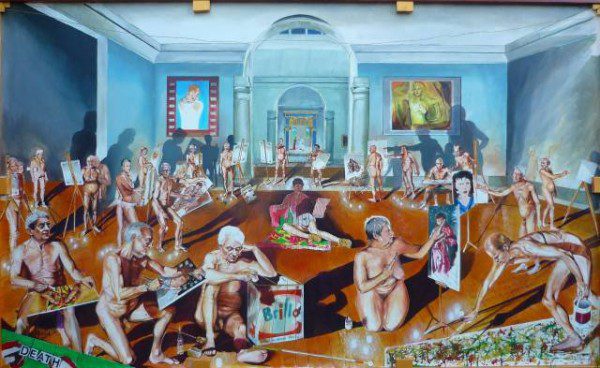
“The School of Postmodernism” By Vittorio Pelosi – Own work, Public Domain, via WikiCommons

For the past four or five decades, we’ve thought of ourselves as living in “postmodern times,” or as under the influences of “postmodernity” or “postmodernism.”
The postmodern being, of course, either a reaction to modernism or an extension or intensification of it.
Modernism, the previous age, involved the quest for universals, for trans-cultural knowledge, for “absolute truth.” Often utopian in orientation, it was also often elitist and racist in its visions of what utopia looks like. Modernists were optimistic about conquering the world and its problems and believed they were (however slowly but surely) progressing toward the climax of history.
Enter WWI and WWI and the beginning of the postmodern, when all this utopianism came to a screeching halt, and the positive and naive assumptions about human nature collided into horrific glimpses of our awfulness. Bombs and concentration camps revealed something: things weren’t getting better, but–at least in many ways–much worse.
Modernity boasted, among many other things: An optimism for humanity’s direction and goal; Absolute Truth over localized, standpoints on truth; the pragmatics and supposed neutrality of technology over suspicion about its uses; individual rationality over (“heteronomous”) authority (like that of religion and metaphysics), and the elimination of mysticism in favor of science and reason.
These modernistic assumptions all came to a halt as the cheerless postmodern mood swept over us like a grey rain cloud, or better: a tornado on the horizon.
Postmodernism was the age of skepticism, of deconstruction, of epistemic humility (how can we know anything, really?), of the resurgence of tradition (if we can’t transcend our standpoints, perhaps we should better embrace our traditioned forms of knowledge?), and of the heightening of awareness of those society has left on the margins. Technology was no longer seen as neutral and its use in the service of global capitalism was deeply noticed.
Postmodernism, as Jean-Francois Lyotard would put it in his groundbreaking The Postmodern Condition (1979) was the end of a unifying, underlying “grand-story,” or narrative that would justify knowledge, behavior, and action. Postmodernity was “incredulity toward the meta-narrative,” and this incredulity, or radical skepticism, would effect the emergence of discrete, distinct communities each with a shared “language game,” a way of seeing the world which only that community could access. Globalism still deeply affected all these communities, but postmodernity marked the end of its positive features.
But, theoretically at least, this kind of postmodernity (or postmodernism) was largely benign. Why? Because these communities, these groups organized around shared language games, were still largely governed by a sense of humility. They had their truth, their morality, their values, their nation, their politics, their god. But who was to say that theirs was better than yours? Or that yours was better than theirs? Let us live our lives, believe and practice our religion, and have our morality: you can have yours. Let’s agree to disagree.
Those days are over.
What we’re witnessing in these fragile, violent days just might be the end of this largely benign postmodernism and the emergence of a malignant post-postmodernism.
The term “post-postmodernism” has been around for over a decade, but I suspect historians might just locate its beginnings at around 2016 CE.
The lid of gentility has come off, “Politically Correct” is going out of style in many quarters (with a childish, racist, vengeance, in some cases), and the universality of globalism is, while not being replaced (capitalism will never allow a wholesale displacement of globalism) is being challenged by an intensified nationalism, an angry tribalism/localism, and an open disregard for the well-being of anyone outside “my” group, or my language-game.
I’ve long thought of postmodernism as, at its core, a deep toleration for difference and otherness. That’s a simplistic reduction, of course, but this toleration of otherness is turning into an intensified, angry rejection of difference and otherness and the attempt to overcome the problem of difference, not by rational argument or toleration, but by the sheer exertion of power, by the politics of fear, and by a polemics steeped in rhetoric but devoid of substance.
Post-postmodernism is tribalism to the extreme and with gloves off. It might just be the ultimate extension or intensification of post-modernism. It’s postmodern to the extent that it accepts the reality of difference and the reality of tribalism, “language-games,” and unique standpoints (unlike modernism, it doesn’t seek to transcend those boundaries). But it is post-postmodern in it is not chastened by epistemic humility, but hardened by certainty. In the post-postmodern mood, there may be a recognition that we don’t have the Absolute Truth, but that doesn’t make any difference, because we don’t care. It doesn’t change the way we relate to others; it doesn’t change the way we understand our place in the world. It isn’t chastened by difference and otherness, but angered by it. It isn’t motivated by peace, but by war.
This is a bleak picture, and it’s not the whole picture. If this analysis is in any way accurate, it doesn’t make me feel better about the immediate and distant future. But we need to have some kind of understanding of the forces at work if we’re going to have any hope of constructively dealing with them.
Previous Post

July 21, 2016
Kierkegaard, Unmasking the Illusion of Political Revolution
Next Post
July 29, 2016 On Mixing Religion and Politics: Post-Convention Edition
Browse Our Archives
Select a Category Uncategorized
Select a Month December 2020 November 2020 June 2020 May 2020 April 2020 December 2018 July 2018 March 2018 February 2018 January 2018 December 2017 November 2017 October 2017 September 2017 August 2017 July 2017 June 2017 April 2017 March 2017 February 2017 January 2017 December 2016 November 2016 October 2016 September 2016 August 2016 July 2016 June 2016 May 2016 April 2016 March 2016 February 2016 January 2016 December 2015 November 2015 October 2015 September 2015 August 2015 July 2015 June 2015 May 2015 April 2015 March 2015 February 2015 January 2015 December 2014
Follow Us!
TAKE THE
Religious Wisdom Quiz
What animal was most often sacrificed for a sin offering in the Old Testament?
Select your answer to see how you score.
A bird A lamb A goat A bull
Books by This Author Books by Kyle Roberts
Related posts from Unsystematic Theology

Mother God: What Are We Doing When We...
The Value of Seminary in a World Gone...
10 Very Good Books on the Reformation and...

The Problem With Liberal Christianity (From the Perspective...
TRENDING AT PATHEOS Progressive Christian

Why Christians Have a Sacred Duty to Vote:...
The Bible offers strong support for the sacred duty to vote. Here...

What Being a Modern-Day Apostle Means to Me
In my last column, I discussed the ins and outs of modern-day...

Did Ancient China Once Worship the God of...
Across human history, a common thread weaves through the origins of the...

Love Your Neighbor – Including Earth-Kin: Lev. 19,...
God’s command to love your neighbor means acting in an ethical and...

Lead a Church Study of “Jesus and Lao...
Guest writer Jack Thomas (The Irreverent Reverend) reflects on leading his church...

Principles for Understanding the Apostolic Ministry Today
Whenever people discover that my formal ministry title is "apostle," as in...
view all Progressive Christian blogs
Ad-Free & Subscriber Log-In Subscription Support
- About Us
- 2026 Calendar
- Videos
- Podcasts
- Library of World Religions
- Faith In Media Tracker
- Advertise With Us
- Write for Us
- Privacy Policy
- Terms of Service
- Do Not Sell My Data
- Contact Us
- Radiant Digital
- Manage Newsletter Subscriptions
- Unsubscribe From Notifications
- Sitemap
Copyright 2008-2026, Patheos. All rights reserved.
Subscription Support Ad-Free & Subscriber Log-In
Follow Patheos