
BuddhistCatholicContemplativeEvangelicalGeneral ChristianHinduJewishLatter-day SaintMuslimNew VisionsProgressive Christian
Beliefs
- Buddhist
- Catholic
- Contemplative
- Evangelical
- General Christian
- Hindu
- Jewish
- Latter-day Saint
- More Voices
- Muslim
- New Visions
- Pagan
- Progressive Christian
Topics
- Religion News
- Food and Religion
- Sports and Religion
- Religious Art
- Religious Music and Entertainment
- Religious Events
- History and Religion
- Style and Religion
- Politics and Religion
- Women in Religion
- Recreation Outdoors and Religion
- Business Finance and Religion
- Careers Workplace and Religion
- Education and Religion
- Family Parenting and Religion
- Health Fitness and Religion
- Home and Religion
- Relationships and Religion
- Technology and Religion
- Travel and Religion
Columnists
- Buddhist Columnists
- Business Finance and Religion Columnists
- Careers Workplace and Religion Columnists
- Catholic Columnists
- Contemplative Columnists
- Education and Religion Columnists
- Evangelists Columnists
- Family Parenting and Religion Columnists
- General Christian Columnists
- Health Fitness and Religion Columnists
- Hindu Columnists
- History and Religion Columnists
- Home and Religion Columnists
- Jewish Columnists
- More Voices Columnists
- Latter Day Columnists
- Muslim Columnists
- New Visions Columnists
- Nonreligious Columnists
- Pagan Columnists
- Politics and Religion Columnists
- Progressive Columnists
- Recreation Outdoors and Religion Columnists
- Relationships and Religion Columnists
- Religion News Columnists
- Religious Art Columnists
- Religious Events Columnists
- Religious Music and Entertainment Columnists
- Sports and Religion Columnists
- Style and Religion Columnists
- Technology and Religion Columnists
- Travel and Religion Columnists
- Women in Religion Columnists
Resource Library
- 2026 Calendar
- Library of World Religions
- The 100 Most Holy Places on Earth
- Patheos Answers
- Podcasts
- Videos
- Faith Leaders Database
- Anglican Episcopalian
- Bahai
- Baptist
- Buddhism
- Christianity
- Confucianism
- Eastern Orthodoxy
- Hinduism
- Holiness and Pentecostal
- ISKCON
- Islam
- Judaism
- Lutheran
- Methodist
- The Church of Jesus Christ of Latter-day Saints
- New Age
- Paganism
- Presbytarian and Reformed
- Protestantism
- Religion Behind the Scenes
- Roman Catholic
- Scientology
- Shia Islam
- Sikhism
- Sufism
- Sunni Islam
- Taoism
- Zen
- See all religions
Research Tools
 Ad-Free & Subscriber Log-In Subscription Support
Ad-Free & Subscriber Log-In Subscription Support
Follow Patheos 

- Trending:
- Forgiveness
- |
- Marriage
- |
- Consciousness
- |
- Death Penalty
- |
- Election
- |
- Halloween
 Unsystematic Theology
- Home
- Progressive Christian
- Art and Star Wars: Reflections on Myth, Painting, and the Force
Art and Star Wars: Reflections on Myth, Painting, and the Force
Last updated on: December 11, 2015 at 7:25 pm by Kyle Roberts
Art and Star Wars: Reflections on Myth, Painting, and the Force 2015-12-11T19:25:53-05:00 Kyle Roberts
Patheos Explore the world's faith through different perspectives on religion and spirituality! Patheos has the views of the prevalent religions and spiritualities of the world.
What if the Millennium Falcon landed on an art gallery?
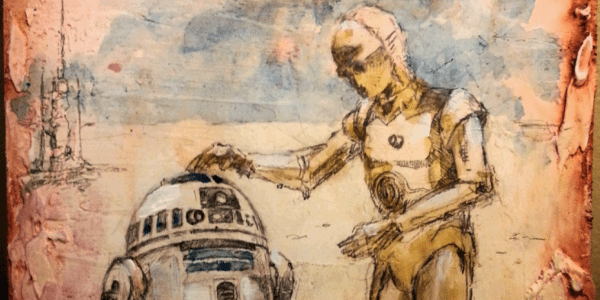
“R2D2 C3P0 BFF” 9×9 mixed media on wood panel (cropped)
Dan Addington is a Chicago artist who specializes in encaustic painting, using a variety of materials and thick textures that emphasize paintings as visceral objects, evoking physical presence but mediating a deep, spiritual ethos (read his full bio here).
I’ve long been a fan of Dan’s work and when I discovered his recent series of “Star Wars” themed paintings, I decided to ask him some questions. Here are my questions (KR), Dan’s answers (DA), and a few of the images to boot:
KR: The subject matter (Star Wars characters) is a pretty big departure from your previous fare. What prompted a serious artist to take this turn?
DA: Earlier this year, I decided to do some large paintings for my 7 year old son’s Star Wars-themed birthday party. We were holding the party in my gallery space, and I felt like we needed something on the walls besides posters, decals, and the standard birthday decorations. I had 3 large canvases that had been sitting untouched in the studio for years (I typically work on panel).
On a lark, I did life-sized paintings of Darth Vader, Luke Skywalker, and Yoda in a style and with materials and colors that I don’t
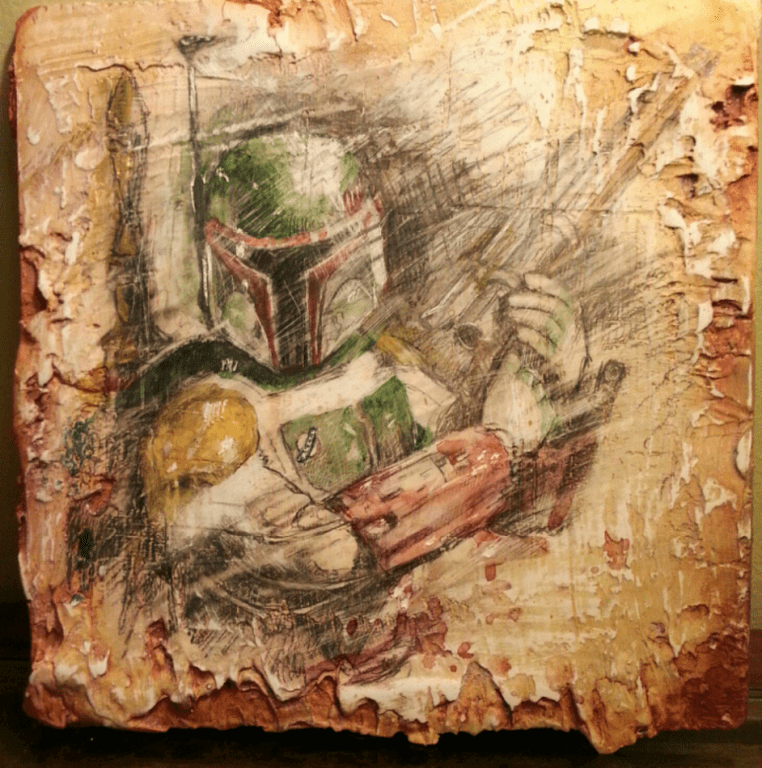
“Have You Met Boba Fett?” 9×9, mixed media on wood panel.
typically use. Often artists in any discipline discover that when they do something outside of their usual approach, it can be very rewarding, and in some cases can lead to new ideas or breakthroughs in their work. I really enjoyed working with a wider range of color and paint, as opposed to the mixed media techniques of tar and wax that I usually employ.
We had the party and the parents dug the paintings, but I don’t think the kids really noticed them. They were too busy dueling with light-sabers.
Last month I was picking up my son from school, and I got into a conversation with a friend who was at that birthday party with his son. He mentioned those paintings, and showed photos he had on his phone to another dad who was also standing there. That dad turned out to be the owner of Metropolis Coffee Company, which operates a large, well-known cafe/coffee shop on the North Side that regularly exhibits art. He asked me where those paintings were now, and I said “in storage” (they were way too big for my son’s room).
He suggested that with the new Star Wars movie coming out soon, it would be a great time to show them at the cafe. Of course, I couldn’t leave it like that, and decided to take the opportunity to create a series of small pieces to accompany the three large paintings that were already completed. So, I started working on this series using 9 inch square wood panels, and using mostly graphite and acrylic, which looks a bit like watercolor in many of the pieces.
KR: Your usual method (encaustic) is a very interesting way to put these familiar characters in a different setting. Have you found that to be an appealing aspect of this project? Taking these guys (and gals) off the screen and into the depth of your materials? (I feel like it kind of gives them a mystical and spiritual orientation in a way that the big screen sometimes lack.)
DA: I’ve had a few people ask after seeing these pieces what it’s like to render them in encaustic, and the answer is I don’t know, because I’ve just been using acrylic, graphite, and modeling paste (a sandable, plaster-like substance). I think the fact that I use the modeling paste in a way that enhances the physicality of the paintings gives it that mixed-media look that is typical of my encaustic work.
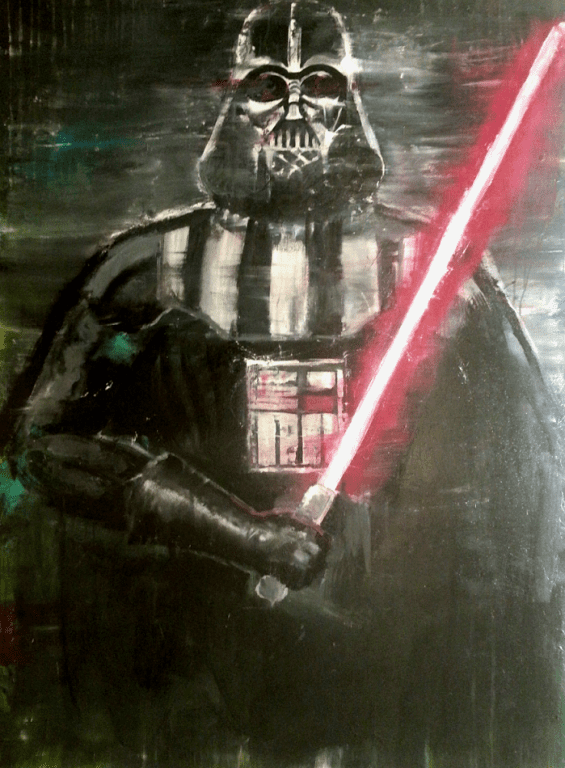
48×60, Acrylic on canvas (one of the three pieces that started the idea)
But in this case, I wanted to use the fact that this isn’t my usual subject matter to change my approach to the making paintings. I felt that since the accuracy of the images mattered to me, it would be nice to use a much more realistic style than I usually do, and to use the act of drawing as the foundation of the work.
One thing I have always admired about those original Star Wars films was the idea of a used, weathered, beaten up technology that informed the production design. Up until that point, Sci-fi was all about a Utopian, antiseptic, shiny futurism. But these films were famously set “A long time ago…”. Those are actually the first words one encounters in that first film.
I have found an echo of that aesthetic in my approach to these paintings. While some of the drawing is delicate and precise, most of the surfaces are painted, then sanded, then drawn on, then scraped and scrubbed, then painted again etc. They endure a real process, which is one of the main reasons I work on panel. This is typical of most of the work I do, and it’s nice that this approach connects to the subject matter so well. I’m intrigued by the fact that my work often references history both in subject and in process, and the these movies, in effect, are historical “period pieces”.
Artist John Powers has written an interesting essay called “Star Wars: A New Heap, or, How I Learned to Stop Worrying and Love the Death Star.” It explores (with visuals and text) how the aesthetics of Star Wars was informed by everything from abstract expressionism to modern machinery. He calls the Death Star (and its eventual destruction) “an essential work of minimalism…[and] a turning point for modernism.” Underneath all the popcorn fun of these movies, there are real aesthetic ideas at work.
Your question makes a good point. Taking these familiar characters and seeing them in the context of painting has been a great exercise. The Star Wars narrative is loaded with mystical references, and if this re-contextualization and treatment of the images calls that out, then that’s great!
KR: What surprises or insights have come about for you personally as you’ve painted these characters? Which one is your favorite–and why?
DA: I’m surprised by how much fun it has been to draw the mechanical elements of the androids and the armored costumes of characters like Boba Fett, Darth Vader, stormtroopers etc. Perhaps it’s the irony that rendering these characters is actually more forgiving than drawing the human face, figure, hands etc.
When you’re working on a likeness, especially one that is common in culture, it doesn’t take much to throw it off. One tiny move can mean the difference between success and failure. The colors and shapes of the armored characters are more stylized and straightforward, and immediately recognizable.
Likeness is less of an issue, so that’s been an interesting difference to work with. In some cases I chose to do pieces that focus less on the iconic qualities of the individual characters and more on relationships, and I like that extra human element (although the relationships are rarely exclusive to humans!).
I have enjoyed painting Vader because of the stark, iconic nature of that image. I’ve also enjoyed doing the Han Solo pieces. I like that character’s personality in the films, and I enjoy trying to translate it into the paintings. The fact that for years I have used heroic imagery from past cultures in my work suggests that there may be more continuity in this idea than I originally thought.
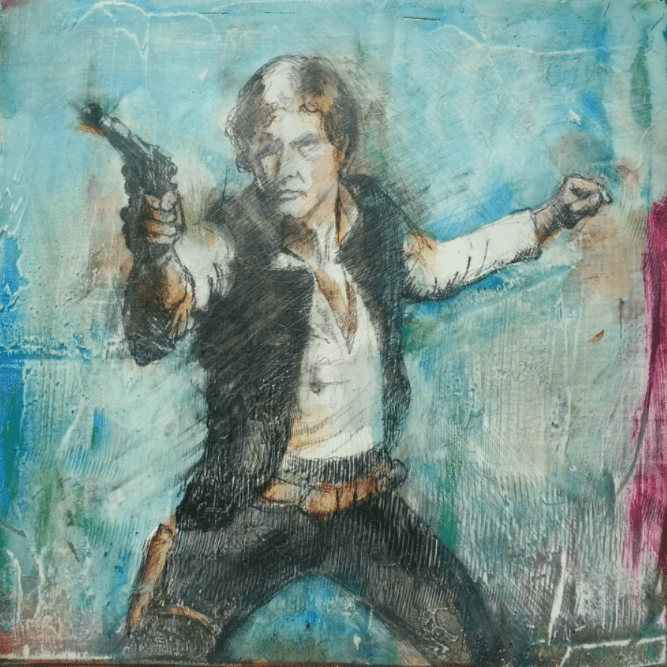
Blue Han
KR: What’s the reception to this series been like so far? Do you think the popularity–and familiarity–with Star Wars has detracted from interest in your work or enhanced it? (I could see it going either way.)
DA: People who are familiar with my work have been getting a kick out of seeing this series. I’ve had great conversations with other artists about the act of using new or unfamiliar subject matter and materials that have led to some interesting insights.
Conversations about why we choose the imagery we choose. Thoughts about embracing vs critiquing pop culture. Thoughts about how changing subject matter affects one’s formal approach to making a painting. In the end, I think the subject is so specific that one would have to have at least SOME interest in the films to find these pieces engaging.
Conversely, people who love those movies but don’t spend a lot of time looking at art might find these paintings much more engaging than if they were still life paintings. That is interesting to me. When one works with imagery, the way the viewer relates to the subject matter is an immediate consideration.
KR: Is there a particular message, theme or meaning to the Star Wars series that you’ve followed or pursued as a theme in your art–whether intentionally or not?
DA: I did not grow up a huge fan of Star Wars. I enjoyed the films, but they weren’t especially important to me. (I would have
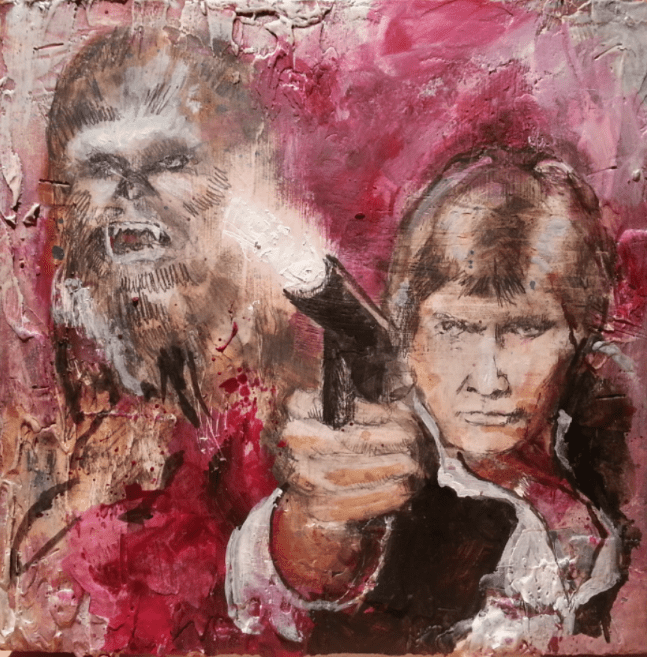
“Never Tell Me the Odds”
ranked “Star Trek: The Wrath of Kahn” higher in terms of my own enjoyment). But these movies are undeniably a contemporary cultural phenomenon in a way that not many other films can claim.
I am interested in the themes of myth and the hero that provide some of the conceptual weight in these stories. Much has been written about the influence of the writings of Joseph Campbell on these scripts and on the overarching narrative of the film series. I actually tip my hat to that fact in one of my pieces, which uses pages from Joseph Campbell’s book “Hero with a Thousand Faces”, his seminal book of comparative mythology, as a literal “background” for the painting.
But here’s the real deal for me: My 7 year old son loves Star Wars. Before he ever saw the original 3 films (the only ones he’s seen), he was already a fan through the toys. Action figures, spacecraft, blasters and light-sabers, but most importantly, the Lego sets, where he has spent countless hours building spaceships and walkers, and playing with the mini-figures.
He pours over encyclopedias of the Star Wars mythology, memorizing the characters, and learning the intricate twists of the story. Like with millions of kids, the stories speak to him. He loves those stories, and I love him. In the end, my interest in these images springs from his connection to them. These paintings are the product of our relationship. Like many other things in my life, he’s the touchstone.
“PAINTINGS FOR A LITTLE DUDE: WORKS INSPIRED BY A SON’S LOVE OF STAR WARS” Opens December 12 and runs for one month at Metropolis Coffee, 1039 West Granville Ave, Chicago IL

Here Comes Daddy
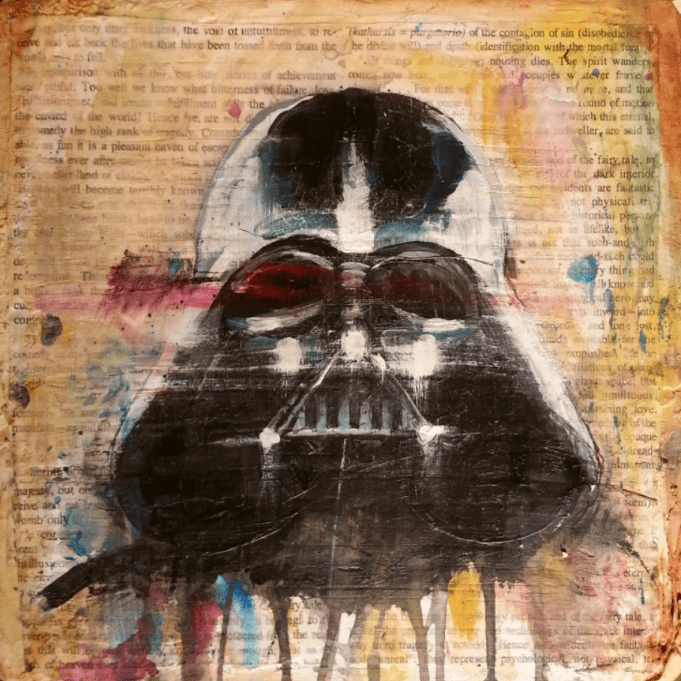
“”A Thousand Faces” / Acrylic and wax on Joseph Campbell book pages
Previous Post

December 10, 2015
Is Liberty University About to Become an Army Barracks?
Next Post
December 12, 2015 That Day Mary Was Presented at the Temple When She Was Three Years Old?
Browse Our Archives
Select a Category Uncategorized
Select a Month December 2020 November 2020 June 2020 May 2020 April 2020 December 2018 July 2018 March 2018 February 2018 January 2018 December 2017 November 2017 October 2017 September 2017 August 2017 July 2017 June 2017 April 2017 March 2017 February 2017 January 2017 December 2016 November 2016 October 2016 September 2016 August 2016 July 2016 June 2016 May 2016 April 2016 March 2016 February 2016 January 2016 December 2015 November 2015 October 2015 September 2015 August 2015 July 2015 June 2015 May 2015 April 2015 March 2015 February 2015 January 2015 December 2014
Follow Us!
TAKE THE
Religious Wisdom Quiz
Which book follows Proverbs in the Old Testament?
Select your answer to see how you score.
Ecclesiastes Song of Solomon Psalms Isaiah
Books by This Author Books by Kyle Roberts
Related posts from Unsystematic Theology

The Mystical Luther That Time Forgot

The Evangelical Relationship With God, from an Anthropologist's...

The 10 Most Influential Progressive and Spiritual Leaders...

"True Sadness" and Christianity After Religion: Where the...
TRENDING AT PATHEOS Progressive Christian

Why Christians Have a Sacred Duty to Vote:...
The Bible offers strong support for the sacred duty to vote. Here...

What Being a Modern-Day Apostle Means to Me
In my last column, I discussed the ins and outs of modern-day...

Did Ancient China Once Worship the God of...
Across human history, a common thread weaves through the origins of the...

Love Your Neighbor – Including Earth-Kin: Lev. 19,...
God’s command to love your neighbor means acting in an ethical and...

Lead a Church Study of “Jesus and Lao...
Guest writer Jack Thomas (The Irreverent Reverend) reflects on leading his church...

Principles for Understanding the Apostolic Ministry Today
Whenever people discover that my formal ministry title is "apostle," as in...
view all Progressive Christian blogs
Ad-Free & Subscriber Log-In Subscription Support
- About Us
- 2026 Calendar
- Videos
- Podcasts
- Library of World Religions
- Faith In Media Tracker
- Advertise With Us
- Write for Us
- Privacy Policy
- Terms of Service
- Do Not Sell My Data
- Contact Us
- Radiant Digital
- Manage Newsletter Subscriptions
- Unsubscribe From Notifications
- Sitemap
Copyright 2008-2026, Patheos. All rights reserved.
Subscription Support Ad-Free & Subscriber Log-In
Follow Patheos