
BuddhistCatholicContemplativeEvangelicalGeneral ChristianHinduJewishLatter-day SaintMuslimNew VisionsProgressive Christian
Beliefs
- Buddhist
- Catholic
- Contemplative
- Evangelical
- General Christian
- Hindu
- Jewish
- Latter-day Saint
- More Voices
- Muslim
- New Visions
- Pagan
- Progressive Christian
Topics
- Religion News
- Food and Religion
- Sports and Religion
- Religious Art
- Religious Music and Entertainment
- Religious Events
- History and Religion
- Style and Religion
- Politics and Religion
- Women in Religion
- Recreation Outdoors and Religion
- Business Finance and Religion
- Careers Workplace and Religion
- Education and Religion
- Family Parenting and Religion
- Health Fitness and Religion
- Home and Religion
- Relationships and Religion
- Technology and Religion
- Travel and Religion
Columnists
- Buddhist Columnists
- Business Finance and Religion Columnists
- Careers Workplace and Religion Columnists
- Catholic Columnists
- Contemplative Columnists
- Education and Religion Columnists
- Evangelists Columnists
- Family Parenting and Religion Columnists
- General Christian Columnists
- Health Fitness and Religion Columnists
- Hindu Columnists
- History and Religion Columnists
- Home and Religion Columnists
- Jewish Columnists
- More Voices Columnists
- Latter Day Columnists
- Muslim Columnists
- New Visions Columnists
- Nonreligious Columnists
- Pagan Columnists
- Politics and Religion Columnists
- Progressive Columnists
- Recreation Outdoors and Religion Columnists
- Relationships and Religion Columnists
- Religion News Columnists
- Religious Art Columnists
- Religious Events Columnists
- Religious Music and Entertainment Columnists
- Sports and Religion Columnists
- Style and Religion Columnists
- Technology and Religion Columnists
- Travel and Religion Columnists
- Women in Religion Columnists
Resource Library
- 2026 Calendar
- Library of World Religions
- The 100 Most Holy Places on Earth
- Patheos Answers
- Podcasts
- Videos
- Faith Leaders Database
- Anglican Episcopalian
- Bahai
- Baptist
- Buddhism
- Christianity
- Confucianism
- Eastern Orthodoxy
- Hinduism
- Holiness and Pentecostal
- ISKCON
- Islam
- Judaism
- Lutheran
- Methodist
- The Church of Jesus Christ of Latter-day Saints
- New Age
- Paganism
- Presbytarian and Reformed
- Protestantism
- Religion Behind the Scenes
- Roman Catholic
- Scientology
- Shia Islam
- Sikhism
- Sufism
- Sunni Islam
- Taoism
- Zen
- See all religions
Research Tools
 Ad-Free & Subscriber Log-In Subscription Support
Follow Patheos 

- Trending:
- Advent
- |
- Forgiveness
- |
- Thanksgiving
- |
- Election
- |
- Seasonal Holidays
- |
- Marriage
 Unsystematic Theology
- Home
- Progressive Christian
- Seven Images of God’s Disturbing Behavior in the Old Testament
Seven Images of God’s Disturbing Behavior in the Old Testament
Last updated on: November 10, 2015 at 10:58 am by Kyle Roberts
Seven Images of God’s Disturbing Behavior in the Old Testament 2015-11-10T10:58:58-05:00 Kyle Roberts
Patheos Explore the world's faith through different perspectives on religion and spirituality! Patheos has the views of the prevalent religions and spiritualities of the world.
Have you ever wondered what to do with all those nasty passages in the Bible (most of them in the Old Testament) where God seems to behave rather terribly–by most current standards of appropriate human conduct?
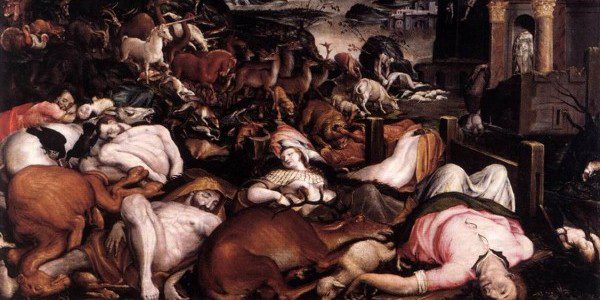
Noah’s Ark by Kaspar Memberger via WikiCommons
For just one, big, example, we’ve got the “conquest narrative,” the story of Israel’s escape from slavery in Egypt and their subsequent 40-year wandering, before entering the promised land . There at the Jordan, they get a brief history lesson and some marching orders from God (via Moses). Here’s a bit of those marching orders:
When the Lord your God brings you into the land that you are about to enter and occupy, and he clears away many nations before you—the Hittites, the Girgashites, the Amorites, the Canaanites, the Perizzites, the Hivites, and the Jebusites, seven nations mightier and more numerous than you— 2 and when the Lord your God gives them over to you and you defeat them, then you must utterly destroy them. Make no covenant with them and show them no mercy. (Deut. 7:1-2).
A little further on, to confirm the message:
Do not leave alive anything that breathes. Completely destroy them…as the Lord your God has commanded you. (Deut. 20:16-17)
Most of you have heard this story before–if not in a Sunday School class or in a sermon perhaps in your own reading. For some, the story might be so familiar that it’s become sanitized and we sort of instinctively either spiritualize the story (we might think of these battle images as being about “spiritual warfare”–as a number of early Christian theologians suggested) or we have so learned to demonize the Canaanites that we assume their divinely-ordered deaths were justified (we conveniently forget about the infants and children). But on that second option, if you stop and think about it for more than a second, you begin to see the depths of the problems with that approach.
The brutal reality is this: In this story Moses gives them a command, and elaborates on that command over the next several chapters, calling it a direct order from God: Completely destroy seven nations currently existing on the land they are about to enter. *Utterly destroy them–*show them no mercy.
Genocide, violent aggression, land-theft, enslavement. Sanctioned by God and divinely commanded?
Religion can be pretty screwed up.
This is only one example, albeit a major one, in the Old Testament.
In his book, Disturbing Divine Behavior: Troubling Old Testament Images of God, Eric Seibert (Old Testament professor at Messiah College) argues that Christians should honestly grapple with these troubling images. He groups the troubling texts under the following categories:
1. God as Deadly Lawgiver (God commands that those who break certain laws be put to death)
2. God as Instant Executioner (God sometimes instantly kills individuals himself when they do something he deems as bad, such as using the wrong kind of fire for sacrifice or steadying the ark when it’s about to fall)
3. God as Mass Murderer (the Flood story, for one example)
4. God as Divine Warrior (the Conquest narrative, among other stories of God “fighting for Israel”)
5. God as Genocidal General (again, see Conquest narratives)
6. God as Dangerous Abuser (God sometimes doesn’t kill people, but treats them rather abusively–see God’s treatment of Hagar and his treatment of Abraham/Isaac, for examples)
7. God as Divine Deceiver (God sometimes lies/deceives to accomplish his purposes–that seems to go against his own prescriptions for human behavior, right?)
Seibert provides many more examples than I have here. But you get the picture.
I should add that Seibert notes that’s much more to the OT’s presentation of God than these troubling images. It has plenty of beautiful images, too. He notes that he could have written a book about all the positive, lovely, justice/righteous/peace images of God. But obviously those aren’t the images people struggle with. Those images we like don’t make the disturbing ones disappear.
This is not a problem that can be easily dismissed with a wave of the hand by a pastor, Bible professor, or other religious authority. Nor can it be swept under the rug with simple answers like, “just have faith,” or “whatever God does is right simply because it’s God who does it,” or “well, you see, that was then, this is now.”
If Christian leaders are going to help people deal honestly and seriously with their sacred text, the Bible, and have a mature faith that doesn’t avoid or ignore hard problems–then they need to take this issue seriously and honestly, too.
The problem of divine violence in the Old Testament is a big reason for people leaving Christianity or otherwise refusing to have anything to do with it (and I presume it’s also a challenge within Judaism, too–though I don’t know much about that).
In subsequent posts I will share some of the ways people have dealt with this issue in the past and present. And I’ll also try to summarize Seibert’s own suggested response to the problem of disturbing divine images.
But I’ll give you a hint now: What if God didn’t command Moses to kill the Mideanites or the Canaanites or what if God didn’t topple the walls of Jericho? What if these stories are not describing God’s actual behavior within time/space history? What is there’s a difference between the “God of the text” and the real God? What if these stories are telling us more about the people and the worldview of those who are writing the stories down, than they are telling us about what’s actually going on in the stories themselves?
That would change things, wouldn’t it?
Previous Post

November 8, 2015
"Show Them No Mercy" God Says?
Next Post
November 12, 2015 Did God Really Say, "Show Them No Mercy"? God, Genocide, and the Bible
Browse Our Archives
Select a Category Uncategorized
Select a Month December 2020 November 2020 June 2020 May 2020 April 2020 December 2018 July 2018 March 2018 February 2018 January 2018 December 2017 November 2017 October 2017 September 2017 August 2017 July 2017 June 2017 April 2017 March 2017 February 2017 January 2017 December 2016 November 2016 October 2016 September 2016 August 2016 July 2016 June 2016 May 2016 April 2016 March 2016 February 2016 January 2016 December 2015 November 2015 October 2015 September 2015 August 2015 July 2015 June 2015 May 2015 April 2015 March 2015 February 2015 January 2015 December 2014
Follow Us!
TAKE THE
Religious Wisdom Quiz
What was the first plague on Egypt?
Select your answer to see how you score.
Lice Death of the Firstborn Nile turned to Blood Hail
Books by This Author Books by Kyle Roberts
Related posts from Unsystematic Theology

After Paris Attacks, Wrestling with the Bible's Violence

Did God Really Say, "Show Them No Mercy"?...

"Show Them No Mercy" God Says?

Recommendation: A Christmas Book for Progressive Christians
TRENDING AT PATHEOS Progressive Christian

Can a Chatbot Touch Your Soul?
Can a chatbot offer genuine spiritual counsel? One conversation brought me to...

Religion and Politics: How Should We Then Live?
Two cultural axioms get repeated in polite company. Don't mix religion and...

7 Things We Get Wrong About Giving Thanks
It's a time of year when many of us turn to the...

Uncaging Truth: Spirituality Beyond Institutions
The Lost Connection: Why True Spirituality, Not Religion, Is the Key to...

Christ the King? Maybe We've Misunderstood the Crown
What do we mean when we say that Jesus is King? What...

Counter “Christ Is King” Nationalism with Christ THE...
Christ the King Sunday is an ideal time to address the heresy...
view all Progressive Christian blogs
Ad-Free & Subscriber Log-In Subscription Support
- About Us
- 2026 Calendar
- Videos
- Podcasts
- Library of World Religions
- Faith In Media Tracker
- Advertise With Us
- Write for Us
- Privacy Policy
- Terms of Service
- Do Not Sell My Data
- Contact Us
- Radiant Digital
- Manage Newsletter Subscriptions
- Unsubscribe From Notifications
- Sitemap
Copyright 2008-2026, Patheos, part of the Radiant Digital network of media brands. All rights reserved.
Subscription Support Ad-Free & Subscriber Log-In
Follow Patheos