
BuddhistCatholicContemplativeEvangelicalGeneral ChristianHinduJewishLatter-day SaintMuslimNew VisionsProgressive Christian
Beliefs
- Buddhist
- Catholic
- Contemplative
- Evangelical
- General Christian
- Hindu
- Jewish
- Latter-day Saint
- More Voices
- Muslim
- New Visions
- Pagan
- Progressive Christian
Topics
- Religion News
- Food and Religion
- Sports and Religion
- Religious Art
- Religious Music and Entertainment
- Religious Events
- History and Religion
- Style and Religion
- Politics and Religion
- Women in Religion
- Recreation Outdoors and Religion
- Business Finance and Religion
- Careers Workplace and Religion
- Education and Religion
- Family Parenting and Religion
- Health Fitness and Religion
- Home and Religion
- Relationships and Religion
- Technology and Religion
- Travel and Religion
Columnists
- Buddhist Columnists
- Business Finance and Religion Columnists
- Careers Workplace and Religion Columnists
- Catholic Columnists
- Contemplative Columnists
- Education and Religion Columnists
- Evangelists Columnists
- Family Parenting and Religion Columnists
- General Christian Columnists
- Health Fitness and Religion Columnists
- Hindu Columnists
- History and Religion Columnists
- Home and Religion Columnists
- Jewish Columnists
- More Voices Columnists
- Latter Day Columnists
- Muslim Columnists
- New Visions Columnists
- Nonreligious Columnists
- Pagan Columnists
- Politics and Religion Columnists
- Progressive Columnists
- Recreation Outdoors and Religion Columnists
- Relationships and Religion Columnists
- Religion News Columnists
- Religious Art Columnists
- Religious Events Columnists
- Religious Music and Entertainment Columnists
- Sports and Religion Columnists
- Style and Religion Columnists
- Technology and Religion Columnists
- Travel and Religion Columnists
- Women in Religion Columnists
Resource Library
- 2026 Calendar
- Library of World Religions
- The 100 Most Holy Places on Earth
- Patheos Answers
- Podcasts
- Videos
- Faith Leaders Database
- Anglican Episcopalian
- Bahai
- Baptist
- Buddhism
- Christianity
- Confucianism
- Eastern Orthodoxy
- Hinduism
- Holiness and Pentecostal
- ISKCON
- Islam
- Judaism
- Lutheran
- Methodist
- The Church of Jesus Christ of Latter-day Saints
- New Age
- Paganism
- Presbytarian and Reformed
- Protestantism
- Religion Behind the Scenes
- Roman Catholic
- Scientology
- Shia Islam
- Sikhism
- Sufism
- Sunni Islam
- Taoism
- Zen
- See all religions
Research Tools
 Ad-Free & Subscriber Log-In Subscription Support
Ad-Free & Subscriber Log-In Subscription Support
Follow Patheos 

- Trending:
- Forgiveness
- |
- Marriage
- |
- Consciousness
- |
- Death Penalty
- |
- Election
- |
- Halloween
 Unsystematic Theology
- Home
- Progressive Christian
- Is Deconversion the Result of Rationalism or Emotions (or Both)?
Is Deconversion the Result of Rationalism or Emotions (or Both)?
Last updated on: November 19, 2015 at 7:57 pm by Kyle Roberts
Is Deconversion the Result of Rationalism or Emotions (or Both)? 2015-11-19T19:57:00-05:00 Kyle Roberts
Patheos Explore the world's faith through different perspectives on religion and spirituality! Patheos has the views of the prevalent religions and spiritualities of the world.
Steven Davis, a Christian theology and apologetics professor, recently deconverted from Christianity and theism to atheism. He is telling his story over on the blog “Almost Heresy.” You can read the first installment here.
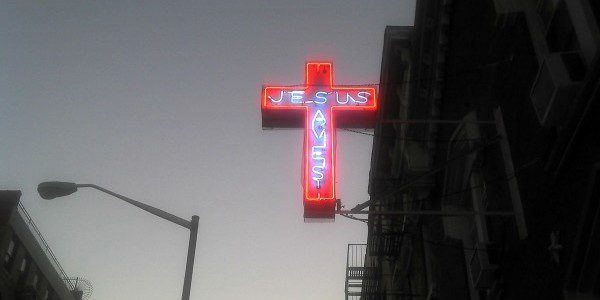
Jesus Saves sign, by David Shankbone, CC by 3.0
I summarized and briefly engaged Davis on what I thought to be something of a conflict or even contradiction in the way he described the “guiding principles” that ultimately led him to become an atheist–and subsequently to resign his professor position at a Christian college.
On the one hand, Davis acknowledges that “humans are not objective,” which means he acknowledges the subjectivity of knowledge, truth, and belief. He also acknowledges the “social construction of reality”–which is the title of an important sociology book which describes the cultural and social dissemination of belief (a book written by theists, as one of my blog’s commenters pointed out).
The contradiction, I suggested, is that Davis’ confidence in critical thinking bucks up against his acknowledgment of the subjectivity of human knowing as well as against the socialization of all knowledge and belief. This tension is intriguing, for reasons I’ll explain a little further below.
In any case, I assume that Davis’ response would be along the lines of this: Because of the subjectivity and social formation of knowledge (and, for Davis’ purposes, of religious belief in particular), we must be especially vigorous in applying objective, critical reflection on our beliefs–especially religious ones (which tend to lack evidential support and tend to include all sorts of preposterous claims).
This brings us to the occasion of today’s post. Davis’ second installment, posted yesterday. It includes some interesting personal reflection on his experience of leaving theism. He notes that, while becoming an atheist has resulted in many losses (relationally, vocationally, and economically), it also has enabled him to live an authentic life (which he clarifies to mean simply that he can now “be himself”) and to discover who his genuine friends are. All things considered, that’s not a bad trade-off.
A theme continues from the first to the second post: The primacy of “rationalism,” or critical thinking, and the supreme value Davis accords to rationalism over against emotional and social influences. Beliefs dependent on emotional experience are to be distrusted and social formation/transmission of knowledge should similarly be held up to the light of “objective,” critical rationality.
We are to (objectively) follow the evidence wherever it leads. But too many of us, Davis suggests, refuse to do this. Using Plato’s cave analogy, Davis suggests we (theists) are afraid to look away from the shadows on the wall and turn into the light so we can see reality for what it is and our deceptions and illusions for what they are.
By the way, I’ve also heard Plato’s analogy used to illustrate religiousconversion–and it’s interesting to note that Plato was not an atheist. In any case, Davis writes,
But, frankly, the evidence (or lack thereof) doesn’t matter to most people. The overwhelming majority of people become religious due to socio-cultural and emotional-psychological factors, and they remain religious for socio-cultural and emotional-psychological reasons.
Here Davis pits rationality over against “socio-cultural” factors and “emotional-psychological” reasons.
I’m sure a valid distinction can be drawn between cognitive/intellectual/rational thinking and “emotional-psychological” reasoning. From what I understand, however, rational cognition and emotional thinking are not entirely separable. Often, what we assume to be “rational (objective) thinking” is at least partly (and sometimes largely) driven by an emotional or intuitive core beneath.
Now, I’m not saying any of this to question Davis’s understanding of the process by which he came to reject theism. I’m glad that he’s found freedom and authenticity within atheism. I have no goal of talking him back into theistic belief.
I’m taking Davis’ story as an opportunity to think about what happens with religious belief–and religious dis-belief–more generally. Personally, I’ve long understood “critical thinking” as always already captive to the limitations of the human experience and to context. This doesn’t mean we throw it out, it just means that we temper our expectations of what it gives us. I also think it means we should accept that reason, emotion, and socio-cultural context are not ultimately separable–nor should they be.
From what I’ve seen and read of other de-conversion narratives, there are often very personal, experiential, and even emotional components to these major transitions in belief and life. These personal experiences are often mentioned in the many testimonies given on ex-christian.net, that repository of de-conversion narratives that Davis also mentions. While many ex-theists have intellectual reasons for leaving God or losing belief, those reasons are often also tied up with stories of relational disconnection; abandonment; revelations of hypocrisy in religious leaders, family and friends; and so on. The intellectual aspects are often intertwined with emotions of anger, disgust, disappointment, and so on.
Of course, the accompanying and underlying emotions aren’t always negative. Intellectual transitions can be accompanied by positive emotions and experiences, too: relief, a sense of openness, feelings of freedom, etc.
There’s a narrative context to intellectual thought and emotions are intertwined with rational reflection. This is not to disparage or undermine intellectual reasons and critical reflection. This is just what it means to be human.
I guess I’m just uncomfortable with the implied suggestion that if we would all be rational, objective, and honest, we’d all become atheists, too.
Finally, I’ll just say there are big fences at the edges of rational thought–particularly when the object of rational reflection is God, or the “metaphysical,” or transcendent, or whatever. By definition, rationality would have no claim to penetrate beyond these edges completely–whether in the attempted “proofs” for God’s existence (as in Davis’ former field of study, Christian apologetics) or in the purported attempt to disprove God’s existence by some supposedly universal “critical method.”
Incidentally, for those of you interested in Davis’ reasons for his deconversion, he does plan to spell out those reasons in upcoming posts.

Previous Post

November 18, 2015
Why We Can Never Cease Speaking of Bodies (M. Shawn Copeland)
Next Post
November 22, 2015 Mark Strauss' "Bad, Bad Jesus"
Browse Our Archives
Select a Category Uncategorized
Select a Month December 2020 November 2020 June 2020 May 2020 April 2020 December 2018 July 2018 March 2018 February 2018 January 2018 December 2017 November 2017 October 2017 September 2017 August 2017 July 2017 June 2017 April 2017 March 2017 February 2017 January 2017 December 2016 November 2016 October 2016 September 2016 August 2016 July 2016 June 2016 May 2016 April 2016 March 2016 February 2016 January 2016 December 2015 November 2015 October 2015 September 2015 August 2015 July 2015 June 2015 May 2015 April 2015 March 2015 February 2015 January 2015 December 2014
Follow Us!
TAKE THE
Religious Wisdom Quiz
Who was the cupbearer to the king who fasted and prayed for Jerusalem?
Select your answer to see how you score.
Nehemiah Ezra Zerubbabel Haggai
Books by This Author Books by Kyle Roberts
Related posts from Unsystematic Theology

The Value of Seminary in a World Gone...

When Churches Conflate Christianity and Nationalism (10 Consequences)

On the Origin of Modern Apologetics and the...
Is Your God as Friendly as Joel Osteen's?
TRENDING AT PATHEOS Progressive Christian

Why Christians Have a Sacred Duty to Vote:...
The Bible offers strong support for the sacred duty to vote. Here...

What Being a Modern-Day Apostle Means to Me
In my last column, I discussed the ins and outs of modern-day...

Did Ancient China Once Worship the God of...
Across human history, a common thread weaves through the origins of the...

Love Your Neighbor – Including Earth-Kin: Lev. 19,...
God’s command to love your neighbor means acting in an ethical and...

Lead a Church Study of “Jesus and Lao...
Guest writer Jack Thomas (The Irreverent Reverend) reflects on leading his church...

Principles for Understanding the Apostolic Ministry Today
Whenever people discover that my formal ministry title is "apostle," as in...
view all Progressive Christian blogs
Ad-Free & Subscriber Log-In Subscription Support
- About Us
- 2026 Calendar
- Videos
- Podcasts
- Library of World Religions
- Faith In Media Tracker
- Advertise With Us
- Write for Us
- Privacy Policy
- Terms of Service
- Do Not Sell My Data
- Contact Us
- Radiant Digital
- Manage Newsletter Subscriptions
- Unsubscribe From Notifications
- Sitemap
Copyright 2008-2026, Patheos. All rights reserved.
Subscription Support Ad-Free & Subscriber Log-In
Follow Patheos