
BuddhistCatholicContemplativeEvangelicalGeneral ChristianHinduJewishLatter-day SaintMuslimNew VisionsProgressive Christian
Beliefs
- Buddhist
- Catholic
- Contemplative
- Evangelical
- General Christian
- Hindu
- Jewish
- Latter-day Saint
- More Voices
- Muslim
- New Visions
- Pagan
- Progressive Christian
Topics
- Religion News
- Food and Religion
- Sports and Religion
- Religious Art
- Religious Music and Entertainment
- Religious Events
- History and Religion
- Style and Religion
- Politics and Religion
- Women in Religion
- Recreation Outdoors and Religion
- Business Finance and Religion
- Careers Workplace and Religion
- Education and Religion
- Family Parenting and Religion
- Health Fitness and Religion
- Home and Religion
- Relationships and Religion
- Technology and Religion
- Travel and Religion
Columnists
- Buddhist Columnists
- Business Finance and Religion Columnists
- Careers Workplace and Religion Columnists
- Catholic Columnists
- Contemplative Columnists
- Education and Religion Columnists
- Evangelists Columnists
- Family Parenting and Religion Columnists
- General Christian Columnists
- Health Fitness and Religion Columnists
- Hindu Columnists
- History and Religion Columnists
- Home and Religion Columnists
- Jewish Columnists
- More Voices Columnists
- Latter Day Columnists
- Muslim Columnists
- New Visions Columnists
- Nonreligious Columnists
- Pagan Columnists
- Politics and Religion Columnists
- Progressive Columnists
- Recreation Outdoors and Religion Columnists
- Relationships and Religion Columnists
- Religion News Columnists
- Religious Art Columnists
- Religious Events Columnists
- Religious Music and Entertainment Columnists
- Sports and Religion Columnists
- Style and Religion Columnists
- Technology and Religion Columnists
- Travel and Religion Columnists
- Women in Religion Columnists
Resource Library
- 2026 Calendar
- Library of World Religions
- The 100 Most Holy Places on Earth
- Patheos Answers
- Podcasts
- Videos
- Faith Leaders Database
- Anglican Episcopalian
- Bahai
- Baptist
- Buddhism
- Christianity
- Confucianism
- Eastern Orthodoxy
- Hinduism
- Holiness and Pentecostal
- ISKCON
- Islam
- Judaism
- Lutheran
- Methodist
- The Church of Jesus Christ of Latter-day Saints
- New Age
- Paganism
- Presbytarian and Reformed
- Protestantism
- Religion Behind the Scenes
- Roman Catholic
- Scientology
- Shia Islam
- Sikhism
- Sufism
- Sunni Islam
- Taoism
- Zen
- See all religions
Research Tools
 Ad-Free & Subscriber Log-In Subscription Support
Ad-Free & Subscriber Log-In Subscription Support
Follow Patheos 

- Trending:
- Forgiveness
- |
- Marriage
- |
- Consciousness
- |
- Death Penalty
- |
- Election
- |
- Halloween
 Unsystematic Theology
- Home
- Progressive Christian
- An Argument for the Bible as “Love Letter From God”
An Argument for the Bible as “Love Letter From God”
Last updated on: November 2, 2015 at 12:08 pm by Kyle Roberts
An Argument for the Bible as “Love Letter From God” 2015-11-02T12:08:44-05:00 Kyle Roberts
Patheos Explore the world's faith through different perspectives on religion and spirituality! Patheos has the views of the prevalent religions and spiritualities of the world.
Last week, James McGrath, over at Exploring Our Matrix, posted this meme :
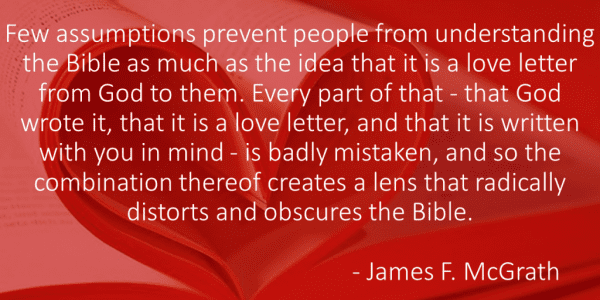
I enjoy McGrath’s blog and have learned a lot from him. And I’ve been glad to get to know him a bit, digitally anyway, as a colleague on Patheos’ Progressive Channel.
But I think he overstates his case on this one. I’ve previously suggested the “Bible as love letter” analogy as one of the options with something positive to contribute to how Christians relate to the Bible.
Yes, the “Bible as love letter” analogy can and has been misused to distort what we should reasonably and reliably expect the Bible to do for us.
It can imply or underline a dictation theory of inspiration, in which God is presumed to be speaking words for the authors to write (to God’s “lovers,” all future readers).
It can blur the boundaries between the historical contexts of the Bible’s origins and our own contexts as contemporary readers.
It can render historical, textual, canonical (etc.) criticism obsolete. Who needs critical study of the Bible when we can just read it simply as a love letter from God? Who needs academic study when we can simply worship, pray…love?
These responses–call them temptations or tendencies–are all problematic from the standpoint of responsible approaches to an ancient document from contemporary readers.
The basic fact of the matter is that most of the Bible’s material simply doesn’t come close to fitting the “love letter” analogy. Legal material, genealogies and other historical records, accounts of violence and war, creation myths, even moral prescriptions seem to make the analogy a case of special pleading.
All that said, there are good reasons to argue for a limited use of the analogy.
Kierkegaard gave us a good example, in my opinion, of such a limited use. Here’s what he says in For Self-Examination:
Imagine a lover who has received a letter from his beloved–I assume that God’s Word is just as precious to you as this letter is to the lover. I assume that you read and think you ought to read God’s Word in the same way that the lover reads this letter. Yet you perhaps say, “Yes, but Holy Scripture is written in a foreign language”… (p. 26)
Now think of God’s Word. When you read God’s Word in a scholarly way–we do not disparage scholarship, no, far from it, but do bear this in mind: when you are reading God’s Word in a scholarly way, with a dictionary, etc., then you are not reading God’s Word–remember what the lover said: “This is not reading the letter from the beloved.” If you happen to be a scholar, then please see to it that in all this learned reading (which is not reading God’s Word) you do not forget to read God’s Word. (pp. 29).
Here’s the relevant section in Emerging Prophet where I describe his use of the analogy as a way of moving beyond the two “rationalisms” of academic higher criticism (then in it’s infancy period) and doctrinaire fundamentalism:
“Scientific scholarship,” was, for Kierkegaard, mainly an excuse to avoid the strenuousness of the New Testament. [1] In a journal entry, Kierkegaard suggests that the New Testament should be read without a commentary. Using the analogy of a love letter, he wonders why anyone would read a love letter using a commentary.[2] The “love letter” metaphor sheds light on Kierkegaard’s distaste for scholarly apparatus and third-party mediation. The Bible is written from God to the single individual, and should be read with that in mind: “Every commentary detracts. He who can sit with ten open commentaries and read the Holy Scriptures—well, he probably is writing the eleventh, but he deals with the Scriptures contra naturam.” [against its nature] [3]
It is important to note that Kierkegaard likely did not object to the use of critical interpretive methodologies as a basic hermeneutical tool, when used for the purpose of greater biblical understanding. But he objected to the elevation of human reason as the ultimate, final arbiter of what the Bible means.[4] Most crucially, he objected to using higher criticism as an avoidance, or distraction, tactic from its ethical and religious function. The key, he insisted, was the disposition of the interpreter and the goal of interpretation.[5] Kierkegaard did not object to the application of reason (and imagination) in the interpretation of Scripture, nor did he object to individuals interpreting Scripture and doing theology; he was a Lutheran, after all.[6] His concern was to secure the priority of divine revelation over human rationality and to maintain a place for the Holy Spirit in guiding one’s interpretation of Scripture.[7] Kierkegaard would rather see Denmark give all its Bibles back to God[8] than perpetuate a situation in which the Bible is approached as an historical curiosity, an aesthetic masterpiece, or even a doctrinal compendium, rather than for what it really is: the “highway signs” pointing to Christ, the way of truth and life.[9]
Now, this description and contextualizing may not make the analogy any more palatable to those who object to it as fundamentally misleading or to those who object to its potential and actual misuses.
But I do think there is something here worthy of reflection.
On a personal note, Kierkegaard’s approach to the Bible helped me move beyond the literalism, objectivism, and doctrinalism of evangelical fundamentalism (any number of other “isms” could be tossed in here) into a more dynamic, relational, and contextual view of the Bible. This reflects a pietistic (in the historical, church-history sense) approach to Scripture as meant primarily for spiritual transformation and as applicable in that spiritual sense to all readers (not just its first recipients).
I’m currently co-authoring a commentary, so it may seem strange for me to come to the defense of Kierkegaard’s analogy. Aren’t I one of those who are dodging God’s Word precisely by writing academic commentary about it?
But it seems to me the main gist of Kierkegaard’s point is that the way we relate to the Bible will evidence what we think of the Bible’s role in the context of our relation to God. The ultimate objective of our reading of the Bible shouldn’t be academic knowledge (information for information’s sake) or doctrinal understanding, but action, transformation, response. The Bible is important because it derives from God and makes ultimate sense in the context of our relation to God–not the other way around.
For all its limitations (and I admit there are certainly limitations), the analogy might be a good “first step” away from a view of the Bible as merely a historical document or as merely as doctrinal or moral handbook into a view of the Bible as instrumental for experiencing the holy and witnessing to the gospel.
For more links and discussions on theology and society, like/follow Unsystematic Theology on Facebook

[1] On this point, see Murray Rae, Kierkegaard and Theology, 45-46
[2] JP 1*,* 210. He acknowledges, that, were the letter written in a foreign language, one would learn the language in order to understand the letter, but otherwise use of a commentary should be out of the question.
[3]JP 1, 210.
[4]JP 1, 210.
[5]One of the influences on Kierkegaard’s theological education was the biblical scholar H.N. Clausen. Clausen was a student of Schleiermacher and a devotee of the “rational” and philological approach to synthesizing the Bible’s meaning. See Elrod, Kierkegaard and Christendom, 31.
[6]Kierkegaard’s view of the Bible and of the freedom of individuals to interpret the Bible contrasted with his contemporary, N.F.S. Grundtvig, who argued that the best response to the rising critical, rationalist approach (and to the problem of interpretation) was to set the Bible aside in favor of the creeds and church practices. For a comparison of Grundtvig and Kierkegaard on the role of the Bible in the Christian life and church, see Roberts, “The Living Word or the Word of God? Kierkegaard and Grundtvig as Two Kinds of Pietists,” in The Pietist Impulse in Christianity, ed. Christian Collins Winn, et. al. 120-134.
[7]The role of the Spirit in biblical interpretation and theology will be unpacked in Chapter 3.
[8]JP 1, 216.
[9] JP 1, 208.
Previous Post

October 30, 2015
Haunted by Caputo (and the "Specter")
Next Post

November 3, 2015 Tom Oord's New Book is Coming: The Uncontrolling Love of God
Browse Our Archives
Select a Category Uncategorized
Select a Month December 2020 November 2020 June 2020 May 2020 April 2020 December 2018 July 2018 March 2018 February 2018 January 2018 December 2017 November 2017 October 2017 September 2017 August 2017 July 2017 June 2017 April 2017 March 2017 February 2017 January 2017 December 2016 November 2016 October 2016 September 2016 August 2016 July 2016 June 2016 May 2016 April 2016 March 2016 February 2016 January 2016 December 2015 November 2015 October 2015 September 2015 August 2015 July 2015 June 2015 May 2015 April 2015 March 2015 February 2015 January 2015 December 2014
Follow Us!
TAKE THE
Religious Wisdom Quiz
My reign brought prosperity until pride led me to burn incense in the temple, resulting in leprosy. Who am I?
Select your answer to see how you score.
Josiah Hezekiah Asa Uzziah
Books by This Author Books by Kyle Roberts
Related posts from Unsystematic Theology

Kierkegaard on the Incarnation: God is Like an...

Kierkegaard on Christian Nationalism: "Will He Find Faith...

"Might Makes Right": How Evangelicals Can Still Support...

A "Case for Christ" Movie? On the Problem...
TRENDING AT PATHEOS Progressive Christian

What Being a Modern-Day Apostle Means to Me
In my last column, I discussed the ins and outs of modern-day...

Did Ancient China Once Worship the God of...
Across human history, a common thread weaves through the origins of the...

Love Your Neighbor – Including Earth-Kin: Lev. 19,...
God’s command to love your neighbor means acting in an ethical and...

Lead a Church Study of “Jesus and Lao...
Guest writer Jack Thomas (The Irreverent Reverend) reflects on leading his church...

Pastoral Wisdom for Responding to Sermon Pushback
Getting sermon pushback on your social justice sermon? Learn practical, Proverbs-based strategies...

Principles for Understanding the Apostolic Ministry Today
Whenever people discover that my formal ministry title is "apostle," as in...
view all Progressive Christian blogs
Ad-Free & Subscriber Log-In Subscription Support
- About Us
- 2026 Calendar
- Videos
- Podcasts
- Library of World Religions
- Faith In Media Tracker
- Advertise With Us
- Write for Us
- Privacy Policy
- Terms of Service
- Do Not Sell My Data
- Contact Us
- Radiant Digital
- Manage Newsletter Subscriptions
- Unsubscribe From Notifications
- Sitemap
Copyright 2008-2026, Patheos. All rights reserved.
Subscription Support Ad-Free & Subscriber Log-In
Follow Patheos