
BuddhistCatholicContemplativeEvangelicalGeneral ChristianHinduJewishLatter-day SaintMuslimNew VisionsProgressive Christian
Beliefs
- Buddhist
- Catholic
- Contemplative
- Evangelical
- General Christian
- Hindu
- Jewish
- Latter-day Saint
- More Voices
- Muslim
- New Visions
- Pagan
- Progressive Christian
Topics
- Religion News
- Food and Religion
- Sports and Religion
- Religious Art
- Religious Music and Entertainment
- Religious Events
- History and Religion
- Style and Religion
- Politics and Religion
- Women in Religion
- Recreation Outdoors and Religion
- Business Finance and Religion
- Careers Workplace and Religion
- Education and Religion
- Family Parenting and Religion
- Health Fitness and Religion
- Home and Religion
- Relationships and Religion
- Technology and Religion
- Travel and Religion
Columnists
- Buddhist Columnists
- Business Finance and Religion Columnists
- Careers Workplace and Religion Columnists
- Catholic Columnists
- Contemplative Columnists
- Education and Religion Columnists
- Evangelists Columnists
- Family Parenting and Religion Columnists
- General Christian Columnists
- Health Fitness and Religion Columnists
- Hindu Columnists
- History and Religion Columnists
- Home and Religion Columnists
- Jewish Columnists
- More Voices Columnists
- Latter Day Columnists
- Muslim Columnists
- New Visions Columnists
- Nonreligious Columnists
- Pagan Columnists
- Politics and Religion Columnists
- Progressive Columnists
- Recreation Outdoors and Religion Columnists
- Relationships and Religion Columnists
- Religion News Columnists
- Religious Art Columnists
- Religious Events Columnists
- Religious Music and Entertainment Columnists
- Sports and Religion Columnists
- Style and Religion Columnists
- Technology and Religion Columnists
- Travel and Religion Columnists
- Women in Religion Columnists
Resource Library
- 2026 Calendar
- Library of World Religions
- The 100 Most Holy Places on Earth
- Patheos Answers
- Podcasts
- Videos
- Faith Leaders Database
- Anglican Episcopalian
- Bahai
- Baptist
- Buddhism
- Christianity
- Confucianism
- Eastern Orthodoxy
- Hinduism
- Holiness and Pentecostal
- ISKCON
- Islam
- Judaism
- Lutheran
- Methodist
- The Church of Jesus Christ of Latter-day Saints
- New Age
- Paganism
- Presbytarian and Reformed
- Protestantism
- Religion Behind the Scenes
- Roman Catholic
- Scientology
- Shia Islam
- Sikhism
- Sufism
- Sunni Islam
- Taoism
- Zen
- See all religions
Research Tools
 Ad-Free & Subscriber Log-In Subscription Support
Follow Patheos 

- Trending:
- Advent
- |
- Forgiveness
- |
- Thanksgiving
- |
- Election
- |
- Seasonal Holidays
- |
- Marriage
 Unsystematic Theology
- Home
- Progressive Christian
- The Difference Between a Liberal and a Libertarian (From Jonathan Haidt’s Righteous Mind)
The Difference Between a Liberal and a Libertarian (From Jonathan Haidt’s Righteous Mind)
Last updated on: May 11, 2015 at 3:23 pm by Kyle Roberts
The Difference Between a Liberal and a Libertarian (From Jonathan Haidt’s Righteous Mind) 2015-05-11T15:23:12-05:00 Kyle Roberts
Patheos Explore the world's faith through different perspectives on religion and spirituality! Patheos has the views of the prevalent religions and spiritualities of the world.
A liberal and a libertarian walk into a bar…
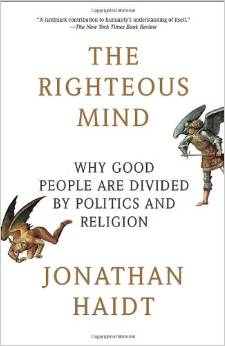
Not really. But have you ever looked for a good, succinct explanation of the difference between a liberal and a libertarian? I came across one recently in Jonathan Haidt’s The Righteous Mind: Why Good People are Divided by Politics and Religion:
Libertarians are the direct descendants of the eighteenth- and nineteenth-century Englightenment reformers who fought to free people and markets from the control of kings and clergy. Libertarians
love liberty; that is their sacred value. Many libertarians wish they could simply be known as liberals, but they lost that term in the United States (though not in Europe) when liberalism split into two camps in the late nineteenth century. Some liberals began to see powerful corporations and wealthy industrialists as the chief threats to liberty. These ‘new liberals’ (also known as ‘left liberals’ or ‘progressives’) looks to government as the only force capable of protecting the public and rescuing the many victims of the brutal practices of early industrial capitalism. Liberals who continued to fear government as the chief threat to liberty became known as “classical liberals,” “right liberals” (in some countries), or libertarians (in the United States) (p. 350).
He goes on to explain that liberals sought to make use of government to protect individual rights and freedoms (to “safeguard liberty”) but also to “advance the general welfare of the people,” by doing things like “breaking up monopolies and creating new government agencies to regulate labor practices and to ensure the quality of foods and medicines.” But libertarians, in contrast, saw these things as a capitulation to the authority of government and a fast to the abdication of liberty (freedom from control, authority, constraint).
Haidt has developed a “moral matrix,” based on his extensive empirical, psychological research, which suggests there are six “moral foundations,” which comprise our (human) moral intuitions: (1) Care/Harm; (2) Liberty/oppression; (3) Fairness/cheating; (4) Loyalty/betrayal; (5) Authority / Subversion; and (6) Sanctity / Degradation. I can’t go into an explanation of all these here (I’m working on a review of the book, and will share other pieces later). But the point is that some of us are inspired by or drawn to several of these values or moral intuitions, but not so much to others. Haidt says that his research shows that
libertarians join liberals in scoring very low on the Loyalty, Authority, and Sanctity foundations. Where they diverge from liberals most sharply is on two measures: the Care foundation, where they score very low (even lower than conservatives), and on…economic liberty, where they score extremely high (a little higher than conservatives, a lot higher than liberals).
For the record, Haidt notes that he has empathy with a number of libertarian positions: “I believe that libertarians are right on many points.”
Personally, though, I must admit to feeling more tension than empathy with a perspective that is defined by low scores on the foundation of “Care.”
For Haidt’s popular Ted Talk summarizing his book and research, go here
For Bill Moyer’s fascinating interview of Haidt, go here
For Haidt’s website, where you can take the “moral foundations” test yourself, go here.
Previous Post

May 8, 2015
My Wish for my Mom on Mother's Day: A Cure for Alzheimer's Disease
Next Post
May 12, 2015 Reflections on the Pew Forum: Adjusting to the "New Normal"
Browse Our Archives
Select a Category Uncategorized
Select a Month December 2020 November 2020 June 2020 May 2020 April 2020 December 2018 July 2018 March 2018 February 2018 January 2018 December 2017 November 2017 October 2017 September 2017 August 2017 July 2017 June 2017 April 2017 March 2017 February 2017 January 2017 December 2016 November 2016 October 2016 September 2016 August 2016 July 2016 June 2016 May 2016 April 2016 March 2016 February 2016 January 2016 December 2015 November 2015 October 2015 September 2015 August 2015 July 2015 June 2015 May 2015 April 2015 March 2015 February 2015 January 2015 December 2014
Follow Us!
TAKE THE
Religious Wisdom Quiz
Which Psalm is the longest chapter in the Bible?
Select your answer to see how you score.
Psalm 50 Psalm 23 Psalm 1 Psalm 119
Books by This Author Books by Kyle Roberts
Related posts from Unsystematic Theology

Eight Reasons Evangelicals Still Trust in Trump

The Surprising Evangelical Switch from Virtue to Consequences

Christian Ethics After Trump: A Letter to My...

The Virtue Gap: Our Current Mess and the...
TRENDING AT PATHEOS Progressive Christian

Can a Chatbot Touch Your Soul?
Can a chatbot offer genuine spiritual counsel? One conversation brought me to...

Religion and Politics: How Should We Then Live?
Two cultural axioms get repeated in polite company. Don't mix religion and...

7 Things We Get Wrong About Giving Thanks
It's a time of year when many of us turn to the...

Uncaging Truth: Spirituality Beyond Institutions
The Lost Connection: Why True Spirituality, Not Religion, Is the Key to...

Christ the King? Maybe We've Misunderstood the Crown
What do we mean when we say that Jesus is King? What...

Counter “Christ Is King” Nationalism with Christ THE...
Christ the King Sunday is an ideal time to address the heresy...
view all Progressive Christian blogs
Ad-Free & Subscriber Log-In Subscription Support
- About Us
- 2026 Calendar
- Videos
- Podcasts
- Library of World Religions
- Faith In Media Tracker
- Advertise With Us
- Write for Us
- Privacy Policy
- Terms of Service
- Do Not Sell My Data
- Contact Us
- Radiant Digital
- Manage Newsletter Subscriptions
- Unsubscribe From Notifications
- Sitemap
Copyright 2008-2026, Patheos, part of the Radiant Digital network of media brands. All rights reserved.
Subscription Support Ad-Free & Subscriber Log-In
Follow Patheos