
BuddhistCatholicContemplativeEvangelicalGeneral ChristianHinduJewishLatter-day SaintMuslimNew VisionsProgressive Christian
Beliefs
- Buddhist
- Catholic
- Contemplative
- Evangelical
- General Christian
- Hindu
- Jewish
- Latter-day Saint
- More Voices
- Muslim
- New Visions
- Pagan
- Progressive Christian
Topics
- Religion News
- Food and Religion
- Sports and Religion
- Religious Art
- Religious Music and Entertainment
- Religious Events
- History and Religion
- Style and Religion
- Politics and Religion
- Women in Religion
- Recreation Outdoors and Religion
- Business Finance and Religion
- Careers Workplace and Religion
- Education and Religion
- Family Parenting and Religion
- Health Fitness and Religion
- Home and Religion
- Relationships and Religion
- Technology and Religion
- Travel and Religion
Columnists
- Buddhist Columnists
- Business Finance and Religion Columnists
- Careers Workplace and Religion Columnists
- Catholic Columnists
- Contemplative Columnists
- Education and Religion Columnists
- Evangelists Columnists
- Family Parenting and Religion Columnists
- General Christian Columnists
- Health Fitness and Religion Columnists
- Hindu Columnists
- History and Religion Columnists
- Home and Religion Columnists
- Jewish Columnists
- More Voices Columnists
- Latter Day Columnists
- Muslim Columnists
- New Visions Columnists
- Nonreligious Columnists
- Pagan Columnists
- Politics and Religion Columnists
- Progressive Columnists
- Recreation Outdoors and Religion Columnists
- Relationships and Religion Columnists
- Religion News Columnists
- Religious Art Columnists
- Religious Events Columnists
- Religious Music and Entertainment Columnists
- Sports and Religion Columnists
- Style and Religion Columnists
- Technology and Religion Columnists
- Travel and Religion Columnists
- Women in Religion Columnists
Resource Library
- 2026 Calendar
- Library of World Religions
- The 100 Most Holy Places on Earth
- Patheos Answers
- Podcasts
- Videos
- Faith Leaders Database
- Anglican Episcopalian
- Bahai
- Baptist
- Buddhism
- Christianity
- Confucianism
- Eastern Orthodoxy
- Hinduism
- Holiness and Pentecostal
- ISKCON
- Islam
- Judaism
- Lutheran
- Methodist
- The Church of Jesus Christ of Latter-day Saints
- New Age
- Paganism
- Presbytarian and Reformed
- Protestantism
- Religion Behind the Scenes
- Roman Catholic
- Scientology
- Shia Islam
- Sikhism
- Sufism
- Sunni Islam
- Taoism
- Zen
- See all religions
Research Tools
 Ad-Free & Subscriber Log-In Subscription Support
Ad-Free & Subscriber Log-In Subscription Support
Follow Patheos 

- Trending:
- Forgiveness
- |
- Marriage
- |
- Consciousness
- |
- Death Penalty
- |
- Election
- |
- Halloween
 Unsystematic Theology
- Home
- Progressive Christian
- The Blues as “Secular Spirituals”: James Cone on B.B. King
The Blues as “Secular Spirituals”: James Cone on B.B. King
Last updated on: May 15, 2015 at 10:01 am by Kyle Roberts
The Blues as “Secular Spirituals”: James Cone on B.B. King 2015-05-15T10:01:14-05:00 Kyle Roberts
Patheos Explore the world's faith through different perspectives on religion and spirituality! Patheos has the views of the prevalent religions and spiritualities of the world.
Blues legend B.B. King died on Thursday, at 89 years, after an announcement several weeks ago that he was receiving hospice care.
This morning, I pulled out my copy James Cone’s The Spirituals and the Blues. Cone unpacks the historical context of the emergence of blues music, showing how it is both similar to and different from its antecedent in the spirituals, and then gives us a “theology of the blues” by connecting it to God, Jesus, suffering in the black experience, and to black eschatology–the particularized hope and anticipations of liberation and of heaven in black religion in the context of slavery and deep suffering.
In his intro, Cone writes:
No black person could escape the reality they expressed. B.B. King, Johnny Lee Hooker, and
Mahalia Jackson created essential structures that defined my blackness. I affirmed the reality of the spirituals and blues as authentic expressions of my humanity, responding to them in the rhythms of dance. I, therefore, write about the spirituals and the blues, because I am the blues and my life is a spiritual. Without them, I cannot be” (7).
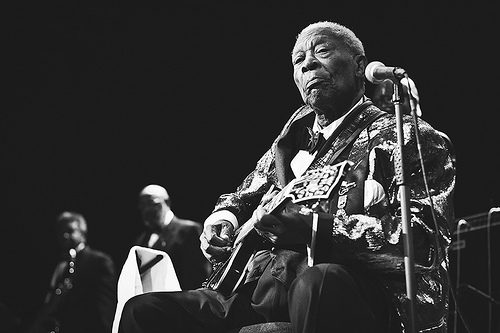
Cone describes the blues as a “secular spiritual”:
The blues depict the “secular” dimension of black experience. They are “worldly” songs which tell us about love and sex and about that other “mule kickin’ in my stall.” They tell us about the “Black Cat’s Bones,” “a Mojo hand,” and “dese back-bitin’ womens tryin’ fo’ to steal my man.” The blues are about black life and the sheer earth and gut capacity to survive in an extreme situation of oppression (97).
The blues, Cone explains emerged out of the backdrop of slavery, and are “closely related to the ‘slave seculars,” which were non- or even “occasionally anti-religious” songs (called “‘devil songs’ by religious folk”)
While seculars were not strictly atheistic as defined by modern Western philosophy, they nonetheless uncover the difficulties black people encountered when they attempted to relate white Christian categories to their situation of oppression.
And the blues, Cone explains, “reflect the same existential tension” as the slave seculars. They,
invited black people to embrace the reality and truth of black experience…Implied in the blues is a stubborn refusal to go beyond the existential problem and substitute otherwordly answers. It is not that the blues reject God; rather, they ignore God by embracing the joys and sorrows of life, such as those of a man’s relationship with his woman, a woman with her man (99).
As “secular spirituals,” the blues differ from the spirituals of the slave experience in that they came out of a new situation of freedom: “the blues express conditions associated with the ‘burden of freedom'” (101). But the blues differed from western philosophical explorations of “freedom,” as in existentialism, by focusing on the “factual, not conceptual” aspects of the challenges brought by a new kind of freedom–which was still a limited freedom.
The blues, while not denying that the world was strange, described its strangeness in more concrete and vivid terms. Freedom took on historical specificity when contrasted with legal servitude. It meant getting married, drinking gin, praising God–and expressing these historical possibilities in song (101).
Cone moves on from there to unpack a definition of the blues and its function in black life, in relation to the particular experience of black suffering:
The origin and definition of the blues cannot be understood independent of the suffering that black people endured in the context of white racism and hate. Therefore, the question that gave shape and purpose to the blues was: How could black people keep themselves together, preserving a measure of their cultural being, and not lose their physical lives? … The blues tell us about black people’s attempt to carve out a significant existence in a very trying situation. The purpose of the blues is to give structure to black existence in a context where color means rejection and humiliation (110).
Suggestion: Buy Cone’s book and read it while listening to some B.B. King. Maybe you’ll have both a new appreciation for the blues–and for theology, too.

Browse Our Archives
Select a Category Uncategorized
Select a Month December 2020 November 2020 June 2020 May 2020 April 2020 December 2018 July 2018 March 2018 February 2018 January 2018 December 2017 November 2017 October 2017 September 2017 August 2017 July 2017 June 2017 April 2017 March 2017 February 2017 January 2017 December 2016 November 2016 October 2016 September 2016 August 2016 July 2016 June 2016 May 2016 April 2016 March 2016 February 2016 January 2016 December 2015 November 2015 October 2015 September 2015 August 2015 July 2015 June 2015 May 2015 April 2015 March 2015 February 2015 January 2015 December 2014
Follow Us!
TAKE THE
Religious Wisdom Quiz
What did Jesus use to heal blind man?
Select your answer to see how you score.
Water Mud and saliva Cloth Oil
Books by This Author Books by Kyle Roberts
Related posts from Unsystematic Theology

Mother God: What Are We Doing When We...

The Value of Seminary in a World Gone...
10 Very Good Books on the Reformation and...

The Problem With Liberal Christianity (From the Perspective...
TRENDING AT PATHEOS Progressive Christian

Why Christians Have a Sacred Duty to Vote:...
The Bible offers strong support for the sacred duty to vote. Here...

What Being a Modern-Day Apostle Means to Me
In my last column, I discussed the ins and outs of modern-day...

Did Ancient China Once Worship the God of...
Across human history, a common thread weaves through the origins of the...

Love Your Neighbor – Including Earth-Kin: Lev. 19,...
God’s command to love your neighbor means acting in an ethical and...

Lead a Church Study of “Jesus and Lao...
Guest writer Jack Thomas (The Irreverent Reverend) reflects on leading his church...

Principles for Understanding the Apostolic Ministry Today
Whenever people discover that my formal ministry title is "apostle," as in...
view all Progressive Christian blogs
Ad-Free & Subscriber Log-In Subscription Support
- About Us
- 2026 Calendar
- Videos
- Podcasts
- Library of World Religions
- Faith In Media Tracker
- Advertise With Us
- Write for Us
- Privacy Policy
- Terms of Service
- Do Not Sell My Data
- Contact Us
- Radiant Digital
- Manage Newsletter Subscriptions
- Unsubscribe From Notifications
- Sitemap
Copyright 2008-2026, Patheos. All rights reserved.
Subscription Support Ad-Free & Subscriber Log-In
Follow Patheos