
BuddhistCatholicContemplativeEvangelicalGeneral ChristianHinduJewishLatter-day SaintMuslimNew VisionsProgressive Christian
Beliefs
- Buddhist
- Catholic
- Contemplative
- Evangelical
- General Christian
- Hindu
- Jewish
- Latter-day Saint
- More Voices
- Muslim
- New Visions
- Pagan
- Progressive Christian
Topics
- Religion News
- Food and Religion
- Sports and Religion
- Religious Art
- Religious Music and Entertainment
- Religious Events
- History and Religion
- Style and Religion
- Politics and Religion
- Women in Religion
- Recreation Outdoors and Religion
- Business Finance and Religion
- Careers Workplace and Religion
- Education and Religion
- Family Parenting and Religion
- Health Fitness and Religion
- Home and Religion
- Relationships and Religion
- Technology and Religion
- Travel and Religion
Columnists
- Buddhist Columnists
- Business Finance and Religion Columnists
- Careers Workplace and Religion Columnists
- Catholic Columnists
- Contemplative Columnists
- Education and Religion Columnists
- Evangelists Columnists
- Family Parenting and Religion Columnists
- General Christian Columnists
- Health Fitness and Religion Columnists
- Hindu Columnists
- History and Religion Columnists
- Home and Religion Columnists
- Jewish Columnists
- More Voices Columnists
- Latter Day Columnists
- Muslim Columnists
- New Visions Columnists
- Nonreligious Columnists
- Pagan Columnists
- Politics and Religion Columnists
- Progressive Columnists
- Recreation Outdoors and Religion Columnists
- Relationships and Religion Columnists
- Religion News Columnists
- Religious Art Columnists
- Religious Events Columnists
- Religious Music and Entertainment Columnists
- Sports and Religion Columnists
- Style and Religion Columnists
- Technology and Religion Columnists
- Travel and Religion Columnists
- Women in Religion Columnists
Resource Library
- 2026 Calendar
- Library of World Religions
- The 100 Most Holy Places on Earth
- Patheos Answers
- Podcasts
- Videos
- Faith Leaders Database
- Anglican Episcopalian
- Bahai
- Baptist
- Buddhism
- Christianity
- Confucianism
- Eastern Orthodoxy
- Hinduism
- Holiness and Pentecostal
- ISKCON
- Islam
- Judaism
- Lutheran
- Methodist
- The Church of Jesus Christ of Latter-day Saints
- New Age
- Paganism
- Presbytarian and Reformed
- Protestantism
- Religion Behind the Scenes
- Roman Catholic
- Scientology
- Shia Islam
- Sikhism
- Sufism
- Sunni Islam
- Taoism
- Zen
- See all religions
Research Tools
 Ad-Free & Subscriber Log-In Subscription Support
Ad-Free & Subscriber Log-In Subscription Support
Follow Patheos 

- Trending:
- Forgiveness
- |
- Marriage
- |
- Consciousness
- |
- Death Penalty
- |
- Election
- |
- Halloween
 Unsystematic Theology
- Home
- Progressive Christian
- If You Think ReThinking is Easy, Try Riding this Backwards Bike
If You Think ReThinking is Easy, Try Riding this Backwards Bike
Last updated on: May 4, 2015 at 3:52 pm by Kyle Roberts
If You Think ReThinking is Easy, Try Riding this Backwards Bike 2015-05-04T15:52:26-05:00 Kyle Roberts
Patheos Explore the world's faith through different perspectives on religion and spirituality! Patheos has the views of the prevalent religions and spiritualities of the world.
Destin Sandlin of the SmarterEveryDay YouTube channel has a challenge for you: Try riding the “backwards bicycle,” a bike whose wheel turns opposite the handlebars (i.e. you turn to the right, the wheel goes left). It took him several months of practicing every day to learn to ride this bike–because the normal way had been so deeply engrained in his neural pathways. His young son, however, caught on in only a few weeks.
I’ve been working through Robert Burton’s On Being Certain: Believing You Are Right Even When You’re Not. Burton describes the process by which our brains become firmly established in a certain pattern of thought or practice or habit. The brain processes information through a “neural network,” a “massive web of neuronal connections microscopically interwoven throughout the brain” (51). This network constitutes what Burton calls 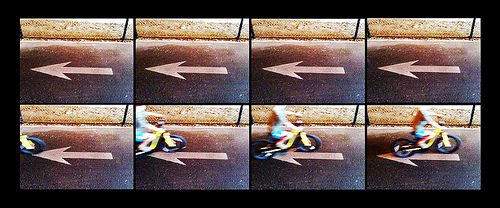 the “hidden layer” that pretty much determines, beneath the level of conscious awareness, how we process ideas and events and how we make decisions. That hidden layer functions like a “powerful committee” which organizes, sorts and filters inputs of information–letting some come through and pushing others out of conscious awareness. The network is also responsible for the resistance to change and to re-thinking new ways of doing things. Here’s what he says:
The concept of neural networks also helps explain why established habits, beliefs, and judgments are so difficult to change. Imagine the gradual formation of a riverbed. The initial flow of water might be completely random–there are no preferred routes in the beginning. But once a creek has been formed, water is more likely to follow this newly created path of least resistance. As the water continues, the creek deepens and a river develops…
The brain is only human; it, too relies on established ways. As interneuronal connections increase, they become more difficult to overcome. A hitch in your golf swing, biting your nails, persisting with a faulty idea, not dumping your dot.com stocks in late 1999–habits, whether mental or physical, are exasperating examples of the power of these microscopic linkages (52).
There are so many implications for the phenomenon of the “only human” brain and the power of the “hidden layer” of neural networks.
For one thing, we should try to be consciously aware of the difficulty of thinking outside of our established patterns. Perhaps we can practice doing that. For another thing, we might have more empathy for those whose resistance to our ideas or suggestions seems so intolerably unreasonable.
And for theology: Just reflect for a moment on the implication of the difficulty of unlearning and rethinking well-established “tried and true” beliefs, convictions, interpretations of the Bible, ways of doing church, theological education, and so on. The human way is following pattern, habit, and custom. The challenge of facing those established patterns head-on seems rather difficult; but–at times, at least–must be worth the effort.
photo credit: <a href=”http://www.flickr.com/photos/73645804@N00/4805055489″>little story</a> via <a href=”http://photopin.com”>photopin</a> <a href=”https://creativecommons.org/licenses/by/2.0/”>(license)</a>
Previous Post

May 2, 2015
Does Jesus Approve of Boxing?
Browse Our Archives
Select a Category Uncategorized
Select a Month December 2020 November 2020 June 2020 May 2020 April 2020 December 2018 July 2018 March 2018 February 2018 January 2018 December 2017 November 2017 October 2017 September 2017 August 2017 July 2017 June 2017 April 2017 March 2017 February 2017 January 2017 December 2016 November 2016 October 2016 September 2016 August 2016 July 2016 June 2016 May 2016 April 2016 March 2016 February 2016 January 2016 December 2015 November 2015 October 2015 September 2015 August 2015 July 2015 June 2015 May 2015 April 2015 March 2015 February 2015 January 2015 December 2014
Follow Us!
TAKE THE
Religious Wisdom Quiz
True or False: The parable of the Good Samaritan is found in all four Gospels.
Select your answer to see how you score.
FALSE TRUE
Books by This Author Books by Kyle Roberts
Related posts from Unsystematic Theology
Mother God: What Are We Doing When We...

The Value of Seminary in a World Gone...
10 Very Good Books on the Reformation and...
The Problem With Liberal Christianity (From the Perspective...
TRENDING AT PATHEOS Progressive Christian

Why Christians Have a Sacred Duty to Vote:...
The Bible offers strong support for the sacred duty to vote. Here...

What Being a Modern-Day Apostle Means to Me
In my last column, I discussed the ins and outs of modern-day...

Did Ancient China Once Worship the God of...
Across human history, a common thread weaves through the origins of the...

Love Your Neighbor – Including Earth-Kin: Lev. 19,...
God’s command to love your neighbor means acting in an ethical and...

Lead a Church Study of “Jesus and Lao...
Guest writer Jack Thomas (The Irreverent Reverend) reflects on leading his church...

Principles for Understanding the Apostolic Ministry Today
Whenever people discover that my formal ministry title is "apostle," as in...
view all Progressive Christian blogs
Ad-Free & Subscriber Log-In Subscription Support
- About Us
- 2026 Calendar
- Videos
- Podcasts
- Library of World Religions
- Faith In Media Tracker
- Advertise With Us
- Write for Us
- Privacy Policy
- Terms of Service
- Do Not Sell My Data
- Contact Us
- Radiant Digital
- Manage Newsletter Subscriptions
- Unsubscribe From Notifications
- Sitemap
Copyright 2008-2026, Patheos. All rights reserved.
Subscription Support Ad-Free & Subscriber Log-In
Follow Patheos