
BuddhistCatholicContemplativeEvangelicalGeneral ChristianHinduJewishLatter-day SaintMuslimNew VisionsProgressive Christian
Beliefs
- Buddhist
- Catholic
- Contemplative
- Evangelical
- General Christian
- Hindu
- Jewish
- Latter-day Saint
- More Voices
- Muslim
- New Visions
- Pagan
- Progressive Christian
Topics
- Religion News
- Food and Religion
- Sports and Religion
- Religious Art
- Religious Music and Entertainment
- Religious Events
- History and Religion
- Style and Religion
- Politics and Religion
- Women in Religion
- Recreation Outdoors and Religion
- Business Finance and Religion
- Careers Workplace and Religion
- Education and Religion
- Family Parenting and Religion
- Health Fitness and Religion
- Home and Religion
- Relationships and Religion
- Technology and Religion
- Travel and Religion
Columnists
- Buddhist Columnists
- Business Finance and Religion Columnists
- Careers Workplace and Religion Columnists
- Catholic Columnists
- Contemplative Columnists
- Education and Religion Columnists
- Evangelists Columnists
- Family Parenting and Religion Columnists
- General Christian Columnists
- Health Fitness and Religion Columnists
- Hindu Columnists
- History and Religion Columnists
- Home and Religion Columnists
- Jewish Columnists
- More Voices Columnists
- Latter Day Columnists
- Muslim Columnists
- New Visions Columnists
- Nonreligious Columnists
- Pagan Columnists
- Politics and Religion Columnists
- Progressive Columnists
- Recreation Outdoors and Religion Columnists
- Relationships and Religion Columnists
- Religion News Columnists
- Religious Art Columnists
- Religious Events Columnists
- Religious Music and Entertainment Columnists
- Sports and Religion Columnists
- Style and Religion Columnists
- Technology and Religion Columnists
- Travel and Religion Columnists
- Women in Religion Columnists
Resource Library
- 2026 Calendar
- Library of World Religions
- The 100 Most Holy Places on Earth
- Patheos Answers
- Podcasts
- Videos
- Faith Leaders Database
- Anglican Episcopalian
- Bahai
- Baptist
- Buddhism
- Christianity
- Confucianism
- Eastern Orthodoxy
- Hinduism
- Holiness and Pentecostal
- ISKCON
- Islam
- Judaism
- Lutheran
- Methodist
- The Church of Jesus Christ of Latter-day Saints
- New Age
- Paganism
- Presbytarian and Reformed
- Protestantism
- Religion Behind the Scenes
- Roman Catholic
- Scientology
- Shia Islam
- Sikhism
- Sufism
- Sunni Islam
- Taoism
- Zen
- See all religions
Research Tools
 Ad-Free & Subscriber Log-In Subscription Support
Follow Patheos 

- Trending:
- Advent
- |
- Forgiveness
- |
- Thanksgiving
- |
- Election
- |
- Seasonal Holidays
- |
- Marriage
 Unsystematic Theology
- Home
- Progressive Christian
- Could Jesus Have Been Overcome?
Could Jesus Have Been Overcome?
Last updated on: April 3, 2015 at 3:00 pm by Kyle Roberts
Could Jesus Have Been Overcome? 2015-04-03T15:00:35-05:00 Kyle Roberts
Patheos Explore the world's faith through different perspectives on religion and spirituality! Patheos has the views of the prevalent religions and spiritualities of the world.
As I wrote in my last post, many theologians throughout history have been freaked out by the Gethsemane account. They tended to rely on the “two natures” (divine and human) doctrine of Christ, in order to protect the “divine nature” of Jesus from the emotions, anguish, and temptation of the Garden of Gethsemane. Jesus may have been anxious, in his human nature, but not in his divine nature. He may have been sorrowful in his human nature, but not in his divine nature. But in modern theology, this tendency to carve up the person of Jesus into two separable “nature,” and then allocate the “weakness” to the human side, is far less prevalent (thankfully!).
Karl Barth, for example, has urged that we not overlook the genuine humanity of Jesus as encountered in the Gethsemane account. For Barth, Christ was the “new Adam,” the covenant figure who mediated between God and humanity and who brought about reconciliation between God and the cosmos. Barth interpreted the Gethsemane account as mirroring the wilderness temptation
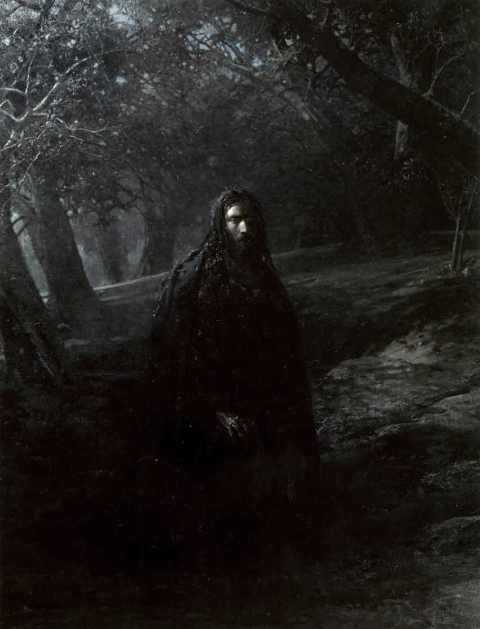
Nicholai Ge, “Mount of Olives,” 1869-1880
story, but with an important difference. He writes,
In the [wilderness] there is not even the remotest glimpse of any hesitation or questioning on the part of Jesus Himself. Self-evidently and with the greatest precision the tempter is at once resisted. But then it was only a matter of continuing without deviation on the way He had entered at Jordan. Now he had to face the reckoning. Now [in the Garden of Gethsemane] He was confronted with the final fruit and consequence of what He had begun.[1]
In Barth’s view, the dread of the event he was about to undergo, the crucifixion, was not just the fear of physical pain and death, but had more to do with the alignment of the will of Satan with the will of God. That is, the cross would in effect mean that the powers of evil had taken up ruler-ship over the world; somehow, the history of God’s redemption would include within it Satan’s victory (even if only temporary).. So Jesus prays, in the garden, “that for the sake of God’s own cause and glory the evil determination of world-occurrence should not finally rage against Himself, the sent One of God and the divine Son.”[2]
Jesus prayed to discover the will of God and was intent on aligning his own will with God’s will—knowing also that God’s will was directed toward the reconciliation of God with creation and with the salvation of humanity. In Gethsemane, we encounter both the obedience and the freedom of Christ. While Jesus desired to obey the will of God and pressed his way into complete obedience, even unto death, the will of Jesus was not automatically folded into the will of God. As Paul Dafydd Jones writes, engaging Barth’s discussion of Gethsemane,
Christian theologians cannot bury the possibility that Jesus might have been overcome and that the project of reconciliation might have miscarried. The theologian must take with full seriousness Jesus’ quandary in Gethsemane as he asks, “Does all this have to happen?”[3]
Jones might be pushing Barth a bit further than he actually went, but it’s a profound question nonetheless. Could we fathom, even just for a moment, on this Good Friday, the possibility that Jesus might have been overcome? That the “temptation” of the second wilderness (Gethsemane) might have simply been too much to bear?
[1] CD IV/1, p. 265.
[2] CD IV/1, p. 269.
[3]Paul Dafydd Jones, “Karl Barth on Gethsemane,” International Journal of Systematic Theology 9, no. 2 (2007): p. 159. See also CD IV/1, p. 264.
Previous Post

April 2, 2015
Gethsemane: The Most Troubling Story in the Bible?
Next Post
April 6, 2015 Lesson from the Rolling Stone: We Are Easily Duped
Browse Our Archives
Select a Category Uncategorized
Select a Month December 2020 November 2020 June 2020 May 2020 April 2020 December 2018 July 2018 March 2018 February 2018 January 2018 December 2017 November 2017 October 2017 September 2017 August 2017 July 2017 June 2017 April 2017 March 2017 February 2017 January 2017 December 2016 November 2016 October 2016 September 2016 August 2016 July 2016 June 2016 May 2016 April 2016 March 2016 February 2016 January 2016 December 2015 November 2015 October 2015 September 2015 August 2015 July 2015 June 2015 May 2015 April 2015 March 2015 February 2015 January 2015 December 2014
Follow Us!
TAKE THE
Religious Wisdom Quiz
Who was the only female judge of Israel?
Select your answer to see how you score.
Ruth Deborah Hannah Esther
Books by This Author Books by Kyle Roberts
Related posts from Unsystematic Theology

If He "Emptied Himself" Was He Still God?...
Kierkegaard on the Incarnation: God is Like an...
"A Complicated Pregnancy" Now Available for Pre-Order
TRENDING AT PATHEOS Progressive Christian

Can a Chatbot Touch Your Soul?
Can a chatbot offer genuine spiritual counsel? One conversation brought me to...

Religion and Politics: How Should We Then Live?
Two cultural axioms get repeated in polite company. Don't mix religion and...

7 Things We Get Wrong About Giving Thanks
It's a time of year when many of us turn to the...

Uncaging Truth: Spirituality Beyond Institutions
The Lost Connection: Why True Spirituality, Not Religion, Is the Key to...

Christ the King? Maybe We've Misunderstood the Crown
What do we mean when we say that Jesus is King? What...

Counter “Christ Is King” Nationalism with Christ THE...
Christ the King Sunday is an ideal time to address the heresy...
view all Progressive Christian blogs
Ad-Free & Subscriber Log-In Subscription Support
- About Us
- 2026 Calendar
- Videos
- Podcasts
- Library of World Religions
- Faith In Media Tracker
- Advertise With Us
- Write for Us
- Privacy Policy
- Terms of Service
- Do Not Sell My Data
- Contact Us
- Radiant Digital
- Manage Newsletter Subscriptions
- Unsubscribe From Notifications
- Sitemap
Copyright 2008-2026, Patheos, part of the Radiant Digital network of media brands. All rights reserved.
Subscription Support Ad-Free & Subscriber Log-In
Follow Patheos