
BuddhistCatholicContemplativeEvangelicalGeneral ChristianHinduJewishLatter-day SaintMuslimNew VisionsProgressive Christian
Beliefs
- Buddhist
- Catholic
- Contemplative
- Evangelical
- General Christian
- Hindu
- Jewish
- Latter-day Saint
- More Voices
- Muslim
- New Visions
- Pagan
- Progressive Christian
Topics
- Religion News
- Food and Religion
- Sports and Religion
- Religious Art
- Religious Music and Entertainment
- Religious Events
- History and Religion
- Style and Religion
- Politics and Religion
- Women in Religion
- Recreation Outdoors and Religion
- Business Finance and Religion
- Careers Workplace and Religion
- Education and Religion
- Family Parenting and Religion
- Health Fitness and Religion
- Home and Religion
- Relationships and Religion
- Technology and Religion
- Travel and Religion
Columnists
- Buddhist Columnists
- Business Finance and Religion Columnists
- Careers Workplace and Religion Columnists
- Catholic Columnists
- Contemplative Columnists
- Education and Religion Columnists
- Evangelists Columnists
- Family Parenting and Religion Columnists
- General Christian Columnists
- Health Fitness and Religion Columnists
- Hindu Columnists
- History and Religion Columnists
- Home and Religion Columnists
- Jewish Columnists
- More Voices Columnists
- Latter Day Columnists
- Muslim Columnists
- New Visions Columnists
- Nonreligious Columnists
- Pagan Columnists
- Politics and Religion Columnists
- Progressive Columnists
- Recreation Outdoors and Religion Columnists
- Relationships and Religion Columnists
- Religion News Columnists
- Religious Art Columnists
- Religious Events Columnists
- Religious Music and Entertainment Columnists
- Sports and Religion Columnists
- Style and Religion Columnists
- Technology and Religion Columnists
- Travel and Religion Columnists
- Women in Religion Columnists
Resource Library
- 2026 Calendar
- Library of World Religions
- The 100 Most Holy Places on Earth
- Patheos Answers
- Podcasts
- Videos
- Faith Leaders Database
- Anglican Episcopalian
- Bahai
- Baptist
- Buddhism
- Christianity
- Confucianism
- Eastern Orthodoxy
- Hinduism
- Holiness and Pentecostal
- ISKCON
- Islam
- Judaism
- Lutheran
- Methodist
- The Church of Jesus Christ of Latter-day Saints
- New Age
- Paganism
- Presbytarian and Reformed
- Protestantism
- Religion Behind the Scenes
- Roman Catholic
- Scientology
- Shia Islam
- Sikhism
- Sufism
- Sunni Islam
- Taoism
- Zen
- See all religions
Research Tools
 Ad-Free & Subscriber Log-In Subscription Support
Ad-Free & Subscriber Log-In Subscription Support
Follow Patheos 

- Trending:
- Forgiveness
- |
- Marriage
- |
- Consciousness
- |
- Death Penalty
- |
- Election
- |
- Halloween
 Unfundamentalist Parenting
- Home
- Progressive Christian
- Family, Parenting and Religion
- Deliberate Acts of Kindness
Deliberate Acts of Kindness
Last updated on: April 6, 2017 at 1:11 pm by Cindy Brandt
Deliberate Acts of Kindness 2017-04-06T13:11:03+08:00 Cindy Brandt
Patheos Explore the world's faith through different perspectives on religion and spirituality! Patheos has the views of the prevalent religions and spiritualities of the world.
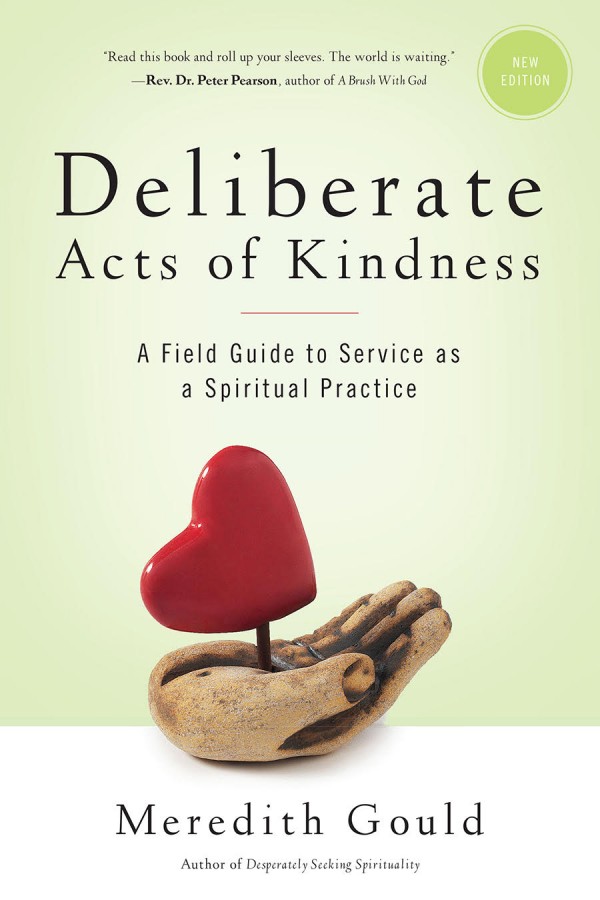
I interview author, Meredith Gould, about her new book as it relates to Unfundamentalist parenting:
Many of my readers here at Unfundamentalist parenting grew up evangelical Christian, but are Somes and Dones. Meaning, they don’t identify with much if any of the Christian faith anymore. And yet, they want to raise their children with a moral core and be open to spirituality. How do you think service and acts of kindness can be a family practice to cultivate without triggering religious trauma?
First, some background. I was raised Jewish, a tradition in which ethical behavior is often considered more important than ritualized observance. Because it emerged from Judaism and Jesus of Nazareth was a Jew, Christianity is a religion that emphasizes serving others and mustering mercy. Unfortunately, ethical action is often freighted with moral judgment. Good Christians love and serve their neighbors because Jesus said it was the greatest commandment. Bad Christians are self-serving sinners.
According to (some) Christian theologies, ethical action can be understood by using what sociologists call exchange theory. Serving others is done in exchange for something else. Service becomes a ticket to salvation rather than evidence of spiritual maturity. And by “spiritual maturity” I mean a durable sense of connection to all creation, including all people regardless of age, ethnicity, gender, religion, sexual preference, or social class. I describe the religious roots of service as a spiritual practice in the first chapter of Deliberate Acts of Kindness. I go into more depth about the disconnect between religion and spirituality in another book, Desperately Seeking Spirituality.
Serving with generosity, mercy, and kindness without triggering painful memories will depend to some extent on the source and extent of the religious trauma. Someone growing up in a church that preaches eternal damnation for opting out of service as a vehicle for evangelism may have emotional difficulty instituting service as a family practice. Some will need to begin or continue the work of healing spiritual wounds before getting involved with service. Others may find that serving others without the goal of saving souls for Christ will support their healing.
To offset the possibility of unproductively trash talking earlier experiences, I believe some healing must happen before parents are able to joyfully engage the entire family in service. I’d say this is especially true if the service opportunity is sponsored by an organization with a leadership structure and style reminiscent of church.
As for deliberate acts of kindness, those can become a family practice without triggering trauma if everyone focuses on kindness and uses that word, rather than love. The word “love” can be a trigger, especially for anyone whose former church leadership preached love while covering up abuse of any kind. Speaking of which, my top recommendation for understanding and healing from church-inflicted wounds is Carol Howard Merritt’s new book, Healing Spiritual Wounds.
Why do you think it’s important for young people to discern their calling or place of service in the world?
People of all ages will explore these radical questions at various points throughout their life: Who am I? (Identity) Why am I here? (Purpose) What happens when I die? (Legacy)
Younger people and especially young adults, currently defined as those between ages 18 and 35, tend to focus more on identity and purpose. These are important issues to explore early on. The inquiry itself builds self-awareness and ego strength, both of which are foundational to understanding that other people not only exist, but deserve to be treated with kindness and generosity. Service as a spiritual practice that takes some practice, so starting sooner rather than later makes sense, right?
In Chapter 2, “Discerning the Call, I provide exercises and tips for this inquiry. For example, I encourage readers to ask and spend time contemplating their answer to the question, “What sort of person would I like to become?” Chapter 3, “Discovering Your Place,” provides exercises and tips for figuring out where to serve. Here, again, I encourage readers to explore assumptions about where and how to share their skills, talents, and passions.
Young people will try and experiment different acts of service before they discover their unique contribution to the world. Do you have any tips on how to navigate that potentially messy journey?
I believe that everyone, not just young people, should explore different types of service as well as different environments for serving. We can count on the journey getting messy. Humans are involved! But, there’s a difference between working through discomfort and enduring unnecessary suffering.
Chapter 5, which focuses on the “Shadow Side of Service,” offers tips for establishing healthy boundaries; what to do if triggered; when to call out bad or illegal behavior; and how to recognizing signs of stress and distress. I also have a background in yoga and holistic health, so I’m always keen on getting people to at least acknowledge, if not recognize, the body-mind-spirit connection.
Your readers will find exercises designed to help them identify healthy emotional and physical boundaries; their own less-than-lovely attitudes and feelings; and how to get back on track when service seems like an impossibly difficult spiritual practice. Here’s where, to return to the heart of service after a difficult day, I recommend asking: What did I learn today? How did I help? When was I most present to what was happening? How is my life being enhanced?
Do you think it’s important to do acts of service as a family or in community with others, or should there be space for individuals to do their own thing?
I think it’s important to serve in all the ways you’ve mentioned while being aware of psychosocial development and family structure. Let’s go back to your first question about moral development.
When does that typically begin happening for children? Lots of theory and research. If there’s any agreement, it’s that certain cognitive and emotional abilities must develop first. As a practical and sanity-preserving matter, serving in a community will be more successful after children understand the concepts of going away and returning. Here, I’m thinking about service activities where families may sign up to participate but then family members are separated by age to do different things. Could be disastrous for children who are not yet emotionally equipped for time and tasks away from parents or siblings.
As for family structure, the work demands of adults might make it difficult for an entire family to participate together every time. This is one reason I include information about service-oriented vacations or at least building deliberate acts of kindness into family getaways. I absolutely do not recommend service-oriented vacations for families that include members still healing from forced mission trips.
I do believe it’s not only appropriate but necessary for individuals to do their own thing in the world of service. In the context of family, parents would need to assess the maturity of their tweens and teens before sending them off as individuals for activities like neighborhood cleanups. They’ll also need to vet the activity’s sponsor and ensure that appropriate adult supervision is in place. Once all that is good-to-go, individual service activities are yet another way to build confidence as well as generosity of spirit.
Finally—for now, anyway—if parents do nothing more than teach their children how to act with integrity and honesty; to feel and express empathy, generosity, and kindness; to consider the needs of others; and to become good citizens, then serving within and for family is an excellent place to begin this spiritual practice.
Meredith Gould, PhD (@meredithgould), is a longtime spiritual seeker, sociologist, and online community manager. She’s an award-winning author of eleven books, including Desperately Seeking Spirituality: A Field Guide to Practice and is known for her passionate advocacy of using digital tools for ministry. Her next book, Transcending Generations: A Field Guide to Collaboration in Church is due out in August 2017. Visit: www.meredithgould.com Please support independent publishers by ordering directly from Clear Faith Publishing.
Previous Post

April 3, 2017
Mike Pence, The Billy Graham Rule, & Mixed Gender Friendships
Next Post

April 6, 2017 Let’s Be Thoughtful About the Way We Share Pictures of Syrian Children
Browse Our Archives
Select a Category Uncategorized
Select a Month November 2017 October 2017 September 2017 August 2017 July 2017 June 2017 May 2017 April 2017 March 2017 February 2017 January 2017 December 2016 November 2016 October 2016 September 2016 August 2016 July 2016 June 2016 May 2016 April 2016 March 2016 February 2016
Follow Us!
TAKE THE
Religious Wisdom Quiz
In Philippians, Paul mentions two women who need to be of the same mind. Who are they?
Select your answer to see how you score.
Euodia and Syntyche Phoebe and Priscilla Lydia and Chloe Mary and Martha
Related posts from Unfundamentalist Parenting

Help! My Child Got "Saved" at VBS
Contemplative Prayer with Kids
How to Parent when Grandparents are Conservative?
Unfundamentalist Resources for Babies/Toddlers
TRENDING AT PATHEOS Progressive Christian

What Being a Modern-Day Apostle Means to Me
In my last column, I discussed the ins and outs of modern-day...

Did Ancient China Once Worship the God of...
Across human history, a common thread weaves through the origins of the...

Love Your Neighbor – Including Earth-Kin: Lev. 19,...
God’s command to love your neighbor means acting in an ethical and...

Lead a Church Study of “Jesus and Lao...
Guest writer Jack Thomas (The Irreverent Reverend) reflects on leading his church...

Pastoral Wisdom for Responding to Sermon Pushback
Getting sermon pushback on your social justice sermon? Learn practical, Proverbs-based strategies...

Principles for Understanding the Apostolic Ministry Today
Whenever people discover that my formal ministry title is "apostle," as in...
view all Progressive Christian blogs
Ad-Free & Subscriber Log-In Subscription Support
- About Us
- 2026 Calendar
- Videos
- Podcasts
- Library of World Religions
- Faith In Media Tracker
- Advertise With Us
- Write for Us
- Privacy Policy
- Terms of Service
- Do Not Sell My Data
- Contact Us
- Radiant Digital
- Manage Newsletter Subscriptions
- Unsubscribe From Notifications
- Sitemap
Copyright 2008-2026, Patheos. All rights reserved.
Subscription Support Ad-Free & Subscriber Log-In
Follow Patheos