
BuddhistCatholicContemplativeEvangelicalGeneral ChristianHinduJewishLatter-day SaintMuslimNew VisionsProgressive Christian
Beliefs
- Buddhist
- Catholic
- Contemplative
- Evangelical
- General Christian
- Hindu
- Jewish
- Latter-day Saint
- More Voices
- Muslim
- New Visions
- Pagan
- Progressive Christian
Topics
- Religion News
- Food and Religion
- Sports and Religion
- Religious Art
- Religious Music and Entertainment
- Religious Events
- History and Religion
- Style and Religion
- Politics and Religion
- Women in Religion
- Recreation Outdoors and Religion
- Business Finance and Religion
- Careers Workplace and Religion
- Education and Religion
- Family Parenting and Religion
- Health Fitness and Religion
- Home and Religion
- Relationships and Religion
- Technology and Religion
- Travel and Religion
Columnists
- Buddhist Columnists
- Business Finance and Religion Columnists
- Careers Workplace and Religion Columnists
- Catholic Columnists
- Contemplative Columnists
- Education and Religion Columnists
- Evangelists Columnists
- Family Parenting and Religion Columnists
- General Christian Columnists
- Health Fitness and Religion Columnists
- Hindu Columnists
- History and Religion Columnists
- Home and Religion Columnists
- Jewish Columnists
- More Voices Columnists
- Latter Day Columnists
- Muslim Columnists
- New Visions Columnists
- Nonreligious Columnists
- Pagan Columnists
- Politics and Religion Columnists
- Progressive Columnists
- Recreation Outdoors and Religion Columnists
- Relationships and Religion Columnists
- Religion News Columnists
- Religious Art Columnists
- Religious Events Columnists
- Religious Music and Entertainment Columnists
- Sports and Religion Columnists
- Style and Religion Columnists
- Technology and Religion Columnists
- Travel and Religion Columnists
- Women in Religion Columnists
Resource Library
- 2026 Calendar
- Library of World Religions
- The 100 Most Holy Places on Earth
- Patheos Answers
- Podcasts
- Videos
- Faith Leaders Database
- Anglican Episcopalian
- Bahai
- Baptist
- Buddhism
- Christianity
- Confucianism
- Eastern Orthodoxy
- Hinduism
- Holiness and Pentecostal
- ISKCON
- Islam
- Judaism
- Lutheran
- Methodist
- The Church of Jesus Christ of Latter-day Saints
- New Age
- Paganism
- Presbytarian and Reformed
- Protestantism
- Religion Behind the Scenes
- Roman Catholic
- Scientology
- Shia Islam
- Sikhism
- Sufism
- Sunni Islam
- Taoism
- Zen
- See all religions
Research Tools
 Ad-Free & Subscriber Log-In Subscription Support
Ad-Free & Subscriber Log-In Subscription Support
Follow Patheos 

- Trending:
- Forgiveness
- |
- Marriage
- |
- Consciousness
- |
- Death Penalty
- |
- Election
- |
- Halloween
 Unfundamentalist Parenting
- Home
- Progressive Christian
- Family, Parenting and Religion
- Ten Ways Children Save Our Faith
Ten Ways Children Save Our Faith
Last updated on: February 15, 2017 at 8:26 pm by Cindy Brandt
Ten Ways Children Save Our Faith 2017-02-15T20:26:10+08:00 Cindy Brandt
Patheos Explore the world's faith through different perspectives on religion and spirituality! Patheos has the views of the prevalent religions and spiritualities of the world.
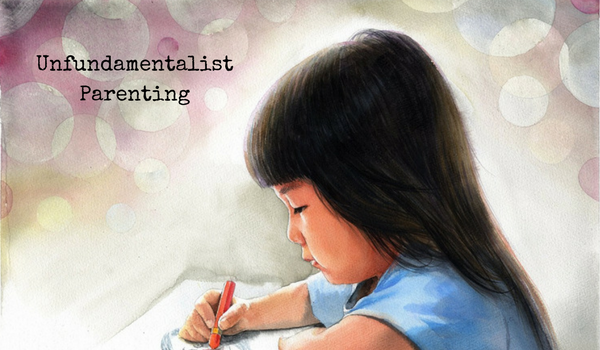
Image: Pixabay
I was lost, and then I was found. And then I was lost again.
I have come to view my spiritual path not as a one-time conversion experience of being “saved” but walking an off-beaten path of wandering, trespassing the path briefly before wandering off again. I was saved. But I am being saved still, again and again.
The more I delve into the work of unfundamentalist parenting, the more I am convinced that those of us parents who are disillusioned with our faith upbringing need not give up our faith for the sake of the kids, we need to be saved into the faith by our children. The more I realize when it comes to faith, we almost always get it wrong, and the children are the ones who really get what it means to live a vibrant, spiritually rich life of faith.
Here are ten ways children save our faith:
1. Curiosity & Openness. Children are endlessly curious and no question is off limits. They inquire deeply and persistently. They interrogate every object, smell, feeling, and story that comes their way. Theologian Karl Rahner says adults should strive for mature childhood, referring to the infinite openness of childhood as the ultimate expression of humanity’s religious existence.
2. Vulnerability. The vulnerability inherent in children, and especially GLBTQ children, children of color and children with disabilities, bring us to confront our own frailty and reveal a God who cares for the margins. They compel us to become tender and soft. In their dependence upon us, they compel us into our greatest calling: to love and give of ourselves.
3. Stories. Children are drawn to stories and are masterful storytellers. They view the world through a narrative lens. We need to reclaim the art of story in our stale doctrines and institutionalized laws. Stories convey truth more powerfully than propositions and is our most subversive form of faith.
4. Sense of Justice. How many times have you heard a child yell, “BUT THAT’S NOT FAIR!” Children have an innate drive to make wrongs right. They are social beings and concrete thinkers. They challenge us to take our faith from theological musings into real-life change. Last night at dinner, my son forked a piece of fish and remarked, “this fish just died and we are eating it.” He pierces my conscience all the time with his innocent musings.
5. Spontaneity. I’ve said here that whimsy needs to be a fruit of the Spirit. Our faith becomes dead when it loses joy, delight, and whimsy—when we have repressed our emotions for so long by fundamentalism that we can no longer feel pleasure in simply being. “Imaginative living is a disruption of the status quo. The children are already practicing the vibrant life of resurrection resistance.”
6. Sacrament of the Present Moment. Children do not operate on the same schedule as us. Their priorities are for play whereas ours are for work. Our society has become sick with The Disease of Being Busy. Taking a walk with a child pulls us into connecting to life in the present moment, an opportunity to pause, breathe, and allow the child to direct our messed up priorities.
7. Truth-Telling. The classic story of the child who reveals the Emperor does not indeed have clothing points to children’s ability to tell unflinching truth in the face of power. In this present political climate, where fake news and polarizing rhetoric convolutes facts, there’s no greater resistance than the ministry of truth-telling. The world requires truth telling. Our faith requires truth telling. Someone needs to shout that the Emperor has no clothes.
8. Holistic Living. A child is never bored in nature. Even the ones raised in cities (like mine are) find ways to entertain themselves when playing in a lake, or given rocks and sticks and sand to build stuff with. Children’s inherent connection to nature reminds us of how we are a small part of a much larger environment, and how we share it with fellow citizens of the planet. We need to tap into a child’s adventurous spirit to explore and play in our world, and through which to find our faith interconnected with our bodies, mind, spirit, as well as our earth.
9. Differentiation. Children go through several developmental stages to differentiate their identity from their caretakers. They are wholly consumed with the task of developing their unique identity, to find who they are and answer the existential questions of their place in this life. Our faith needs to mirror the process of differentiation because a faith that stays the same becomes stale and toxic, but a fluid faith that evolves maintain a prophetic edge to critique the systems of the world and make it a better place. Toddlers show us how to be the best prophets, bucking against authority with all their might, proving to the world they are worthy to have a voice and make a difference.
10. Because Jesus Said. The last and most important reason why children are qualified to evangelize us is because Jesus said so. “Whoever welcomes one of these little children in my name welcomes me; and whoever welcomes me does not welcome me but the one who sent me.” The disciples wanted to keep the children from Jesus because they felt there were more important matters than little children. They used their power to dominate the children. But Jesus flips the script and says no, if you want to follow me, follow them. The kingdom belongs to these little ones. They hold a Jesus-centric spiritual authority.
Join us at Raising Children Unfundamentalist.
Previous Post

February 13, 2017
Parenting With Spiritual Baggage - 5 Tips
Next Post

February 17, 2017 We Live in an Anti-Child World
Browse Our Archives
Select a Category Uncategorized
Select a Month November 2017 October 2017 September 2017 August 2017 July 2017 June 2017 May 2017 April 2017 March 2017 February 2017 January 2017 December 2016 November 2016 October 2016 September 2016 August 2016 July 2016 June 2016 May 2016 April 2016 March 2016 February 2016
Follow Us!
TAKE THE
Religious Wisdom Quiz
What was the purpose of the cities of refuge?
Select your answer to see how you score.
To house the sick To train future priests To store food for famine To protect those accused of manslaughter
Related posts from Unfundamentalist Parenting

Five FAQs - Parenting While Deconstructing

My Daughter Loves Jesus. Is That Okay?

Help! My Child Got "Saved" at VBS

What ‘Biblical Parenting’ REALLY Means
TRENDING AT PATHEOS Progressive Christian

What Being a Modern-Day Apostle Means to Me
In my last column, I discussed the ins and outs of modern-day...

Did Ancient China Once Worship the God of...
Across human history, a common thread weaves through the origins of the...

Love Your Neighbor – Including Earth-Kin: Lev. 19,...
God’s command to love your neighbor means acting in an ethical and...

Lead a Church Study of “Jesus and Lao...
Guest writer Jack Thomas (The Irreverent Reverend) reflects on leading his church...

Pastoral Wisdom for Responding to Sermon Pushback
Getting sermon pushback on your social justice sermon? Learn practical, Proverbs-based strategies...

Principles for Understanding the Apostolic Ministry Today
Whenever people discover that my formal ministry title is "apostle," as in...
view all Progressive Christian blogs
Ad-Free & Subscriber Log-In Subscription Support
- About Us
- 2026 Calendar
- Videos
- Podcasts
- Library of World Religions
- Faith In Media Tracker
- Advertise With Us
- Write for Us
- Privacy Policy
- Terms of Service
- Do Not Sell My Data
- Contact Us
- Radiant Digital
- Manage Newsletter Subscriptions
- Unsubscribe From Notifications
- Sitemap
Copyright 2008-2026, Patheos. All rights reserved.
Subscription Support Ad-Free & Subscriber Log-In
Follow Patheos