
BuddhistCatholicContemplativeEvangelicalGeneral ChristianHinduJewishLatter-day SaintMuslimNew VisionsProgressive Christian
Beliefs
- Buddhist
- Catholic
- Contemplative
- Evangelical
- General Christian
- Hindu
- Jewish
- Latter-day Saint
- More Voices
- Muslim
- New Visions
- Pagan
- Progressive Christian
Topics
- Religion News
- Food and Religion
- Sports and Religion
- Religious Art
- Religious Music and Entertainment
- Religious Events
- History and Religion
- Style and Religion
- Politics and Religion
- Women in Religion
- Recreation Outdoors and Religion
- Business Finance and Religion
- Careers Workplace and Religion
- Education and Religion
- Family Parenting and Religion
- Health Fitness and Religion
- Home and Religion
- Relationships and Religion
- Technology and Religion
- Travel and Religion
Columnists
- Buddhist Columnists
- Business Finance and Religion Columnists
- Careers Workplace and Religion Columnists
- Catholic Columnists
- Contemplative Columnists
- Education and Religion Columnists
- Evangelists Columnists
- Family Parenting and Religion Columnists
- General Christian Columnists
- Health Fitness and Religion Columnists
- Hindu Columnists
- History and Religion Columnists
- Home and Religion Columnists
- Jewish Columnists
- More Voices Columnists
- Latter Day Columnists
- Muslim Columnists
- New Visions Columnists
- Nonreligious Columnists
- Pagan Columnists
- Politics and Religion Columnists
- Progressive Columnists
- Recreation Outdoors and Religion Columnists
- Relationships and Religion Columnists
- Religion News Columnists
- Religious Art Columnists
- Religious Events Columnists
- Religious Music and Entertainment Columnists
- Sports and Religion Columnists
- Style and Religion Columnists
- Technology and Religion Columnists
- Travel and Religion Columnists
- Women in Religion Columnists
Resource Library
- 2026 Calendar
- Library of World Religions
- The 100 Most Holy Places on Earth
- Patheos Answers
- Podcasts
- Videos
- Faith Leaders Database
- Anglican Episcopalian
- Bahai
- Baptist
- Buddhism
- Christianity
- Confucianism
- Eastern Orthodoxy
- Hinduism
- Holiness and Pentecostal
- ISKCON
- Islam
- Judaism
- Lutheran
- Methodist
- The Church of Jesus Christ of Latter-day Saints
- New Age
- Paganism
- Presbytarian and Reformed
- Protestantism
- Religion Behind the Scenes
- Roman Catholic
- Scientology
- Shia Islam
- Sikhism
- Sufism
- Sunni Islam
- Taoism
- Zen
- See all religions
Research Tools
 Ad-Free & Subscriber Log-In Subscription Support
Ad-Free & Subscriber Log-In Subscription Support
Follow Patheos 

- Trending:
- Forgiveness
- |
- Marriage
- |
- Consciousness
- |
- Death Penalty
- |
- Election
- |
- Halloween
 Unfundamentalist Parenting
- Home
- Progressive Christian
- Family, Parenting and Religion
- The Binding of Isaac as Cautionary Tale
The Binding of Isaac as Cautionary Tale
Last updated on: July 15, 2016 at 1:55 am by Ryan Stollar
The Binding of Isaac as Cautionary Tale 2016-07-15T01:55:59+08:00 Ryan Stollar
Patheos Explore the world's faith through different perspectives on religion and spirituality! Patheos has the views of the prevalent religions and spiritualities of the world.
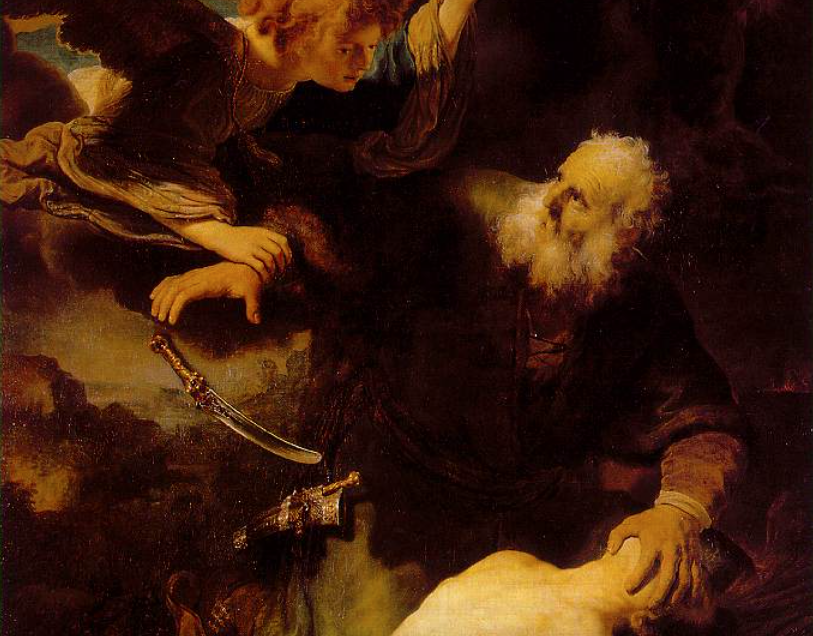
Rembrandt, “Abraham and Isaac,” 1634, public domain.
Abraham took the wood for the burnt offering and placed it on his son Isaac, and he himself carried the fire and the knife. As the two of them went on together, Isaac spoke up and said to his father Abraham, “Father?” “Yes, my son?” Abraham replied. “The fire and wood are here,” Isaac said, “but where is the lamb for the burnt offering?” Abraham answered, “God himself will provide the lamb for the burnt offering, my son.” And the two of them went on together. When they reached the place God had told him about, Abraham built an altar there and arranged the wood on it. He bound his son Isaac and laid him on the altar, on top of the wood. Then he reached out his hand and took the knife to slay his son.
Genesis 22:6-10
The Binding of Isaac is one of the most troubling passages in the Bible. Abraham whisks his son Isaac off to a mountain top in Moriah, binds him with rope, and raises a knife to kill him—all as a sacrifice to his God, Yahweh. Only in the last moment is Isaac’s life spared. This passage has bewildered, disturbed, and provoked all sorts of interpretations. Defenses have been given, critiques have been levied—yet the passage remains elusive. Is it the penultimate example of religiously justified child abuse, only eclipsed by Yahweh’s actual sacrifice of his own child Jesus?
Honestly, the passage confounds me. I am not going to suggest I found the true interpretation. But I do want to work through how perhaps most interpretations have missed the point by focusing so much on Abraham, and thus neglecting to consider the point of view of the child. Most interpretations consider whether Abraham was doing the right thing, whether Abraham really meant to kill his son, whether Yahweh really would have let Abraham follow through, whether Abraham is a model of faith. Little attention is given to Isaac—not only the role he played, but more importantly, how he experienced the events in question. The famous Christian philosopher Soren Kierkegaard, for example, argued in Fear and Trembling that Abraham placed religious concerns over ethical concerns, thereby proving his faith in God—but what about Isaac’s religious concerns? Does Isaac’s relationship to God mean nothing simply because he is a child? Interpretations like Kierkegaard’s consider the likely agony Abraham went through during his test, but neglect to center the overwhelming terror Isaac likely experienced.
As I have stated previously, my goal these days is to approach biblical passages with an eye towards child liberation and child protection. So I am interested in looking at this passage from the vantage point of Isaac. And I seek to discover what this passage can tell us today—in our contemporary contexts—about children. How can we consider this passage in a way that better protects children today? How can we think about the ramifications of Isaac’s experience such that we can better liberate children in our faith communities?
The first question we must consider is the age of Isaac. Some scholars consider Isaac to be an adult during this time, around the age of 32. Others place him at the age of a toddler or as a late teenager. I tend to agree with Terence E. Fretheim, who argues Isaac was likely 12 or 13. Fretheim says, “On the one hand, he was old enough to carry wood and ask questions that assume a capacity to analyze a situation and potential problems relating to it (Gen. 22:6-7). On the other hand, God refers to him as a ‘boy’ (22:12), and he calls out ‘Father’ to Abraham (22:27)” (The Child in the Bible, p. 14). Isaac certainly does seem old enough to recognize that Abraham is making a trek to offer a sacrifice without the needed animal. However, Isaac also seems completely trusting in his father, despite the ominous foreboding of the story—so he seems young enough to have a childlike faith in his father’s deceitful words.
I think this childlike faith of Isaac’s—which is met by the betraying deceit of his father—is an entry point into the story. Isaac trusts that his father has his best interests in mind and is telling the truth that God will provide an animal to sacrifice. Isaac does not hesitate when tasked with carrying the firewood. When Isaac asks Abraham where the animal will come from, he accepts his father’s answer without question. What is notable here is that Isaac is vocal at this point—he does not hesitate to speak up with his doubts. This is notable because later, when Abraham binds Isaac to the wood, Isaac’s voice is no longer heard.
I think the disappearance of Isaac’s voice is telling. It signifies that Isaac knows he has been betrayed. Note that Isaac openly asked Abraham where the animal will come from—but Abraham lies to his child. Abraham knew full well what God said, and that God was asking him to sacrifice his son. Whether or not Abraham trusted God would provide an alternative, or whether or not “Abraham reasoned that God could even raise the dead” (Hebrews 11:19), is irrelevant at this point. If Abraham thought either of those thoughts, he did not involve Isaac in that process. Instead, he kept Isaac at arm’s distance and was not forthright with him. In his fervent commitment to God, Abraham missed a chance to walk alongside his child as a partner in faith.
The actual binding moment appears brutal in the text. We are not told whether Isaac struggled or fought back against his father, but the blunt force of the narrative comes across. One moment Isaac is a talkative, trusting, and inquisitive child; the next moment he is silent, unmoving, and restrained. One moment Isaac is a subject, a human being pursuing knowledge about God’s ways; the next moment he is reduced to an object, a thing to be sacrificed in order for an adult to better himself with God.
While I wish I could explain away the whole event, what is made clear in the text is that God commends Abraham’s faith. This is why many people make parallels between Abraham sacrificing Isaac and Yahweh sacrificing Jesus. But I think that the Binding of Isaac is a cautionary tale, despite God’s commendation of Abraham’s faith. I think it is a cautionary tale because it actually is the very opposite of Jesus’ sacrifice.
Jesus came willingly to our world. Despite John 3:16 saying God “gave Their only begotten son,” Jesus’ own words indicate that it was his own choice to enter our world and be in relationship with us. Jesus chose his path. He chose to be a Child and walk among us, as Yahweh once walked in the Garden with Adam and Eve. As a human child and later an adult, Jesus was always a subject, always an active agent in his spirituality and how he engaged with the God Parent Yahweh. As God Child, Jesus assumes the power in his relationship to Yahweh, as ultimately it is Jesus the God Child who “return with the sword” and judge humankind.
In contrast, Isaac did not go willingly to the slaughter. Isaac made no choice to be a sacrifice. And Abraham not only gave Isaac no choice in the matter, Abraham also erased his child’s agency. He treated his child as an object, a means to an end, instead of treating his child as a subject with his own thoughts, relationship to God, and rights to determine his own life. So while God commends Abraham’s faithfulness, note that God never commends any other aspect of how Abraham put his faith into practice. In fact, we are later told by the prophet Jeremiah that God considers child sacrifice “a detestable thing” (Jeremiah 32:35).
If God finds child sacrifice detestable, but Abraham’s faith commendable, it seems reasonable to separate Abraham’s faith from how he let his faith make him act. This is not an uncommon event in the Bible. For example, in Judges 11, Jephthah the Gileadite “made a vow to the Lord: ‘If you give the Ammonites into my hands, whatever comes out of the door of my house to meet me when I return in triumph from the Ammonites will be the Lord’s, and I will sacrifice it as a burnt offering.’” But “when Jephthah returned to his home in Mizpah, who should come out to meet him but his daughter, dancing to the sound of timbrels! She was an only child.” Jephthah’s faith caused him to act in a stupid, rash way.
Applying this idea that faith does not necessarily result in moral acts to Genesis would suggest that the text might condemn how Abraham as a parent valued his own spirituality over and against his child. Note that when Abraham and Isaac ascend the mountain, “the two of them went on together” (emphasis added). But when the descent is made, “Abraham returned to his servants” (emphasis added). Isaac does not return alongside his father.
Not only does Isaac not return alongside his father, Isaac also is never again seen in a relationship with his parents. Fretheim notes that, “Abraham and Isaac never again converse in the narrative that follows, not even in connection with the search for a wife for Isaac (Gen. 24). While Isaac attends Abraham’s funeral (25:9), he does not attend Sarah’s or even return to her death bed (Gen. 23). Moreover, why would God, but not Abraham, bless Isaac (23:11)?”
Fretheim then asks, “Might these textual details, even if in subtle ways, recognize that a child has been abused?” I think the answer is yes—though I do not think the details are subtle in that regard. The answer is unequivocally yes, a child has been abused. A child was restrained without his consent, tied to firewood, and then had to watch his own parent lift a knife to kill him. Full stop, that is child abuse. Whereas Jesus chose to sacrifice himself, Isaac was abused. Whereas Jesus was respected as a subject, Isaac was reduced to an object.
This is why I read the Binding of Isaac is a cautionary tale about parents who value their own faiths over and against their children’s lives. Yes, Abraham showed immense faith. But that faith came with a cost: the silence and alienation of his beloved child. God commends Abraham’s faith but God never commends how Abraham lied to his child and gave his child no choice in the matter.
If Abraham’s descent from the mountain and later distance from Isaac indicates anything, it is that faith without love and relationship is dead. It kills people, sometimes quite literally. I cannot help but think of parents who believe fidelity to God mean they must throw their own LGBTQ children out on the streets. Or parents who allow their children to die because of their commitment to faith healing. Or parents who beat their children because of their myopic interpretation of the Proverbs. Surely their fervor is astounding, but they entirely miss the point of the Gospel.
The Gospel is found in relationship, in loving one’s neighbor and seeing one’s neighbor as a fellow subject before God, not as an object to sacrifice in the name of purity. When one sacrifices one’s neighbor in the name of faith, one loses the very heart of the Gospel.
Previous Post

July 13, 2016
Why Salvation doesn’t need the Sinner’s Prayer
Next Post

July 20, 2016 Talking About Race With Children: The Worst Advice I Ever Gave
Browse Our Archives
Select a Category Uncategorized
Select a Month November 2017 October 2017 September 2017 August 2017 July 2017 June 2017 May 2017 April 2017 March 2017 February 2017 January 2017 December 2016 November 2016 October 2016 September 2016 August 2016 July 2016 June 2016 May 2016 April 2016 March 2016 February 2016
Follow Us!
TAKE THE
Religious Wisdom Quiz
Who said: "Yet I hold this against you: You have forsaken the love you had at first"?
Select your answer to see how you score.
An angel The Spirit Jesus (to the church in Ephesus) John
Related posts from Unfundamentalist Parenting

Understanding Children’s Existential Struggles

Give Children Space to be Conscientious Objectors


TRENDING AT PATHEOS Progressive Christian

Why Christians Have a Sacred Duty to Vote:...
The Bible offers strong support for the sacred duty to vote. Here...

What Being a Modern-Day Apostle Means to Me
In my last column, I discussed the ins and outs of modern-day...

Did Ancient China Once Worship the God of...
Across human history, a common thread weaves through the origins of the...

Love Your Neighbor – Including Earth-Kin: Lev. 19,...
God’s command to love your neighbor means acting in an ethical and...

Lead a Church Study of “Jesus and Lao...
Guest writer Jack Thomas (The Irreverent Reverend) reflects on leading his church...

Principles for Understanding the Apostolic Ministry Today
Whenever people discover that my formal ministry title is "apostle," as in...
view all Progressive Christian blogs
Ad-Free & Subscriber Log-In Subscription Support
- About Us
- 2026 Calendar
- Videos
- Podcasts
- Library of World Religions
- Faith In Media Tracker
- Advertise With Us
- Write for Us
- Privacy Policy
- Terms of Service
- Do Not Sell My Data
- Contact Us
- Radiant Digital
- Manage Newsletter Subscriptions
- Unsubscribe From Notifications
- Sitemap
Copyright 2008-2026, Patheos. All rights reserved.
Subscription Support Ad-Free & Subscriber Log-In
Follow Patheos