
BuddhistCatholicContemplativeEvangelicalGeneral ChristianHinduJewishLatter-day SaintMuslimNew VisionsProgressive Christian
Beliefs
- Buddhist
- Catholic
- Contemplative
- Evangelical
- General Christian
- Hindu
- Jewish
- Latter-day Saint
- More Voices
- Muslim
- New Visions
- Pagan
- Progressive Christian
Topics
- Religion News
- Food and Religion
- Sports and Religion
- Religious Art
- Religious Music and Entertainment
- Religious Events
- History and Religion
- Style and Religion
- Politics and Religion
- Women in Religion
- Recreation Outdoors and Religion
- Business Finance and Religion
- Careers Workplace and Religion
- Education and Religion
- Family Parenting and Religion
- Health Fitness and Religion
- Home and Religion
- Relationships and Religion
- Technology and Religion
- Travel and Religion
Columnists
- Buddhist Columnists
- Business Finance and Religion Columnists
- Careers Workplace and Religion Columnists
- Catholic Columnists
- Contemplative Columnists
- Education and Religion Columnists
- Evangelists Columnists
- Family Parenting and Religion Columnists
- General Christian Columnists
- Health Fitness and Religion Columnists
- Hindu Columnists
- History and Religion Columnists
- Home and Religion Columnists
- Jewish Columnists
- More Voices Columnists
- Latter Day Columnists
- Muslim Columnists
- New Visions Columnists
- Nonreligious Columnists
- Pagan Columnists
- Politics and Religion Columnists
- Progressive Columnists
- Recreation Outdoors and Religion Columnists
- Relationships and Religion Columnists
- Religion News Columnists
- Religious Art Columnists
- Religious Events Columnists
- Religious Music and Entertainment Columnists
- Sports and Religion Columnists
- Style and Religion Columnists
- Technology and Religion Columnists
- Travel and Religion Columnists
- Women in Religion Columnists
Resource Library
- 2026 Calendar
- Library of World Religions
- The 100 Most Holy Places on Earth
- Patheos Answers
- Podcasts
- Videos
- Faith Leaders Database
- Anglican Episcopalian
- Bahai
- Baptist
- Buddhism
- Christianity
- Confucianism
- Eastern Orthodoxy
- Hinduism
- Holiness and Pentecostal
- ISKCON
- Islam
- Judaism
- Lutheran
- Methodist
- The Church of Jesus Christ of Latter-day Saints
- New Age
- Paganism
- Presbytarian and Reformed
- Protestantism
- Religion Behind the Scenes
- Roman Catholic
- Scientology
- Shia Islam
- Sikhism
- Sufism
- Sunni Islam
- Taoism
- Zen
- See all religions
Research Tools
 Ad-Free & Subscriber Log-In Subscription Support
Ad-Free & Subscriber Log-In Subscription Support
Follow Patheos 

- Trending:
- Forgiveness
- |
- Marriage
- |
- Consciousness
- |
- Death Penalty
- |
- Election
- |
- Halloween
 Unfundamentalist Parenting
- Home
- Progressive Christian
- Family, Parenting and Religion
- Unfundamentalist Parenting with Kathy Escobar
Unfundamentalist Parenting with Kathy Escobar
Last updated on: June 13, 2016 at 10:30 am by Cindy Brandt
Unfundamentalist Parenting with Kathy Escobar 2016-06-13T10:30:31+08:00 Cindy Brandt
Patheos Explore the world's faith through different perspectives on religion and spirituality! Patheos has the views of the prevalent religions and spiritualities of the world.
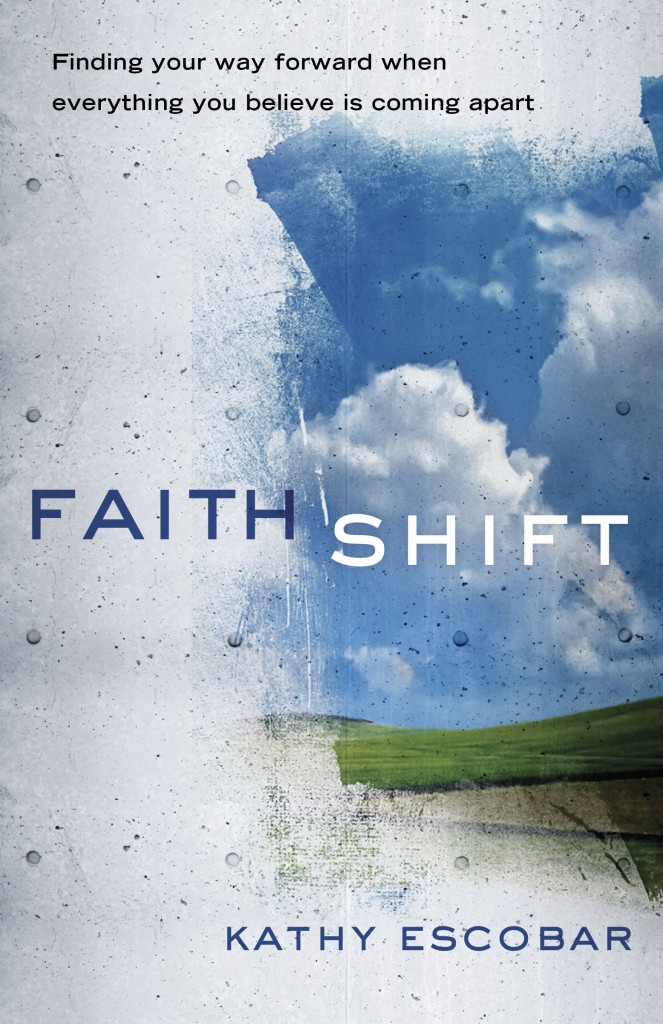
Image: provided by Kathy Escobar
In my Raising Children Unfundamentalist facbeook group, many of us are figuring out how to parent while we are deconstructing or otherwise changing our most foundational Christian values. This is what Kathy Escobar calls Faith Shift, the title of her latest book. Many have been helped by this book so I asked if Kathy would be so kind as to answer some questions my group members had with faith shifting specifically regarding parenting. I love Kathy’s honesty and lack of pretentiousness, as if we were just sharing conversation over coffee. Enjoy the interview!
Q: How do I combat the apparent “need” my extended family & some friends have to inform my children 6,5, & 3 about hell? I don’t know what to say to my children as I personally don’t know if I believe in hell anymore. But I definitely don’t want them terrified.
Oh, that is one of the hardest things, when family members or friends impart certain things onto our children about faith that we don’t have control over. It gets a little easier when they are older because I can ask my kids what was said and we can process it (my kids are all getting older and tend to come home and go ‘Mom, omg, listen to what _____ said…”). But when they are younger, it’s trickier. I’d definitely say if you are present and hear it being said, that it’s totally appropriate to open the conversation with them and set some boundaries on what topics you’d like for them to avoid. Of course, every situation is different and that won’t always work but I think it’s important to remember that when kids are as little at 6, 5, and 3, some of these things can feel really scary!
I remember when my daughter was younger and attended a conservative Christian school and they were doing a whole unit on the rapture. She was terrified to go to sleep at night. I was so angry! We had a great conversation about it because she was probably 10 or 11, but the truth is that no matter how much I tried to reassure her, she was scared inside because they made it all seem so real and “for sure true.”
What is your best practical advice from parenting and ministry experience, given that many of us are parenting while we are deconstructing and faith shifting?
It is so hard to know what to share, what to teach, what to pass on, what to emphasize, what to impart when it comes to faith and our kids when we just aren’t sure anymore. I don’t have any easy answers, but I advise keeping things simple, consider age-appropriateness, and remember that what they “see” is way more important than what they “hear.” Seeing us serve others, advocate for justice, care for the poor, engage with the margins, be honest about our struggles, ask for forgiveness, be kind to strangers, all of those things are ways we are “teaching” them.
A few years ago, when the twins were about 13 we decided to read the entire Children’s Bible that I had from my homeschooling days together each night. It was hard, but good because we didn’t try to pick it apart. They asked questions and I often replied, “I don’t know, there’s no good answer for that” and they appreciated that honesty. In my earlier days I would have tried to explain and exegete for them and I had completely lost that ability. The #1 thing that continues to sustain me is that the best thing I can do for them is to live out my faith and not try to impose it on them. I love that they “get” the justice and mercy part and highly value it without us ever talking about it.
How do I handle my own faith shift in a healthy way when my husband is nowhere on the scale? How do we navigate this with three kids in tow?
This is a really painful and lonely road, when you shift and your spouse isn’t. I’ve got a little section about it in Faith Shift and highlight a few of the main points and see what might resonate. Here are a few highlights from this section—Ways Faith Shifters Can Help Their Non-Shifting Spouses:
* Affirm the relationship. “My relationship with God is changing, but I’m still here.”
* Ask what would help your partner. “In the same way faith shifters need help from the people around them, the spouses who haven’t unraveled could use a little extra love too. It’s appropriate to ask ‘What would help you right now?’ You might not feel comfortable with whatever it is, but your willingness to extend an open hand matters” (p. 205).
* Figure out what you would be willing to do. For some, going to church still is an option. For others, it’s not, but the question is exploring together what is still possible without compromising integrity.
* Decide what is off the table for certain conversations. Some topics are just too painful, and it’s okay to talk through the “let’s just not get into a discussion about that because it will lead to nowhere…”
There’s also a little bit about ways that Non-Shifting Spouses Can Help Faith Shifters. It could be part of the conversation, too. Some of the items that are on there:
* Let go of control
* Be a good listener
* Practice validation
* Hold your own truth – This is so important, on both directions!
* Ask what might help
* Accept the change
These are all fleshed out a little more in the book, but the bottom line is trying to keep the lines of communication open and be willing to make some compromises together, especially when there are kids in the mix.
My most curious question I have is about prayer. Where have you landed currently regarding prayer, and what are your routines like now? How much of your day to day activities depend upon prayer? Do you experience “hearing God” for direction? How do you pray with your children?
One huge change that has helped me is re-framing prayer to mean “when I am thinking about, focusing my attention on, noticing, experiencing.” It has made me realize how much I actually do “pray” during the day but how different it looks.
When I go to sleep at night, I try to do a daily examen, a spiritual practice where we notice God’s presence or absence during the day. I am not a very disciplined person so it is kind of haphazard but I like reflecting back on the day and thinking where I felt peace, where I felt hope, where I felt God’s presence somehow. That’s prayer. I also sometimes still just spend a little time thinking about every person who was in a circle or group or interaction I was in and pray for them in the simplest of ways, it has helped me connect with prayer being ‘my hope for my friends and me, too’.
On the “hearing God” question, it is so different now. I used to get such clear direction and now it feels so much more fuzzy, but I think that sometimes when I’m processing something with people or in my art journal or being quiet on a walk or hike by myself, I get a sense of peace or direction or conviction and I would attribute it to God moving somehow.
With the kids, it’s different because I have 3 adult children. It’s interesting because two of them have completely deconstructed their faith yet if the going gets rough, they will still say “pray for me, okay?” and that always makes me smile. We don’t pray with our 16 year olds intentionally anymore, but we do still say a little prayer before we eat at home sometimes (not always) but I kind of like that, the pause, the moment to be thankful, the we’re-here-together.
Why did you say that you were so glad you faith shifted after spending time with your adult children recently? How old were your children when you began the faith shift and how do you think that has affected them?
The reason I am glad our faith shifted is we transitioned out of a shame-based, performance-centered system into a freedom-based one.
My oldest two got the brunt of it, my #3 got a little less (and is less tainted for sure), and my #4 and 5 have really only grown up in The Refuge and mainly all in public school, and I’ve just seen how they don’t have some of the spiritual baggage that my oldest ones do. We were very controlling in the early years, expected perfection not only of them but also ourselves. A lot of our identity was tied up in their behavior, and we were in fear—“if we don’t teach them ____, then they will not become Christians and that was worst thing in the world.” “If they read Harry Potter, they will be sucked into the demonic.” “If they don’t hide the word in their heart, they won’t have a foundation to stand on.” Oh, so many things that were so fear-based! So that’s what I’m most grateful for—letting go of the fear and trusting them and trusting God.
When I experienced my faith free-fall, my oldest was 13, my daughter was 11, my #3 was 9. The twins were only 6. We waited another couple of years before we pulled them out of school, so they were there up to 15 and 13 and 11. I am not saying all Christian schools are bad; the early years were just fine for us but it is true, as middle school approached, we started hearing things that bothered us but we didn’t think it was as big of a deal as it was. We do wish we would have moved them out sooner. But the reality is, we didn’t, this is their story. They can laugh about a lot of it now and we have made our apologies but I am sad that they spent so much time learning scary, fear-based things about God.
Previous Post

June 9, 2016
Respecting World Religions
Next Post

June 14, 2016 What Harriet Tubman Taught My White Five-Year-Old
Browse Our Archives
Select a Category Uncategorized
Select a Month November 2017 October 2017 September 2017 August 2017 July 2017 June 2017 May 2017 April 2017 March 2017 February 2017 January 2017 December 2016 November 2016 October 2016 September 2016 August 2016 July 2016 June 2016 May 2016 April 2016 March 2016 February 2016
Follow Us!
TAKE THE
Religious Wisdom Quiz
Who said, "Who am I, that I should go to Pharaoh?"
Select your answer to see how you score.
Joshua Aaron Elijah Moses
Related posts from Unfundamentalist Parenting
Don't Unload your Spiritual Baggage on your Children

Training for Motherhood: Learning to Be Invisible

My Grandfather Was Racist, and I Loved Him

When Your Christian Family is Not Perfect
TRENDING AT PATHEOS Progressive Christian

What Being a Modern-Day Apostle Means to Me
In my last column, I discussed the ins and outs of modern-day...

Did Ancient China Once Worship the God of...
Across human history, a common thread weaves through the origins of the...

Love Your Neighbor – Including Earth-Kin: Lev. 19,...
God’s command to love your neighbor means acting in an ethical and...

Lead a Church Study of “Jesus and Lao...
Guest writer Jack Thomas (The Irreverent Reverend) reflects on leading his church...

Pastoral Wisdom for Responding to Sermon Pushback
Getting sermon pushback on your social justice sermon? Learn practical, Proverbs-based strategies...

Principles for Understanding the Apostolic Ministry Today
Whenever people discover that my formal ministry title is "apostle," as in...
view all Progressive Christian blogs
Ad-Free & Subscriber Log-In Subscription Support
- About Us
- 2026 Calendar
- Videos
- Podcasts
- Library of World Religions
- Faith In Media Tracker
- Advertise With Us
- Write for Us
- Privacy Policy
- Terms of Service
- Do Not Sell My Data
- Contact Us
- Radiant Digital
- Manage Newsletter Subscriptions
- Unsubscribe From Notifications
- Sitemap
Copyright 2008-2026, Patheos. All rights reserved.
Subscription Support Ad-Free & Subscriber Log-In
Follow Patheos