
BuddhistCatholicContemplativeEvangelicalGeneral ChristianHinduJewishLatter-day SaintMuslimNew VisionsProgressive Christian
Beliefs
- Buddhist
- Catholic
- Contemplative
- Evangelical
- General Christian
- Hindu
- Jewish
- Latter-day Saint
- More Voices
- Muslim
- New Visions
- Pagan
- Progressive Christian
Topics
- Religion News
- Food and Religion
- Sports and Religion
- Religious Art
- Religious Music and Entertainment
- Religious Events
- History and Religion
- Style and Religion
- Politics and Religion
- Women in Religion
- Recreation Outdoors and Religion
- Business Finance and Religion
- Careers Workplace and Religion
- Education and Religion
- Family Parenting and Religion
- Health Fitness and Religion
- Home and Religion
- Relationships and Religion
- Technology and Religion
- Travel and Religion
Columnists
- Buddhist Columnists
- Business Finance and Religion Columnists
- Careers Workplace and Religion Columnists
- Catholic Columnists
- Contemplative Columnists
- Education and Religion Columnists
- Evangelists Columnists
- Family Parenting and Religion Columnists
- General Christian Columnists
- Health Fitness and Religion Columnists
- Hindu Columnists
- History and Religion Columnists
- Home and Religion Columnists
- Jewish Columnists
- More Voices Columnists
- Latter Day Columnists
- Muslim Columnists
- New Visions Columnists
- Nonreligious Columnists
- Pagan Columnists
- Politics and Religion Columnists
- Progressive Columnists
- Recreation Outdoors and Religion Columnists
- Relationships and Religion Columnists
- Religion News Columnists
- Religious Art Columnists
- Religious Events Columnists
- Religious Music and Entertainment Columnists
- Sports and Religion Columnists
- Style and Religion Columnists
- Technology and Religion Columnists
- Travel and Religion Columnists
- Women in Religion Columnists
Resource Library
- 2026 Calendar
- Library of World Religions
- The 100 Most Holy Places on Earth
- Patheos Answers
- Podcasts
- Videos
- Faith Leaders Database
- Anglican Episcopalian
- Bahai
- Baptist
- Buddhism
- Christianity
- Confucianism
- Eastern Orthodoxy
- Hinduism
- Holiness and Pentecostal
- ISKCON
- Islam
- Judaism
- Lutheran
- Methodist
- The Church of Jesus Christ of Latter-day Saints
- New Age
- Paganism
- Presbytarian and Reformed
- Protestantism
- Religion Behind the Scenes
- Roman Catholic
- Scientology
- Shia Islam
- Sikhism
- Sufism
- Sunni Islam
- Taoism
- Zen
- See all religions
Research Tools
 Ad-Free & Subscriber Log-In Subscription Support
Ad-Free & Subscriber Log-In Subscription Support
Follow Patheos 

- Trending:
- Forgiveness
- |
- Marriage
- |
- Consciousness
- |
- Death Penalty
- |
- Election
- |
- Halloween
 Unfundamentalist Parenting
- Home
- Progressive Christian
- Family, Parenting and Religion
- Raising Children Beyond the Christian Bubble
Raising Children Beyond the Christian Bubble
Last updated on: May 9, 2017 at 5:59 pm by Cindy Brandt
Raising Children Beyond the Christian Bubble 2017-05-09T17:59:24+08:00 Cindy Brandt
Patheos Explore the world's faith through different perspectives on religion and spirituality! Patheos has the views of the prevalent religions and spiritualities of the world.
“Should I let my 12 year old watch this rated R movie?”
“What are some Christian family-friendly songs appropriate for my elementary aged children?”
“Can my 8 year old read Harry Potter?” (<== the answer to this is yes, OF COURSE)
These are the sorts of questions which plague many Christian parents, and the root of these practical daily decisions is the desire to frame the way our children interacts with society at large. On the one hand, we want to protect our children by censoring their exposure to the often brutal realities of our world. On the other hand, so many of us grew up sheltered in small Christian bubbles, restricted to cheesy Christian music titles and overly sanitized book selections, that we are resolved to expose our children to the beauty present in art and literature and yes, even the latest Hollywood blockbuster.
Here is what I believe to be the sentiment behind the Christian Bubble Makers. Raising children in a sheltered environment enables them to put down strong roots in the Christian tradition. They develop a strong foundation in their belief system so that when they go out into the world, they aren’t tousled by the prevailing cultural winds.
The main problem with this set up is that it is inherently defensive. It postures the Christian community as those on the inside venturing out. Before the littles are mature enough to handle the outside world, the bubble is a necessary protective mechanism. Those on the inside are taught that inside = good, outside = bad. Children thrive on structure and categorize by nature. They easily internalize this paradigm from a young age and relegate their life experiences into black and white value judgments.
The unfortunate result is that unless the child remains in a commune, they will inevitably experience a world that brings a diversity of values and expressions of life. The constant stress of categorizing good vs. bad brings about a faith crisis which ends in them either rejecting their childhood faith OR a rigid persistence that the only God that is real is one inside the bubble, who begins to look vey small and irrelevant. God either doesn’t exist, or is a very fragile, fenced in One that needs defending at all costs.
Unfundamentalist parenting is to teach the kids not who God is, but where to find God. Not what God is, but how to spot God. Young children don’t need systematic theology which delineates with painstaking detail each character trait of God, they need permission to discover God for themselves. When it comes to learning about God, we are much better postured as students of our children, because their delight and wonder in our world have much to teach us about where God is alive and present.
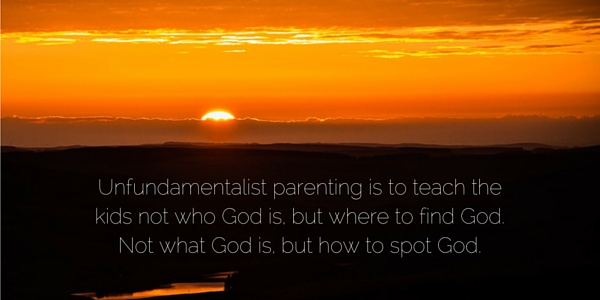
Image: Pixabay
Pay attention to what makes them tick, what breathes life into their souls, what makes their eyes twinkle and their laughter infectious. Watch how they give generously, lavishing hugs and kisses. See through their eyes the attention to details we have long taken for granted, tiny ants and the big, blue sky.
Show them the love of God by loving them, loving others, and pointing out every act of goodness and kindness and justice in this world. Sit with them and soak in the beauty and awe of art that steals our breath, talent that drops our jaws, generosity that warms our hearts and wonder together, “did we just see a glimpse of God?”
Read them stories, Bible stories certainly, but also fairy tales, dragon warriors and the princess and the pea. Tell them stories of our ancestors, of children in Afghanistan and Iceland, of our neighbors down the road. Let them spot the heroes and the villains and ask them where they see God moving in hearts, in love, in power.
When it comes to God, we are not their teachers, we are co-spectators of God’s glory.
In this way, we are not sending them out into the world armed with a defense of God against the world, but filled with an anticipation of how much more they can experience God as their world opens up into adulthood.
In C.S. Lewis’s beloved Narnia Chronicles, the youngest of the four main characters, a little girl named Lucy, encounters Aslan, the lion who is an archetype for God. She hadn’t seen him for a time and she remarks,
“Aslan, you are bigger,” to which Aslan replies with his strong, gentle voice.
“Every year you grow, so shall I.”
As parents we are saddled with some anxiety to make sure we teach our children everything that they need to know within the short eighteen years we have them in our home. But when it comes to our faith, we can breath easy, because our God is not One who can be limited to eighteen years of instruction. We get to walk with our children in this very beginning of their journey, and watch them dip their toes into just how wide and long and high and deep is the love of God.
The question we need to ask when they leave home is not, have you learned everything there is to know about God?
But,
Are you ready to get started?
Discover the best stories and resources for parenting with progressive values here.
Join us at Raising Children Unfundamentalist.
Previous Post

April 28, 2016
Fundamentalist Hate, Unfundamentalist Love
Next Post

May 3, 2016 Parenting Advice that Correlates with Abuse
Browse Our Archives
Select a Category Uncategorized
Select a Month November 2017 October 2017 September 2017 August 2017 July 2017 June 2017 May 2017 April 2017 March 2017 February 2017 January 2017 December 2016 November 2016 October 2016 September 2016 August 2016 July 2016 June 2016 May 2016 April 2016 March 2016 February 2016
Follow Us!
TAKE THE
Religious Wisdom Quiz
Who was David’s best friend?
Select your answer to see how you score.
Saul Samuel Joseph Jonathan
Related posts from Unfundamentalist Parenting

When Your Christian Family is Not Perfect

No, John Piper, Kids Do Not Delight to...

Back to School and Child Shaming

TRENDING AT PATHEOS Progressive Christian

Why Christians Have a Sacred Duty to Vote:...
The Bible offers strong support for the sacred duty to vote. Here...

What Being a Modern-Day Apostle Means to Me
In my last column, I discussed the ins and outs of modern-day...

Did Ancient China Once Worship the God of...
Across human history, a common thread weaves through the origins of the...

Love Your Neighbor – Including Earth-Kin: Lev. 19,...
God’s command to love your neighbor means acting in an ethical and...

Lead a Church Study of “Jesus and Lao...
Guest writer Jack Thomas (The Irreverent Reverend) reflects on leading his church...

Principles for Understanding the Apostolic Ministry Today
Whenever people discover that my formal ministry title is "apostle," as in...
view all Progressive Christian blogs
Ad-Free & Subscriber Log-In Subscription Support
- About Us
- 2026 Calendar
- Videos
- Podcasts
- Library of World Religions
- Faith In Media Tracker
- Advertise With Us
- Write for Us
- Privacy Policy
- Terms of Service
- Do Not Sell My Data
- Contact Us
- Radiant Digital
- Manage Newsletter Subscriptions
- Unsubscribe From Notifications
- Sitemap
Copyright 2008-2026, Patheos. All rights reserved.
Subscription Support Ad-Free & Subscriber Log-In
Follow Patheos