
BuddhistCatholicContemplativeEvangelicalGeneral ChristianHinduJewishLatter-day SaintMuslimNew VisionsProgressive Christian
Beliefs
- Buddhist
- Catholic
- Contemplative
- Evangelical
- General Christian
- Hindu
- Jewish
- Latter-day Saint
- More Voices
- Muslim
- New Visions
- Pagan
- Progressive Christian
Topics
- Religion News
- Food and Religion
- Sports and Religion
- Religious Art
- Religious Music and Entertainment
- Religious Events
- History and Religion
- Style and Religion
- Politics and Religion
- Women in Religion
- Recreation Outdoors and Religion
- Business Finance and Religion
- Careers Workplace and Religion
- Education and Religion
- Family Parenting and Religion
- Health Fitness and Religion
- Home and Religion
- Relationships and Religion
- Technology and Religion
- Travel and Religion
Columnists
- Buddhist Columnists
- Business Finance and Religion Columnists
- Careers Workplace and Religion Columnists
- Catholic Columnists
- Contemplative Columnists
- Education and Religion Columnists
- Evangelists Columnists
- Family Parenting and Religion Columnists
- General Christian Columnists
- Health Fitness and Religion Columnists
- Hindu Columnists
- History and Religion Columnists
- Home and Religion Columnists
- Jewish Columnists
- More Voices Columnists
- Latter Day Columnists
- Muslim Columnists
- New Visions Columnists
- Nonreligious Columnists
- Pagan Columnists
- Politics and Religion Columnists
- Progressive Columnists
- Recreation Outdoors and Religion Columnists
- Relationships and Religion Columnists
- Religion News Columnists
- Religious Art Columnists
- Religious Events Columnists
- Religious Music and Entertainment Columnists
- Sports and Religion Columnists
- Style and Religion Columnists
- Technology and Religion Columnists
- Travel and Religion Columnists
- Women in Religion Columnists
Resource Library
- 2026 Calendar
- Library of World Religions
- The 100 Most Holy Places on Earth
- Patheos Answers
- Podcasts
- Videos
- Faith Leaders Database
- Anglican Episcopalian
- Bahai
- Baptist
- Buddhism
- Christianity
- Confucianism
- Eastern Orthodoxy
- Hinduism
- Holiness and Pentecostal
- ISKCON
- Islam
- Judaism
- Lutheran
- Methodist
- The Church of Jesus Christ of Latter-day Saints
- New Age
- Paganism
- Presbytarian and Reformed
- Protestantism
- Religion Behind the Scenes
- Roman Catholic
- Scientology
- Shia Islam
- Sikhism
- Sufism
- Sunni Islam
- Taoism
- Zen
- See all religions
Research Tools
 Ad-Free & Subscriber Log-In Subscription Support
Ad-Free & Subscriber Log-In Subscription Support
Follow Patheos 

- Trending:
- Forgiveness
- |
- Marriage
- |
- Consciousness
- |
- Death Penalty
- |
- Election
- |
- Halloween
 Unfundamentalist Parenting
- Home
- Progressive Christian
- Family, Parenting and Religion
- 5 Signs of Religious Fundamentalism
5 Signs of Religious Fundamentalism
Last updated on: April 12, 2016 at 12:14 pm by Stephen Mattson
5 Signs of Religious Fundamentalism 2016-04-12T12:14:44+08:00 Stephen Mattson
Patheos Explore the world's faith through different perspectives on religion and spirituality! Patheos has the views of the prevalent religions and spiritualities of the world.
Fundamentalism is many things to many different people. For some, it can be defined by the deep conviction that the Bible is entirely inspired, completely inerrant, and should always be translated literally. For others, fundamentalism is more of an idea, spirit, or particular way of doing things—strict, unwavering, and unforgiving.
The term is used frequently in the media—Christian fundamentalists, Islamic fundamentalists, Religious fundamentalists—and is generally viewed in a negative way.
Nobody proudly claims to be a fundamentalist, instead, it’s a label derisively used to describe others. But fundamentalism is still very popular within various Christian communities. Here are five common ways fundamentalism manifests itself:
Fundamentalists Prefer Judgment over Grace:
Not only can people be harshly criticized, berated, emotionally abused, threatened, publicly humiliated, and even mocked, but they can be ruthlessly destroyed—relationally, emotionally, spiritually, and even physically—all under the guise of “judgment.”
For fundamentalists, judgment is a common tool used for “righteousness” and is aggressively implemented to control people. They use judgment as a way to dictate their exact doctrines, practice their precise traditions, enforce their explicit expectations, and punish anyone who opposes them.
Not only are the judgments rigid and cruel, but both insiders and outsiders are constantly warned with threats of eternal damnation—manipulated with nightmarish warnings and forebodings.
A fundamentalist worldview is obsessed with judgment. Things ranging from small routine occurrences to large international events are interpreted through the lenses of God’s fierce judgment. Therefore, a natural disaster is surely the result of some sin, and losing your keys in the couch is possibly a sign of God’s disfavor towards you.
Unfortunately, what fundamentalists perceive as “faith” is often just plain hate. Thus, fundamentalists are easily recognizable in public because they’re so blatantly hateful—with their vicious rhetoric, vile placards, hostile protests, and violent actions.
Instead of forgiveness, there’s condemnation.
Instead of mercy, there’s disdain.
Instead of gentleness, there’s cruelty.
Instead of grace, there’s intolerance.
Instead of love, there’s strict obedience.
Fundamentalists Prefer Fear over Hope:
Being infatuated with judgment leads fundamentalists to thrive off of fear instead of hope or any other form of positive inspiration. They’re religious pessimists who view God as a Divine Grouch that is just waiting to destroy humanity because of its incessant sin.
The United States is going to hell. Obama is the antichrist. Terrorists are going to kill us all. Every current event is a sure sign that we’re living in the End Times and that the Apocalypse is imminent.
The fundamentalist message is built around negativity and is motivated by fear. Things like hope, joy, grace, and peace are only minor benefits for the few who manage to strictly adhere to the impossible expectations that fundamentalism mandates.
Fundamentalists Idolize Uniformity:
Fundamentalists are uncomfortable with anything different from themselves. They fear change. People, places, things, and ideas that are new, different, or complex are not only rejected, but attacked as being something viciously evil—things to be avoided at all cost.
This mentality is one reason that many fundamentalist groups actually look, dress, and act like the past—because they are rejecting modernity. It was fundamentalists who once (some still do) rejected that notion of interracial marriage, women pastors, gender equality and many other changes that society now generally accepts as normal.
It’s also why fundamentalists glorify the past and vilify the future. To them, the world is constantly getting worse because it’s a world that’s constantly changing. It’s a place where their unrealistic expectations are continually becoming less likely to happen.
Contrarily, they usually consider a particular historic period of the past—based on their own revisionist interpretation—as being idyllic and without flaw, and want the world to join them in working towards getting back there.
There usually refers to “the good old days when people prayed, attended church, everyone had good jobs, the government wasn’t corrupt, all children were smart and respectful, and people feared God.” To fundamentalists, there is usually the exact opposite of the here and now. Unsurprisingly, it’s during this golden age of the past when fundamentalists once upon a time had the most influence, political power, and social authority. Obviously, they want to go back.
Fundamentalists Prefer Simplicity over Complexity:
Once reason fundamentalists hate change is because they idolize certainty, value having all the answers, and holding ideas that leave no room for doubt, criticism, or complexity. Fundamentalism thrives on the lie that only they alone have the market cornered on all truth.
Fundamentalists view themselves as being completely correct while everyone else is totally wrong. Nobody beyond their fundamentalist communities could possibly have anything to offer them because they already know it all—they exclusively hold all spiritual wisdom and authority.
Diversity, nuance, and anything unknown are ruthlessly rooted out for the sake of reinforcing and upholding the unquestionable tenants of their flawless beliefs.
Any challenge to their unassailable truths are seen as an attack against them and their faith, and dissenting voices are either pressured back into submission, condemned as heretics, treated as enemies, or quickly exiled.
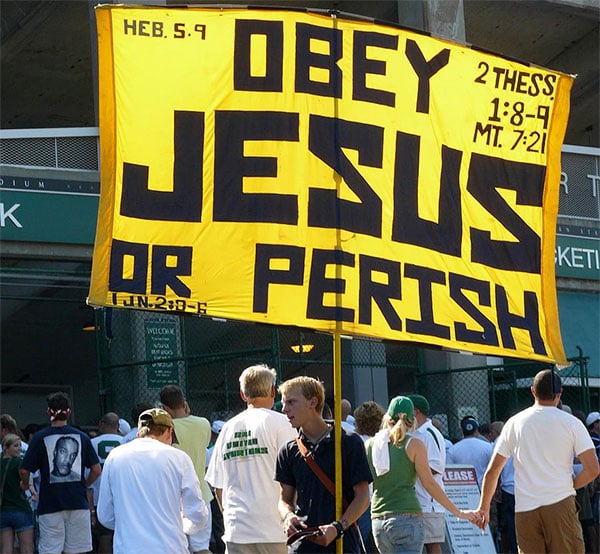
Photo by Saraware – Own work, CC BY 3.0
Fundamentalists Serve Themselves More than Anyone
Being the ultimate holders of truth means fundamentalists trust themselves more than family, friends, relatives, communities, schools, businesses, and governments. They believe in themselves more than anyone—even God.
They worship themselves without admitting it. Their missions, ministries, community service projects, volunteerism, hospitality, and any other outward act of “faith” is ultimately a way of propagating their own salvation, convincing themselves of their own ideologies, and offers a convenient way of cementing their own predetermined beliefs.
Any offerings or acts of “love” to the outside world seem superficial, cheap, corrupt, fake, and duplicitous—because they are. The Fruits of the Spirit—love, joy, peace, forbearance, kindness, goodness, faithfulness, gentleness and self-control—are conspicuously absent because fundamentalism selfishly serves itself above all else. Fundamentalism prioritizes its own glory even at the sake of abandoning humanity and ignoring God.
Overall, fundamentalism looks nothing like the life of Jesus—it lacks humility, healing, generosity, and love. For Christians, this is the ultimate litmus test: does it emulate the life of Christ?
Most importantly, above all else, always strive to be like Jesus, even if religious people, churches, communities, organizations and institutions won’t. God help us.
Previous Post

April 8, 2016
Parenting with Hope, not Punishment
Next Post

April 14, 2016 Spring Rolls and Green Bean Casserole
Browse Our Archives
Select a Category Uncategorized
Select a Month November 2017 October 2017 September 2017 August 2017 July 2017 June 2017 May 2017 April 2017 March 2017 February 2017 January 2017 December 2016 November 2016 October 2016 September 2016 August 2016 July 2016 June 2016 May 2016 April 2016 March 2016 February 2016
Follow Us!
TAKE THE
Religious Wisdom Quiz
I saw a river flowing from the temple threshold, getting deeper until it became a river no one could cross. What grew along its banks?
Select your answer to see how you score.
Grass Flowers Trees Vines
Related posts from Unfundamentalist Parenting

6 Ways Fundamentalists Need to Grow up

How Children Rescue Us From Fundamentalism

Five FAQs - Parenting While Deconstructing

Family Drama, Bad Religion, and Shit Happens
TRENDING AT PATHEOS Progressive Christian

What Being a Modern-Day Apostle Means to Me
In my last column, I discussed the ins and outs of modern-day...

Did Ancient China Once Worship the God of...
Across human history, a common thread weaves through the origins of the...

Love Your Neighbor – Including Earth-Kin: Lev. 19,...
God’s command to love your neighbor means acting in an ethical and...

Lead a Church Study of “Jesus and Lao...
Guest writer Jack Thomas (The Irreverent Reverend) reflects on leading his church...

Pastoral Wisdom for Responding to Sermon Pushback
Getting sermon pushback on your social justice sermon? Learn practical, Proverbs-based strategies...

Principles for Understanding the Apostolic Ministry Today
Whenever people discover that my formal ministry title is "apostle," as in...
view all Progressive Christian blogs
Ad-Free & Subscriber Log-In Subscription Support
- About Us
- 2026 Calendar
- Videos
- Podcasts
- Library of World Religions
- Faith In Media Tracker
- Advertise With Us
- Write for Us
- Privacy Policy
- Terms of Service
- Do Not Sell My Data
- Contact Us
- Radiant Digital
- Manage Newsletter Subscriptions
- Unsubscribe From Notifications
- Sitemap
Copyright 2008-2026, Patheos. All rights reserved.
Subscription Support Ad-Free & Subscriber Log-In
Follow Patheos