
BuddhistCatholicContemplativeEvangelicalGeneral ChristianHinduJewishLatter-day SaintMuslimNew VisionsProgressive Christian
Beliefs
- Buddhist
- Catholic
- Contemplative
- Evangelical
- General Christian
- Hindu
- Jewish
- Latter-day Saint
- More Voices
- Muslim
- New Visions
- Pagan
- Progressive Christian
Topics
- Religion News
- Food and Religion
- Sports and Religion
- Religious Art
- Religious Music and Entertainment
- Religious Events
- History and Religion
- Style and Religion
- Politics and Religion
- Women in Religion
- Recreation Outdoors and Religion
- Business Finance and Religion
- Careers Workplace and Religion
- Education and Religion
- Family Parenting and Religion
- Health Fitness and Religion
- Home and Religion
- Relationships and Religion
- Technology and Religion
- Travel and Religion
Columnists
- Buddhist Columnists
- Business Finance and Religion Columnists
- Careers Workplace and Religion Columnists
- Catholic Columnists
- Contemplative Columnists
- Education and Religion Columnists
- Evangelists Columnists
- Family Parenting and Religion Columnists
- General Christian Columnists
- Health Fitness and Religion Columnists
- Hindu Columnists
- History and Religion Columnists
- Home and Religion Columnists
- Jewish Columnists
- More Voices Columnists
- Latter Day Columnists
- Muslim Columnists
- New Visions Columnists
- Nonreligious Columnists
- Pagan Columnists
- Politics and Religion Columnists
- Progressive Columnists
- Recreation Outdoors and Religion Columnists
- Relationships and Religion Columnists
- Religion News Columnists
- Religious Art Columnists
- Religious Events Columnists
- Religious Music and Entertainment Columnists
- Sports and Religion Columnists
- Style and Religion Columnists
- Technology and Religion Columnists
- Travel and Religion Columnists
- Women in Religion Columnists
Resource Library
- 2026 Calendar
- Library of World Religions
- The 100 Most Holy Places on Earth
- Patheos Answers
- Podcasts
- Videos
- Faith Leaders Database
- Anglican Episcopalian
- Bahai
- Baptist
- Buddhism
- Christianity
- Confucianism
- Eastern Orthodoxy
- Hinduism
- Holiness and Pentecostal
- ISKCON
- Islam
- Judaism
- Lutheran
- Methodist
- The Church of Jesus Christ of Latter-day Saints
- New Age
- Paganism
- Presbytarian and Reformed
- Protestantism
- Religion Behind the Scenes
- Roman Catholic
- Scientology
- Shia Islam
- Sikhism
- Sufism
- Sunni Islam
- Taoism
- Zen
- See all religions
Research Tools
 Ad-Free & Subscriber Log-In Subscription Support
Ad-Free & Subscriber Log-In Subscription Support
Follow Patheos 

- Trending:
- Forgiveness
- |
- Marriage
- |
- Consciousness
- |
- Death Penalty
- |
- Election
- |
- Halloween
 Unfundamentalist Parenting
- Home
- Progressive Christian
- Family, Parenting and Religion
- Don’t Scare Children with Hell
Don’t Scare Children with Hell
Last updated on: March 21, 2016 at 4:45 pm by Cindy Brandt
Don’t Scare Children with Hell 2016-03-21T16:45:43+08:00 Cindy Brandt
Patheos Explore the world's faith through different perspectives on religion and spirituality! Patheos has the views of the prevalent religions and spiritualities of the world.
I was a morbidly fearful child.
I was also a highly literate child, having learned to read before school years. My mother tongue is Mandarin, and the storybooks I consumed were Chinese folk stories. Some of them were harmless tales of developing moral character, but many recounted ancient Chinese myths of hell. In Chinese folk religion, hell consisted of eighteen levels, each containing a specific type of torture reserved for corresponding sins. It is not a stretch to say that the visual images of hell I saw in picture books as a young girl impacts me till this day. I was terrified.
Fast forward to my school age years, when my parents sent me to a Christian school started by western missionaries, where I learned of the Jesus who could save me from hell. It was a no brainer for me. I believed swiftly because I was deathly afraid of hell.
I have told this testimony many, many times throughout my growing up years in the Christian world. It was the ice-breaker to my testimony, the chuckle-inducing anecdote to begin a speech: “I accepted Jesus because I didn’t want to go to hell!” People would smile and nod with approval at my child-like faith. How did nobody tell me it was not funny?
Certainly, as I grew in cognitive and spiritual development, I learned there was more to the Christian life than an escape from hell, but once you begin a relationship with God based on fear it takes years to unlearn the image of the punitive God to be able to receive the heart of the gospel of grace. It was true for me.
Aside from Universalists, most Christian traditions contain the doctrine of judgment, although the particulars of how that judgment is carried out varies along a spectrum. Whether it is actual physical torture for all eternity or some sort of separation from God; whether there’s purgatory or a second chance post mortem, there exists a form of judgment within the systems of Christian faith.
Good parenting sensibilities tell us we shouldn’t shy away from difficult truths, and although we try to be age-appropriate, we are obligated to share even the most unpalatable aspect of the Christian faith with our kids.
The problem is: children don’t yet have the emotional maturity and logical capability to process a belief in eternal punishment. Their budding minds can’t reason through the theological necessity of judgment in a loving God. So they panic and retreat into fear. In order to coax them out of their distress we comfort them, it’s okay, Jesus will save you, just believe in Jesus.
And so it begins, even as kids develop and eventually learn the nuances of Christian life, they are bearing the invisible baggage of fear that had them gripping for Jesus. The genesis of a relationship with a good and loving God is a child’s nightmare.
If we are really honest with ourselves, we plant fear into our children’s hearts because we have not yet uprooted fear from our own. We want our children saved because we are so afraid of what would happen if they are not.
Before we can raise our children unfundamentalist, we must excavate the nasty enemy of fear from deep within our hearts and boot it for good. Despite strong Christian traditions on the doctrines of heaven and hell, the afterlife remains an unknown mystery. To tell children you know for sure what will happen is to to be dishonest, and to act, well, as a fundamentalist.
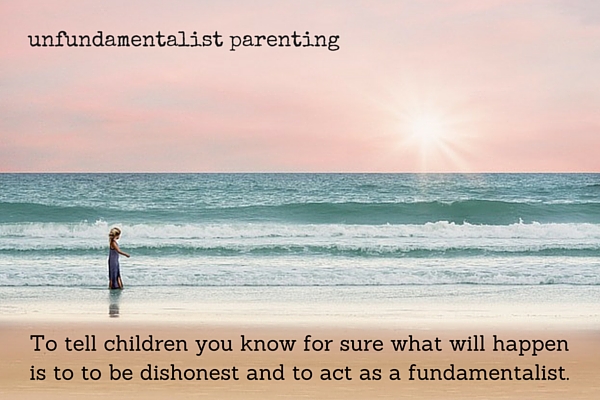
It is bad religion to scare children into conversion and to dictate their morality from the basis of fear.
A strong desire for our children to know God and follow God need not and should not come from a fear for their eternal destination. Spiritual security for our kids doesn’t mean an assurance they will escape the fates of fiery doom, it means providing security rooted in the love of God. Just as we do all we can to provide for the physical and emotional needs of our children, so we must give them this safe spiritual environment.
God loves you without condition. God will never leave your side. God delights in you. God is like the mother hen gathering chicks. God is like the forgiving father welcoming his prodigal son. God is like a warm fire on a cold night, bringing you comfort. God cares beyond what you can imagine. God loves you. God loves you. God loves you.
This doesn’t guarantee the child will grow to believe in God. It doesn’t mean the hard conversations about suffering, judgment and injustice won’t be had when the child is old enough to tackle these issues. It does mean, however, that should they choose to live a life of faith, of belief in God, that it would not have come from a place of fear. Hopefully, it will mean they were compelled by the truths and love they witnessed in the lives of their parents, community, and the acts of God in the world.
When I was a young convert, having believed I was safe from hell because of a belief in Jesus, I remained terrified. Because my parents had not yet become Christians. I spent agonizing hours praying desperately for them, willing there to not be an accident that takes their lives before they convert. I wish I knew then, what I know now, that the weight of the eternal damnation of my loved ones was far too heavy for my young, frail shoulders to carry. I wish I knew and believed God loves everyone, that we don’t know for sure what will happen after death, that choosing to love trumps fear.
I will not repeat this mistake with my children. I will not be afraid for their salvation. I am choosing to channel my childhood fears into a fierce force of love for them, in the best ways I know how.
And may they know that I have only ever been able to love them the way I do because the God who loves them so, also loves me.
Previous Post

March 16, 2016
Zootopia - Taking On Racism
Next Post

March 22, 2016 Parenting in the midst of faith wandering
Browse Our Archives
Select a Category Uncategorized
Select a Month November 2017 October 2017 September 2017 August 2017 July 2017 June 2017 May 2017 April 2017 March 2017 February 2017 January 2017 December 2016 November 2016 October 2016 September 2016 August 2016 July 2016 June 2016 May 2016 April 2016 March 2016 February 2016
Follow Us!
TAKE THE
Religious Wisdom Quiz
What does the Hebrew word "Chokmah", often used in Proverbs, mean?
Select your answer to see how you score.
Wisdom Fear Strength Knowledge
Related posts from Unfundamentalist Parenting

A Parenting Shift From Fear to Love

My Daughter Loves Jesus. Is That Okay?

No, John Piper, Kids Do Not Delight to...

My Child is Afraid of Hell. What Do...
TRENDING AT PATHEOS Progressive Christian

What Being a Modern-Day Apostle Means to Me
In my last column, I discussed the ins and outs of modern-day...

Did Ancient China Once Worship the God of...
Across human history, a common thread weaves through the origins of the...

Love Your Neighbor – Including Earth-Kin: Lev. 19,...
God’s command to love your neighbor means acting in an ethical and...

Lead a Church Study of “Jesus and Lao...
Guest writer Jack Thomas (The Irreverent Reverend) reflects on leading his church...

Pastoral Wisdom for Responding to Sermon Pushback
Getting sermon pushback on your social justice sermon? Learn practical, Proverbs-based strategies...

Principles for Understanding the Apostolic Ministry Today
Whenever people discover that my formal ministry title is "apostle," as in...
view all Progressive Christian blogs
Ad-Free & Subscriber Log-In Subscription Support
- About Us
- 2026 Calendar
- Videos
- Podcasts
- Library of World Religions
- Faith In Media Tracker
- Advertise With Us
- Write for Us
- Privacy Policy
- Terms of Service
- Do Not Sell My Data
- Contact Us
- Radiant Digital
- Manage Newsletter Subscriptions
- Unsubscribe From Notifications
- Sitemap
Copyright 2008-2026, Patheos. All rights reserved.
Subscription Support Ad-Free & Subscriber Log-In
Follow Patheos