
BuddhistCatholicContemplativeEvangelicalGeneral ChristianHinduJewishLatter-day SaintMuslimNew VisionsProgressive Christian
Beliefs
- Buddhist
- Catholic
- Contemplative
- Evangelical
- General Christian
- Hindu
- Jewish
- Latter-day Saint
- More Voices
- Muslim
- New Visions
- Pagan
- Progressive Christian
Topics
- Religion News
- Food and Religion
- Sports and Religion
- Religious Art
- Religious Music and Entertainment
- Religious Events
- History and Religion
- Style and Religion
- Politics and Religion
- Women in Religion
- Recreation Outdoors and Religion
- Business Finance and Religion
- Careers Workplace and Religion
- Education and Religion
- Family Parenting and Religion
- Health Fitness and Religion
- Home and Religion
- Relationships and Religion
- Technology and Religion
- Travel and Religion
Columnists
- Buddhist Columnists
- Business Finance and Religion Columnists
- Careers Workplace and Religion Columnists
- Catholic Columnists
- Contemplative Columnists
- Education and Religion Columnists
- Evangelists Columnists
- Family Parenting and Religion Columnists
- General Christian Columnists
- Health Fitness and Religion Columnists
- Hindu Columnists
- History and Religion Columnists
- Home and Religion Columnists
- Jewish Columnists
- More Voices Columnists
- Latter Day Columnists
- Muslim Columnists
- New Visions Columnists
- Nonreligious Columnists
- Pagan Columnists
- Politics and Religion Columnists
- Progressive Columnists
- Recreation Outdoors and Religion Columnists
- Relationships and Religion Columnists
- Religion News Columnists
- Religious Art Columnists
- Religious Events Columnists
- Religious Music and Entertainment Columnists
- Sports and Religion Columnists
- Style and Religion Columnists
- Technology and Religion Columnists
- Travel and Religion Columnists
- Women in Religion Columnists
Resource Library
- 2026 Calendar
- Library of World Religions
- The 100 Most Holy Places on Earth
- Patheos Answers
- Podcasts
- Videos
- Faith Leaders Database
- Anglican Episcopalian
- Bahai
- Baptist
- Buddhism
- Christianity
- Confucianism
- Eastern Orthodoxy
- Hinduism
- Holiness and Pentecostal
- ISKCON
- Islam
- Judaism
- Lutheran
- Methodist
- The Church of Jesus Christ of Latter-day Saints
- New Age
- Paganism
- Presbytarian and Reformed
- Protestantism
- Religion Behind the Scenes
- Roman Catholic
- Scientology
- Shia Islam
- Sikhism
- Sufism
- Sunni Islam
- Taoism
- Zen
- See all religions
Research Tools
 Ad-Free & Subscriber Log-In Subscription Support
Ad-Free & Subscriber Log-In Subscription Support
Follow Patheos 

- Trending:
- Forgiveness
- |
- Marriage
- |
- Consciousness
- |
- Death Penalty
- |
- Election
- |
- Halloween
 Unfundamentalist Christians
- Home
- Progressive Christian
- Discovering “Biblical Truths”
Discovering “Biblical Truths”
Last updated on: October 13, 2017 at 7:29 am by Dan Wilkinson
Discovering “Biblical Truths” 2017-10-13T07:29:27-06:00 Dan Wilkinson
Patheos Explore the world's faith through different perspectives on religion and spirituality! Patheos has the views of the prevalent religions and spiritualities of the world.
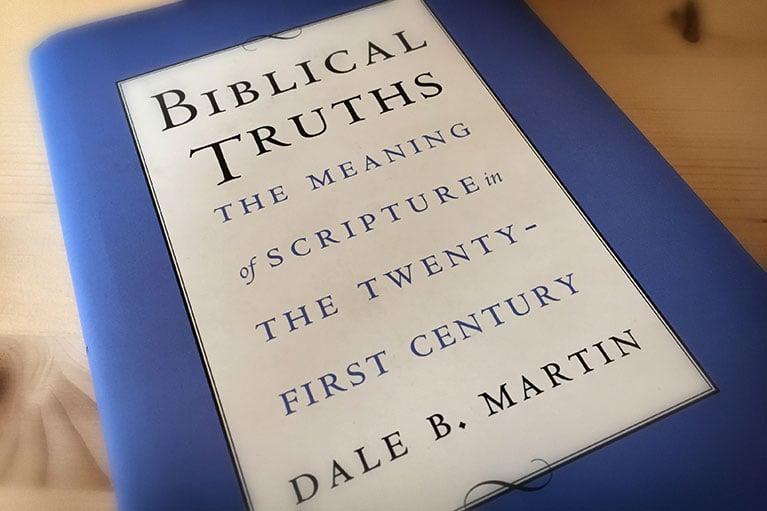
Over the years that this blog has been running, we’ve devoted a great deal of space to countering the dominant theological propositions of fundamentalist Christianity. But this inevitably leads to questions about alternatives: If a literal, “plain-text” reading of the Bible, especially as informed by modern evangelical theology, isn’t the “right” way to read the text, then what is?
How are we — Christians who reject limited, self-serving conceptions of God, who reject the absolute authority of an inerrant Bible, who reject the misogyny and homophobia of the modern Church, who, indeed, reject much of the “modern” part of church in general — how are we to think about our faith? How can we thoughtfully — and faithfully — wrestle with the theological issues at the heart of Christianity?
In response to such questions, I can now enthusiastically recommend Yale theologian Dale Martin’s new book, Biblical Truths: The Meaning of Scripture in the Twenty-first Century.
This 408 page volume (including a bibliography and subject, author, and scriptural indices), offers nothing less than a “nonfoundationalist, postmodern, Marxist, orthodox, ecumenical, and provisional theological interpretation of the New Testament“ (32), in which Martin explains “why and how I continue to find traditional Christian doctrines and confessions ‘true,’ why I’m willing to confess the creeds, even though I am a critical scholar who knows much of the Bible is not ‘true’ when taken as history or science” (31).
Organized as a systematic theology text, Martin thoughtfully discusses the ins and outs of virtually every aspect of Christian faith, grouped under the general topics of Knowledge, Scripture, God, Christ, Spirit, Human, and Church. Steeped in biblical examples, Martin’s theological explorations are challenging and engaging, offering eye-opening counterpoints to modern historical criticism.
Martin takes the standard methods of biblical interpretation to task for being insufficient for building a meaningful and robust Christian theology. These methodologies, in which primacy is placed on understanding what the biblical texts would have meant for the original authors and readers, simply cannot sustain Christian faith in light of all we know about history and science. Martin concludes that “modern theologies of the New Testament were failures from a Christian point of view precisely because what they ended up offering was bad history, bad theology, or both” (18).
For Martin, the basic interpretive methods that are pervasive in most seminaries and bible classes today are, in essence, a dead-end:
“As long as Christian scholars insist that they are simply ‘describing’ the theology that is really ‘in’ the text itself, and they arrive at their conclusions using historical criticism, as long as the ‘meaning’ they claim to ‘find’ in the text is supposed to be also what the ancient author ‘intended’ or the ancient audience would have understood, they cannot produce robust, sufficient, orthodox Christian theology.” (28)
Instead, Martin offers a biblical theology centered around “creative anachronism,” reading into the text “views I would not say are simply in the text” (31). For Martin, we cannot simply turn to the pages of the Bible to discover Christian theology. Rather, the text of the Bible is something to be used in order to “think theologically” (31).
And, this methodology is guided by an overriding principle:
“Any interpretation of scripture that does not work for the good of ourselves and our fellow human beings to the glory of God cannot be the ‘literal’ and true meaning of that passage of scripture. The rule is applicable to all Christian epistemology. The beginning and end of Christian knowing must be the rule of love.” (70)
This hermetic of love leads Martin to conclusions such as this one, regarding the role of the church as a place of refuge:
“… the church can never be a space of escape from controversy and struggle. Learning to love one another–including others very different from ourselves and including those outside the church, such as Jews, Muslims, and others of whatever religion, agnostics, atheists, or just ‘indifferents’–is difficult. But the church must become a space where that learning can take place.” (348)
I have but two criticisms to level at this book, and both are mild. First, as a book that seeks to provide an overview of virtually all of Christian theology, too many topics were addressed in tantalizing brevity. Though Martin does an admirable job explicating past, present, and new theological understandings, many of his proposals merit much deeper discussion. Fortunately, the plentiful footnotes and extensive bibliography provide welcome resources for further study.
Second, since this book is published by an academic press, it’s a bit pricey, weighing in at $40 for the hardback. But I’d argue that it’s worth every penny and then some. Just like the theology it discusses, it’s the sort of book that’s worth returning to again and again. I know I’ll be opening its pages many times over the next few months and, if you find contemorary Christain theology as fascinating and as important as I do, I’d strongly suggest you do so as well.
Find out more about Biblical Truths: The Meaning of Scripture in the Twenty-first Century here.
Photo by Dan Wilkinson.
 Dan Wilkinson
Dan is the Executive Editor of the Unfundamentalist Christians blog. He is a writer, graphic designer and IT specialist. He lives in Montana, is married and lives with two cats.
Previous Post
October 3, 2017
On Conservative Christians’ Sudden Devotion to Imperial Cult
Browse Our Archives
Select a Category Book Reviews Christian History Christian Issues Christian Spirituality Current Events Fundamentalism Islam John Shore LGBT Movie Reviews Poetry Uncategorized
Select a Month October 2017 September 2017 August 2017 July 2017 June 2017 May 2017 April 2017 March 2017 February 2017 January 2017 December 2016 November 2016 October 2016 September 2016 August 2016 July 2016 June 2016 May 2016 April 2016 March 2016 February 2016 January 2016 December 2015 November 2015 October 2015 September 2015 August 2015 July 2015 June 2015 May 2015 April 2015 March 2015 February 2015 January 2015 December 2014 November 2014 October 2014 September 2014 August 2014 July 2014 June 2014 May 2014 April 2014 March 2014 February 2014 January 2014 December 2013 November 2013 October 2013 September 2013 August 2013 July 2013 June 2013
Follow Us!
TAKE THE
Religious Wisdom Quiz
Who was the strongest man in the Bible?
Select your answer to see how you score.
David Samson Adam John
Related posts from Unfundamentalist Christians

Bible Nation: The United States of Hobby Lobby

5 Things We'll Miss If We Take the...

What's So Confusing About Grace?

When the Bible Doesn't Give You History
TRENDING AT PATHEOS Progressive Christian

What Being a Modern-Day Apostle Means to Me
In my last column, I discussed the ins and outs of modern-day...

Did Ancient China Once Worship the God of...
Across human history, a common thread weaves through the origins of the...

Love Your Neighbor – Including Earth-Kin: Lev. 19,...
God’s command to love your neighbor means acting in an ethical and...

Lead a Church Study of “Jesus and Lao...
Guest writer Jack Thomas (The Irreverent Reverend) reflects on leading his church...

Pastoral Wisdom for Responding to Sermon Pushback
Getting sermon pushback on your social justice sermon? Learn practical, Proverbs-based strategies...

Principles for Understanding the Apostolic Ministry Today
Whenever people discover that my formal ministry title is "apostle," as in...
view all Progressive Christian blogs
Ad-Free & Subscriber Log-In Subscription Support
- About Us
- 2026 Calendar
- Videos
- Podcasts
- Library of World Religions
- Faith In Media Tracker
- Advertise With Us
- Write for Us
- Privacy Policy
- Terms of Service
- Do Not Sell My Data
- Contact Us
- Radiant Digital
- Manage Newsletter Subscriptions
- Unsubscribe From Notifications
- Sitemap
Copyright 2008-2026, Patheos. All rights reserved.
Subscription Support Ad-Free & Subscriber Log-In
Follow Patheos