
BuddhistCatholicContemplativeEvangelicalGeneral ChristianHinduJewishLatter-day SaintMuslimNew VisionsProgressive Christian
Beliefs
- Buddhist
- Catholic
- Contemplative
- Evangelical
- General Christian
- Hindu
- Jewish
- Latter-day Saint
- More Voices
- Muslim
- New Visions
- Pagan
- Progressive Christian
Topics
- Religion News
- Food and Religion
- Sports and Religion
- Religious Art
- Religious Music and Entertainment
- Religious Events
- History and Religion
- Style and Religion
- Politics and Religion
- Women in Religion
- Recreation Outdoors and Religion
- Business Finance and Religion
- Careers Workplace and Religion
- Education and Religion
- Family Parenting and Religion
- Health Fitness and Religion
- Home and Religion
- Relationships and Religion
- Technology and Religion
- Travel and Religion
Columnists
- Buddhist Columnists
- Business Finance and Religion Columnists
- Careers Workplace and Religion Columnists
- Catholic Columnists
- Contemplative Columnists
- Education and Religion Columnists
- Evangelists Columnists
- Family Parenting and Religion Columnists
- General Christian Columnists
- Health Fitness and Religion Columnists
- Hindu Columnists
- History and Religion Columnists
- Home and Religion Columnists
- Jewish Columnists
- More Voices Columnists
- Latter Day Columnists
- Muslim Columnists
- New Visions Columnists
- Nonreligious Columnists
- Pagan Columnists
- Politics and Religion Columnists
- Progressive Columnists
- Recreation Outdoors and Religion Columnists
- Relationships and Religion Columnists
- Religion News Columnists
- Religious Art Columnists
- Religious Events Columnists
- Religious Music and Entertainment Columnists
- Sports and Religion Columnists
- Style and Religion Columnists
- Technology and Religion Columnists
- Travel and Religion Columnists
- Women in Religion Columnists
Resource Library
- 2026 Calendar
- Library of World Religions
- The 100 Most Holy Places on Earth
- Patheos Answers
- Podcasts
- Videos
- Faith Leaders Database
- Anglican Episcopalian
- Bahai
- Baptist
- Buddhism
- Christianity
- Confucianism
- Eastern Orthodoxy
- Hinduism
- Holiness and Pentecostal
- ISKCON
- Islam
- Judaism
- Lutheran
- Methodist
- The Church of Jesus Christ of Latter-day Saints
- New Age
- Paganism
- Presbytarian and Reformed
- Protestantism
- Religion Behind the Scenes
- Roman Catholic
- Scientology
- Shia Islam
- Sikhism
- Sufism
- Sunni Islam
- Taoism
- Zen
- See all religions
Research Tools
 Ad-Free & Subscriber Log-In Subscription Support
Ad-Free & Subscriber Log-In Subscription Support
Follow Patheos 

- Trending:
- Forgiveness
- |
- Marriage
- |
- Consciousness
- |
- Death Penalty
- |
- Election
- |
- Halloween
 Unfundamentalist Christians
- Home
- Progressive Christian
- Shoes on — a Hurricane Story
Shoes on — a Hurricane Story
Last updated on: September 24, 2017 at 11:09 pm by Guest Contributor
Shoes on — a Hurricane Story 2017-09-24T23:09:18-06:00 Guest Contributor
Patheos Explore the world's faith through different perspectives on religion and spirituality! Patheos has the views of the prevalent religions and spiritualities of the world.
This guest post was written by Art Callaham.
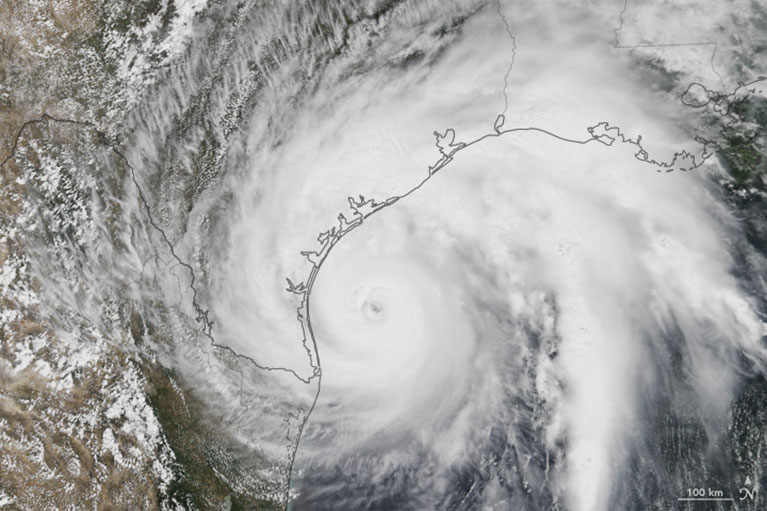
Hurricane Harvey approaches the coast of Texas, August 25, 2017, via NASA.
I turned the knob slowly, believing that anything I could do to preserve a few more minutes of silence would be worth it. Hannah, who falls asleep more slowly, was the first to respond. “Is it time?” she said. “Yes, it’s time again. Get up little girl.”
I walked over to her brother’s bed. “Aaron, c’mon. It’s time.” He rolled over, groggy. “Grab your things and put on your shoes.”
Growing up, it seemed that there were two types of people in the world: those that wore shoes in the house and those that didn’t. Neat people left shoes by the door, fastidious about white carpets and shiney linoleum. People less concerned about cleanliness and those with wood floors left shoes on, mostly.
But there’s something more to it than that, right? “Kick your shoes off and sit a spell” is what the old folks say. Even those who had dirt floors. Shoes-off in the house is about more than cleanliness. It’s about ease. Shoes-off in the house is about more than just safety. It’s about Sabbath. It’s about cessation of work, cessation of anxiety. Shoes-off is how we want to live, at least in a metaphorical sense.
If things really got bad there would be room for four in the closet. This was still just the tornado warning. First would come the breaking glass, then the freight train, then ducking inside and shutting the door and holding on for our lives. For the moment, Erica and I sat in the hallway, kids uneasily dozing in the closet-cum-storm-shelter, everyone with their shoes on, waiting for the storm. This is how the Callahams spent three long days at the end of last month; never leaving the house, but running from a storm nonetheless.
This was was also the scene that came pouring back to me when the Passover Ordinance, the story of Hebrew slaves ordered by God to eat with shoes on as they prepared to leave Egypt, appeared in the Sunday lectionary.
I don’t mean to equate the trials that Houston faced during hurricane Harvey with those of the Hebrews long ago. Contemporary urbanism is as far from Iron Age slavery as the weather patterns of Houston are from those of North Africa. Neither do I wish to compare the inconveniences that my family experienced with the horror of those who were literally out in the storm. Our stories are not the same, except for the shoes.
I wonder how the Hebrews felt as they cleaned up their final meal in Goshen? There must have been quiet moments to wonder about whether all the preparation had been worth it, to wonder whether the blood on the doorpost would actually work, to wonder whether the morning would bring another hardening of the heart of Pharaoh, a return to work and death. Did Hebrew children dose uneasily under their parents’ anxious gaze? Did anyone take comfort in the discomfort of dining with shoes on? Does the fear I felt while sheltering-in-place have anything to do with the hope that we are taught is at the heart of the Passover story?
In recent days, the inevitable question that accompanies most natural disasters has been raised. “Where was God in the midst of our storm?” Predictably, the voices that have risen to the top of the media are not those most prepared to answer. Rather, celebrities and pundits suggest one of two troubling things.
Principally and tragically, some suggest that God was the cause of the storm. That, like some eleventh plague, God was seeking to again turn hardened hearts by afflicting the masses. This is wrong. It shows neither understanding of the basic biblical narrative nor nuance in its interpretation. The citizens of Houston were not waiting for salvation, not of this type at least. Moreover, God has shown that the wanton destruction of life and property is no longer his game, even if it ever was.
More pleasant, but similarly challenging, is the suggestion that God was present in the hands and feet of the heroic rescuer who, like a contemporary Moses, parted water in boat or truck to free those trapped by rising water. This is closer to the truth. But, it still disenfranchises those who cowered in closets, shivered on rooftops and waited for phone calls from lost loved ones. Yes, we owe much to our rescuers and their bass boats. But was God not also present in the lives of the others as well?
The same lectionary’s Gospel lesson portrays Jesus wrapping up a lesson in early church discipline. “Wherever two or three are gathered in my name,” he says, “I am among them.” While this may have originally been a poetic flourish on a pragmatic exhortation, in the context of this conversation about God and shoes and storms it takes on new meaning.
Where was God in the midst of our storm? He was sitting in that hallway next to me. He was in the back of a city dump truck comforting those who had lost everything. He was in the shelter reassuring evacuees that though separated from family and friends they were never truly alone. He was praying with purpose that the creation he authored would not take the life of another of his children. He was dining with his shoes on. Treading the line between hope and fear as he did on the night of the Passover and the night of the Last Supper and the nights that Montana burned and Mexico City shook.
I’m happy to report that shoes are the only things in closets at my house these days. Houstonians don’t own many coats.
Our hurricane experience has changed us, though. It’s made us more aware of the true meaning of preparedness — best to wear clean socks to bed if you’re going to have to wake with shoes on. More than that, it has taught us to seek out those sacred places in life where God calls us to take our shoes off — Holy Ground.
About Art Callaham
Art Callaham is a religious professional. He’s an amateur at almost everything else. Art lives in Houston, TX and blogs at Late2Church.wordpress.com.
Previous Post

September 20, 2017
No, Our Non-Profit Is Not a Ministry
Next Post

September 25, 2017 Faith in the Fog: On Losing Beliefs and Finding God
Browse Our Archives
Select a Category Book Reviews Christian History Christian Issues Christian Spirituality Current Events Fundamentalism Islam John Shore LGBT Movie Reviews Poetry Uncategorized
Select a Month October 2017 September 2017 August 2017 July 2017 June 2017 May 2017 April 2017 March 2017 February 2017 January 2017 December 2016 November 2016 October 2016 September 2016 August 2016 July 2016 June 2016 May 2016 April 2016 March 2016 February 2016 January 2016 December 2015 November 2015 October 2015 September 2015 August 2015 July 2015 June 2015 May 2015 April 2015 March 2015 February 2015 January 2015 December 2014 November 2014 October 2014 September 2014 August 2014 July 2014 June 2014 May 2014 April 2014 March 2014 February 2014 January 2014 December 2013 November 2013 October 2013 September 2013 August 2013 July 2013 June 2013
Follow Us!
TAKE THE
Religious Wisdom Quiz
What church leader is called "the Bishop of Rome"?
Select your answer to see how you score.
The Archbishop of Canterbury The Pope The Patriarch The General Superintendent
Related posts from Unfundamentalist Christians



Post-Pentecost, Hope of Love Remains!
TRENDING AT PATHEOS Progressive Christian

What Being a Modern-Day Apostle Means to Me
In my last column, I discussed the ins and outs of modern-day...

Did Ancient China Once Worship the God of...
Across human history, a common thread weaves through the origins of the...

Love Your Neighbor – Including Earth-Kin: Lev. 19,...
God’s command to love your neighbor means acting in an ethical and...

Lead a Church Study of “Jesus and Lao...
Guest writer Jack Thomas (The Irreverent Reverend) reflects on leading his church...

Pastoral Wisdom for Responding to Sermon Pushback
Getting sermon pushback on your social justice sermon? Learn practical, Proverbs-based strategies...

Principles for Understanding the Apostolic Ministry Today
Whenever people discover that my formal ministry title is "apostle," as in...
view all Progressive Christian blogs
Ad-Free & Subscriber Log-In Subscription Support
- About Us
- 2026 Calendar
- Videos
- Podcasts
- Library of World Religions
- Faith In Media Tracker
- Advertise With Us
- Write for Us
- Privacy Policy
- Terms of Service
- Do Not Sell My Data
- Contact Us
- Radiant Digital
- Manage Newsletter Subscriptions
- Unsubscribe From Notifications
- Sitemap
Copyright 2008-2026, Patheos. All rights reserved.
Subscription Support Ad-Free & Subscriber Log-In
Follow Patheos