
BuddhistCatholicContemplativeEvangelicalGeneral ChristianHinduJewishLatter-day SaintMuslimNew VisionsProgressive Christian
Beliefs
- Buddhist
- Catholic
- Contemplative
- Evangelical
- General Christian
- Hindu
- Jewish
- Latter-day Saint
- More Voices
- Muslim
- New Visions
- Pagan
- Progressive Christian
Topics
- Religion News
- Food and Religion
- Sports and Religion
- Religious Art
- Religious Music and Entertainment
- Religious Events
- History and Religion
- Style and Religion
- Politics and Religion
- Women in Religion
- Recreation Outdoors and Religion
- Business Finance and Religion
- Careers Workplace and Religion
- Education and Religion
- Family Parenting and Religion
- Health Fitness and Religion
- Home and Religion
- Relationships and Religion
- Technology and Religion
- Travel and Religion
Columnists
- Buddhist Columnists
- Business Finance and Religion Columnists
- Careers Workplace and Religion Columnists
- Catholic Columnists
- Contemplative Columnists
- Education and Religion Columnists
- Evangelists Columnists
- Family Parenting and Religion Columnists
- General Christian Columnists
- Health Fitness and Religion Columnists
- Hindu Columnists
- History and Religion Columnists
- Home and Religion Columnists
- Jewish Columnists
- More Voices Columnists
- Latter Day Columnists
- Muslim Columnists
- New Visions Columnists
- Nonreligious Columnists
- Pagan Columnists
- Politics and Religion Columnists
- Progressive Columnists
- Recreation Outdoors and Religion Columnists
- Relationships and Religion Columnists
- Religion News Columnists
- Religious Art Columnists
- Religious Events Columnists
- Religious Music and Entertainment Columnists
- Sports and Religion Columnists
- Style and Religion Columnists
- Technology and Religion Columnists
- Travel and Religion Columnists
- Women in Religion Columnists
Resource Library
- 2026 Calendar
- Library of World Religions
- The 100 Most Holy Places on Earth
- Patheos Answers
- Podcasts
- Videos
- Faith Leaders Database
- Anglican Episcopalian
- Bahai
- Baptist
- Buddhism
- Christianity
- Confucianism
- Eastern Orthodoxy
- Hinduism
- Holiness and Pentecostal
- ISKCON
- Islam
- Judaism
- Lutheran
- Methodist
- The Church of Jesus Christ of Latter-day Saints
- New Age
- Paganism
- Presbytarian and Reformed
- Protestantism
- Religion Behind the Scenes
- Roman Catholic
- Scientology
- Shia Islam
- Sikhism
- Sufism
- Sunni Islam
- Taoism
- Zen
- See all religions
Research Tools
 Ad-Free & Subscriber Log-In Subscription Support
Ad-Free & Subscriber Log-In Subscription Support
Follow Patheos 

- Trending:
- Forgiveness
- |
- Marriage
- |
- Consciousness
- |
- Death Penalty
- |
- Election
- |
- Halloween
 Unfundamentalist Christians
- Home
- Progressive Christian
- Bullying Bishops and Castrated Christians: The Nashville Statement’s Eunuch Omission
Bullying Bishops and Castrated Christians: The Nashville Statement’s Eunuch Omission
Last updated on: September 19, 2017 at 6:16 pm by Don M Burrows
Bullying Bishops and Castrated Christians: The Nashville Statement’s Eunuch Omission 2017-09-19T18:16:54-06:00 Don M Burrows
Patheos Explore the world's faith through different perspectives on religion and spirituality! Patheos has the views of the prevalent religions and spiritualities of the world.
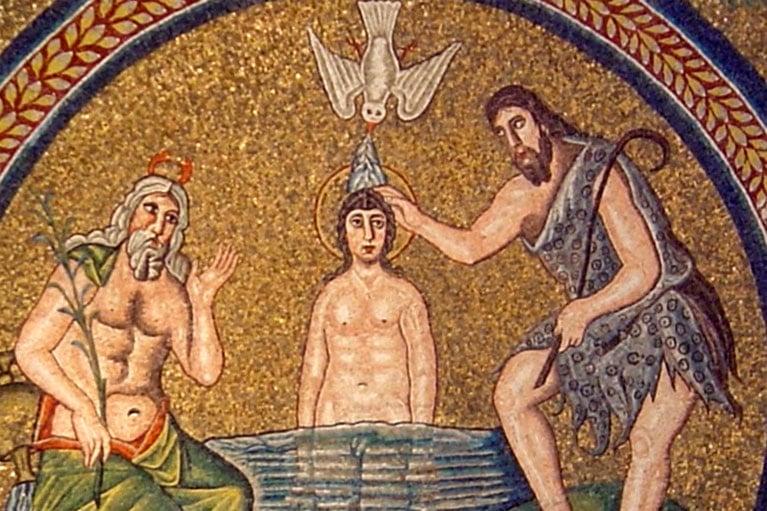
Baptism of Jesus, Arian Baptistry in Ravenna, Italy. Photo by Don M. Burrows.
Mountains of ink have already been spilled rightfully condemning the anti-gay, transphobic Nashville Statement last month, but I was particularly drawn to one of its infamous affirmations/denials that made use of a New Testament passage routinely abused by gender-conformity enforcers: Matthew 19.
This is the passage where Jesus is asked about divorce, answers that it is not really acceptable, and caps his discussion by talking about castration. Yes, really. Not the way you remember it? That’s probably by design.
The standard translation for Matthew 19:12 is (as usual) most accurately conveyed by the New Revised Standard Version:
For there are eunuchs who have been so from birth, and there are eunuchs who have been made eunuchs by others, and there are eunuchs who have made themselves eunuchs for the sake of the kingdom of heaven. Let anyone accept this who can.
Yet a perusal of other translations shows just how much many Christian translators want to avoid any notion of men “making themselves eunuchs.” Any number of alternative translations have been offered, like “those who choose to live like eunuchs” (NIV), or “some choose not to marry” (NLT), or those who “became eunuchs” (NET), or who “decided to be celibate” (God’s Word), or my favorite, “disabled themselves” (Weymouth).
None of these come as close as the NRSV does at capturing what the Greek actually says in the text, and yet the NRSV and its traditional wording (the same found in the King James Bible) are themselves trafficking in euphemism to avoid the uncomfortable, literal reading: men who have castrated themselves.
The Nashville signers specifically cited Matthew 19 in their manifesto while affirming “those born with a physical disorder of sex development,” suggesting they are “created in the image of God and have dignity and worth equal to all other image-bearers” and “are acknowledged by our Lord Jesus in his words about ‘eunuchs who were born that way from their mother’s womb.’” This was no doubt added in an attempt to soften the language of the preceding line, which asserts that “male and female reproductive structures are integral to God’s design for self-conception as male or female.” Knowing that intersex individuals do exist, the signers tried to wrestle some proof-texted, cherry-picked Scripture to remind us that, of course, the Bible has thought of everything.
Except that in order support their own rigid ideologies, they intentionally omitted two-thirds of what Jesus says about eunuchs. For, if “male and female reproductive structures” (leave it to fundamentalists to come up with the worst ways to talk about genitalia) are in fact “integral to God’s design for self-conception,” then one has to wonder what they make of Jesus himself in essence praising self-made eunuchs as Kingdom-seekers.
The same signers love to tell us how “clear” the Bible is about these matters, insisting that clobber passages with vague and ambiguous terminology unapologetically condemn same-sex relations. They also love reading selectively from Matthew 19, mentioning Jesus’s prefacing remarks about male-female creation but not the fact that he goes on to condemn divorce and, ultimately, praise self-castrators.
Yet if ever there’s “clear” language in the New Testament, Matthew 19:12 would be one such case. The entirety of the eunuch discussion looks like this in the Greek. I’ve bolded the nouns and verbs that reference eunuchs:
εἰσὶν γὰρ εὐνοῦχοι οἵτινες ἐκ κοιλίας μητρὸς ἐγεννήθησαν οὕτως, καὶ εἰσὶν εὐνοῦχοι οἵτινες εὐνουχίσθησαν ὑπὸ τῶν ἀνθρώπων, καὶ εἰσὶν εὐνοῦχοι οἵτινες εὐνούχισαν ἑαυτοὺς διὰ τὴν βασιλείαν τῶν οὐρανῶν. ὁ δυνάμενος χωρεῖν χωρείτω.
There is little question about what is going on linguistically. The only intransitive genesis of the eunuchs in Matthew 19:12 are those who are born (ἐγεννήθησαν) from their mothers’ wombs, the only ones the Nashville signers want to pretend exist. But Jesus also talks about those who are not born that way, and he gives them in obvious contrast: those who are “eunuchized” by men (a passive verb with a genitive of agent) and those who “eunuchize themselves” using an active verb and a reflexive pronoun. There’s no passivity in that last statement. They have done this to themselves.
So what does the verb eunuchize (εὐνουχίζω) mean? As the KJV and NRSV suggest, it means to “make a eunuch,” and that means to castrate. That is how it’s used in Lucian’s Saturnalia when Cronus mentions castrating his father Ouranos, and that is the primary definition used in the most authoritative Greek-English lexicons, because that’s how one makes a eunuch – through castration.
Of course, most conservative Christian commentators want this to be metaphorical, not literal. As in so many other areas, conservative Christians browbeat everyone with the “plain and literal” meaning when it suits their agendas, then insist we look to metaphor when it doesn’t. So the 19th-century Pulpit Commentary insists, “This is not to be understood of excision; for this would be a contravention of the order of nature and the good work of creation.” In other words, because castration contradicts most Christians’ own ideologies about sex and gender, Jesus of course couldn’t possibly have been talking about castration.
But why not? In fact, castration to show religious devotion is entirely common in the ancient world. Attis, as told by the poet Catullus, castrated himself out of devotion to Cybele, and his cult followers did the same thereafter. The Oxford Classical Dictionary references Matthew 19:12 directly to note that the “whole of the institution (of eunuchs) created a class of pure servants of a god,” because the passage is so wholly in line with the religious castration commonplace all over antiquity, including in the Near East.
It also accords with many parts of the New Testament that not only speak of eschewing marriage, but also advocate a genderless Christianity (like the famous Galatians 3:28), which often saw expression in the androgyne, an image popular in early Christianity. For example, the depiction of Jesus (the photo at the top of this post) in Ravenna’s Arian Baptistery is one of several images in early Christian art that depicts androgyny. Moreover, Jesus himself indicates that we should not soften our interpretations of the passage, because he ends his discussion of it with an acknowledgment that many will not be able to go along with it: “Let anyone accept this who can,” (literally, anyone who is able to proceed, to advance, to go along with this).

Indeed, we are told by Eusebius that the church father Origen, often considered the most learned of the early theologians, took the verse to heart and castrated himself accordingly. Eusebius writes that Origen took the passage “more plainly” (ἁπλούστερον) and more youthfully (νεανικώτερον) than apparently Eusebius himself did, and at once calls the act immature and juvenile (ἀτελοῦς καὶ νεανικῆς), but he then also immediately describes it as the greatest sign (μέγιστον δεῖγμα) of Origen’s faith (πίστεώς) and prudence (σωφροσύνης).
Eusebius’s entire narrative about Origen is wrapped up with Demetrius, a contemporary bishop, who at first generally approved of Origen’s enthusiasm (προθυμίαν) and sincerity of faith (τὸ γνήσιον αὐτοῦ τῆς πίστεως). However, after Christians begin to lay hands on Origen and elevate him within the church, Demetrius jealously changes course, describing the deed as “most abnormal” (ἀτοπωτάτου), and making a “terrible scandal” (δεινὴν ποιεῖται διαβολήν) about the castration among all the bishops of the world (sound familiar?).
Needless to say, in the account of Christianity’s earliest historian, the condemnations of the judgmental bishop are criticized far more than Origen’s castration of himself.
Let me be perfectly clear: despite routine attempts to do so, I do not consider ancient eunuchs in any way analogous to transgender or gay individuals today. That is not the point of all of this. What is, however, the point, is that a group of arch-conservative Christians, touting their “plain reading of the Bible,” took it upon themselves to “define what it means to be a human being” and came away with a definition that included only biologically born males and biologically born females, with a cursory acknowledgment of people born intersex for good measure. Yet in the very chapter and verse they cite to support their gender dichotomy, we have Jesus muddying that very distinction, and “for the sake of the kingdom of heaven” to boot!
The Nashville statement, then, amounts to little more than the excavated mud-slinging of Demetrius’s assertions about “abnormality.” The signers of the statement are not interested in the myriad and complicated expressions of gender throughout the Bible, early Christianity, and human history writ large. Rather, they are like a jilted, jealous bishop, angry that anyone in the church might lay hands on someone who is “abnormal,” and willing to ignore Jesus’s own words to feed their hungry prejudice.
 About Don M. Burrows
Don M. Burrows is a former journalist and current college preparatory school teacher. Don holds a Ph.D. in Classical Studies with a Ph.D. minor in New Testament. A former Christian fundamentalist, Don is now a member of the United Church of Christ and can be found routinely advocating that the Bible cannot be read or explored without appreciating its ancient, historical context. Don lives in Minneapolis with his wife and three young children. Don blogs at Nota Bene and can also be found on Facebook.
Previous Post
September 15, 2017
5 Things We'll Miss If We Take the Bible Too Literally
Next Post

September 20, 2017 No, Our Non-Profit Is Not a Ministry
Browse Our Archives
Select a Category Book Reviews Christian History Christian Issues Christian Spirituality Current Events Fundamentalism Islam John Shore LGBT Movie Reviews Poetry Uncategorized
Select a Month October 2017 September 2017 August 2017 July 2017 June 2017 May 2017 April 2017 March 2017 February 2017 January 2017 December 2016 November 2016 October 2016 September 2016 August 2016 July 2016 June 2016 May 2016 April 2016 March 2016 February 2016 January 2016 December 2015 November 2015 October 2015 September 2015 August 2015 July 2015 June 2015 May 2015 April 2015 March 2015 February 2015 January 2015 December 2014 November 2014 October 2014 September 2014 August 2014 July 2014 June 2014 May 2014 April 2014 March 2014 February 2014 January 2014 December 2013 November 2013 October 2013 September 2013 August 2013 July 2013 June 2013
Follow Us!
TAKE THE
Religious Wisdom Quiz
What does "Deuteronomy" mean in Greek?
Select your answer to see how you score.
Sacred Song Great Journey Many Stories Second Law
Related posts from Unfundamentalist Christians
On Conservative Christians’ Sudden Devotion to Imperial Cult
Conservatives Double-Down on Archaic Views on Sexuality, Bigots...

TRENDING AT PATHEOS Progressive Christian

What Being a Modern-Day Apostle Means to Me
In my last column, I discussed the ins and outs of modern-day...

Did Ancient China Once Worship the God of...
Across human history, a common thread weaves through the origins of the...

Love Your Neighbor – Including Earth-Kin: Lev. 19,...
God’s command to love your neighbor means acting in an ethical and...

Lead a Church Study of “Jesus and Lao...
Guest writer Jack Thomas (The Irreverent Reverend) reflects on leading his church...

Pastoral Wisdom for Responding to Sermon Pushback
Getting sermon pushback on your social justice sermon? Learn practical, Proverbs-based strategies...

Principles for Understanding the Apostolic Ministry Today
Whenever people discover that my formal ministry title is "apostle," as in...
view all Progressive Christian blogs
Ad-Free & Subscriber Log-In Subscription Support
- About Us
- 2026 Calendar
- Videos
- Podcasts
- Library of World Religions
- Faith In Media Tracker
- Advertise With Us
- Write for Us
- Privacy Policy
- Terms of Service
- Do Not Sell My Data
- Contact Us
- Radiant Digital
- Manage Newsletter Subscriptions
- Unsubscribe From Notifications
- Sitemap
Copyright 2008-2026, Patheos. All rights reserved.
Subscription Support Ad-Free & Subscriber Log-In
Follow Patheos