
BuddhistCatholicContemplativeEvangelicalGeneral ChristianHinduJewishLatter-day SaintMuslimNew VisionsProgressive Christian
Beliefs
- Buddhist
- Catholic
- Contemplative
- Evangelical
- General Christian
- Hindu
- Jewish
- Latter-day Saint
- More Voices
- Muslim
- New Visions
- Pagan
- Progressive Christian
Topics
- Religion News
- Food and Religion
- Sports and Religion
- Religious Art
- Religious Music and Entertainment
- Religious Events
- History and Religion
- Style and Religion
- Politics and Religion
- Women in Religion
- Recreation Outdoors and Religion
- Business Finance and Religion
- Careers Workplace and Religion
- Education and Religion
- Family Parenting and Religion
- Health Fitness and Religion
- Home and Religion
- Relationships and Religion
- Technology and Religion
- Travel and Religion
Columnists
- Buddhist Columnists
- Business Finance and Religion Columnists
- Careers Workplace and Religion Columnists
- Catholic Columnists
- Contemplative Columnists
- Education and Religion Columnists
- Evangelists Columnists
- Family Parenting and Religion Columnists
- General Christian Columnists
- Health Fitness and Religion Columnists
- Hindu Columnists
- History and Religion Columnists
- Home and Religion Columnists
- Jewish Columnists
- More Voices Columnists
- Latter Day Columnists
- Muslim Columnists
- New Visions Columnists
- Nonreligious Columnists
- Pagan Columnists
- Politics and Religion Columnists
- Progressive Columnists
- Recreation Outdoors and Religion Columnists
- Relationships and Religion Columnists
- Religion News Columnists
- Religious Art Columnists
- Religious Events Columnists
- Religious Music and Entertainment Columnists
- Sports and Religion Columnists
- Style and Religion Columnists
- Technology and Religion Columnists
- Travel and Religion Columnists
- Women in Religion Columnists
Resource Library
- 2026 Calendar
- Library of World Religions
- The 100 Most Holy Places on Earth
- Patheos Answers
- Podcasts
- Videos
- Faith Leaders Database
- Anglican Episcopalian
- Bahai
- Baptist
- Buddhism
- Christianity
- Confucianism
- Eastern Orthodoxy
- Hinduism
- Holiness and Pentecostal
- ISKCON
- Islam
- Judaism
- Lutheran
- Methodist
- The Church of Jesus Christ of Latter-day Saints
- New Age
- Paganism
- Presbytarian and Reformed
- Protestantism
- Religion Behind the Scenes
- Roman Catholic
- Scientology
- Shia Islam
- Sikhism
- Sufism
- Sunni Islam
- Taoism
- Zen
- See all religions
Research Tools
 Ad-Free & Subscriber Log-In Subscription Support
Follow Patheos 

- Trending:
- Advent
- |
- Forgiveness
- |
- Thanksgiving
- |
- Election
- |
- Seasonal Holidays
- |
- Marriage
 Unfundamentalist Christians
- Home
- Progressive Christian
- Problematizing Biblical Inerrancy
Problematizing Biblical Inerrancy
Last updated on: July 21, 2017 at 10:13 am by Matthew Distefano
Problematizing Biblical Inerrancy 2017-07-21T10:13:53-06:00 Matthew Distefano
Patheos Explore the world's faith through different perspectives on religion and spirituality! Patheos has the views of the prevalent religions and spiritualities of the world.

It seems safe to say that most Christians — whether Catholic, Protestant, Orthodox, Anabaptist, or something else entirely — believe they are generally correct in their doctrinal views. Otherwise, why would they have them? This is not necessarily a bad thing, since there is nothing wrong with loosely holding onto beliefs we find credible. However, many of these folks — mainly Protestants who affirm an inerrant Bible — are not simply convinced about their beliefs, but are certain they are correct. Which makes those who differ wrong. Dead wrong.
In this piece, while I am not going to put forth a particular way to approach Scripture (I’ve done that here, here, and here), I am going to be a bit of a rabble-rouser and simply problematize things for folks who consider themselves inerrantists. After all, the first step to solving a problem is to admit there is one. And Houston, inerrancy has and is a problem.
Problem I: Jesus Takes a Back Seat to Scripture
If we begin our theological pilgrimage (as Karl Barth might call it) with an inerrant Bible, then we aren’t beginning with Jesus. And if we fail to start with Jesus, instead opting to start with a certain view of the book — or rather, books — that testify about him, how can we ever know the way in which Jesus himself approached his Scriptures? Is it enough to say that “because he quotes from Scripture, he therefore affirms it all?” Well, that would be highly irresponsible of us, as it assumes far too much and fails to lead us in asking some crucial questions, such as: How did he interpret Scripture? Did he follow a certain pattern? What did he even consider “Scripture?”
Furthermore, if we begin with the view that everything said in the Bible — even all the whacky stuff — testifies to the true nature of God, then we would be more than hard-pressed in saying, as Paul did, that Jesus is the fullness of God in bodily form (Col 2:9). In other words, with inerrancy, any theological truths that Jesus reveals become papered over by the whole of Scripture, instead of the whole of Scripture being read through the lens of the life, death, resurrection, and ascension of Christ.
This seems bass-ackwards!
Problem II: Sociological Problems Abound
When every jot and tittle of Scripture is assumed to be inerrant, real world problems arise. Turn your attention to John 9. In this story, Jesus and his disciples come across a societal outcast who was born blind. The disciples ask “Rabbi, who sinned, this man or his parents, that he was born blind?” But why do they assume this?
Well, this thinking comes straight from Deuteronomy 5 and 28. The Bible is clear:
- Deut 5:9: You shall not bow down to them or worship them; for I the Lord your God am a jealous God, punishing children for the iniquity of parents, to the third and fourth generation of those who reject me.
- Deut 28:18: Cursed shall be the fruit of your womb.
- Deut 28:22: The Lord will afflict you with consumption, fever, inflammation.
- Deut 28:27: The Lord will afflict you with the boils of Egypt; with ulcers, scurvy, and itch, of which you cannot be healed.
- Deut 28:37: You shall become an object of horror.
Needless to say, when we take for granted that everything in Scripture is from God himself, we certainly run the risk of looking around at those in need and concluding that they are cursed — just like Job’s “friends” did all throughout the book of Job. And just like many of the folks did in Jesus’ day. Sadly, and since we are living post-Jesus, ironically, we still do this today.
Problem III: You Can’t Shed Your Subjectivity
No matter what objective truths are out there, we can never approach them objectively ourselves. We are always in first-person mode, bringing our own subjectivity to the table. Even if the Bible were written by God and contained zero historical, anthropological, psychological, or theological errors, we would still never be able to approach it objectively. We will always bring our presuppositions to our interpretation.
For one example of what I’m talking about, let’s think about Paul’s phrase pistis Christou. Is it the “faithfulness of Christ” or “faith in Christ” that saves us? Some scholars affirm the former, others the latter. What are we non-scholars to say? It makes a difference, because if it is the faithfulness of Christ that “reconciles the world to God,” then salvation is, first and foremost, an act of God. If, on the other hand, it is our faith in Christ that saves us, then salvation is, first and foremost, offered by God, but actualized by our faith. Our answer likely depends upon a whole host of factors, including any assumptions and presuppositions we may currently have.
Piggybacking on this, what is the “correct” biblical way of thinking about our “belief” in Jesus? As the Lord says in John’s Gospel, he is “the way” to the Father (John 14:6). But how are we to interpret this? As Michael Machuga points out in our book, A Journey with Two Mystics, this can mean a whole host of things. First, it could mean we simply must acknowledge that Jesus exists, that he is who he says he is — sort of like believing in Santa Claus. Or, it could mean believing that his way of living — his ethics, politics, and philosophy — is our model for living. And third, it could mean believing he accomplished what he set out to accomplish, namely, that he indeed conquered death and was victorious over sin and the devil.
At the end of the day, all these issues (and many more) are open for interpretation, whether we call our Bible inerrant or not.
Problem IV: Which Bible Are We Even Talking About?
When we make the claim that “the Bible is inerrant,” which canon are we referring to? Is it only the 66 book Protestant Bible? Or should we add some deuterocanonical books? Why? Why not? How would it change things if, for example, we had 1 Enoch in our canon (Jude probably did)? That instead of the Bible being 66 books, it was 80? Or 81, as the Ethiopian Orthodox Church suggests?
Furthermore, are only the original manuscripts (which we don’t have) inerrant or did the translations also stand the test of time? All of them? Even the ones that contradict each other? Even the ones with missing verses (the NIV doesn’t include John 5:4, Acts 8:37, and a few others)?
Problem V: The Bible Never Makes this Claim
The Bible simply never makes the claim that it is inerrant. (And even if it did, the logic would be entirely circular. And it still wouldn’t address our fourth problem.) Sure, there is that funky verse in 2 Timothy, but using it as some proof-text for inerrancy seems rather dubious.
First, there is no “is” in the Greek text. The writer simply begins the sentence with “Pasa graphe theopneustos kai,” which literally translates to “Every writing God-breathed and.” So, translators have to make a decision. Should it read: “All Scripture is inspired by God…” or “Every Scripture inspired by God is…” or “Every writing God-breathed is…” or something else entirely? Our answer makes a lot of difference here.
Second, given that the writer of 2 Timothy could not have possessed what we moderns call “the Bible,” one would have to conclude that what they meant by “Scripture/writing” was in relation to the Hebrew Scriptures. Forcing our canon of Scripture back into this text is anachronistic and fallacious.
All that said, even if we take what we call “the Bible” and determine it is all “God-breathed,” that hardly means it is inerrant (or infallible for that matter). Heck, the Bible clearly states that humanity is “God-breathed” — God breathes the ruach into the adama to create a living nefesh — but no one I know is clamoring on about how humanity is inerrant. Far from it, in fact! And I would agree with them.
In Closing
If you don’t happen to see the same problems with inerrancy that I do, then that is understandable. These are just the issues I was confronted with that forced me, after 25 years of living the Evangelical lifestyle, into the desert of deconstruction. Sure, when I “came out the other side,” Jesus was there, with the Scriptures in-hand, so that I could sit at his feet. But I didn’t always know this, so I empathize with those who think I am trying to “take away their Bibles.” I am not — I am just verbalizing the problems I, and others, have faced in our journey out of inerrancy. Do with it as you see fit.
Peace.
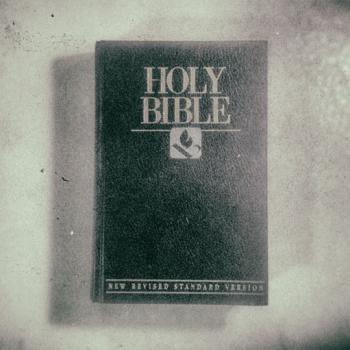
Image via Unsplash.
 About Matthew Distefano
Matthew Distefano is the author of All Set Free: How God is Revealed in Jesus and Why That is Really Good News, From the Blood of Abel: Humanity’s Root Causes of Violence and the Bible’s Theological-Anthropological Solution and the newly-released A Journey with Two Mystics: Conversations between a Girardian and a Wattsian. He is also a Regular Contributor for The Raven ReView and ProgressiveChristianity.org. You can find him on his website, Facebook, and Twitter.
Previous Post

July 17, 2017
For the Invisible People
Next Post

July 21, 2017 Too Many Churches, Not Enough Christians
Browse Our Archives
Select a Category Book Reviews Christian History Christian Issues Christian Spirituality Current Events Fundamentalism Islam John Shore LGBT Movie Reviews Poetry Uncategorized
Select a Month October 2017 September 2017 August 2017 July 2017 June 2017 May 2017 April 2017 March 2017 February 2017 January 2017 December 2016 November 2016 October 2016 September 2016 August 2016 July 2016 June 2016 May 2016 April 2016 March 2016 February 2016 January 2016 December 2015 November 2015 October 2015 September 2015 August 2015 July 2015 June 2015 May 2015 April 2015 March 2015 February 2015 January 2015 December 2014 November 2014 October 2014 September 2014 August 2014 July 2014 June 2014 May 2014 April 2014 March 2014 February 2014 January 2014 December 2013 November 2013 October 2013 September 2013 August 2013 July 2013 June 2013
Follow Us!
TAKE THE
Religious Wisdom Quiz
Who was the Roman centurion who converted to Christianity in Acts 10?
Select your answer to see how you score.
Cornelius Herod Nicodemus Felix
Related posts from Unfundamentalist Christians

Faith in the Fog: On Losing Beliefs and...

My Cancer Didn't Happen for a Reason
5 Things We'll Miss If We Take the...

No, Our Non-Profit Is Not a Ministry
TRENDING AT PATHEOS Progressive Christian

Can a Chatbot Touch Your Soul?
Can a chatbot offer genuine spiritual counsel? One conversation brought me to...

Religion and Politics: How Should We Then Live?
Two cultural axioms get repeated in polite company. Don't mix religion and...

7 Things We Get Wrong About Giving Thanks
It's a time of year when many of us turn to the...

Uncaging Truth: Spirituality Beyond Institutions
The Lost Connection: Why True Spirituality, Not Religion, Is the Key to...

Christ the King? Maybe We've Misunderstood the Crown
What do we mean when we say that Jesus is King? What...

Counter “Christ Is King” Nationalism with Christ THE...
Christ the King Sunday is an ideal time to address the heresy...
view all Progressive Christian blogs
Ad-Free & Subscriber Log-In Subscription Support
- About Us
- 2026 Calendar
- Videos
- Podcasts
- Library of World Religions
- Faith In Media Tracker
- Advertise With Us
- Write for Us
- Privacy Policy
- Terms of Service
- Do Not Sell My Data
- Contact Us
- Radiant Digital
- Manage Newsletter Subscriptions
- Unsubscribe From Notifications
- Sitemap
Copyright 2008-2026, Patheos, part of the Radiant Digital network of media brands. All rights reserved.
Subscription Support Ad-Free & Subscriber Log-In
Follow Patheos