
BuddhistCatholicContemplativeEvangelicalGeneral ChristianHinduJewishLatter-day SaintMuslimNew VisionsProgressive Christian
Beliefs
- Buddhist
- Catholic
- Contemplative
- Evangelical
- General Christian
- Hindu
- Jewish
- Latter-day Saint
- More Voices
- Muslim
- New Visions
- Pagan
- Progressive Christian
Topics
- Religion News
- Food and Religion
- Sports and Religion
- Religious Art
- Religious Music and Entertainment
- Religious Events
- History and Religion
- Style and Religion
- Politics and Religion
- Women in Religion
- Recreation Outdoors and Religion
- Business Finance and Religion
- Careers Workplace and Religion
- Education and Religion
- Family Parenting and Religion
- Health Fitness and Religion
- Home and Religion
- Relationships and Religion
- Technology and Religion
- Travel and Religion
Columnists
- Buddhist Columnists
- Business Finance and Religion Columnists
- Careers Workplace and Religion Columnists
- Catholic Columnists
- Contemplative Columnists
- Education and Religion Columnists
- Evangelists Columnists
- Family Parenting and Religion Columnists
- General Christian Columnists
- Health Fitness and Religion Columnists
- Hindu Columnists
- History and Religion Columnists
- Home and Religion Columnists
- Jewish Columnists
- More Voices Columnists
- Latter Day Columnists
- Muslim Columnists
- New Visions Columnists
- Nonreligious Columnists
- Pagan Columnists
- Politics and Religion Columnists
- Progressive Columnists
- Recreation Outdoors and Religion Columnists
- Relationships and Religion Columnists
- Religion News Columnists
- Religious Art Columnists
- Religious Events Columnists
- Religious Music and Entertainment Columnists
- Sports and Religion Columnists
- Style and Religion Columnists
- Technology and Religion Columnists
- Travel and Religion Columnists
- Women in Religion Columnists
Resource Library
- 2026 Calendar
- Library of World Religions
- The 100 Most Holy Places on Earth
- Patheos Answers
- Podcasts
- Videos
- Faith Leaders Database
- Anglican Episcopalian
- Bahai
- Baptist
- Buddhism
- Christianity
- Confucianism
- Eastern Orthodoxy
- Hinduism
- Holiness and Pentecostal
- ISKCON
- Islam
- Judaism
- Lutheran
- Methodist
- The Church of Jesus Christ of Latter-day Saints
- New Age
- Paganism
- Presbytarian and Reformed
- Protestantism
- Religion Behind the Scenes
- Roman Catholic
- Scientology
- Shia Islam
- Sikhism
- Sufism
- Sunni Islam
- Taoism
- Zen
- See all religions
Research Tools
 Ad-Free & Subscriber Log-In Subscription Support
Ad-Free & Subscriber Log-In Subscription Support
Follow Patheos 

- Trending:
- Forgiveness
- |
- Marriage
- |
- Consciousness
- |
- Death Penalty
- |
- Election
- |
- Halloween
 Unfundamentalist Christians
- Home
- Progressive Christian
- Understanding Backwards
Understanding Backwards
Last updated on: June 30, 2017 at 2:02 am by Guest Contributor
Understanding Backwards 2017-06-29T15:17:18-06:00 Guest Contributor
Patheos Explore the world's faith through different perspectives on religion and spirituality! Patheos has the views of the prevalent religions and spiritualities of the world.
This guest post was written by Barry Casey.

“Life must be lived forward, but can only be understood backwards.” — Soren Kierkegaard
For a good part of my life, I have seen religion as a duty which must be accomplished with dedication if not enjoyment. Since all people are sinners and sinners must seek salvation, it did not occur to me that some people might not see the point in all this religion business. “Oh, I’m not religious,” some friends would say to me, as if it were genetically transmitted or perhaps an acquired taste. They would blithely go about their lives, unencumbered by guilt, enjoying their sins, and occasionally pausing to shake their heads at my dutifulness. “Why do you bother?” they would ask curiously.
For my part, I could not understand how religion could be regarded as an accessory. It was core, at the heart, deep inside, that which guided and prompted all that was good and pure and true. One could no more shuck it off and live a decent, upright life than one could see one’s hand in a room without light. There was one way to salvation and that was through obedience to the rules, as inexplicable as they appeared sometimes. And yet I continued to meet people who claimed no religious allegiance, but seemed to me honest and good, the kind of people who would take you in during a storm or give you a lift miles out of their way. It was disconcerting. Some of them even smoked.
So I tried harder, tried to be dutiful, tried to be aligned without completely losing myself. But myself would slip out of my grasp at the most inopportune moments and do something embarrassing, like refusing to stand and go forward for altar calls. Even if I had made a clear and heartfelt decision years before to join the side of the angels, I squirmed in the pew when the preacher began his pitch. I felt that I owed it to the unchurched and the disbelievers in the house to stand yet again and be a living example. Despite my inner diatribe that religion was personal and that honesty demanded a consonance between motivation, belief, and action, I felt I was letting down the team.
And yet I was always fascinated by religion, or rather by the quest for God and transcendence. Growing up in California in the 60s, I was surrounded by those who sought a shortcut to enlightenment or at least bliss. I plodded along, waving as they roared past, secure that I had the safer path if by far the slower one. If it was there, I thought, I’d find it eventually by dint of just keeping at it, one foot in front of the other. But I didn’t.
I studied theology, philosophy of religion, eventually got a doctorate and taught religion for some years. I had no doubt I should be there and yet I constantly felt like an imposter. I could not be like my colleagues, men who had signed up for the church for life and who seemingly could overlook all manner of missteps and outright lies on the part of the church. I struggled to understand how to avoid the sin of self-righteousness while sidestepping hypocrisy. But pride goes before a fall—and I took a fall of my own making.
Years later, I am seeing some things much differently. I am learning not to let the foibles of the official church body distract me from my own spiritual quest. I have met the enemy, like Pogo, and they are me. I know what I am capable of doing against my better judgment and where most of the fault lines appear in my foundations.
And I have learned, or perhaps discovered, that signing up for a set of beliefs is not the point. Some beliefs fall away over the years because they never really found a place, because I never really believed them. Others simply don’t make sense no matter how I’ve tried. But the vast majority of religious beliefs ought to be seen as practices. We practice them because in the practicing comes understanding and with understanding comes the willingness to live in grace, to be in God. “Religion is a practical discipline that teaches us to discover new capacities of mind and heart,” says Karen Armstrong in The Case for God. “You will discover their truth—or lack of it—only if you translate these doctrines into ritual or ethical action.”
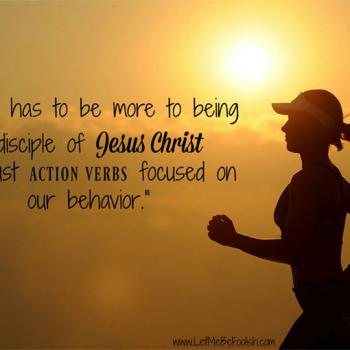
Orthopraxy over orthodoxy—right action over right belief is how I see it—but with two important caveats. First, we do not earn our way through “right” action because this is not a contractual relationship. God is in the giving business, not the litigation business. Thus, I have nothing to fear from him; I have no need to protect myself. Second, belief is not abandoned, but made firm through action. “Like any skill,” continues Armstrong, “religion requires perseverance, hard work, and discipline. Some people will be better at it than others, some appallingly inept, and some will miss the point entirely. But those who do not apply themselves will get nowhere at all.”
In the end—and in fact, in the beginning and in the middle, is grace. That is what makes this whole venture possible. Room to move, to experiment, to make mistakes and learn from them. Here is the mysterious presence of the Christ. T. S. Eliot knew something of this, laying down the lines in The Wasteland:
Who is the third who walks always beside you?
When I count, there are only you and I together
But when I look ahead up the white road
There is always another one walking beside you…
And that is enough for the time being.
Photo via Unsplash.
Barry Casey teaches philosophy and ethics at Trinity Washington University in Washington, DC, and public speaking at Stevenson University in Maryland. He writes a blog called Dante’s Woods at danteswoods.com.
Previous Post

June 28, 2017
Faith in the Fog: Making Peace With the Messiness of the Bible
Next Post

July 3, 2017 To My Conservative Christian Friends
Browse Our Archives
Select a Category Book Reviews Christian History Christian Issues Christian Spirituality Current Events Fundamentalism Islam John Shore LGBT Movie Reviews Poetry Uncategorized
Select a Month October 2017 September 2017 August 2017 July 2017 June 2017 May 2017 April 2017 March 2017 February 2017 January 2017 December 2016 November 2016 October 2016 September 2016 August 2016 July 2016 June 2016 May 2016 April 2016 March 2016 February 2016 January 2016 December 2015 November 2015 October 2015 September 2015 August 2015 July 2015 June 2015 May 2015 April 2015 March 2015 February 2015 January 2015 December 2014 November 2014 October 2014 September 2014 August 2014 July 2014 June 2014 May 2014 April 2014 March 2014 February 2014 January 2014 December 2013 November 2013 October 2013 September 2013 August 2013 July 2013 June 2013
Follow Us!
TAKE THE
Religious Wisdom Quiz
What does "Shiloh" mean in Hebrew?
Select your answer to see how you score.
Prince of peace He whose it is God’s dwelling The chosen one
Related posts from Unfundamentalist Christians


Post-Pentecost, Hope of Love Remains!
TRENDING AT PATHEOS Progressive Christian

What Being a Modern-Day Apostle Means to Me
In my last column, I discussed the ins and outs of modern-day...

Did Ancient China Once Worship the God of...
Across human history, a common thread weaves through the origins of the...

Love Your Neighbor – Including Earth-Kin: Lev. 19,...
God’s command to love your neighbor means acting in an ethical and...

Lead a Church Study of “Jesus and Lao...
Guest writer Jack Thomas (The Irreverent Reverend) reflects on leading his church...

Pastoral Wisdom for Responding to Sermon Pushback
Getting sermon pushback on your social justice sermon? Learn practical, Proverbs-based strategies...

Principles for Understanding the Apostolic Ministry Today
Whenever people discover that my formal ministry title is "apostle," as in...
view all Progressive Christian blogs
Ad-Free & Subscriber Log-In Subscription Support
- About Us
- 2026 Calendar
- Videos
- Podcasts
- Library of World Religions
- Faith In Media Tracker
- Advertise With Us
- Write for Us
- Privacy Policy
- Terms of Service
- Do Not Sell My Data
- Contact Us
- Radiant Digital
- Manage Newsletter Subscriptions
- Unsubscribe From Notifications
- Sitemap
Copyright 2008-2026, Patheos. All rights reserved.
Subscription Support Ad-Free & Subscriber Log-In
Follow Patheos