
BuddhistCatholicContemplativeEvangelicalGeneral ChristianHinduJewishLatter-day SaintMuslimNew VisionsProgressive Christian
Beliefs
- Buddhist
- Catholic
- Contemplative
- Evangelical
- General Christian
- Hindu
- Jewish
- Latter-day Saint
- More Voices
- Muslim
- New Visions
- Pagan
- Progressive Christian
Topics
- Religion News
- Food and Religion
- Sports and Religion
- Religious Art
- Religious Music and Entertainment
- Religious Events
- History and Religion
- Style and Religion
- Politics and Religion
- Women in Religion
- Recreation Outdoors and Religion
- Business Finance and Religion
- Careers Workplace and Religion
- Education and Religion
- Family Parenting and Religion
- Health Fitness and Religion
- Home and Religion
- Relationships and Religion
- Technology and Religion
- Travel and Religion
Columnists
- Buddhist Columnists
- Business Finance and Religion Columnists
- Careers Workplace and Religion Columnists
- Catholic Columnists
- Contemplative Columnists
- Education and Religion Columnists
- Evangelists Columnists
- Family Parenting and Religion Columnists
- General Christian Columnists
- Health Fitness and Religion Columnists
- Hindu Columnists
- History and Religion Columnists
- Home and Religion Columnists
- Jewish Columnists
- More Voices Columnists
- Latter Day Columnists
- Muslim Columnists
- New Visions Columnists
- Nonreligious Columnists
- Pagan Columnists
- Politics and Religion Columnists
- Progressive Columnists
- Recreation Outdoors and Religion Columnists
- Relationships and Religion Columnists
- Religion News Columnists
- Religious Art Columnists
- Religious Events Columnists
- Religious Music and Entertainment Columnists
- Sports and Religion Columnists
- Style and Religion Columnists
- Technology and Religion Columnists
- Travel and Religion Columnists
- Women in Religion Columnists
Resource Library
- 2026 Calendar
- Library of World Religions
- The 100 Most Holy Places on Earth
- Patheos Answers
- Podcasts
- Videos
- Faith Leaders Database
- Anglican Episcopalian
- Bahai
- Baptist
- Buddhism
- Christianity
- Confucianism
- Eastern Orthodoxy
- Hinduism
- Holiness and Pentecostal
- ISKCON
- Islam
- Judaism
- Lutheran
- Methodist
- The Church of Jesus Christ of Latter-day Saints
- New Age
- Paganism
- Presbytarian and Reformed
- Protestantism
- Religion Behind the Scenes
- Roman Catholic
- Scientology
- Shia Islam
- Sikhism
- Sufism
- Sunni Islam
- Taoism
- Zen
- See all religions
Research Tools
 Ad-Free & Subscriber Log-In Subscription Support
Ad-Free & Subscriber Log-In Subscription Support
Follow Patheos 

- Trending:
- Forgiveness
- |
- Marriage
- |
- Consciousness
- |
- Death Penalty
- |
- Election
- |
- Halloween
 Unfundamentalist Christians
- Home
- Progressive Christian
- A Lesson on Divine Grief
A Lesson on Divine Grief
Last updated on: May 24, 2017 at 2:02 am by Guest Contributor
A Lesson on Divine Grief 2017-05-23T20:31:48-06:00 Guest Contributor
Patheos Explore the world's faith through different perspectives on religion and spirituality! Patheos has the views of the prevalent religions and spiritualities of the world.
This guest post was written by DeWayne R. Stallworth.
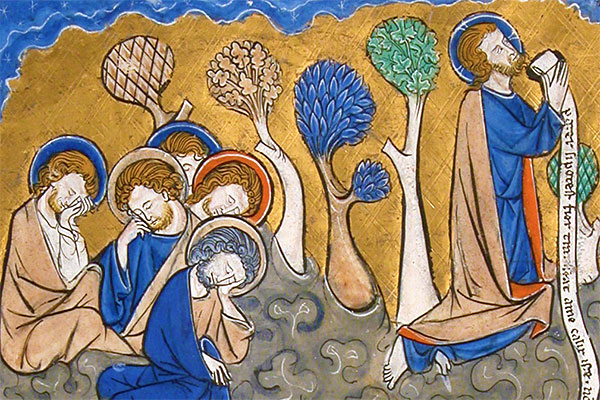
Detail from “Manuscript Leaf with the Agony in the Garden and Betrayal of Christ, from a Royal Psalter” via The Metropolitan Museum of Art, licensed under CC0 1.0
He came out and went, as was his custom, to the Mount of Olives; and the disciples followed him. When he reached the place, he said to them, “Pray that you may not come into the time of trial.” Then he withdrew from them about a stone’s throw, knelt down, and prayed, “Father, if you are willing, remove this cup from me; yet, not my will but yours be done.” Then an angel from heaven appeared to him and gave him strength. In his anguish he prayed more earnestly, and his sweat became like great drops of blood falling down on the ground. When he got up from prayer, he came to the disciples and found them sleeping because of grief, and he said to them, “Why are you sleeping? Get up and pray that you may not come into the time of trial.”
—Luke 22:39-46
The text presents Jesus as a vulnerable man. To be sure, Jesus displayed great power through many miraculous acts. He had given sight to the blind, fed the destitute, and even walked on water; however, on the eve of his engagement with the cross, Jesus kneels and prays: “Father, if you are willing, remove this cup from me; yet, not my will but your will be done (v42).” Additionally, “In his anguish he prayed more earnestly, and his sweat became like great drops of blood falling down to the ground (v44).”
The reader then discovers that while Jesus is dealing with his own anguish, the disciples have fallen asleep due to the amount of grief they are experiencing. In essence, Jesus wanted to feel attached to human sources of intimacy and connectedness; being God, Jesus knew that the disciples were unable to understand what he was experiencing. However, being human, Jesus needed that human association as a means of providing comfort and a sense of connectedness.
The trauma of the cross forced Jesus to display humanistic tendencies. For instance, Jesus’ expectation was that the disciples would simply stay awake while he prayed to the Father. Jesus’ experience with the Father and the lack of human support promoted a condition known as hematidrosis. Luke, a physician, is the only gospel writer with the proper terminology to articulate such a traumatic event in the life of Jesus. A high level of anxiety likely prompted Jesus to experience a psycho-bio response–he began to sweat blood.
Although Jesus takes the disciples to task for falling to sleep, the reader must understand how grief and sadness affects human physiology. Considering the constant theological instruction from Jesus during his final days and the movement into hostile engagement, it’s possible the disciples had fallen into a state of depression. When one is dealing with depression, the lack of sleep (or constant sleeping) is an indication that the mind is grappling with an overwhelming degree of psychic stimuli.
Luke, however, presents a more sympathetic Jesus toward the end of the text. Matthew, Mark, and John certainly highlight the back-and-forth didactic between Jesus and his disciples. Jesus goes to them for comfort, but they are emotionally unavailable. He goes to the Father, but God is unwilling to compromise his divinely processed plan regarding human and divine relations.
Jesus follows this back-and-forth progression until he understands that the disciples are unable to consider his anguish, especially when they are attempting to deal with their own human frailties. God the Father has not presented an alternative means of salvation; therefore, Jesus concludes that God’s way is the preferred way. He humbly acquiesces to the Will of God.
There is nothing abnormal about wanting human sympathy. Jesus’ response in Luke provides an example for Christians to follow. Having theological and spiritual awareness does not make one immune to trauma and grief, and there will be times when even our most intimate friends won’t understand what we are going through. In such an instance, rather than labeling them as unsympathetic, we should attempt to understand that trauma is subjective, and that it takes time to understand.
 About DeWayne R. Stallworth
DeWayne R. Stallworth, Ph.D., MA. teaches religion and counseling at American Baptist College, Nashville, TN.
Previous Post

May 22, 2017
Is Living Together Before Marriage a Sin?
Next Post

May 26, 2017 The Real Face of the Persecuted
Browse Our Archives
Select a Category Book Reviews Christian History Christian Issues Christian Spirituality Current Events Fundamentalism Islam John Shore LGBT Movie Reviews Poetry Uncategorized
Select a Month October 2017 September 2017 August 2017 July 2017 June 2017 May 2017 April 2017 March 2017 February 2017 January 2017 December 2016 November 2016 October 2016 September 2016 August 2016 July 2016 June 2016 May 2016 April 2016 March 2016 February 2016 January 2016 December 2015 November 2015 October 2015 September 2015 August 2015 July 2015 June 2015 May 2015 April 2015 March 2015 February 2015 January 2015 December 2014 November 2014 October 2014 September 2014 August 2014 July 2014 June 2014 May 2014 April 2014 March 2014 February 2014 January 2014 December 2013 November 2013 October 2013 September 2013 August 2013 July 2013 June 2013
Follow Us!
TAKE THE
Religious Wisdom Quiz
Who insulted and opposed David, then died after Abigail pleaded his case?
Select your answer to see how you score.
Amasa Ahithophel Joab Nabal
Related posts from Unfundamentalist Christians


No, Our Non-Profit Is Not a Ministry


TRENDING AT PATHEOS Progressive Christian

What Being a Modern-Day Apostle Means to Me
In my last column, I discussed the ins and outs of modern-day...

Did Ancient China Once Worship the God of...
Across human history, a common thread weaves through the origins of the...

Love Your Neighbor – Including Earth-Kin: Lev. 19,...
God’s command to love your neighbor means acting in an ethical and...

Lead a Church Study of “Jesus and Lao...
Guest writer Jack Thomas (The Irreverent Reverend) reflects on leading his church...

Pastoral Wisdom for Responding to Sermon Pushback
Getting sermon pushback on your social justice sermon? Learn practical, Proverbs-based strategies...

Principles for Understanding the Apostolic Ministry Today
Whenever people discover that my formal ministry title is "apostle," as in...
view all Progressive Christian blogs
Ad-Free & Subscriber Log-In Subscription Support
- About Us
- 2026 Calendar
- Videos
- Podcasts
- Library of World Religions
- Faith In Media Tracker
- Advertise With Us
- Write for Us
- Privacy Policy
- Terms of Service
- Do Not Sell My Data
- Contact Us
- Radiant Digital
- Manage Newsletter Subscriptions
- Unsubscribe From Notifications
- Sitemap
Copyright 2008-2026, Patheos. All rights reserved.
Subscription Support Ad-Free & Subscriber Log-In
Follow Patheos