
BuddhistCatholicContemplativeEvangelicalGeneral ChristianHinduJewishLatter-day SaintMuslimNew VisionsProgressive Christian
Beliefs
- Buddhist
- Catholic
- Contemplative
- Evangelical
- General Christian
- Hindu
- Jewish
- Latter-day Saint
- More Voices
- Muslim
- New Visions
- Pagan
- Progressive Christian
Topics
- Religion News
- Food and Religion
- Sports and Religion
- Religious Art
- Religious Music and Entertainment
- Religious Events
- History and Religion
- Style and Religion
- Politics and Religion
- Women in Religion
- Recreation Outdoors and Religion
- Business Finance and Religion
- Careers Workplace and Religion
- Education and Religion
- Family Parenting and Religion
- Health Fitness and Religion
- Home and Religion
- Relationships and Religion
- Technology and Religion
- Travel and Religion
Columnists
- Buddhist Columnists
- Business Finance and Religion Columnists
- Careers Workplace and Religion Columnists
- Catholic Columnists
- Contemplative Columnists
- Education and Religion Columnists
- Evangelists Columnists
- Family Parenting and Religion Columnists
- General Christian Columnists
- Health Fitness and Religion Columnists
- Hindu Columnists
- History and Religion Columnists
- Home and Religion Columnists
- Jewish Columnists
- More Voices Columnists
- Latter Day Columnists
- Muslim Columnists
- New Visions Columnists
- Nonreligious Columnists
- Pagan Columnists
- Politics and Religion Columnists
- Progressive Columnists
- Recreation Outdoors and Religion Columnists
- Relationships and Religion Columnists
- Religion News Columnists
- Religious Art Columnists
- Religious Events Columnists
- Religious Music and Entertainment Columnists
- Sports and Religion Columnists
- Style and Religion Columnists
- Technology and Religion Columnists
- Travel and Religion Columnists
- Women in Religion Columnists
Resource Library
- 2026 Calendar
- Library of World Religions
- The 100 Most Holy Places on Earth
- Patheos Answers
- Podcasts
- Videos
- Faith Leaders Database
- Anglican Episcopalian
- Bahai
- Baptist
- Buddhism
- Christianity
- Confucianism
- Eastern Orthodoxy
- Hinduism
- Holiness and Pentecostal
- ISKCON
- Islam
- Judaism
- Lutheran
- Methodist
- The Church of Jesus Christ of Latter-day Saints
- New Age
- Paganism
- Presbytarian and Reformed
- Protestantism
- Religion Behind the Scenes
- Roman Catholic
- Scientology
- Shia Islam
- Sikhism
- Sufism
- Sunni Islam
- Taoism
- Zen
- See all religions
Research Tools
 Ad-Free & Subscriber Log-In Subscription Support
Ad-Free & Subscriber Log-In Subscription Support
Follow Patheos 

- Trending:
- Forgiveness
- |
- Marriage
- |
- Consciousness
- |
- Death Penalty
- |
- Election
- |
- Halloween
 Unfundamentalist Christians
- Home
- Progressive Christian
- Nones, Dones and Religionless Christianity, Part 1
Nones, Dones and Religionless Christianity, Part 1
Last updated on: April 26, 2017 at 7:19 am by Guest Contributor
Nones, Dones and Religionless Christianity, Part 1 2017-04-26T07:19:16-06:00 Guest Contributor
Patheos Explore the world's faith through different perspectives on religion and spirituality! Patheos has the views of the prevalent religions and spiritualities of the world.
This guest post was written by Russ Shumaker.
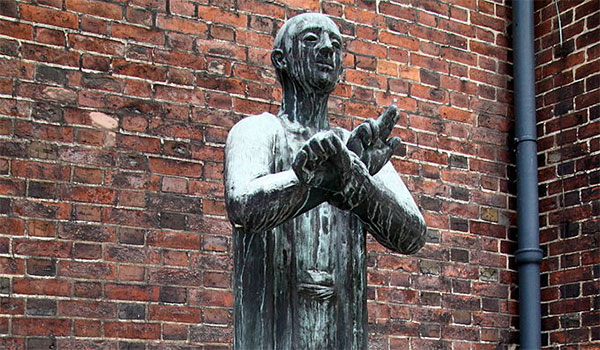
Sculpture of Dietrich Bonhoeffer by Fritz Fleer in front of St. Peter’s Church, Hamburg. Photo by David Meisel [CC BY-SA 4.0], via Wikimedia Commons

Religious nones and dones are some of the fastest growing groups in America. For those unfamiliar with the terms, “nones” are those who self identify as having no religion, including atheists, agnostics, and those who believe in God but reject particular religious traditions. “Dones” are formerly religious individuals, often people who were highly involved but became disillusioned and burned out.
Articles and conversations about the nones and dones from a religious perspective often have an undercurrent of panic as people try to understand why so many are leaving organized religion. Anxiety is a normal human response to change (especially when those changes expose our own hidden doubts). But there’s a better way to think about the future of religion. It’s found in Dietrich Bonhoeffer’s Letters and Papers from Prison.
Bonhoeffer was a German Lutheran theologian, one of just a handful who took a stand against the Third Reich and spoke up for the Jewish people. Although he was offered sanctuary in the U.S., Bonhoeffer believed that he needed to be present in Germany during the war to have any role in healing and rebuilding the nation when it was over. He was eventually imprisoned by the Nazi regime for avoiding military service (his interpretation of the gospels led him to being a pacifist)[1] and executed. His writing while in prison has been collected into book form. Put it on your reading list.
In April, 1944, Bonhoeffer wrote:
We are moving toward a completely religionless time; people as they are now simply cannot be religious anymore. Even those who honestly describe themselves as ‘religious’ do not in the least act up to it, and so they presumably mean something quite different by ‘religious’.
Letters and Papers from Prison, 279
Bonhoeffer was writing about the German Christians who failed to speak up against Hitler, but his words apply equally to Christians today who are more concerned with a political or religious agenda than they are with imitating Jesus in his radical stand with the marginalized and oppressed.[2] His letter continues:
Our whole nineteen-hundred-year-old Christian preaching and theology rest on the ‘religious a priori‘ of mankind. ‘Christianity’ has always been a form — perhaps the true form — of ‘religion’. But if one day it becomes clear that this a priori does not exist at all, but was a historically conditioned and transient form of human self-expression, and if therefore man becomes radically religionless — and I think that that is already more or less the case (else how is it, for example, that this war, in contrast to all previous ones, is not calling forth any ‘religious’ reaction?) — what does that mean for ‘Christianity’? It means that the foundation is taken away from the whole of what has up to now been our ‘Christianity’, and that there remain only a few ‘last survivors of the age of chivalry’, or a few intellectually dishonest people, on whom we can descend as ‘religious’. Are they to be the chosen few? Is it on this dubious group of people that we are to pounce in fervor, pique, or indignation, in order to sell them goods? Are we to fall upon a few unfortunate people in their hour of need and exercise a sort of religious compulsion on them? If we don’t want to do all that, if our final judgment must be that the western form of Christianity, too, was only a preliminary stage to a complete absence of religion, what kind of situation emerges for us, for the church? How can Christ become the Lord of the religionless as well? Are there religionless Christians? If religion is only a garment of Christianity — and even this garment has looked very different at different times — then what is a religionless Christianity?
Letters and Papers from Prison, 280
“It’s a relationship, not a religion” wasn’t a slogan yet when Bonhoeffer wrote these letters. If it had been, I’m sure he would have protested against it as adding to the problem. What Bonhoeffer was referring to, and what many nones and dones experience, is a Christianity that carries so much emotional and psychological baggage that it has become meaningless as a frame of reference. The world has been disenchanted, and it turns out religious language is unnecessary, like a shaman’s explanation of why aspirin works. Although language plays a role in shaping our understanding, what’s more important than the language used is the reality underneath the terminology. For Bonhoeffer, this religionless world is not something to be lamented, but an opportunity to be explored:
How do we speak of God — without religion, i.e. without the temporally conditioned presuppositions of metaphysics, inwardness, and so on? How do we speak (or perhaps we cannot now even ‘speak’ as we used to) in a ‘secular’ way about ‘God’? In what way are we ‘religionless-secular’ Christians, in what way are we the ἐκ-κλησία, those who are called forth, not regarding ourselves from a religious point of view as specially favoured, but rather as belonging wholly to the world? In that case Christ is no longer an object of religion, but something quite different, really the Lord of the world. But what does that mean? What is the place of worship and prayer in a religionless situation?
Letters and Papers from Prison, 280-281
I’ll continue to explore this topic in part 2 and part 3, but feel free to jump in with your thoughts. Is Bonhoeffer writing about the absurd, or is he on to something? How do you experience religion/religionlessness? What is the way forward?
———————–
- ^ Bonhoeffer was influenced by Gandhi and had plans to study under him but was prevented by the war. You can read Gandhi’s insightful thoughts on imitating Jesus here.
- ^ The U.S. was still segregated when Bonhoeffer lived there. He was greatly impressed by African American spirituality in the face of this injustice.
 About Russ Shumaker
Russ Shumaker is a writer/producer in Los Angeles. With an MA in theology and currently finishing an MBA, he provides spiritual mentoring and business/career coaching. He blogs at www.intersecting.weebly.com.
Previous Post
April 14, 2017
Finding Faith Again
Next Post

April 19, 2017 Nones, Dones and Religionless Christianity, Part 2
Browse Our Archives
Select a Category Book Reviews Christian History Christian Issues Christian Spirituality Current Events Fundamentalism Islam John Shore LGBT Movie Reviews Poetry Uncategorized
Select a Month October 2017 September 2017 August 2017 July 2017 June 2017 May 2017 April 2017 March 2017 February 2017 January 2017 December 2016 November 2016 October 2016 September 2016 August 2016 July 2016 June 2016 May 2016 April 2016 March 2016 February 2016 January 2016 December 2015 November 2015 October 2015 September 2015 August 2015 July 2015 June 2015 May 2015 April 2015 March 2015 February 2015 January 2015 December 2014 November 2014 October 2014 September 2014 August 2014 July 2014 June 2014 May 2014 April 2014 March 2014 February 2014 January 2014 December 2013 November 2013 October 2013 September 2013 August 2013 July 2013 June 2013
Follow Us!
TAKE THE
Religious Wisdom Quiz
Who cried at the tomb of Lazarus?
Select your answer to see how you score.
John Peter David Jesus
Related posts from Unfundamentalist Christians

Faith in the Fog: On Losing Beliefs and...

My Cancer Didn't Happen for a Reason

5 Things We'll Miss If We Take the...

No, Our Non-Profit Is Not a Ministry
TRENDING AT PATHEOS Progressive Christian

Why Christians Have a Sacred Duty to Vote:...
The Bible offers strong support for the sacred duty to vote. Here...

What Being a Modern-Day Apostle Means to Me
In my last column, I discussed the ins and outs of modern-day...

Did Ancient China Once Worship the God of...
Across human history, a common thread weaves through the origins of the...

Love Your Neighbor – Including Earth-Kin: Lev. 19,...
God’s command to love your neighbor means acting in an ethical and...

Lead a Church Study of “Jesus and Lao...
Guest writer Jack Thomas (The Irreverent Reverend) reflects on leading his church...

Principles for Understanding the Apostolic Ministry Today
Whenever people discover that my formal ministry title is "apostle," as in...
view all Progressive Christian blogs
Ad-Free & Subscriber Log-In Subscription Support
- About Us
- 2026 Calendar
- Videos
- Podcasts
- Library of World Religions
- Faith In Media Tracker
- Advertise With Us
- Write for Us
- Privacy Policy
- Terms of Service
- Do Not Sell My Data
- Contact Us
- Radiant Digital
- Manage Newsletter Subscriptions
- Unsubscribe From Notifications
- Sitemap
Copyright 2008-2026, Patheos. All rights reserved.
Subscription Support Ad-Free & Subscriber Log-In
Follow Patheos