
BuddhistCatholicContemplativeEvangelicalGeneral ChristianHinduJewishLatter-day SaintMuslimNew VisionsProgressive Christian
Beliefs
- Buddhist
- Catholic
- Contemplative
- Evangelical
- General Christian
- Hindu
- Jewish
- Latter-day Saint
- More Voices
- Muslim
- New Visions
- Pagan
- Progressive Christian
Topics
- Religion News
- Food and Religion
- Sports and Religion
- Religious Art
- Religious Music and Entertainment
- Religious Events
- History and Religion
- Style and Religion
- Politics and Religion
- Women in Religion
- Recreation Outdoors and Religion
- Business Finance and Religion
- Careers Workplace and Religion
- Education and Religion
- Family Parenting and Religion
- Health Fitness and Religion
- Home and Religion
- Relationships and Religion
- Technology and Religion
- Travel and Religion
Columnists
- Buddhist Columnists
- Business Finance and Religion Columnists
- Careers Workplace and Religion Columnists
- Catholic Columnists
- Contemplative Columnists
- Education and Religion Columnists
- Evangelists Columnists
- Family Parenting and Religion Columnists
- General Christian Columnists
- Health Fitness and Religion Columnists
- Hindu Columnists
- History and Religion Columnists
- Home and Religion Columnists
- Jewish Columnists
- More Voices Columnists
- Latter Day Columnists
- Muslim Columnists
- New Visions Columnists
- Nonreligious Columnists
- Pagan Columnists
- Politics and Religion Columnists
- Progressive Columnists
- Recreation Outdoors and Religion Columnists
- Relationships and Religion Columnists
- Religion News Columnists
- Religious Art Columnists
- Religious Events Columnists
- Religious Music and Entertainment Columnists
- Sports and Religion Columnists
- Style and Religion Columnists
- Technology and Religion Columnists
- Travel and Religion Columnists
- Women in Religion Columnists
Resource Library
- 2026 Calendar
- Library of World Religions
- The 100 Most Holy Places on Earth
- Patheos Answers
- Podcasts
- Videos
- Faith Leaders Database
- Anglican Episcopalian
- Bahai
- Baptist
- Buddhism
- Christianity
- Confucianism
- Eastern Orthodoxy
- Hinduism
- Holiness and Pentecostal
- ISKCON
- Islam
- Judaism
- Lutheran
- Methodist
- The Church of Jesus Christ of Latter-day Saints
- New Age
- Paganism
- Presbytarian and Reformed
- Protestantism
- Religion Behind the Scenes
- Roman Catholic
- Scientology
- Shia Islam
- Sikhism
- Sufism
- Sunni Islam
- Taoism
- Zen
- See all religions
Research Tools
 Ad-Free & Subscriber Log-In Subscription Support
Follow Patheos 

- Trending:
- Advent
- |
- Forgiveness
- |
- Thanksgiving
- |
- Election
- |
- Seasonal Holidays
- |
- Marriage
 Unfundamentalist Christians
- Home
- Progressive Christian
- “I Just Go by What the Bible Says” and Other Ridiculous Things Pastors Say
“I Just Go by What the Bible Says” and Other Ridiculous Things Pastors Say
Last updated on: July 28, 2017 at 9:27 am by Guest Contributor
“I Just Go by What the Bible Says” and Other Ridiculous Things Pastors Say 2017-07-28T09:27:05-06:00 Guest Contributor
Patheos Explore the world's faith through different perspectives on religion and spirituality! Patheos has the views of the prevalent religions and spiritualities of the world.
This guest post was written by Darrell Lackey.
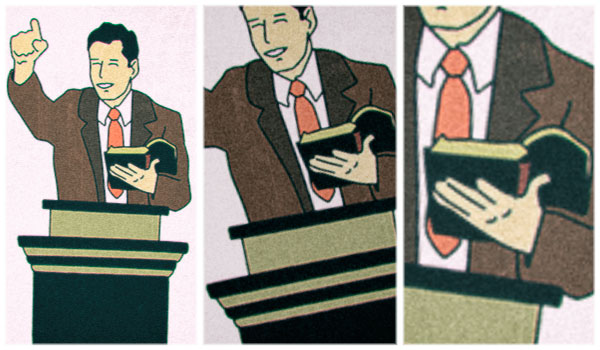
If you’ve spent any time in a fundamentalist or evangelical church, you’ve probably heard some variation of the following from the pastor or leaders: “I don’t preach my opinions, I just preach God’s word;” or, “I just want to know what the Bible says;” or, “I just believe what the Bible says;” or my favorite, “The Bible says it, I believe it, and that settles it.” You get the idea. And even if you haven’t heard these exact words, you’ve likely heard the similar sentiments. However, these assertions and the ideas they represent are entirely unhelpful and frankly ridiculous.
The primary idea informing the statements above is that we need to remove ourselves from our Bible reading. We need to stand outside the text, at a distance, so that we don’t taint our reading with our own personal subjective opinions and ideas. The Bible just means what it “says” or what is written. Simple. Just open it and read. What’s the problem? Wow–where to begin?
First, no one can step outside themselves and interpret any writing from a purely objective space. No such space exists. We are always persons in context. We exist in specific locations, whether culturally, geographically, philosophically, or theologically. We were and are shaped by a myriad of complex influences, many of which we are hardly even aware. We are the result of a long process of shaping and the influence of others. We are always “situated.” We bring all this to whatever it is we are reading (not just the Bible) and we interpret everything through the lens provided by that shaping. This isn’t to say that we are not our own persons, who make up our own minds, but it is to say we are still always doing this from some place, some context, some situated-ness.
If we are aware of this “being situated,” then we can read more cautiously and wisely because we are aware of our biases and prejudices. If we are not aware of our always being “situated,” however, it can mask those biases and prejudices. Therefore, many Christians read the Bible and what they “hear” only confirms (shocker!) what they already believe. This becomes a reinforcing echo chamber that confirms what we already thought (were taught) and prevents us from ever “hearing” anything in the Bible that would disrupt, deconstruct, or bring under judgment any prejudices or self-serving readings.
What this means is that no one is ever just going by “what the Bible says.” When someone tells us the Bible just “says what it says,” the natural rejoinder is: “But what does it say?” When someone tells us that a passage in the Bible just “means what it means” the natural rejoinder is “But what does it mean?” All those assertions (“I just go by what the Bible says”) are nonsense and question-begging. They are really meant to cut off discussion and prevent disagreement. They are often code for this sentiment: “You are no longer questioning my views or interpretations, you are really questioning God himself and what God has written.” How does one respond to that? Those types of statements come from a deep insecurity, fear, and the need to control others. They do not arise out of a real effort to humbly converse, to learn from, and engage another person in good faith.
Second, when we are reading, whether the Bible or any other text, we are always interpreting. There is no direct, one-to-one correspondence, between my reading and my assertion regarding what the text means, as if I had some inside line to the very mind of the writer. Unless the writer is literally and physically present to correct us or tell us exactly what they meant, we are always interpreting, which means there are layers to our reading. We are never just letting the Bible speak for itself–if that were the case there would be no need for sermons or teaching. The pastor or priest would simply stand, read the text, and sit down.
Let’s be clear about what is really happening when we hear the “I just go by what the Bible says” types of statements. What’s really being said is: “I just go by what I have been taught, by what others have thought or written about these passages, and all that is still further interpreted and understood through my own personal, cultural, educational, family, geographical, social background and history.”
Remember, the Bible doesn’t “say” anything until someone articulates what they think it is saying. The last time I checked, the Bible did not literally and audibly just start speaking in English to me as I read it. We are the readers. We must do the hard work of hermeneutics, of interpreting, which is both an art and science. Furthermore, we should always be aware that our interpretations could be wrong. We might completely miss what the author wanted us to hear or understand. Instead of claiming that we are speaking for God or just “going by what the Bible clearly teaches,” we need to be humble and admit that we are trying to interpret and understand as best we can–and that it is us who is speaking.
Why is this important? One need only look to the issue of slavery or the way women have been treated historically to point out how wrong the church has at times found itself when it comes to interpreting the Bible. Are there issues in our present day where the church could be making the same interpretive mistakes?
So, don’t be fooled when you hear pastors or church leaders claim, “We are just going by what the Bibles says” or that a passage “just means what it means–what it says.” Smile to yourself, and think: “Yeah, right, sure.” In the meantime, in private, you may want to respectfully challenge such thinking and ask those making such statements to reconsider how they talk about reading the Bible.
Image via Pixabay, edited by Dan Wilkinson.
 About Darrell Lackey
Darrell Lackey has been a lead pastor and currently manages a small law firm. He is active in his current church as a teacher and plays guitar with the worship team. He is a graduate of the University of San Francisco and Golden Gate Baptist Theological Seminary (now Gateway).
Previous Post

April 2, 2017
Dust
Next Post

April 5, 2017 Jesus, the Cathedral and Me
Browse Our Archives
Select a Category Book Reviews Christian History Christian Issues Christian Spirituality Current Events Fundamentalism Islam John Shore LGBT Movie Reviews Poetry Uncategorized
Select a Month October 2017 September 2017 August 2017 July 2017 June 2017 May 2017 April 2017 March 2017 February 2017 January 2017 December 2016 November 2016 October 2016 September 2016 August 2016 July 2016 June 2016 May 2016 April 2016 March 2016 February 2016 January 2016 December 2015 November 2015 October 2015 September 2015 August 2015 July 2015 June 2015 May 2015 April 2015 March 2015 February 2015 January 2015 December 2014 November 2014 October 2014 September 2014 August 2014 July 2014 June 2014 May 2014 April 2014 March 2014 February 2014 January 2014 December 2013 November 2013 October 2013 September 2013 August 2013 July 2013 June 2013
Follow Us!
TAKE THE
Religious Wisdom Quiz
According to 1 John, what commandment have we had from the beginning?
Select your answer to see how you score.
To believe in Jesus Christ To keep the Sabbath holy To love one another To forgive our enemies
Related posts from Unfundamentalist Christians
Bible Nation: The United States of Hobby Lobby

Faith in the Fog: On Losing Beliefs and...

My Cancer Didn't Happen for a Reason
TRENDING AT PATHEOS Progressive Christian

Can a Chatbot Touch Your Soul?
Can a chatbot offer genuine spiritual counsel? One conversation brought me to...

Religion and Politics: How Should We Then Live?
Two cultural axioms get repeated in polite company. Don't mix religion and...

7 Things We Get Wrong About Giving Thanks
It's a time of year when many of us turn to the...

Uncaging Truth: Spirituality Beyond Institutions
The Lost Connection: Why True Spirituality, Not Religion, Is the Key to...

Christ the King? Maybe We've Misunderstood the Crown
What do we mean when we say that Jesus is King? What...

Counter “Christ Is King” Nationalism with Christ THE...
Christ the King Sunday is an ideal time to address the heresy...
view all Progressive Christian blogs
Ad-Free & Subscriber Log-In Subscription Support
- About Us
- 2026 Calendar
- Videos
- Podcasts
- Library of World Religions
- Faith In Media Tracker
- Advertise With Us
- Write for Us
- Privacy Policy
- Terms of Service
- Do Not Sell My Data
- Contact Us
- Radiant Digital
- Manage Newsletter Subscriptions
- Unsubscribe From Notifications
- Sitemap
Copyright 2008-2026, Patheos, part of the Radiant Digital network of media brands. All rights reserved.
Subscription Support Ad-Free & Subscriber Log-In
Follow Patheos