
BuddhistCatholicContemplativeEvangelicalGeneral ChristianHinduJewishLatter-day SaintMuslimNew VisionsProgressive Christian
Beliefs
- Buddhist
- Catholic
- Contemplative
- Evangelical
- General Christian
- Hindu
- Jewish
- Latter-day Saint
- More Voices
- Muslim
- New Visions
- Pagan
- Progressive Christian
Topics
- Religion News
- Food and Religion
- Sports and Religion
- Religious Art
- Religious Music and Entertainment
- Religious Events
- History and Religion
- Style and Religion
- Politics and Religion
- Women in Religion
- Recreation Outdoors and Religion
- Business Finance and Religion
- Careers Workplace and Religion
- Education and Religion
- Family Parenting and Religion
- Health Fitness and Religion
- Home and Religion
- Relationships and Religion
- Technology and Religion
- Travel and Religion
Columnists
- Buddhist Columnists
- Business Finance and Religion Columnists
- Careers Workplace and Religion Columnists
- Catholic Columnists
- Contemplative Columnists
- Education and Religion Columnists
- Evangelists Columnists
- Family Parenting and Religion Columnists
- General Christian Columnists
- Health Fitness and Religion Columnists
- Hindu Columnists
- History and Religion Columnists
- Home and Religion Columnists
- Jewish Columnists
- More Voices Columnists
- Latter Day Columnists
- Muslim Columnists
- New Visions Columnists
- Nonreligious Columnists
- Pagan Columnists
- Politics and Religion Columnists
- Progressive Columnists
- Recreation Outdoors and Religion Columnists
- Relationships and Religion Columnists
- Religion News Columnists
- Religious Art Columnists
- Religious Events Columnists
- Religious Music and Entertainment Columnists
- Sports and Religion Columnists
- Style and Religion Columnists
- Technology and Religion Columnists
- Travel and Religion Columnists
- Women in Religion Columnists
Resource Library
- 2026 Calendar
- Library of World Religions
- The 100 Most Holy Places on Earth
- Patheos Answers
- Podcasts
- Videos
- Faith Leaders Database
- Anglican Episcopalian
- Bahai
- Baptist
- Buddhism
- Christianity
- Confucianism
- Eastern Orthodoxy
- Hinduism
- Holiness and Pentecostal
- ISKCON
- Islam
- Judaism
- Lutheran
- Methodist
- The Church of Jesus Christ of Latter-day Saints
- New Age
- Paganism
- Presbytarian and Reformed
- Protestantism
- Religion Behind the Scenes
- Roman Catholic
- Scientology
- Shia Islam
- Sikhism
- Sufism
- Sunni Islam
- Taoism
- Zen
- See all religions
Research Tools
 Ad-Free & Subscriber Log-In Subscription Support
Ad-Free & Subscriber Log-In Subscription Support
Follow Patheos 

- Trending:
- Forgiveness
- |
- Marriage
- |
- Consciousness
- |
- Death Penalty
- |
- Election
- |
- Halloween
 Unfundamentalist Christians
- Home
- Progressive Christian
- Innocence and Awareness: Questioning Original Sin
Innocence and Awareness: Questioning Original Sin
Last updated on: August 25, 2016 at 4:09 am by Guest Contributor
Innocence and Awareness: Questioning Original Sin 2016-08-24T18:39:04-06:00 Guest Contributor
Patheos Explore the world's faith through different perspectives on religion and spirituality! Patheos has the views of the prevalent religions and spiritualities of the world.
This guest post was written by Daniel Verona.
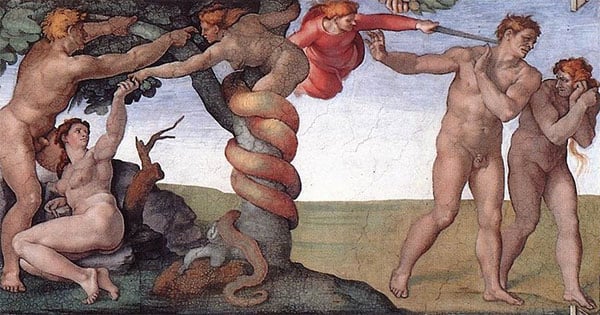
Detail from the Sistine Chapel by Michelangelo, via wikimedia.org
In the churches I grew up in, the story recounted in Genesis 3 was viewed as the moment when sin–Original Sin–entered humanity. In that story, a serpent persuades Eve to eat from the Tree of the Knowledge of Good and Evil. She does. And so does Adam. These events were called The Fall, a theological tragedy that resulted in our Sin Nature, severed our relationship with God, and created a need for a Savior who could save us from our sin and restore our relationship with God so that we would not burn in hell when we die.
This interpretation of Genesis 3 is common, but is it supported by the text? Here are 11 observations about the Genesis 3 story and its characters (because this one goes to 11):
- Traditionally, the serpent in this story is viewed as Satan or the Devil. But it is important to recognize that Genesis 3 never equates the serpent with Satan. There’s not even an implication that the two are the same.
- In the ancient world, serpents were common symbols of wisdom, rebirth, and eternal life. Is it surprising that a serpent shows up in Genesis 3? Is it surprising that this serpent is talking about not dying and being like God and knowing all things?
- Genesis 3 does not contain any Hebrew words that translate to “sin.” The first instance in the Bible of a Hebrew word that translates to “sin” is in Genesis 4 when God is speaking to Cain.
- The term “Tree of the Knowledge of Good and Evil” contains a merism. A merism is a rhetorical tool in which two contrasting terms are combined to refer to an entirety. In this case, the contrasting terms “good” and “evil” are combined to mean “everything.” The meaning of the term is thus “Tree of the Knowledge of Everything.”
- When Eve took the fruit, she wanted to gain wisdom. Is this a malicious or rebellious choice? It doesn’t appear that way in the text–it seems that Eve wants to be more like her Creator.
- When God comes looking for Adam and Eve after they eat, he does not seem angry with them. In their initial conversation, Adam and Eve act like embarrassed children who have been caught by their parent as they pass the blame around.
- God curses the serpent, not Adam and Eve.
- God tells the humans that their lives will now be more difficult because of what they have done.
- God creates coverings of skin for Adam and Eve. It seems that God realizes the shame that they feel in their nakedness and he moves towards them and provides them with coverings so that they do not need to feel their shame any longer.
- God says that Adam and Eve have become “like one of us in knowing good and evil.” (Another merism–this actually means “knowing all things.”)
- God says nothing about a severed relationship between divinity and humanity in this passage.
So, what should we make of these observations?
First, this isn’t a story about Original Sin. Eden is a symbol for innocence and harmony. The Tree of the Knowledge of Good and Evil is a literary device that conveys the idea of a gateway from innocence to awareness. When God (the parent character) tells Adam and Eve (the children characters) not to eat from the Tree, the original audience for this story would have known exactly what Adam and Eve would do. What do children immediately want to do when they are told not to do something? They want to do it!
Are parents surprised when their children disobey them? Of course not. Every parent knows that a child’s innocence cannot be maintained forever. And along with a child’s loss of innocence comes a greater awareness of difficulty and complexity in life. This understanding is echoed in Genesis 3.
Adam and Eve eat the fruit and become like God, knowing all things. Is this bad? God never says that it is. God tells Adam and Eve that their actions will result in greater difficulty in life, but isn’t that the natural progression of things? Isn’t that what happens when you move from innocence to awareness?
Awareness brings with it the ability to choose what kind of life to lead. I can choose negativity in the form of selfishness, jealousy, greed, materialism, pessimism, or violence. I can also choose to cultivate love, joy, peace, and patience. But which is easier?
Modern psychology is getting better at explaining our tendency towards the negative by revealing that human beings have an innate negativity bias. Is this why it’s easier to become resentful? Easier to feed on negative media than positive? Easier to tear things apart than it is to restore what was broken? If negativity is the standard way the mind operates, if Jesus teaches that the mind is the root of sin, and if Paul teaches that we can be transformed by renewing our mind, then I have to wonder if our supposed “sin nature” is really just an ancient way of saying “negativity bias.”
It’s time to move beyond the theological impositions that are commonly placed on the Genesis 3 story. Any talk about The Fall, Original Sin, Total Depravity, or a severed relationship with God is foreign to Genesis 3–that kind of language just isn’t there in the text. Instead, Genesis 3 is a reflection of the difficulty that the awareness of our negative tendencies brings. It asks us what we will do with that awareness–a challenge that we all must face as we progress through life.
 About Daniel Verona
Daniel Verona is a graduate student in biomedical engineering at Texas A&M University. When he is not busy doing literature review or data collection, he enjoys music production, snowboarding, long walks, and Indian food.

Next Post

September 1, 2016 Why I Left the Mormon Church (And You Probably Would Have, Too)
Browse Our Archives
Select a Category Book Reviews Christian History Christian Issues Christian Spirituality Current Events Fundamentalism Islam John Shore LGBT Movie Reviews Poetry Uncategorized
Select a Month October 2017 September 2017 August 2017 July 2017 June 2017 May 2017 April 2017 March 2017 February 2017 January 2017 December 2016 November 2016 October 2016 September 2016 August 2016 July 2016 June 2016 May 2016 April 2016 March 2016 February 2016 January 2016 December 2015 November 2015 October 2015 September 2015 August 2015 July 2015 June 2015 May 2015 April 2015 March 2015 February 2015 January 2015 December 2014 November 2014 October 2014 September 2014 August 2014 July 2014 June 2014 May 2014 April 2014 March 2014 February 2014 January 2014 December 2013 November 2013 October 2013 September 2013 August 2013 July 2013 June 2013
Follow Us!
TAKE THE
Religious Wisdom Quiz
What tree were Adam and Eve told not to eat from?
Select your answer to see how you score.
Fig Tree Tree of Knowledge of Good and Evil Tree of Life Olive Tree
Related posts from Unfundamentalist Christians

Faith in the Fog: On Losing Beliefs and...

My Cancer Didn't Happen for a Reason

5 Things We'll Miss If We Take the...

No, Our Non-Profit Is Not a Ministry
TRENDING AT PATHEOS Progressive Christian

What Being a Modern-Day Apostle Means to Me
In my last column, I discussed the ins and outs of modern-day...

Did Ancient China Once Worship the God of...
Across human history, a common thread weaves through the origins of the...

Love Your Neighbor – Including Earth-Kin: Lev. 19,...
God’s command to love your neighbor means acting in an ethical and...

Lead a Church Study of “Jesus and Lao...
Guest writer Jack Thomas (The Irreverent Reverend) reflects on leading his church...

Pastoral Wisdom for Responding to Sermon Pushback
Getting sermon pushback on your social justice sermon? Learn practical, Proverbs-based strategies...

Principles for Understanding the Apostolic Ministry Today
Whenever people discover that my formal ministry title is "apostle," as in...
view all Progressive Christian blogs
Ad-Free & Subscriber Log-In Subscription Support
- About Us
- 2026 Calendar
- Videos
- Podcasts
- Library of World Religions
- Faith In Media Tracker
- Advertise With Us
- Write for Us
- Privacy Policy
- Terms of Service
- Do Not Sell My Data
- Contact Us
- Radiant Digital
- Manage Newsletter Subscriptions
- Unsubscribe From Notifications
- Sitemap
Copyright 2008-2026, Patheos. All rights reserved.
Subscription Support Ad-Free & Subscriber Log-In
Follow Patheos