
BuddhistCatholicContemplativeEvangelicalGeneral ChristianHinduJewishLatter-day SaintMuslimNew VisionsProgressive Christian
Beliefs
- Buddhist
- Catholic
- Contemplative
- Evangelical
- General Christian
- Hindu
- Jewish
- Latter-day Saint
- More Voices
- Muslim
- New Visions
- Pagan
- Progressive Christian
Topics
- Religion News
- Food and Religion
- Sports and Religion
- Religious Art
- Religious Music and Entertainment
- Religious Events
- History and Religion
- Style and Religion
- Politics and Religion
- Women in Religion
- Recreation Outdoors and Religion
- Business Finance and Religion
- Careers Workplace and Religion
- Education and Religion
- Family Parenting and Religion
- Health Fitness and Religion
- Home and Religion
- Relationships and Religion
- Technology and Religion
- Travel and Religion
Columnists
- Buddhist Columnists
- Business Finance and Religion Columnists
- Careers Workplace and Religion Columnists
- Catholic Columnists
- Contemplative Columnists
- Education and Religion Columnists
- Evangelists Columnists
- Family Parenting and Religion Columnists
- General Christian Columnists
- Health Fitness and Religion Columnists
- Hindu Columnists
- History and Religion Columnists
- Home and Religion Columnists
- Jewish Columnists
- More Voices Columnists
- Latter Day Columnists
- Muslim Columnists
- New Visions Columnists
- Nonreligious Columnists
- Pagan Columnists
- Politics and Religion Columnists
- Progressive Columnists
- Recreation Outdoors and Religion Columnists
- Relationships and Religion Columnists
- Religion News Columnists
- Religious Art Columnists
- Religious Events Columnists
- Religious Music and Entertainment Columnists
- Sports and Religion Columnists
- Style and Religion Columnists
- Technology and Religion Columnists
- Travel and Religion Columnists
- Women in Religion Columnists
Resource Library
- 2026 Calendar
- Library of World Religions
- The 100 Most Holy Places on Earth
- Patheos Answers
- Podcasts
- Videos
- Faith Leaders Database
- Anglican Episcopalian
- Bahai
- Baptist
- Buddhism
- Christianity
- Confucianism
- Eastern Orthodoxy
- Hinduism
- Holiness and Pentecostal
- ISKCON
- Islam
- Judaism
- Lutheran
- Methodist
- The Church of Jesus Christ of Latter-day Saints
- New Age
- Paganism
- Presbytarian and Reformed
- Protestantism
- Religion Behind the Scenes
- Roman Catholic
- Scientology
- Shia Islam
- Sikhism
- Sufism
- Sunni Islam
- Taoism
- Zen
- See all religions
Research Tools
 Ad-Free & Subscriber Log-In Subscription Support
Ad-Free & Subscriber Log-In Subscription Support
Follow Patheos 

- Trending:
- Forgiveness
- |
- Marriage
- |
- Consciousness
- |
- Death Penalty
- |
- Election
- |
- Halloween
 Unfundamentalist Christians
- Home
- Progressive Christian
- A Close Encounter of the Ark Kind
A Close Encounter of the Ark Kind
Last updated on: July 26, 2016 at 8:41 am by Guest Contributor
A Close Encounter of the Ark Kind 2016-07-26T08:41:58-06:00 Guest Contributor
Patheos Explore the world's faith through different perspectives on religion and spirituality! Patheos has the views of the prevalent religions and spiritualities of the world.
This guest post was written by Alexis Misra.
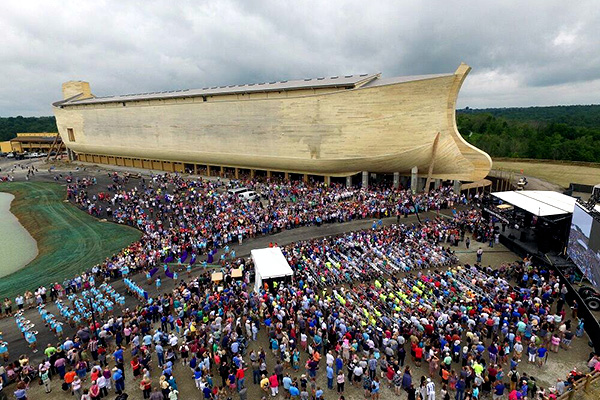
Ark Encounter ribbon cutting ceremony, July 5, 2016. Photo courtesy of Answers in Genesis.
Growing up, I loved the story of Noah’s Ark. I loved the underdog theme in which it was presented in Sunday school lessons and sermons: Noah and his family against the world, laughed at by the pagan masses—the terrible, bloodthirsty people who would soon get their comeuppance.
I pictured poor Noah, laboring day after day with his sons to build an ark to save his family, the chosen of God’s creation, from a cataclysmic flood that would wipe out all of civilization. I imagined the threats and the taunts he endured as he built this massive ship, how strong his faith was, and how good God was to spare such a righteous man and his family. They alone were holy, they alone were worthy of salvation. And after the heavens poured down God’s wrath in the form of rain, after the planet was flooded and the evil purged, God (so mercifully) promised to never again flood the earth and annihilate all of creation.
What a story.
I heard this story countless times throughout my childhood, and I even taught it in children’s Sunday school lessons and children’s church groups. But I never thought much about it. After all, the Bible did say that God was sad to destroy humanity. He didn’t want to do it, but it was necessary and He regretted creating humans in the first place. Man was corrupt, evil beyond repair, and only Noah and his family were salvageable. The rest were beyond repentance, beyond salvation, and the obvious choice for an all-powerful God was to completely destroy and condemn them to hell rather than use His all-powerful-ness to turn their hearts to Him.
It wasn’t until I was older that I really read the story—on my own, away from the storytelling aspect and away from the guidance of a sermon—and only then did something deeply unsettling begin to creep into my soul. I tried to rationalize why an all-powerful (yet all-loving) God would choose to destroy people in a very matter-of-fact way and tone.
People had free will, I told myself, and they chose to turn from God. Or at least chose to not seek Him. They deserved to die because of their sins, because the logical mindset of Christianity is that we all deserve to die because of our sins, right? So really, this wasn’t so bad. Nobody actually deserves to live, so God wasn’t doing anything wrong. He was totally justified in killing people and then sending their souls to hell, because we all deserve it. Somehow.
I began to avoid the Old Testament when discussing my faith, and above all I avoided Noah’s story. I do not believe that the story of Noah’s ark happened as depicted in the Bible, but even so, the story makes me almost nauseous. The staggering death toll that occurred according to the Bible was enough to make me, a certified skeptic, ill—so surely, hardcore inerrant-Bible-believing evangelicals would be doubly sickened by it, no? No. They’re not—quite the opposite, in fact. They have built a “world-class” (their words, not mine) attraction out of it.
The Ark Encounter, located in Kentucky, is the latest Christian tourist attraction, and is the brainchild of Ken Ham, the founder of Answers in Genesis and the Creation Museum. Part museum, part monument, the interactive, walk-through Ark was supposedly built to the specifications described in the book of Genesis. Evangelical Christians are praising it, and Ham, for “standing firm on the Word” (as I’ve seen commented on social media), and for depicting history as it “really” happened.
I have not visited it myself, nor do I plan to, but from the pictures I’ve seen it looks quite impressive. It seems extremely detailed, and thousands are flocking to Kentucky to visit it and live out a beloved Bible story. Protestors have argued that it was a waste of state money (allegedly, nearly 100 million dollars of public funds were poured into the attraction), but I argue against it from a completely different standpoint. If evangelicals believe this is a true story and that millions perished in the cruelest way, why is there rejoicing and not sorrow? Why is it treated as a tourist attraction rather than a memorial?
A literal interpretation of this story calls for sober observation, for humility, and for mourning on a greater scale than even the Holocaust. This is an entire planet wiped of life, ladies and gentlemen. In the Bible, God obliterated humanity, and that should be a heart-wrenching realization for evangelicals. It was a far greater horror than that committed by even Adolf Hitler, and building a monument commemorating this atrocity is like modern-day Germany proudly displaying a gas chamber.
As far as I know, the Ark Encounter never acknowledges this tragic loss of life. From what I’ve read and seen, there isn’t even a memorial garden, or a plaque: “We here recognize and mourn the millions lost in the greatest catastrophe to touch our planet as recorded in the Bible, where our God drowned all of civilization”—nothing.
I reached out to the Ark Encounter to ask if perhaps this was overlooked on social media, and maybe there is some sort of recognition for the lives lost in this story. After all, they believed this really happened, so surely they must somehow recognize and mourn the enormous death toll. I have not received a response.
The evangelical response to, and desire for, something like the Ark Encounter saddens me, and yet does not surprise me, just as the evangelical support for Donald Trump saddens me but does not surprise me. For a belief system that, according to Jesus, teaches loving your neighbor as yourself, far too many evangelicals seem far too excited about celebrating a story about the slaughter of an entire planet. I do not understand why no one else seems even slightly disturbed by the underlying point of the story of Noah’s ark. The point is not redemption or God’s promise–it’s that God killed off all living things, save for a handful of people and animals.
When I first heard about the Ark Encounter, I didn’t picture brave Noah building a safe haven for his family and the chosen animals of God. Instead of envisioning cute animals in an ark-like a petting zoo, I thought of desperate women beating down the doors of the ark, begging them to open and save their children’s lives. I imagined screaming babies as the heavens opened, and the elderly who were too weak to run to higher ground, and the desperation and horror that must have set in once it was realized that there was no higher ground. I imagined millions of innocent animals stampeding, and then simply trying to stay afloat. I imagined the desperation of the crowd depicted in the Bible as scoffers and evildoers, as people who had doubted but were deemed “too far gone” (a teaching later rejected in the Bible and Christianity—nobody is too far gone for God!) and now facing a fearsome death and tortuous afterlife.
It amazes me that this viewpoint will shock and anger many (possibly most) evangelicals, because now that I have moved further away from the filters once placed over my eyes in reading the Bible, I see how shocking and horrifying this story truly is. For those who believe that this is a literally true story, I would expect a far more somber tone. But when it comes to the Ark Encounter and the evangelical world’s response to it, such solemnity is nowhere to be found.
 About Alexis Misra
Alexis Misra is a registered nurse, wife, mom, writer, traveler, and ex-fundamentalist turned contemplative theist.
Previous Post

July 25, 2016
An Election Reflection: Why Politics Is Personal
Next Post

July 27, 2016 The Sermon of the Trump: Evangelical Catechesis
Browse Our Archives
Select a Category Book Reviews Christian History Christian Issues Christian Spirituality Current Events Fundamentalism Islam John Shore LGBT Movie Reviews Poetry Uncategorized
Select a Month October 2017 September 2017 August 2017 July 2017 June 2017 May 2017 April 2017 March 2017 February 2017 January 2017 December 2016 November 2016 October 2016 September 2016 August 2016 July 2016 June 2016 May 2016 April 2016 March 2016 February 2016 January 2016 December 2015 November 2015 October 2015 September 2015 August 2015 July 2015 June 2015 May 2015 April 2015 March 2015 February 2015 January 2015 December 2014 November 2014 October 2014 September 2014 August 2014 July 2014 June 2014 May 2014 April 2014 March 2014 February 2014 January 2014 December 2013 November 2013 October 2013 September 2013 August 2013 July 2013 June 2013
Follow Us!
TAKE THE
Religious Wisdom Quiz
“For I know the plans I have for you,” declares the Lord, “plans to prosper you and not to harm you, plans to give you ______ and a future.”
Select your answer to see how you score.
Life Hope Salvation Love
Related posts from Unfundamentalist Christians

Faith in the Fog: On Losing Beliefs and...

My Cancer Didn't Happen for a Reason

5 Things We'll Miss If We Take the...

No, Our Non-Profit Is Not a Ministry
TRENDING AT PATHEOS Progressive Christian

What Being a Modern-Day Apostle Means to Me
In my last column, I discussed the ins and outs of modern-day...

Did Ancient China Once Worship the God of...
Across human history, a common thread weaves through the origins of the...

Love Your Neighbor – Including Earth-Kin: Lev. 19,...
God’s command to love your neighbor means acting in an ethical and...

Lead a Church Study of “Jesus and Lao...
Guest writer Jack Thomas (The Irreverent Reverend) reflects on leading his church...

Pastoral Wisdom for Responding to Sermon Pushback
Getting sermon pushback on your social justice sermon? Learn practical, Proverbs-based strategies...

Principles for Understanding the Apostolic Ministry Today
Whenever people discover that my formal ministry title is "apostle," as in...
view all Progressive Christian blogs
Ad-Free & Subscriber Log-In Subscription Support
- About Us
- 2026 Calendar
- Videos
- Podcasts
- Library of World Religions
- Faith In Media Tracker
- Advertise With Us
- Write for Us
- Privacy Policy
- Terms of Service
- Do Not Sell My Data
- Contact Us
- Radiant Digital
- Manage Newsletter Subscriptions
- Unsubscribe From Notifications
- Sitemap
Copyright 2008-2026, Patheos. All rights reserved.
Subscription Support Ad-Free & Subscriber Log-In
Follow Patheos