
BuddhistCatholicContemplativeEvangelicalGeneral ChristianHinduJewishLatter-day SaintMuslimNew VisionsProgressive Christian
Beliefs
- Buddhist
- Catholic
- Contemplative
- Evangelical
- General Christian
- Hindu
- Jewish
- Latter-day Saint
- More Voices
- Muslim
- New Visions
- Pagan
- Progressive Christian
Topics
- Religion News
- Food and Religion
- Sports and Religion
- Religious Art
- Religious Music and Entertainment
- Religious Events
- History and Religion
- Style and Religion
- Politics and Religion
- Women in Religion
- Recreation Outdoors and Religion
- Business Finance and Religion
- Careers Workplace and Religion
- Education and Religion
- Family Parenting and Religion
- Health Fitness and Religion
- Home and Religion
- Relationships and Religion
- Technology and Religion
- Travel and Religion
Columnists
- Buddhist Columnists
- Business Finance and Religion Columnists
- Careers Workplace and Religion Columnists
- Catholic Columnists
- Contemplative Columnists
- Education and Religion Columnists
- Evangelists Columnists
- Family Parenting and Religion Columnists
- General Christian Columnists
- Health Fitness and Religion Columnists
- Hindu Columnists
- History and Religion Columnists
- Home and Religion Columnists
- Jewish Columnists
- More Voices Columnists
- Latter Day Columnists
- Muslim Columnists
- New Visions Columnists
- Nonreligious Columnists
- Pagan Columnists
- Politics and Religion Columnists
- Progressive Columnists
- Recreation Outdoors and Religion Columnists
- Relationships and Religion Columnists
- Religion News Columnists
- Religious Art Columnists
- Religious Events Columnists
- Religious Music and Entertainment Columnists
- Sports and Religion Columnists
- Style and Religion Columnists
- Technology and Religion Columnists
- Travel and Religion Columnists
- Women in Religion Columnists
Resource Library
- 2026 Calendar
- Library of World Religions
- The 100 Most Holy Places on Earth
- Patheos Answers
- Podcasts
- Videos
- Faith Leaders Database
- Anglican Episcopalian
- Bahai
- Baptist
- Buddhism
- Christianity
- Confucianism
- Eastern Orthodoxy
- Hinduism
- Holiness and Pentecostal
- ISKCON
- Islam
- Judaism
- Lutheran
- Methodist
- The Church of Jesus Christ of Latter-day Saints
- New Age
- Paganism
- Presbytarian and Reformed
- Protestantism
- Religion Behind the Scenes
- Roman Catholic
- Scientology
- Shia Islam
- Sikhism
- Sufism
- Sunni Islam
- Taoism
- Zen
- See all religions
Research Tools
 Ad-Free & Subscriber Log-In Subscription Support
Ad-Free & Subscriber Log-In Subscription Support
Follow Patheos 

- Trending:
- Forgiveness
- |
- Marriage
- |
- Consciousness
- |
- Death Penalty
- |
- Election
- |
- Halloween
 Unfundamentalist Christians
- Home
- Progressive Christian
- Why biblical inerrancy simply makes no sense
Why biblical inerrancy simply makes no sense
Last updated on: April 5, 2017 at 7:25 pm by Chuck Queen
Why biblical inerrancy simply makes no sense 2017-04-05T19:25:01-06:00 Chuck Queen
Patheos Explore the world's faith through different perspectives on religion and spirituality! Patheos has the views of the prevalent religions and spiritualities of the world.
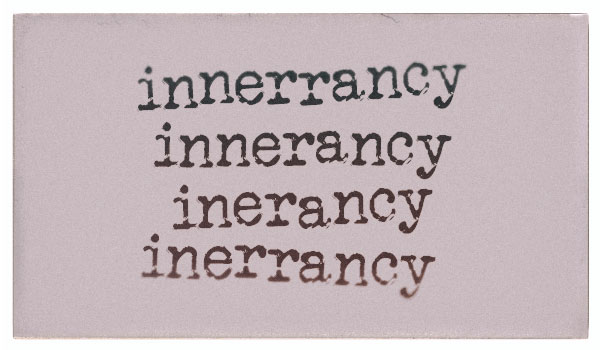
The reason biblical inerrancy simply makes no sense is this: It’s simply not true to human and universal reality.
Conservative Christians generally believe in a literal creation and fall, and because of the fall we are all sinners. Progressive Christians generally believe in some form of theistic evolution — that human beings and all forms of life have evolved, but God has been and continues to be engaged in the process in some way. Both camps offer myriads of variations and explanations to go with these two basic positions, but no one denies that human beings are flawed. We do not, of course, agree on how we became flawed, but we all readily admit that all life is flawed.
Conservatives emphasize original sin; progressives emphasize original blessing (which, by the way, is reason enough to compel anyone to be a progressive). But either way human beings are imperfect and flawed. The earthly creation is flawed. The universe is flawed. Jesus himself never claimed to be flawless. According to Mark’s Gospel Jesus was asked, “Good Teacher, what must I do to inherit eternal life?” Jesus replied, “Why do you call me good? No one is good but God alone?” (Mark 10:17-18). (It was later in the development of Christian doctrine that the institutional church attributed to Jesus sinlessness.) I suppose one could even argue that God, in light of universal flawed reality, is (I would say possibly, but not probably) flawed. (Process theologians believe God is evolving along with the universe). My point here is that there is nothing, with the exception of God himself/herself, in our known universe that is not flawed.
To posit an inerrant Bible written by flawed human beings makes no sense. That is not to say that the writers were not in some sense inspired. I suspect they were, though not all inspiration is good, helpful, constructive inspiration. The biblical writers responsible for the genocidal passages purporting that these whole-scale slaughters of men, women, and children were done in obedience to God’s command were certainly not writing under the inspiration of a good, loving Spirit. The very attempt to justify a divine decree to kill even one child, which of course, inerrantists must do, demonstrates the unreasonableness, futility, and abject blindness of belief in inerrancy. I know inerrantists will accuse me of insensitivity, arrogance, and a lack of understanding here, and that’s okay. I’m simply being honest, and honesty can cut deep. Whatever inspiration may or may not mean, and there are as many definitions and descriptions of inspiration as there are theologians who write on the subject, it most clearly does not mean or imply inerrancy.
As I often say, no one reading the Bible for the first time, unless he or she is told beforehand that the Bible is inerrant, would come to that conclusion on their own. Human imperfections are all over the pages of sacred scripture. The Bible didn’t just float down out of heaven on the wings of angels. Numerous and diverse genres of material were passed down orally, going through a number of changes and alterations, then written, edited, redacted, adapted, and collected through a very human process. Flawed human minds and hands were involved from beginning to end.
Can God use these human documents to form human character and create peace-seeking, just, grace-filled communities? Indeed! God has, is, and will continue to transform lives and communities through sacred scripture. Can the Devil (I am speaking metaphorically here) use these human documents to deform human character and to justify religious, national, and cultural exceptionalism, elitism, sexism, materialism, and racism? Indeed! The Devil has, is, and will continue to inspire evil actions in the name of God.
Every Christian group I know of that is known for its prejudice, condemnation, and its exclusionary practices believes in some form of biblical inerrancy. They read the Bible selectively to justify their harmful beliefs and actions. Evil done with God’s approval is the worst kind of evil, because one can do harm to others without any sense of guilt. Remember Saul of Tarsus. He considered himself “blameless” (Phil. 3:6).
Lest I distort the truth, let me remind my readers that there are many good, gracious people who believe in inerrancy. I have family members and friends who are biblical inerrantists. They believe what they believe because almost all of the people in their life whom they love and respect also believe in inerrancy. To not believe in inerrancy would put them at odds and outs with their whole support network. I suspect that is the greatest reason of all why many of my friends and family will not even entertain the notion that inerrancy may not be true. So they will continue to claim to believe that the whole Bible is the word of God, but then they will read and apply it selectively in ways that conform to the Christian culture they are enmeshed in. They will simply ignore all the bad and crazy stuff in scripture.
Another reason why some inerrantists will not even consider the possibility that they could be wrong relates more to psychology than theology. They equate giving up inerrancy with giving up their faith altogether. Of course, that would probably not be such a bad thing. Many who give up their faith in the interests of honesty and truth end up finding it again at some point along their journey, only the second time around it is much healthier, healing, and life-affirming.
The title of Peter Enns’ latest book, The Sin of Certainty, would suggest that having to have an inerrant Bible out of a need for certainty is a sin. I don’t know if it is or isn’t. I have enough sin in my life to keep me plenty occupied without trying to find it in others. But what I do know is that belief in biblical inerrancy simply makes no sense.
Image by Dan Wilkinson.
 Chuck Queen is a Baptist minister and the author of several books on progressive Christian faith, including his most recent, Being a Progressive Christian (is not) for Dummies (nor for know-it-alls): An Evolution of Faith. Chuck blogs at A Fresh Perspective, has contributed to the blog Faith Forward and is a monthly columnist for Baptist News Global.
Previous Post

April 25, 2016
The Holy Spirit is not a Male, Conservative Evangelical
Next Post

April 27, 2016 11 Bible Verses That Turn Christians Into Atheists
Browse Our Archives
Select a Category Book Reviews Christian History Christian Issues Christian Spirituality Current Events Fundamentalism Islam John Shore LGBT Movie Reviews Poetry Uncategorized
Select a Month October 2017 September 2017 August 2017 July 2017 June 2017 May 2017 April 2017 March 2017 February 2017 January 2017 December 2016 November 2016 October 2016 September 2016 August 2016 July 2016 June 2016 May 2016 April 2016 March 2016 February 2016 January 2016 December 2015 November 2015 October 2015 September 2015 August 2015 July 2015 June 2015 May 2015 April 2015 March 2015 February 2015 January 2015 December 2014 November 2014 October 2014 September 2014 August 2014 July 2014 June 2014 May 2014 April 2014 March 2014 February 2014 January 2014 December 2013 November 2013 October 2013 September 2013 August 2013 July 2013 June 2013
Follow Us!
TAKE THE
Religious Wisdom Quiz
I told my daughter-in-law to uncover a man's feet and lie down at the threshing floor. Who am I?
Select your answer to see how you score.
Bathsheba Naomi Ruth Rebekah
Related posts from Unfundamentalist Christians


Bible Nation: The United States of Hobby Lobby

Faith in the Fog: On Losing Beliefs and...

My Cancer Didn't Happen for a Reason
TRENDING AT PATHEOS Progressive Christian

Why Christians Have a Sacred Duty to Vote:...
The Bible offers strong support for the sacred duty to vote. Here...

What Being a Modern-Day Apostle Means to Me
In my last column, I discussed the ins and outs of modern-day...

Did Ancient China Once Worship the God of...
Across human history, a common thread weaves through the origins of the...

Love Your Neighbor – Including Earth-Kin: Lev. 19,...
God’s command to love your neighbor means acting in an ethical and...

Lead a Church Study of “Jesus and Lao...
Guest writer Jack Thomas (The Irreverent Reverend) reflects on leading his church...

Principles for Understanding the Apostolic Ministry Today
Whenever people discover that my formal ministry title is "apostle," as in...
view all Progressive Christian blogs
Ad-Free & Subscriber Log-In Subscription Support
- About Us
- 2026 Calendar
- Videos
- Podcasts
- Library of World Religions
- Faith In Media Tracker
- Advertise With Us
- Write for Us
- Privacy Policy
- Terms of Service
- Do Not Sell My Data
- Contact Us
- Radiant Digital
- Manage Newsletter Subscriptions
- Unsubscribe From Notifications
- Sitemap
Copyright 2008-2026, Patheos. All rights reserved.
Subscription Support Ad-Free & Subscriber Log-In
Follow Patheos