
BuddhistCatholicContemplativeEvangelicalGeneral ChristianHinduJewishLatter-day SaintMuslimNew VisionsProgressive Christian
Beliefs
- Buddhist
- Catholic
- Contemplative
- Evangelical
- General Christian
- Hindu
- Jewish
- Latter-day Saint
- More Voices
- Muslim
- New Visions
- Pagan
- Progressive Christian
Topics
- Religion News
- Food and Religion
- Sports and Religion
- Religious Art
- Religious Music and Entertainment
- Religious Events
- History and Religion
- Style and Religion
- Politics and Religion
- Women in Religion
- Recreation Outdoors and Religion
- Business Finance and Religion
- Careers Workplace and Religion
- Education and Religion
- Family Parenting and Religion
- Health Fitness and Religion
- Home and Religion
- Relationships and Religion
- Technology and Religion
- Travel and Religion
Columnists
- Buddhist Columnists
- Business Finance and Religion Columnists
- Careers Workplace and Religion Columnists
- Catholic Columnists
- Contemplative Columnists
- Education and Religion Columnists
- Evangelists Columnists
- Family Parenting and Religion Columnists
- General Christian Columnists
- Health Fitness and Religion Columnists
- Hindu Columnists
- History and Religion Columnists
- Home and Religion Columnists
- Jewish Columnists
- More Voices Columnists
- Latter Day Columnists
- Muslim Columnists
- New Visions Columnists
- Nonreligious Columnists
- Pagan Columnists
- Politics and Religion Columnists
- Progressive Columnists
- Recreation Outdoors and Religion Columnists
- Relationships and Religion Columnists
- Religion News Columnists
- Religious Art Columnists
- Religious Events Columnists
- Religious Music and Entertainment Columnists
- Sports and Religion Columnists
- Style and Religion Columnists
- Technology and Religion Columnists
- Travel and Religion Columnists
- Women in Religion Columnists
Resource Library
- 2026 Calendar
- Library of World Religions
- The 100 Most Holy Places on Earth
- Patheos Answers
- Podcasts
- Videos
- Faith Leaders Database
- Anglican Episcopalian
- Bahai
- Baptist
- Buddhism
- Christianity
- Confucianism
- Eastern Orthodoxy
- Hinduism
- Holiness and Pentecostal
- ISKCON
- Islam
- Judaism
- Lutheran
- Methodist
- The Church of Jesus Christ of Latter-day Saints
- New Age
- Paganism
- Presbytarian and Reformed
- Protestantism
- Religion Behind the Scenes
- Roman Catholic
- Scientology
- Shia Islam
- Sikhism
- Sufism
- Sunni Islam
- Taoism
- Zen
- See all religions
Research Tools
 Ad-Free & Subscriber Log-In Subscription Support
Ad-Free & Subscriber Log-In Subscription Support
Follow Patheos 

- Trending:
- Forgiveness
- |
- Marriage
- |
- Consciousness
- |
- Death Penalty
- |
- Election
- |
- Halloween
 Unfundamentalist Christians
- Home
- Progressive Christian
- Three Glorious Surprises in the Resurrection
Three Glorious Surprises in the Resurrection
Last updated on: March 21, 2016 at 4:00 am by Guest Contributor
Three Glorious Surprises in the Resurrection 2016-03-18T21:42:21-06:00 Guest Contributor
Patheos Explore the world's faith through different perspectives on religion and spirituality! Patheos has the views of the prevalent religions and spiritualities of the world.
This guest post was written by Josh Way.
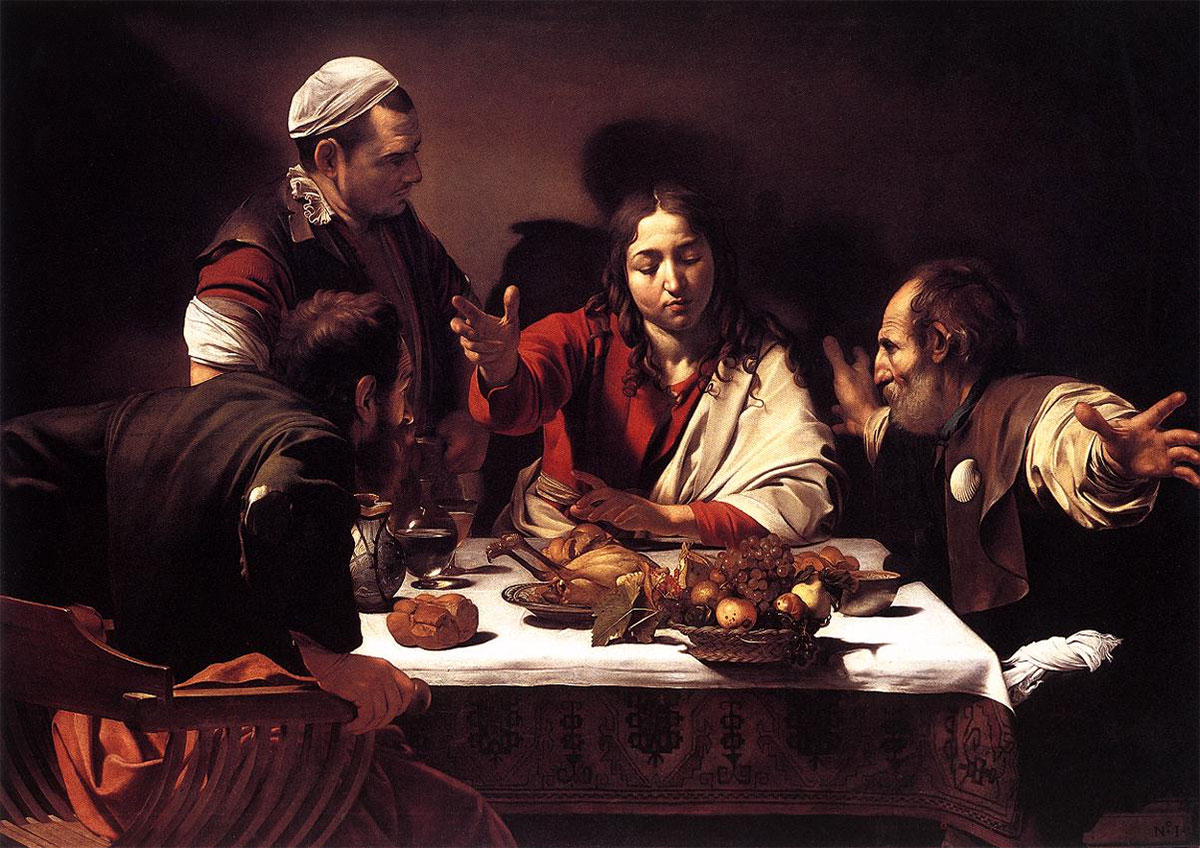
Caravaggio, “Supper at Emmaus,” 1601
The resurrection of Jesus is too often either co-opted for conservative Christian triumphalism or reduced to a magic trick that proves Jesus’s divinity. The actual accounts of the resurrection in the synoptic gospels are odd and beautiful and full of unexpected details. Here are three deeply significant aspects of these strange tales that might have been obscured by traditional readings of the Bible.
1. Jesus returns in peace, unexpectedly.
Clearly no one in the gospel stories expected Jesus to be resurrected. Even when Jesus made cryptic predictions about his death and vindication, his followers told him to stop talking crazy and asked when he was going to become king and kill all the bad guys. In its native Jewish context, the designation “messiah” had little to do with dying and coming back to life and everything to do with winning wars. After Jesus was executed, no one was looking at their watch wondering what was taking him so long. They were defeated and dejected. Their candidate was gone. The end.
And so when Jesus is resurrected, according to the synoptic gospels, it’s a surprise that completely blindsides his friends and followers. The shock and terror of the disciples is dramatized in the gospel texts, and we sympathize. Running into someone you watched die would be unsettling, to say the least. But once again, a deeper consideration of the historical and political background amplifies the drama. No one had ever imagined that a messianic candidate would die and be resurrected, but if that were to ever happen, surely the vindicated one would start the holy war to end all holy wars. With God clearly on his side, nothing could stop him. The disciples aren’t just scared because they think they’ve seen the ghost of a beloved friend, they’re staring at the risen body of the prophet they betrayed and abandoned. They must be thinking that judgment day is upon them.
But it wasn’t. Jesus announces “peace!” and tells them not to fear. The disciples (and innumerable Christian interpreters since) still want to know when the war will start, and Jesus smiles patiently and shakes his head.
2. Jesus returns as a stranger, quietly.
The resurrection narratives are diverse and sparse in detail, and they leave us asking many questions. In light of their ambiguity, however, continuities become more significant. For example, in every appearance story not a single person recognizes the risen Jesus on sight. From the final chapter of Matthew’s gospel to Paul’s vision in Acts, the resurrected Jesus is always encountered first as a stranger. This detail is easily overlooked, but its implications are staggering.
Quite in line with his expectation-defying career as a most unlikely messiah, Jesus is not portrayed as returning from the grave in public spectacle and revenge. His appearances are quiet and private, and his own friends don’t recognize him until they talk and eat with him. This Jesus is not the Jesus of triumphalism or culture war. This Jesus does not take over the world from an earthly seat of power, nor does he publicly shame those who don’t know him. He comes quietly alongside his followers and reveals himself in intimacy and friendship. An encounter with this Jesus is unexpected, a run-in with a stranger, a stranger who challenges us and changes everything forever.
3. Jesus returns to affirm life, not “afterlife.”
The synoptic post-resurrection tales are remarkably brief, given their centrality and theological weight. As a result, we have tended to fill them out with our own assumptions and infer our own meanings. For many, the whole point of Jesus’s resurrection is to prove that heaven is real, and that Jesus can take us there with him if we negotiate a ticket. A peek at the texts, however, reveals a different agenda.
In Matthew, Jesus instructs his followers to go and make “disciples” (students) of his teachings who will keep his “commandments.” In Mark, the risen Jesus instructs the twelve to spread his message and “baptize” new followers. In Luke, the most extensive of the narratives, Jesus reads scripture and eats with his followers, charging them with the task of being “witnesses” to his life and legacy. There is not a word about life after death or of his followers “going to heaven” when they die, but there is a clear mandate to proliferate his teachings. This includes his commandments to love God and neighbor, and his message of forgiveness and empathy.
Other texts may speculate about the nature of Jesus’s “appearing” at the “end of the age,” and of the fate of humanity and creation, but the gospel resurrection stories are clearly more concerned with the present. Here, Jesus’s legacy is first and foremost for this life, the one we’re living, for the well-being of his followers and of the whole world that God loves. This is the Risen Jesus we meet in the pages of the Bible and, hopefully, the one we seek to know in our lives.
 About Josh Way
Josh Way is a writer, cartoonist, seminary graduate, and web programmer. He lives in New York with his awesome wife Shereen and amazing little daughter Gloria. He blogs regularly at bible.joshway.com and podcasts at book.joshway.com.
Previous Post

March 18, 2016
In Our Bones: Holy Week Reflections

Browse Our Archives
Select a Category Book Reviews Christian History Christian Issues Christian Spirituality Current Events Fundamentalism Islam John Shore LGBT Movie Reviews Poetry Uncategorized
Select a Month October 2017 September 2017 August 2017 July 2017 June 2017 May 2017 April 2017 March 2017 February 2017 January 2017 December 2016 November 2016 October 2016 September 2016 August 2016 July 2016 June 2016 May 2016 April 2016 March 2016 February 2016 January 2016 December 2015 November 2015 October 2015 September 2015 August 2015 July 2015 June 2015 May 2015 April 2015 March 2015 February 2015 January 2015 December 2014 November 2014 October 2014 September 2014 August 2014 July 2014 June 2014 May 2014 April 2014 March 2014 February 2014 January 2014 December 2013 November 2013 October 2013 September 2013 August 2013 July 2013 June 2013
Follow Us!
TAKE THE
Religious Wisdom Quiz
What does the Bible say about greed?
Select your answer to see how you score.
It is best It helps you win It leads to ruin It is always wise
Related posts from Unfundamentalist Christians

Faith in the Fog: On Losing Beliefs and...

My Cancer Didn't Happen for a Reason

5 Things We'll Miss If We Take the...

No, Our Non-Profit Is Not a Ministry
TRENDING AT PATHEOS Progressive Christian

Why Christians Have a Sacred Duty to Vote:...
The Bible offers strong support for the sacred duty to vote. Here...

What Being a Modern-Day Apostle Means to Me
In my last column, I discussed the ins and outs of modern-day...

Did Ancient China Once Worship the God of...
Across human history, a common thread weaves through the origins of the...

Love Your Neighbor – Including Earth-Kin: Lev. 19,...
God’s command to love your neighbor means acting in an ethical and...

Lead a Church Study of “Jesus and Lao...
Guest writer Jack Thomas (The Irreverent Reverend) reflects on leading his church...

Principles for Understanding the Apostolic Ministry Today
Whenever people discover that my formal ministry title is "apostle," as in...
view all Progressive Christian blogs
Ad-Free & Subscriber Log-In Subscription Support
- About Us
- 2026 Calendar
- Videos
- Podcasts
- Library of World Religions
- Faith In Media Tracker
- Advertise With Us
- Write for Us
- Privacy Policy
- Terms of Service
- Do Not Sell My Data
- Contact Us
- Radiant Digital
- Manage Newsletter Subscriptions
- Unsubscribe From Notifications
- Sitemap
Copyright 2008-2026, Patheos. All rights reserved.
Subscription Support Ad-Free & Subscriber Log-In
Follow Patheos