
BuddhistCatholicContemplativeEvangelicalGeneral ChristianHinduJewishLatter-day SaintMuslimNew VisionsProgressive Christian
Beliefs
- Buddhist
- Catholic
- Contemplative
- Evangelical
- General Christian
- Hindu
- Jewish
- Latter-day Saint
- More Voices
- Muslim
- New Visions
- Pagan
- Progressive Christian
Topics
- Religion News
- Food and Religion
- Sports and Religion
- Religious Art
- Religious Music and Entertainment
- Religious Events
- History and Religion
- Style and Religion
- Politics and Religion
- Women in Religion
- Recreation Outdoors and Religion
- Business Finance and Religion
- Careers Workplace and Religion
- Education and Religion
- Family Parenting and Religion
- Health Fitness and Religion
- Home and Religion
- Relationships and Religion
- Technology and Religion
- Travel and Religion
Columnists
- Buddhist Columnists
- Business Finance and Religion Columnists
- Careers Workplace and Religion Columnists
- Catholic Columnists
- Contemplative Columnists
- Education and Religion Columnists
- Evangelists Columnists
- Family Parenting and Religion Columnists
- General Christian Columnists
- Health Fitness and Religion Columnists
- Hindu Columnists
- History and Religion Columnists
- Home and Religion Columnists
- Jewish Columnists
- More Voices Columnists
- Latter Day Columnists
- Muslim Columnists
- New Visions Columnists
- Nonreligious Columnists
- Pagan Columnists
- Politics and Religion Columnists
- Progressive Columnists
- Recreation Outdoors and Religion Columnists
- Relationships and Religion Columnists
- Religion News Columnists
- Religious Art Columnists
- Religious Events Columnists
- Religious Music and Entertainment Columnists
- Sports and Religion Columnists
- Style and Religion Columnists
- Technology and Religion Columnists
- Travel and Religion Columnists
- Women in Religion Columnists
Resource Library
- 2026 Calendar
- Library of World Religions
- The 100 Most Holy Places on Earth
- Patheos Answers
- Podcasts
- Videos
- Faith Leaders Database
- Anglican Episcopalian
- Bahai
- Baptist
- Buddhism
- Christianity
- Confucianism
- Eastern Orthodoxy
- Hinduism
- Holiness and Pentecostal
- ISKCON
- Islam
- Judaism
- Lutheran
- Methodist
- The Church of Jesus Christ of Latter-day Saints
- New Age
- Paganism
- Presbytarian and Reformed
- Protestantism
- Religion Behind the Scenes
- Roman Catholic
- Scientology
- Shia Islam
- Sikhism
- Sufism
- Sunni Islam
- Taoism
- Zen
- See all religions
Research Tools
 Ad-Free & Subscriber Log-In Subscription Support
Ad-Free & Subscriber Log-In Subscription Support
Follow Patheos 

- Trending:
- Forgiveness
- |
- Marriage
- |
- Consciousness
- |
- Death Penalty
- |
- Election
- |
- Halloween
 Unfundamentalist Christians
- Home
- Progressive Christian
- The Quest for the Historical Jesus: Part Four
The Quest for the Historical Jesus: Part Four
Last updated on: January 16, 2017 at 7:13 pm by Guest Contributor
The Quest for the Historical Jesus: Part Four 2017-01-16T19:13:30-06:00 Guest Contributor
Patheos Explore the world's faith through different perspectives on religion and spirituality! Patheos has the views of the prevalent religions and spiritualities of the world.
This five part series is written by Christian Chiakulas. Part one is here, part two is here, part three is here, part four is here, and part five is here.
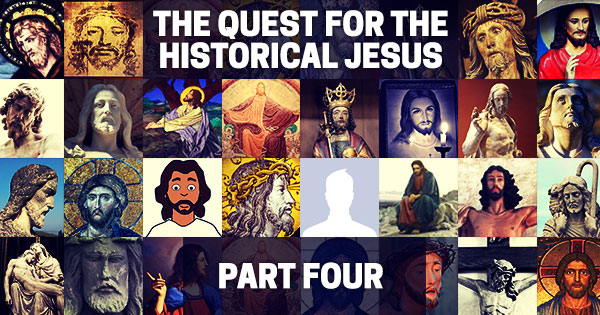
The term “Kingdom of God” and its related form in the Gospel of Matthew, “Kingdom of Heaven,” are at the very center of Jesus’s entire message. New Testament scholar John Reumann wrote: “Ask any hundred New Testament scholars around the world, Protestant, Catholic, or non-Christian, what the central message of Jesus was, and the vast majority of them – perhaps every single expert – would agree that his message centered in the kingdom of God.”
There are differing interpretations of what exactly this Kingdom looks like, but far more controversial is the method of the Kingdom – how and when it will arrive. This is where scholars are divided: at the eschatological views of Jesus.
Eschatology is theology regarding the end of the world. The traditional Christian view is that the world as we know it will end with the second coming of Jesus as told in Revelation. But Revelation was written many years after Jesus’s death. What were his own views?
The traditional model is commonly called “apocalyptic” or “imminent” eschatology. It was codified by Albert Schweitzer and remained the dominant view throughout the 20th century. The dissenting view is called “realized” or “participatory” eschatology, and was first developed by C.H. Dodd; it has found support mostly among more liberal scholars.
Before we discuss these two views of the Kingdom, it’s important to note one strong agreement between the two camps: the Kingdom Jesus spoke of was not about an afterlife, but about a transformed Earth. Consider the Lord’s prayer, found in both a short form in Luke and a longer, more familiar form in Matthew, thus making it from Q (this expansion of the prayer in Matthew, by the way, is an example of one reason most New Testament scholars accept the two-source theory that I discussed in part two of this series).
I won’t reproduce the entire text from Matthew 6:9-13, but Matthew 6:10 is particularly helpful regarding our understanding of the Kingdom: “Your Kingdom come, your will be done, on Earth as it is in Heaven.”
The Lord’s Prayer is thought by most scholars to be an authentic teaching of Jesus, if not in its exact wording, then certainly in its message. Because of this, we can conclude that Jesus believe that the Kingdom of God was a kingdom for the Earth.
Jesus’s use of the term “Kingdom” was no accident. Today we call the Roman political establishment an “Empire,” but at the time Rome billed itself as the “Kingdom of Rome.” Kingdom was an inherently political term, and the term “Kingdom of God” was chosen by Jesus to contrast with the “Kingdom of Rome.” The Kingdom was a world free from the yoke of foreign rule, a kind of Jewish Utopia where God was sovereign.
But we are still left with the question of how exactly this Kingdom was to manifest itself.
Apocalyptic eschatology means that God will intervene to bring His Kingdom to Earth, replacing the way of life of man (or of Rome) with his own. This is a familiar Messianic expectation: the appearance of God’s Messiah would be the catalyst to the coming of the Kingdom. Naturally, many of Jesus’s followers thought that he himself was the Messiah, and after his death postulated that he would soon be returning to finish the job he’d started.
This view is supported by the letters of Paul, who was sure that Jesus would return in his lifetime. John the Baptist also had an eschatological message, urging Jews to repent in time for the Kingdom to arrive. Remember that Jesus most likely began as a disciple of John; since both Jesus’s teacher and many of his successors believed in the imminent arrival of the Kingdom, it follows that he probably did as well.
Many Christians are uncomfortable with perspective, because it obviously means that Jesus was wrong, or at the very least, that most of his followers were. Various theological arguments have been employed to rectify this seeming error, but historically speaking, if Jesus believed that the Kingdom was imminent, he was wrong.
The alternative viewpoint, realized eschatology, is somewhat of a misnomer because it is not truly eschatological. Subscribers believe Jesus taught that the Kingdom of God was in some way present in his own ministry and deeds; that is, already on Earth and accessible to anyone who followed his way.
Geza Vermes argues powerfully in Jesus the Jew that none of the apocalyptic “Son of Man” sayings attributed to Jesus in the gospels can be reliably traced back to him, which would decisively undermine the argument for apocalyptic eschatology. Marcus Borg concurred in his essay A Temperate Case for a Non-Eschatological Jesus, citing several scholars who hold this position. Borg’s friend John Dominic Crossan has been considerably vocal in support of the non-eschatological view as well, and recently Reza Aslan’s Zealot made a similar case.
Though the apocalyptic position has merit, I personally find the non-eschatological model of Jesus more convincing. Both views have their strengths and weaknesses, and it is disagreements like this one that continue to make scholarship on the Historical Jesus so compelling.
In my final post in this series, I’ll offer some thoughts about the personal importance of the Quest for the Historical Jesus…
 About Christian Chiakulas
Christian Chiakulas is a writer and musician from Chicago. He studied writing at Columbia College and writes both fiction and nonfiction. Find him on Twitter and Facebook.
Previous Post

February 10, 2016
Preemptive Forgiveness (The first saying from the cross)
Next Post

February 12, 2016 The Quest for the Historical Jesus: Part Five
Browse Our Archives
Select a Category Book Reviews Christian History Christian Issues Christian Spirituality Current Events Fundamentalism Islam John Shore LGBT Movie Reviews Poetry Uncategorized
Select a Month October 2017 September 2017 August 2017 July 2017 June 2017 May 2017 April 2017 March 2017 February 2017 January 2017 December 2016 November 2016 October 2016 September 2016 August 2016 July 2016 June 2016 May 2016 April 2016 March 2016 February 2016 January 2016 December 2015 November 2015 October 2015 September 2015 August 2015 July 2015 June 2015 May 2015 April 2015 March 2015 February 2015 January 2015 December 2014 November 2014 October 2014 September 2014 August 2014 July 2014 June 2014 May 2014 April 2014 March 2014 February 2014 January 2014 December 2013 November 2013 October 2013 September 2013 August 2013 July 2013 June 2013
Follow Us!
TAKE THE
Religious Wisdom Quiz
In what city was Paul shipwrecked?
Select your answer to see how you score.
Cyprus Rhodes Crete Malta
Related posts from Unfundamentalist Christians
On Conservative Christians’ Sudden Devotion to Imperial Cult

Bullying Bishops and Castrated Christians: The Nashville Statement’s...

No, Our Non-Profit Is Not a Ministry

TRENDING AT PATHEOS Progressive Christian

What Being a Modern-Day Apostle Means to Me
In my last column, I discussed the ins and outs of modern-day...

Did Ancient China Once Worship the God of...
Across human history, a common thread weaves through the origins of the...

Love Your Neighbor – Including Earth-Kin: Lev. 19,...
God’s command to love your neighbor means acting in an ethical and...

Lead a Church Study of “Jesus and Lao...
Guest writer Jack Thomas (The Irreverent Reverend) reflects on leading his church...

Pastoral Wisdom for Responding to Sermon Pushback
Getting sermon pushback on your social justice sermon? Learn practical, Proverbs-based strategies...

Principles for Understanding the Apostolic Ministry Today
Whenever people discover that my formal ministry title is "apostle," as in...
view all Progressive Christian blogs
Ad-Free & Subscriber Log-In Subscription Support
- About Us
- 2026 Calendar
- Videos
- Podcasts
- Library of World Religions
- Faith In Media Tracker
- Advertise With Us
- Write for Us
- Privacy Policy
- Terms of Service
- Do Not Sell My Data
- Contact Us
- Radiant Digital
- Manage Newsletter Subscriptions
- Unsubscribe From Notifications
- Sitemap
Copyright 2008-2026, Patheos. All rights reserved.
Subscription Support Ad-Free & Subscriber Log-In
Follow Patheos