
BuddhistCatholicContemplativeEvangelicalGeneral ChristianHinduJewishLatter-day SaintMuslimNew VisionsProgressive Christian
Beliefs
- Buddhist
- Catholic
- Contemplative
- Evangelical
- General Christian
- Hindu
- Jewish
- Latter-day Saint
- More Voices
- Muslim
- New Visions
- Pagan
- Progressive Christian
Topics
- Religion News
- Food and Religion
- Sports and Religion
- Religious Art
- Religious Music and Entertainment
- Religious Events
- History and Religion
- Style and Religion
- Politics and Religion
- Women in Religion
- Recreation Outdoors and Religion
- Business Finance and Religion
- Careers Workplace and Religion
- Education and Religion
- Family Parenting and Religion
- Health Fitness and Religion
- Home and Religion
- Relationships and Religion
- Technology and Religion
- Travel and Religion
Columnists
- Buddhist Columnists
- Business Finance and Religion Columnists
- Careers Workplace and Religion Columnists
- Catholic Columnists
- Contemplative Columnists
- Education and Religion Columnists
- Evangelists Columnists
- Family Parenting and Religion Columnists
- General Christian Columnists
- Health Fitness and Religion Columnists
- Hindu Columnists
- History and Religion Columnists
- Home and Religion Columnists
- Jewish Columnists
- More Voices Columnists
- Latter Day Columnists
- Muslim Columnists
- New Visions Columnists
- Nonreligious Columnists
- Pagan Columnists
- Politics and Religion Columnists
- Progressive Columnists
- Recreation Outdoors and Religion Columnists
- Relationships and Religion Columnists
- Religion News Columnists
- Religious Art Columnists
- Religious Events Columnists
- Religious Music and Entertainment Columnists
- Sports and Religion Columnists
- Style and Religion Columnists
- Technology and Religion Columnists
- Travel and Religion Columnists
- Women in Religion Columnists
Resource Library
- 2026 Calendar
- Library of World Religions
- The 100 Most Holy Places on Earth
- Patheos Answers
- Podcasts
- Videos
- Faith Leaders Database
- Anglican Episcopalian
- Bahai
- Baptist
- Buddhism
- Christianity
- Confucianism
- Eastern Orthodoxy
- Hinduism
- Holiness and Pentecostal
- ISKCON
- Islam
- Judaism
- Lutheran
- Methodist
- The Church of Jesus Christ of Latter-day Saints
- New Age
- Paganism
- Presbytarian and Reformed
- Protestantism
- Religion Behind the Scenes
- Roman Catholic
- Scientology
- Shia Islam
- Sikhism
- Sufism
- Sunni Islam
- Taoism
- Zen
- See all religions
Research Tools
 Ad-Free & Subscriber Log-In Subscription Support
Ad-Free & Subscriber Log-In Subscription Support
Follow Patheos 

- Trending:
- Forgiveness
- |
- Marriage
- |
- Consciousness
- |
- Death Penalty
- |
- Election
- |
- Halloween
 Unfundamentalist Christians
- Home
- Progressive Christian
- The Jihad of Jesus
The Jihad of Jesus
Last updated on: February 23, 2016 at 4:00 am by Dan Wilkinson
The Jihad of Jesus 2016-02-22T18:59:38-06:00 Dan Wilkinson
Patheos Explore the world's faith through different perspectives on religion and spirituality! Patheos has the views of the prevalent religions and spiritualities of the world.
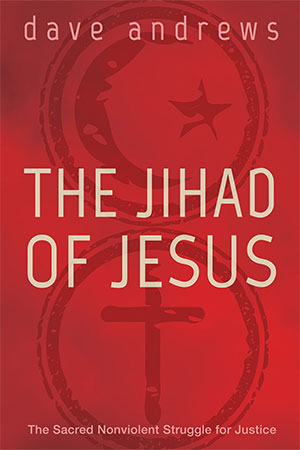 For many people, the word jihad is likely to conjure up images of bearded men wearing suicide vests, of black-robed militants brandishing AK-47s, or of clandestine terrorist cells plotting to overthrow the United States.
But what if, instead of representing violence, hate, war, and death, jihad was understood as a nonviolent struggle for peace, justice, understanding, and love?
In his book The Jihad of Jesus (Wipf & Stock, $22), Dave Andrews draws upon Christian and Muslim history, theology, tradition, and scripture in a quest to reclaim jihad as a powerful challenge for both Christians and Muslims “to practice the radical, alternative, participatory, empowering, nonviolent jihad of Jesus” (163).
Andrews readily acknowledges the checkered history of both these Abrahamic faiths, and offers a sobering and honest examination of the violence that has occurred in the name of Christ and Allah throughout history. This leads him to address an all-important question head-on:
“Are the atrocities that are done in the name of Christianity or Islam true indicators of the nature of Christianity or Islam, or not?” (53)
His answer to that question is one that he realizes many people will characterize as “heresy, even blasphemy” (71). Andrews believes that, yes, the cruelties perpetrated in the name of Christianity and Islam are not mere aberrations of inherently peaceful faiths, but instead are a natural out-working of the “closed set perspective” that currently defines those religions.
According to Andrews, “closed set” thinking entails a narrow and restrictive attitude toward religious belief that understands faith in terms of boundaries and differences. It is the perpetuation of this “mutually exclusive, inevitably conflictual, collision-bound bounded sets” (74) that leads to continual violence.
But though conflict and discord are currently woven into the fabric of Christianity and Islam, Andrews sees a way to move beyond our differences by embracing an “open set perspective of religion.” He writes:
“…we need to find another way of defining our faith that is not so defensive; another way of affirming our faith that is not so aggressive; a way of comprehending our faith that is true, but doesn’t pretend to have a monopoly on truth; and a way of interpreting our faith that is inclusive, not exclusive, of all that is good and healthy and holy and right in other cultures, traditions, and religions. And we can only do that, if we set aside a “closed set” perspective and embrace an “open set” perspective.” (75)
This “open set perspective” doesn’t ask the faithful to compromise their core beliefs, but does encourage us to focus on common ground, on shared perspectives, and on principles that allow us to work with each other toward common goals. In doing so, we can exchange the “not-so-holy” so-called “Holy Wars” for a nonviolent jihad that is characterized by a “whole-hearted strong-but-gentle struggle for justice against injustice” (103).
Andrews’ proposal for reclaiming jihad as a shared ideal of Muslims and Christians is grounded in the person of Jesus, as understood by both faiths. He views Jesus as the definitive exemplar of someone engaging in a nonviolent jihad for love and justice. Andrew shows how the principles of active and participatory nonviolent struggle espoused by Jesus have been realized in a variety of contexts, through the powerful examples of Francis of Assisi, Badshah Khan, Leyman Gbowee, and Muhammad Ashafa. In this respect, The Jihad of Jesus isn’t simply a reflection on our current fractured state of affairs, it is also a guidebook that proposes meaningful and practical foundations for true change.
As tensions between Muslims and Christians continue to escalate around the world, The Jihad of Jesus provides valuable context, insight, and clarity regarding interfaith relationships and serves as a clarion call to reconciliation and action.
Find out more about The Jihad of Jesus at at jihadofjesus.com and about Dave Andrews at daveandrews.com.au.
 Dan Wilkinson
Dan is the Executive Editor of the Unfundamentalist Christians blog. He is a writer, graphic designer and IT specialist. He lives in Montana, is married and has two cats.
Previous Post
February 22, 2016
Even Jesus fell short of perfect love

Browse Our Archives
Select a Category Book Reviews Christian History Christian Issues Christian Spirituality Current Events Fundamentalism Islam John Shore LGBT Movie Reviews Poetry Uncategorized
Select a Month October 2017 September 2017 August 2017 July 2017 June 2017 May 2017 April 2017 March 2017 February 2017 January 2017 December 2016 November 2016 October 2016 September 2016 August 2016 July 2016 June 2016 May 2016 April 2016 March 2016 February 2016 January 2016 December 2015 November 2015 October 2015 September 2015 August 2015 July 2015 June 2015 May 2015 April 2015 March 2015 February 2015 January 2015 December 2014 November 2014 October 2014 September 2014 August 2014 July 2014 June 2014 May 2014 April 2014 March 2014 February 2014 January 2014 December 2013 November 2013 October 2013 September 2013 August 2013 July 2013 June 2013
Follow Us!
TAKE THE
Religious Wisdom Quiz
What city is considered the holiest in Christianity?
Select your answer to see how you score.
Bethlehem Nazareth Jerusalem Rome
Related posts from Unfundamentalist Christians


Bible Nation: The United States of Hobby Lobby

What's So Confusing About Grace?

Can Christians Be Good Americans?
TRENDING AT PATHEOS Progressive Christian

Why Christians Have a Sacred Duty to Vote:...
The Bible offers strong support for the sacred duty to vote. Here...

What Being a Modern-Day Apostle Means to Me
In my last column, I discussed the ins and outs of modern-day...

Did Ancient China Once Worship the God of...
Across human history, a common thread weaves through the origins of the...

Love Your Neighbor – Including Earth-Kin: Lev. 19,...
God’s command to love your neighbor means acting in an ethical and...

Lead a Church Study of “Jesus and Lao...
Guest writer Jack Thomas (The Irreverent Reverend) reflects on leading his church...

Principles for Understanding the Apostolic Ministry Today
Whenever people discover that my formal ministry title is "apostle," as in...
view all Progressive Christian blogs
Ad-Free & Subscriber Log-In Subscription Support
- About Us
- 2026 Calendar
- Videos
- Podcasts
- Library of World Religions
- Faith In Media Tracker
- Advertise With Us
- Write for Us
- Privacy Policy
- Terms of Service
- Do Not Sell My Data
- Contact Us
- Radiant Digital
- Manage Newsletter Subscriptions
- Unsubscribe From Notifications
- Sitemap
Copyright 2008-2026, Patheos. All rights reserved.
Subscription Support Ad-Free & Subscriber Log-In
Follow Patheos