
BuddhistCatholicContemplativeEvangelicalGeneral ChristianHinduJewishLatter-day SaintMuslimNew VisionsProgressive Christian
Beliefs
- Buddhist
- Catholic
- Contemplative
- Evangelical
- General Christian
- Hindu
- Jewish
- Latter-day Saint
- More Voices
- Muslim
- New Visions
- Pagan
- Progressive Christian
Topics
- Religion News
- Food and Religion
- Sports and Religion
- Religious Art
- Religious Music and Entertainment
- Religious Events
- History and Religion
- Style and Religion
- Politics and Religion
- Women in Religion
- Recreation Outdoors and Religion
- Business Finance and Religion
- Careers Workplace and Religion
- Education and Religion
- Family Parenting and Religion
- Health Fitness and Religion
- Home and Religion
- Relationships and Religion
- Technology and Religion
- Travel and Religion
Columnists
- Buddhist Columnists
- Business Finance and Religion Columnists
- Careers Workplace and Religion Columnists
- Catholic Columnists
- Contemplative Columnists
- Education and Religion Columnists
- Evangelists Columnists
- Family Parenting and Religion Columnists
- General Christian Columnists
- Health Fitness and Religion Columnists
- Hindu Columnists
- History and Religion Columnists
- Home and Religion Columnists
- Jewish Columnists
- More Voices Columnists
- Latter Day Columnists
- Muslim Columnists
- New Visions Columnists
- Nonreligious Columnists
- Pagan Columnists
- Politics and Religion Columnists
- Progressive Columnists
- Recreation Outdoors and Religion Columnists
- Relationships and Religion Columnists
- Religion News Columnists
- Religious Art Columnists
- Religious Events Columnists
- Religious Music and Entertainment Columnists
- Sports and Religion Columnists
- Style and Religion Columnists
- Technology and Religion Columnists
- Travel and Religion Columnists
- Women in Religion Columnists
Resource Library
- 2026 Calendar
- Library of World Religions
- The 100 Most Holy Places on Earth
- Patheos Answers
- Podcasts
- Videos
- Faith Leaders Database
- Anglican Episcopalian
- Bahai
- Baptist
- Buddhism
- Christianity
- Confucianism
- Eastern Orthodoxy
- Hinduism
- Holiness and Pentecostal
- ISKCON
- Islam
- Judaism
- Lutheran
- Methodist
- The Church of Jesus Christ of Latter-day Saints
- New Age
- Paganism
- Presbytarian and Reformed
- Protestantism
- Religion Behind the Scenes
- Roman Catholic
- Scientology
- Shia Islam
- Sikhism
- Sufism
- Sunni Islam
- Taoism
- Zen
- See all religions
Research Tools
 Ad-Free & Subscriber Log-In Subscription Support
Ad-Free & Subscriber Log-In Subscription Support
Follow Patheos 

- Trending:
- Forgiveness
- |
- Marriage
- |
- Consciousness
- |
- Death Penalty
- |
- Election
- |
- Halloween
 Unfundamentalist Christians
- Home
- Progressive Christian
- Again: Raping Angels and Being Gay Are Not the Same Thing
Again: Raping Angels and Being Gay Are Not the Same Thing
Last updated on: June 2, 2015 at 10:33 am by Don M Burrows
Again: Raping Angels and Being Gay Are Not the Same Thing 2015-06-02T10:33:10-06:00 Don M Burrows
Patheos Explore the world's faith through different perspectives on religion and spirituality! Patheos has the views of the prevalent religions and spiritualities of the world.
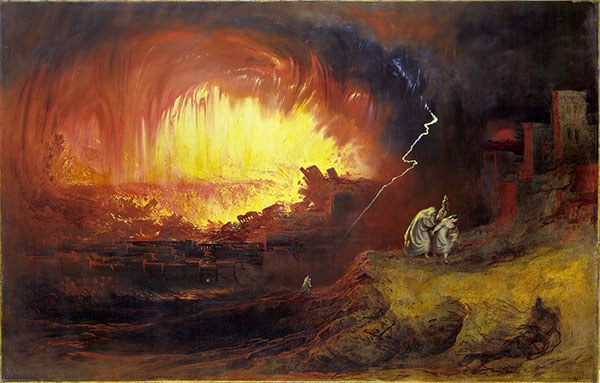
The Destruction Of Sodom And Gomorrah, John Martin, 1852, public domain

There is perhaps no more abused passage in the Bible for condemning gays and lesbians than the story of Sodom and Gomorrah. We’ve discussed other major anti-gay clobber passages on this blog multiple times, including the ambiguous Romans 1 with its mysterious interlocutor, and the equally perplexing 1 Corinthians 6:9 with its invented terms for sexuality.
But fundamentalists return time and again to the story of Sodom and Gomorrah, routinely dismissing the conclusions of informed critical analysis and instead presenting this text as a definitive warning of the impending destruction that awaits those who embrace the homosexual “lifestyle.”
They argue for this understanding despite the plain and literal definition of the sin of Sodom in Ezekiel 16:49:
This was the guilt of your sister Sodom: she and her daughters had pride, excess of food, and prosperous ease, but did not aid the poor and needy.
In light of Ezekiel’s explication, it should go without question that hostile, wandering townsfolk violating the ancient premise of xenia, or hospitality, by demanding to rape the guests in your home is in no way analogous to two men wanting to share a last name and a life-insurance policy — yet the absurdity persists.
It persists despite the fact that Lot, held up as Sodom’s model citizen, offers his daughters to the rapists and yet is still spared by the Lord.
It persists despite the fact that there are parallel hospitality myths from antiquity of gods who take the form of human travelers to test mortals, find their hospitality wanting, and then engage in mass destruction (such as the Greco-Roman myth of Baucis and Philemon).
It persists despite the fact that of course rape is not the same as any form of mutual sexual expression.
And it persists despite the facts that, though disguised, Lot’s guests were, in fact, angels, and that the ancient Christian-Jewish world had a documented anxiety about human-on-angel sexuality.
To support their interpretation of the story of Sodom and Gomorra, conservatives often quote the tiny (and really somewhat nasty) Epistle of Jude to suggest that their neo-traditional take on the cities’ destruction as punishment for homosexuality is “biblically correct.”
Whenever we post a meme from our Redefine Sodomy campaign on the Unfundamentalist Christians Facebook page, we usually get at least one comment “proving” us wrong by citing Jude. This perspective isn’t just confined to trollish Facebook comments: the American Family Association’s Bryan Fischer recently wrote that “Jude uses the verb form of porneia quite explicitly to refer to homosexuality when he connects the word to the behavior of Sodom and Gomorrah.”
But the truth of the matter is that the Epistle of Jude doesn’t support the misguided notion that the sin of Sodom and Gomorra was one of homosexuality. Let’s look at the passage that supposedly supports this argument, Jude 6-7:
And the angels who did not keep their own position, but left their proper dwelling, he has kept in eternal chains in deepest darkness for the judgement of the great day. Likewise, Sodom and Gomorrah and the surrounding cities, which, in the same manner as they, indulged in sexual immorality and pursued unnatural lust, serve as an example by undergoing a punishment of eternal fire.
Here we have angels who have left “their proper dwelling.” But what does that really mean? Many have assumed, because of the author’s preoccupation with the apocryphal 1 Enoch, that Jude is here referring to the Watchers, angels who came down from heaven and mingled with earth women:
It happened after the sons of men had multiplied in those days, that daughters were born to them, elegant and beautiful. And when the angels beheld them, they became enamored of them, saying to each other, “Come, let us select for ourselves wives from the progeny of men, and let us beget children.” (1 Enoch 7:1-2)
This makes sense when coupled with Jude’s remarks about Sodom and Gomorrah, whose inhabitants were said to “in the same manner” pursue “unnatural lust.”
But what exactly is this “unnatural lust”? In the Greek it seems clear that it was the Sodomites’ desire to have sex with angels,. The text states that they literally desired “other flesh,” or sarkos heteras (σαρκὸς ἑτέρας), which quite literally suggests non-human, angel flesh, which he clearly deems immoral and transgressing.
It’s in this context that we must understand the “sexual immorality” mentioned in tandem (ekporneusasai, ἐκπορνεύσασαι). Fisher may want porneia and its various forms to refer specifically to homosexuality, but in fact it’s a broad term whose only specificity, if any still exists at all by this period, would be to prostitution. Here, however, the author’s emphasis on the sameness of the two sins (ton homoion tropon, τὸν ὅμοιον τρόπον), coupled with his description of “other flesh,” makes it clear he’s concerned with angel-human copulation.
Those who claim that Jude supports the idea that the destruction of Sodom and Gomorah was because of human homosexuality are essentially arguing that same-sex people having sex is just like angels preying on human women or human men trying to rape angelic visitors, a position that, given the textual, historical and cultural evidence, makes no sense at all.
Instead of twisting the words of the Bible to advance hate and homophobia, fundamentalist Christians would be wise to heed what the Bible actually says about the tragic consequences of continuing to ignore and perpetuate the true sin of Sodom:
Then he will say to those at his left hand, ‘You that are accursed, depart from me into the eternal fire prepared for the devil and his angels; for I was hungry and you gave me no food, I was thirsty and you gave me nothing to drink, I was a stranger and you did not welcome me, naked and you did not give me clothing, sick and in prison and you did not visit me.’ Then they also will answer, ‘Lord, when was it that we saw you hungry or thirsty or a stranger or naked or sick or in prison, and did not take care of you?’ Then he will answer them, ‘Truly I tell you, just as you did not do it to one of the least of these, you did not do it to me.’ And these will go away into eternal punishment, but the righteous into eternal life. (Matthew 25:41-46)
 About Don M. Burrows
Don M. Burrows is a former journalist and current college preparatory school teacher. Don holds a Ph.D. in Classical Studies from the University of Minnesota. A former Christian fundamentalist, Don is now a member of the United Church of Christ and contends most firmly that the Bible cannot be read or explored without appreciating its ancient, historical context. Don lives in Minneapolis with his wife and two young children. Don blogs at Nota Bene and can also be found on Facebook.
Previous Post

May 31, 2015
Welcome Dan Wilkinson, UC's new editor
Next Post

June 4, 2015 Being Born Again in Unfundamentalist Fashion
Browse Our Archives
Select a Category Book Reviews Christian History Christian Issues Christian Spirituality Current Events Fundamentalism Islam John Shore LGBT Movie Reviews Poetry Uncategorized
Select a Month October 2017 September 2017 August 2017 July 2017 June 2017 May 2017 April 2017 March 2017 February 2017 January 2017 December 2016 November 2016 October 2016 September 2016 August 2016 July 2016 June 2016 May 2016 April 2016 March 2016 February 2016 January 2016 December 2015 November 2015 October 2015 September 2015 August 2015 July 2015 June 2015 May 2015 April 2015 March 2015 February 2015 January 2015 December 2014 November 2014 October 2014 September 2014 August 2014 July 2014 June 2014 May 2014 April 2014 March 2014 February 2014 January 2014 December 2013 November 2013 October 2013 September 2013 August 2013 July 2013 June 2013
Follow Us!
TAKE THE
Religious Wisdom Quiz
According to Ecclesiastes 12, what happens to the human spirit when a person dies?
Select your answer to see how you score.
It ceases to exist It returns to God It remains on earth It is reincarnated
Related posts from Unfundamentalist Christians

Faith in the Fog: On Losing Beliefs and...

My Cancer Didn't Happen for a Reason

5 Things We'll Miss If We Take the...

No, Our Non-Profit Is Not a Ministry
TRENDING AT PATHEOS Progressive Christian

Why Christians Have a Sacred Duty to Vote:...
The Bible offers strong support for the sacred duty to vote. Here...

What Being a Modern-Day Apostle Means to Me
In my last column, I discussed the ins and outs of modern-day...

Did Ancient China Once Worship the God of...
Across human history, a common thread weaves through the origins of the...

Love Your Neighbor – Including Earth-Kin: Lev. 19,...
God’s command to love your neighbor means acting in an ethical and...

Lead a Church Study of “Jesus and Lao...
Guest writer Jack Thomas (The Irreverent Reverend) reflects on leading his church...

Principles for Understanding the Apostolic Ministry Today
Whenever people discover that my formal ministry title is "apostle," as in...
view all Progressive Christian blogs
Ad-Free & Subscriber Log-In Subscription Support
- About Us
- 2026 Calendar
- Videos
- Podcasts
- Library of World Religions
- Faith In Media Tracker
- Advertise With Us
- Write for Us
- Privacy Policy
- Terms of Service
- Do Not Sell My Data
- Contact Us
- Radiant Digital
- Manage Newsletter Subscriptions
- Unsubscribe From Notifications
- Sitemap
Copyright 2008-2026, Patheos. All rights reserved.
Subscription Support Ad-Free & Subscriber Log-In
Follow Patheos