
BuddhistCatholicContemplativeEvangelicalGeneral ChristianHinduJewishLatter-day SaintMuslimNew VisionsProgressive Christian
Beliefs
- Buddhist
- Catholic
- Contemplative
- Evangelical
- General Christian
- Hindu
- Jewish
- Latter-day Saint
- More Voices
- Muslim
- New Visions
- Pagan
- Progressive Christian
Topics
- Religion News
- Food and Religion
- Sports and Religion
- Religious Art
- Religious Music and Entertainment
- Religious Events
- History and Religion
- Style and Religion
- Politics and Religion
- Women in Religion
- Recreation Outdoors and Religion
- Business Finance and Religion
- Careers Workplace and Religion
- Education and Religion
- Family Parenting and Religion
- Health Fitness and Religion
- Home and Religion
- Relationships and Religion
- Technology and Religion
- Travel and Religion
Columnists
- Buddhist Columnists
- Business Finance and Religion Columnists
- Careers Workplace and Religion Columnists
- Catholic Columnists
- Contemplative Columnists
- Education and Religion Columnists
- Evangelists Columnists
- Family Parenting and Religion Columnists
- General Christian Columnists
- Health Fitness and Religion Columnists
- Hindu Columnists
- History and Religion Columnists
- Home and Religion Columnists
- Jewish Columnists
- More Voices Columnists
- Latter Day Columnists
- Muslim Columnists
- New Visions Columnists
- Nonreligious Columnists
- Pagan Columnists
- Politics and Religion Columnists
- Progressive Columnists
- Recreation Outdoors and Religion Columnists
- Relationships and Religion Columnists
- Religion News Columnists
- Religious Art Columnists
- Religious Events Columnists
- Religious Music and Entertainment Columnists
- Sports and Religion Columnists
- Style and Religion Columnists
- Technology and Religion Columnists
- Travel and Religion Columnists
- Women in Religion Columnists
Resource Library
- 2026 Calendar
- Library of World Religions
- The 100 Most Holy Places on Earth
- Patheos Answers
- Podcasts
- Videos
- Faith Leaders Database
- Anglican Episcopalian
- Bahai
- Baptist
- Buddhism
- Christianity
- Confucianism
- Eastern Orthodoxy
- Hinduism
- Holiness and Pentecostal
- ISKCON
- Islam
- Judaism
- Lutheran
- Methodist
- The Church of Jesus Christ of Latter-day Saints
- New Age
- Paganism
- Presbytarian and Reformed
- Protestantism
- Religion Behind the Scenes
- Roman Catholic
- Scientology
- Shia Islam
- Sikhism
- Sufism
- Sunni Islam
- Taoism
- Zen
- See all religions
Research Tools
 Ad-Free & Subscriber Log-In Subscription Support
Ad-Free & Subscriber Log-In Subscription Support
Follow Patheos 

- Trending:
- Forgiveness
- |
- Marriage
- |
- Consciousness
- |
- Death Penalty
- |
- Election
- |
- Halloween
 Unfundamentalist Christians
- Home
- Progressive Christian
- Does “The Moral Arc” bend towards truth and justice?
Does “The Moral Arc” bend towards truth and justice?
Last updated on: July 14, 2017 at 8:37 am by Dan Wilkinson
Does “The Moral Arc” bend towards truth and justice? 2017-07-14T08:37:07-06:00 Dan Wilkinson
Patheos Explore the world's faith through different perspectives on religion and spirituality! Patheos has the views of the prevalent religions and spiritualities of the world.
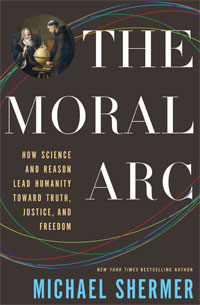
Michael Shermer is an optimist. The outspoken skeptic and author of the new book, The Moral Arc: How Science and Reason Lead Humanity toward Truth, Justice, and Freedom (Henry Holt, $32), sees humanity – and indeed all of life – as progressing on a steady and incremental trek toward a better moral, social, political, technological and economic existence.
Shermer acknowledges the many challenges to his optimism: our history is plagued by violence, hatred, ignorance, superstition and oppression. But through his hefty and ambitious volume, Shermer argues that the only reliable way to conquer such evils is through science and reason. For Shermer, the Scientific Revolution and the dawning of the Age of Reason and Enlightenment stand as the pivotal moments in all of history: these are the events that have catapulted us forward toward an ever brighter future. It is only through the “scientific understanding of the causes of evil and the rational application of the political, economic, and legal forces” that we are able to “bend that arc ever upward.”
According to Shermer, the greatest threat to science and free inquiry are authority and dogmatism, and these negative forces are primarily manifested in religion, most significantly in the form of Christianity. He argues that religion’s tribalistic and xenophobic roots establish it as inherently opposed to true moral progress, and that we must free ourselves from these limitations:
Never again should we allow ourselves to be the intellectual slaves of those who would bind our minds with the chains of dogma and authority. In its stead we use reason and science as the arbiters of truth and knowledge.
Shermer devotes a significant section of his book to documenting these negative aspects of Christian belief, labeling the Bible as “one of the most immoral works in all literature” and taking Jesus to task for failing to overturn the moral shortcomings of the Old Testament.
He deconstructs the Ten Commandments and offers up his own “provisional rational Decalogue” that he summarizes as an attempt “to expand the moral sphere and to push the arc of the moral universe just a bit farther toward truth, justice, and freedom for more sentient beings in more places more of the time.”
It is certainly true that secular values have been powerful forces against slavery and racism, and have effectively championed women’s and LGBT rights – and that Christians all too often have found themselves on the wrong side of these issues. Shermer is hard on Christians, but it’s tough to argue that he’s unfair to us. His challenges are ones that Christians need to pay attention to, that we need to wrestle with and not simply brush aside as irrelevant or misinformed.
Though Shermer spends much time decrying forces that have opposed science and reason, his ultimate goal is to show that
the arc of the moral universe bends not merely toward justice, but also toward truth and freedom, and that these positive outcomes have largely been the product of societies moving toward more secular forms of governance and politics, law and jurisprudence, moral reasoning and ethical analysis.
Does he succeed in defending that thesis?
As a pessimist, I have a difficult time accepting Shermer’s conclusions. Though humans have shown themselves to be startlingly resilient, and though we have made great advances in certain fields, we clearly have an alarming proclivity for screwing things up.
Shermer’s virtually unbridled optimism brings to mind pre-First World War naïveté as described by historian G.P. Gooch:
I grew to manhood in an age of sensational progress and limitless self-confidence. Civilization was spreading across the earth with giant strides; science was tossing us miracle after miracle; wealth was accumulating at a pace undreamed of in earlier generations; the amenities of life were being brought within the range of an ever greater number of our fellow-creatures … There was a robust conviction that we were on the right track: that man was a teachable animal who would work out his salvation if given his chance; that the nations were on the march toward a larger freedom and a fuller humanity; that difficulties could be taken in their stride … We realize today that we were living in a fool’s paradise …
–G.P. Gooch, “The Lessons of 1914-1918,” Current History, August 1934
We’re only 100 years removed from a war that, for Gooch and many others, shattered the myth of human progress. And those subsequent years ushered in a Second World War, a Cold War and countless other conflicts and atrocities. It takes a generous dose of hubris and a thick pair of rose colored glasses to downplay our recent history.
And, contra Shermer, our future also holds a sobering outlook. There are good reasons that the Bulletin of the Atomic Scientists recently nudged their Doomsday Clock two minutes closer to midnight, stating:
In 2015, unchecked climate change, global nuclear weapons modernizations, and outsized nuclear weapons arsenals pose extraordinary and undeniable threats to the continued existence of humanity, and world leaders have failed to act with the speed or on the scale required to protect citizens from potential catastrophe. These failures of political leadership endanger every person on Earth.
I hope that Shermer is right, and that such dire warnings never become catastrophic realities. I hope that we will continue to move forward, albeit in fits and starts, reaching ever greater heights of human achievement, riding a moral arc towards ever greater peace and well-being.
Only time will tell which understanding of our world is the right one. But in the meantime, I wholeheartedly agree with Shermer that it’s incumbent upon all of us, regardless of our religious faith or lack thereof, to embrace science and reason, to eschew dogmatism and oppressive authority, and to fight for freedom and justice.
 Dan Wilkinson
Dan is the Executive Editor of the Unfundamentalist Christians blog. He is a writer, graphic designer and IT specialist. He lives in Montana, is married and cares for several cats.
Previous Post

January 24, 2015
Must "American Sniper" Chris Kyle be seen as immoral?
Next Post

January 29, 2015 No comment
Browse Our Archives
Select a Category Book Reviews Christian History Christian Issues Christian Spirituality Current Events Fundamentalism Islam John Shore LGBT Movie Reviews Poetry Uncategorized
Select a Month October 2017 September 2017 August 2017 July 2017 June 2017 May 2017 April 2017 March 2017 February 2017 January 2017 December 2016 November 2016 October 2016 September 2016 August 2016 July 2016 June 2016 May 2016 April 2016 March 2016 February 2016 January 2016 December 2015 November 2015 October 2015 September 2015 August 2015 July 2015 June 2015 May 2015 April 2015 March 2015 February 2015 January 2015 December 2014 November 2014 October 2014 September 2014 August 2014 July 2014 June 2014 May 2014 April 2014 March 2014 February 2014 January 2014 December 2013 November 2013 October 2013 September 2013 August 2013 July 2013 June 2013
Follow Us!
TAKE THE
Religious Wisdom Quiz
What does "Pentecost" mean?
Select your answer to see how you score.
Fiftieth Firstfruits Twelve Forty
Related posts from Unfundamentalist Christians


Bible Nation: The United States of Hobby Lobby

What's So Confusing About Grace?
Native Americans, the Mainline Church, and the Quest...
TRENDING AT PATHEOS Progressive Christian

Why Christians Have a Sacred Duty to Vote:...
The Bible offers strong support for the sacred duty to vote. Here...

What Being a Modern-Day Apostle Means to Me
In my last column, I discussed the ins and outs of modern-day...

Did Ancient China Once Worship the God of...
Across human history, a common thread weaves through the origins of the...

Love Your Neighbor – Including Earth-Kin: Lev. 19,...
God’s command to love your neighbor means acting in an ethical and...

Lead a Church Study of “Jesus and Lao...
Guest writer Jack Thomas (The Irreverent Reverend) reflects on leading his church...

Principles for Understanding the Apostolic Ministry Today
Whenever people discover that my formal ministry title is "apostle," as in...
view all Progressive Christian blogs
Ad-Free & Subscriber Log-In Subscription Support
- About Us
- 2026 Calendar
- Videos
- Podcasts
- Library of World Religions
- Faith In Media Tracker
- Advertise With Us
- Write for Us
- Privacy Policy
- Terms of Service
- Do Not Sell My Data
- Contact Us
- Radiant Digital
- Manage Newsletter Subscriptions
- Unsubscribe From Notifications
- Sitemap
Copyright 2008-2026, Patheos. All rights reserved.
Subscription Support Ad-Free & Subscriber Log-In
Follow Patheos